
As submitted confidentially to the Securities and Exchange Commission on June 30, 2026. This draft registration statement has not been publicly filed with the Securities and Exchange Commission and all information herein remains strictly confidential.
No. 333-______
UNITED STATES
SECURITIES AND EXCHANGE COMMISSION
Washington, D.C. 20549
FORM S-1
REGISTRATION STATEMENT
UNDER
THE SECURITIES ACT OF 1933
Accelevation Holdings Corp.
(Exact name of registrant as specified in its charter)
| Delaware | 3620 | 42-3222150 | ||||||||||||
| (State or other jurisdiction of incorporation or organization) | (Primary Standard Industrial Classification Code Number) | (I.R.S. Employer Identification No.) | ||||||||||||
9555 N. Springboro Pike, Suite 400
Miamisburg, Ohio 45342
Telephone: (937) 258-0616
(Address, including zip code, and telephone number, including area code, of registrant’s principal executive offices)
Michael Rubiera
Chief Executive Officer
9555 N. Springboro Pike, Suite 400
Miamisburg, Ohio 45342
Telephone: (937) 258-0616
(Name, address, including zip code, and telephone number, including area code, of agent for service)
Copies of all communications, including communications sent to agent for service, should be sent to:
| Robert M. Hayward, P.C. Robert E. Goedert, P.C. Kirkland & Ellis LLP 333 West Wolf Point Plaza Chicago, Illinois 60654 (312) 862-2000 | David W. Azarkh John G. O’Connell Simpson Thacher & Bartlett LLP 425 Lexington Avenue New York, New York 10017 (212) 455-2000 | |||||||
Approximate date of commencement of proposed sale to the public: As soon as practicable after this Registration Statement becomes effective.
If any of the securities being registered on this Form are to be offered on a delayed or continuous basis pursuant to Rule 415 under the Securities Act of 1933 check the following box:☐
If this Form is filed to register additional securities for an offering pursuant to Rule 462(b) under the Securities Act, please check the following box and list the Securities Act registration statement number of the earlier effective registration statement for the same offering. ☐
If this Form is a post-effective amendment filed pursuant to Rule 462(c) under the Securities Act, check the following box and list the Securities Act registration statement number of the earlier effective registration statement for the same offering. ☐
If this Form is a post-effective amendment filed pursuant to Rule 462(d) under the Securities Act, check the following box and list the Securities Act registration statement number of the earlier effective registration statement for the same offering. ☐
Indicate by check mark whether the registrant is a large accelerated filer, an accelerated filer, a non-accelerated filer, smaller reporting company, or an emerging growth company. See the definitions of “large accelerated filer,” “accelerated filer,” “smaller reporting company,” and “emerging growth company” in Rule 12b-2 of the Exchange Act.
| Large accelerated filer | ☐ | Accelerated filer | ☐ | |||||||||||
| Non-accelerated filer | ☒ | Smaller reporting company | ☐ | |||||||||||
| Emerging growth company | ☒ | |||||||||||||
The registrant hereby amends this Registration statement on such date or dates as may be necessary to delay its effective date until the registrant shall file a further amendment which specifically states that this Registration Statement shall thereafter become effective in accordance with Section 8(a) of the Securities Act of 1933 or until this Registration Statement shall become effective on such date as the Commission, acting pursuant to said Section 8(a), may determine.
The information in this prospectus is not complete and may be changed. We may not sell these securities until the registration statement filed with the Securities and Exchange Commission is effective. The prospectus is not an offer to sell these securities nor a solicitation of an offer to buy these securities in any jurisdiction where the offer and sale is not permitted.
Subject to Completion, dated , 2026
Shares
This is the initial public offering of shares of Class A common stock of Accelevation Holdings Corp., par value $ per share (“Class A common stock”). Accelevation Holdings Corp. is offering shares of Class A common stock and the selling stockholders named in this prospectus (the “selling stockholders”) are offering shares of Class A common stock to be sold in the offering. We will not receive any of the proceeds from the sale of shares of Class A common stock by the selling stockholders in this offering. See “Use of Proceeds.” Prior to this offering, there has been no public market for the Class A common stock of Accelevation Holdings Corp. It is currently estimated that the initial public offering price per share will be between $ and $ . We intend to apply to list our Class A common stock on under the symbol “ .” However, no assurance can be given that our listing application will be approved. If our listing application is not approved by , we will not be able to consummate this offering.
This offering is being conducted through what is commonly referred to as an “Up-C” structure, which is often used by partnerships and limited liability companies undertaking an initial public offering. The Up-C structure allows certain existing owners of Accelevation LLC (“Holdings LLC”) to continue to own interests in a pass-through structure and provides potential future tax benefits for both the public company and such existing owners when they ultimately exchange their pass-through interests, which is expected to result in tax basis adjustments in the assets of Holdings LLC and produce favorable tax attributes for us. In connection with this offering, we will enter into a Tax Receivable Agreement (as defined herein), which will require Accelevation Holdings Corp. to make cash payments to the TRA Rights Holders (as defined herein) in respect of certain tax benefits to which Accelevation Holdings Corp. may become entitled, and confers significant economic benefits to the TRA Rights Holders. We expect that the payments Accelevation Holdings Corp. will be required to make under the Tax Receivable Agreement will be substantial and could materially affect our liquidity. See “Organizational Structure,” “Risk Factors—Risks Related to Our Organizational Structure” and “Certain Relationships and Related Party Transactions—Tax Receivable Agreement.”
Following the completion of this offering, Accelevation Holdings Corp. will have two authorized classes of common stock: Class A common stock and Class B common stock (together, the “common stock”). Holders of Class A common stock and Class B common stock will be entitled to one vote per share. All holders of Class A common stock and Class B common stock will vote together as a single class except as otherwise required by applicable law. Holders of Class B common stock will not have any right to receive dividends or distributions upon the liquidation or winding up of Accelevation Holdings Corp.
Accelevation Holdings Corp. will use the net proceeds from this offering to acquire Series A units of Holdings LLC (“Series A Units” and, together with Series B units of Holdings LLC (“Series B Units”), the “LLC Units”) (holders of such LLC Units, the “LLC Unitholders”) at a purchase price per Series A Unit equal to the initial public offering price of the shares of Class A common stock less the underwriting discounts and commissions referred to below. Holdings LLC will use the net proceeds it receives from Accelevation Holdings Corp. in connection with this offering as described in “Use of Proceeds.” Upon completion of this offering, Accelevation Holdings Corp. will have LLC Units representing a % economic interest in Holdings LLC and, although Accelevation Holdings Corp. will initially have a minority economic interest in Holdings LLC, it will be the sole managing member of Holdings LLC and will operate and control its business. The LLC Unitholders will hold the remaining LLC Units representing a % economic interest in Holdings LLC. Each LLC Unit, together with one share of our Class B common stock, is, from time to time, exchangeable for one share of our Class A common stock or, at our election, for cash from a substantially concurrent public offering or private sale (based on the price of our Class A common stock in such public offering or private sale). Accelevation Holdings Corp. will be a holding company, and upon consummation of this offering and the application of the net proceeds therefrom, its sole assets will be LLC Units and certain interests in Instor Blocker, Inc. (“Instor”). Immediately following this offering, the holders of Class A common stock will collectively own % of the economic interests in Accelevation Holdings Corp. and have % of the voting power of Accelevation Holdings Corp. The LLC Unitholders, through ownership of our Class B common stock, will have the remaining % of the voting power of Accelevation Holdings Corp.
Accelevation Holdings Corp. is an “emerging growth company” as defined under the federal securities laws, and as such, we have elected to comply with certain reduced reporting requirements for this prospectus and may elect to do so in future filings. See “Prospectus Summary—Implications of Being an Emerging Growth Company.”
Immediately after this offering, assuming an offering size as set forth above, our principal stockholder, Olympus Partners, LP (our “Principal Stockholder”), will control approximately % of the combined voting power of our outstanding shares of Class A common stock and Class B common stock (or % if the underwriters exercise their option to purchase additional shares in full). As a result, we expect to be a “controlled company” within the meaning of the corporate governance standards of . See “Management—Corporate Governance—Controlled Company Status.”
Investing in our Class A common stock involves risks. See “Risk Factors” beginning on page 38 to read about factors you should consider before buying shares of our Class A common stock.
Neither the Securities and Exchange Commission nor any state securities commission has approved or disapproved of these securities or determined if this prospectus is truthful or complete. Any representation to the contrary is a criminal offense.
Per share | Total | ||||||||||
Initial public offering price | $ | $ | |||||||||
Underwriting discounts and commissions(1) | $ | $ | |||||||||
| Proceeds, before expenses, to Accelevation Holdings Corp. | $ | $ | |||||||||
Proceeds, before expenses, to the selling stockholders | $ | $ | |||||||||
_______________
(1)See “Underwriting” for additional information regarding underwriting compensation.
The underwriters have the option to purchase up to an additional shares of Class A common stock from us and the selling stockholders at the initial public offering price less the underwriting discounts and commissions for a period of 30 days after the date of this prospectus.
The underwriters expect to deliver shares of Class A common stock against payment in New York, New York on or about 2026.
Morgan Stanley | J.P. Morgan | |||||||
__________________
Prospectus dated , 2026
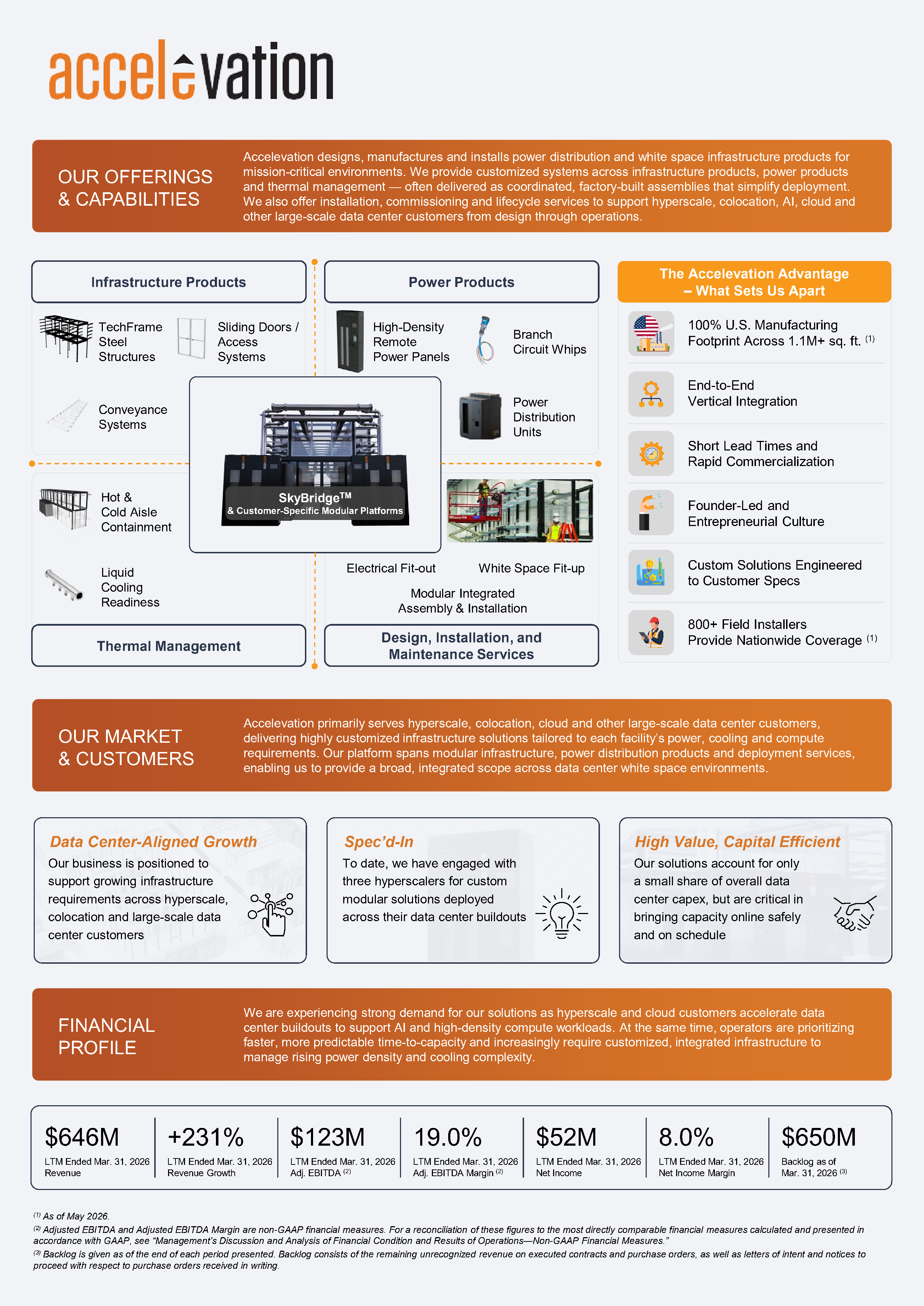
TABLE OF CONTENTS
Neither we, the selling stockholders, nor any of the underwriters have authorized anyone to provide any information or make any representations other than those contained in this prospectus or in any free writing prospectus filed with the U.S. Securities and Exchange Commission (the “SEC”). Neither we, the selling stockholders, nor any of the underwriters take any responsibility for, and can provide no assurance as to the reliability of, any other information that others may give you. This prospectus is not an offer to sell nor is it seeking an offer to buy these securities in any jurisdiction where the offer or sale is not permitted. We and the selling stockholders are offering to sell, and seeking offers to buy, shares of Class A common stock only in jurisdictions where offers and sales are permitted. The information contained in this prospectus is accurate only as of the date of
i
this prospectus, regardless of the time of delivery of this prospectus or of any sale of the Class A common stock. Our business, financial condition, results of operations and prospects may have changed since such date.
For investors outside of the United States, neither we, the selling stockholders, nor any of the underwriters have done anything that would permit this offering or possession or distribution of this prospectus in any jurisdiction where action for that purpose is required, other than in the United States. You are required to inform yourselves about, and to observe any restrictions relating to, this offering and the distribution of this prospectus outside of the United States.
Through and including , 2026 (the 25th day after the date of this prospectus), all dealers effecting transactions in these securities, whether or not participating in this offering, may be required to deliver a prospectus. This is in addition to a dealer’s obligation to deliver a prospectus when acting as an underwriter and with respect to an unsold allotment or subscription.
ii
BASIS OF PRESENTATION
In connection with the consummation of this offering, we will effect certain organizational transactions. Unless otherwise stated or the context otherwise requires, all information in this prospectus reflects the consummation of the organizational transactions and this offering, which we refer to collectively as the “Organizational Transactions.” See “Organizational Structure” for a description of the Organizational Transactions and a diagram depicting our anticipated structure after giving effect to the Organizational Transactions, including this offering.
As a result of the acquisition by Olympus Partners, LP on January 2, 2025, a change in control and a related change in the basis of the carrying value of the Company’s assets and liabilities occurred. Accordingly, this prospectus contains the historical financial statements of Accelevation Holding Company, LLC (“Accelevation Holding Company”) and its consolidated subsidiaries for the predecessor period as of and for the year ended December 31, 2024 (the “Predecessor period”), and the historical financial statements of Holdings LLC and its consolidated subsidiaries for the successor period as of and for the year ended December 31, 2025 and subsequent periods (the “Successor period”). The unaudited consolidated pro forma financial data of Accelevation Holdings Corp. presented in this prospectus has been derived from the application of pro forma adjustments to the historical consolidated financial statements of Holdings LLC and its subsidiaries included elsewhere in this prospectus. These pro forma adjustments give effect to the Organizational Transactions as described in “Organizational Structure,” including the consummation of this offering and other related transactions. See “Unaudited Consolidated Pro Forma Financial Information” for a complete description of the adjustments and assumptions underlying the unaudited consolidated pro forma financial data included in this prospectus.
Unless we state otherwise or the context otherwise requires, the terms “we,” “us,” “our,” “our business,” “the Company,” “Accelevation” and similar references refer: (i) on or following the consummation of the Organizational Transactions, including this offering, to Accelevation Holdings Corp. and its consolidated subsidiaries, including Holdings LLC, and (ii) prior to the consummation of the Organizational Transactions, including this offering, to (a) Accelevation Holding Company and its consolidated subsidiaries for the Predecessor period and (b) Holdings LLC and its consolidated subsidiaries for the Successor period. The term “Olympus” refers to Olympus Partners, LP, our Principal Stockholder, and the term “Holdings LLC” refers to Accelevation LLC.
We will be a holding company and the sole managing member of Holdings LLC and, upon consummation of this offering and the application of the net proceeds therefrom, our sole assets will be LLC Units and certain interests in Instor. Holdings LLC is the predecessor of the issuer, Accelevation Holdings Corp., for financial reporting purposes. Accelevation Holdings Corp. will be the reporting entity following this offering.
1
MARKET AND INDUSTRY DATA
Unless otherwise indicated, information in this prospectus concerning economic conditions, our industry, our markets and our competitive position is based on a variety of sources, including information from independent industry analysts and publications, as well as our own estimates and research.
Our estimates are derived from publicly available information released by third-party sources, as well as data from our internal research, and are based on such data and our knowledge of our industry, which we believe to be reasonable. We have not had this information verified by any independent sources. The independent industry publications used in this prospectus were not prepared on our behalf. While we are not aware of any misstatements regarding any information presented in this prospectus, forecasts, assumptions, expectations, beliefs, estimates and projects involve risk and uncertainties and are subject to change based on various factors, including those described in the sections entitled “Forward-Looking Statements” and “Risk Factors.”
2
TRADEMARKS AND TRADE NAMES
We own or have the right to use various trademarks and service marks that appear in this prospectus, such as “Accelevation,” “SkyBridge” and other trademarks and service marks used in connection with our business, which are protected under applicable intellectual property laws. This prospectus also contains trademarks, service marks, trade names and copyrights of other companies which are the property of their respective owners. Solely for convenience, trademarks, service marks, trade names and copyrights referred to in this prospectus may appear without the ®, SM, © or ™ symbols, but such references are not intended to indicate, in any way, that we or the applicable owner will not assert, to the fullest extent under applicable law, our rights or the rights of the applicable owner to these trademarks, service marks, trade names and copyrights.
3
LETTER FROM THE FOUNDERS
Thank you for your interest in Accelevation. We are grateful that you are considering an investment in Accelevation and are reading this letter. The pages that follow explain the products we make, the exciting markets we serve and our historical financial performance. But they do not address the most important question of all—how did we do this? How did a small, Ohio-based manufacturing company started less than a decade ago grow from under $3.0 million in revenue in January 2021 to where we are today? The answer begins with how we operate.
Accelevation is not a conventional manufacturing company, nor do we intend to become one. We started Accelevation because we wanted to change the paradigm of modern manufacturing by showing that companies can remain nimble and innovative, regardless of their size. We have intentionally created a culture and a company that operates differently.
At our core, we are innovators. We don’t just build products; we design and manufacture solutions to the most demanding scaling challenges of the modern era. We have often said that our growth required the scaffolding to be built as we climbed it, and in many ways that remains true. Staying nimble requires a culture that embraces calculated risk, pivots quickly as business landscapes shift and never loses sight of long-term goals.
We believe this transition will bring important benefits for our employees, our present and future stockholders, our customers and most of all, the communities in which we live and work. It will also help us preserve our exceptional culture, guided by our Core Values and our clearly defined operating principles, The Accelevation Way. These principles are core to who Accelevation is and how we expect we will continue to win.
Who is Accelevation?
It began with a name. One that would represent our belief that innovation is at the heart of everything we wanted to build. A name that could speak to the speed with which we knew we would move, adapt and create. Accelerate. Innovation.
In 2018, we acquired two small tool and die manufacturing companies that, combined, employed approximately 25 people primarily serving the automotive and defense industries. On March 22, 2020, Ohio ordered all non-essential businesses to stay home, causing most of our customers to close their facilities and put on hold all open orders. The COVID-19 pandemic changed everything. As small business owners who had personally guaranteed all loans, the news was devastating and meant everything we owned both personally and professionally was at risk.
Amid market chaos, we immediately implemented two of our most critical values—Speed and Fearless Innovation—and began to understand one of our most important operating principles—Win in the Turns.
Win in the Turns means leveraging moments of market upheaval and chaos—the “turns”—to outpace competitors, innovate and turn potential crises into sustainable, long-term competitive advantages. We did just that. In under 48 hours, we designed a platform of solutions out of our garage to help hospitals and schools open safely. During the next 12 months, we were not only able to keep every employee on our payroll, but also posted an increase in revenue.
As the COVID-19 pandemic began to stabilize, we looked at how air barriers could be used in other industries. Data center air flow containment was a natural progression and in January 2021, we launched that new business line. In the first 30 days, we landed a major job for a well-known hyperscaler. They had an immediate need for containment due to a competitor not being able to hit their deadline. We accepted the job and had less than three weeks to deliver.
The problem was that the COVID-19 pandemic was still impacting supply chains, and a critical fastener required on every panel was unavailable globally. We had to adapt and pivot, which is another key principle of Accelevation. Our small team designed our own fastener that we could make on our CNC machines. To make this
4
work, we had a choice: transition all machines to make this one component for this one order, moving away from our existing 30+ customers, or walk away. We chose to commit 100% to the mission-critical space.
Over the next five years, we added over 1,700 new employees and expanded from 20,000 square feet of manufacturing capacity to approximately 1.1 million. Our team launched infrastructure metal solutions, mechanical cooling and power distribution products within weeks of development, not years.
What Makes This Team Special?
As we take this next step in our journey, we want to share the core principles that guide how we operate, how we make decisions and how we intend to keep delivering long-term value. This is “The Way” we build Accelevation.
Innovation Driven by Curiosity and Simplicity
True innovation does not come from doing things the way they have always been done. It is fueled by curiosity, and we lead with it. We acknowledge that we do not know everything, and we actively challenge the status quo to find a better way.
But as we innovate, we fiercely guard against complexity. Our engineering philosophy is grounded in Keeping it Simple. By eliminating unnecessary complexity in our systems, products and communication, we enhance clarity, lower the risk of failure and optimize resource efficiency.
Getting the Right People in the Right Seats
We are uncompromising when it comes to talent. We look for Builders—individuals who thrive on doing things that have never been done before, drive efficiency and leave things better than they found them.
We believe leadership is about evolving while staying true to your authentic self. Trust is built on authenticity, and we encourage people to use their values and personality as their leadership compass.
A High-Performance Culture Built on Radical Transparency
We have extraordinarily high expectations for ourselves and our teams. To maintain this standard, we foster an environment of Radical Truth and Radical Transparency.
We get comfortable being uncomfortable, because growth and comfort cannot coexist.
Agility Is Our Muscle
Business landscapes are constantly evolving. To thrive in this environment, we rely on The Pivot Principle. At Accelevation, we fail fast and learn faster. When setbacks occur, we reflect on what part of the system failed and what we will do differently next time. We work hard to not repeat mistakes; we view pain plus reflection as the ultimate driver of progress.
Judgment and Accountability
Decisive discernment is critical at Accelevation. When data is incomplete, success depends on translating context, risk and human dynamics into timely, strategic action. We make decisions without waiting for perfect certainty.
It is a core value that moves us from “why” to “how,” rejecting blame with a focus on solutions. See it. Own it. Solve it.
People
We are a purpose-built, people-first organization driven by a belief that success starts with investing in our people and strengthening the communities around us. We’re dedicated to leading with intention by paying above market compensation, introducing bold and innovative incentives and expanding benefits that truly make a
5
difference—like our AcceleHOME first-time homebuyer program. At every step, we’re focused on supporting our people not just at work but in life.
The Accelevation Academy develops skilled trades talent from within through the tools, training and confidence to build meaningful careers. Through hands-on learning, internships, apprenticeships and professional development, we are creating real opportunities for advancement.
Moving Forward
As the astronaut and scientist Mae Jemison noted, “I like to think of ideas as potential energy. They're really wonderful, but nothing will happen until we risk putting them into action.”
At Accelevation, we take that risk every day. We combine a relentless culture of innovation with an unwavering commitment to the human beings who power it. We are proud of our team of innovators, entrepreneurs and builders. At Accelevation, we will continue to build, driven by possibility, grounded in purpose and fearless in pursuit of what comes next.
American manufacturing ingenuity is alive and well and growing every day. We invite you to join us on this journey as we scale our platform, empower our builders and manufacture the future.
-Michael and Shawn Rubiera
6
GLOSSARY OF CERTAIN TERMS
The following are abbreviations, acronyms and definitions of certain terms used in this prospectus:
•“2026 Plan” means the Accelevation Holdings Corp. 2026 Omnibus Incentive Plan;
•“Accelevation Holding Company” means Accelevation Holding Company, LLC, a Delaware limited liability company;
•“Accelevation Pubco Holdings” means Accelevation Pubco Holdings LP, a Delaware limited partnership;
•“AI” means artificial intelligence, which refers to the simulation of human intelligence in machines that are programmed to think and act like humans;
•“backlog” is defined as the remaining unrecognized revenue on executed contracts and purchase orders, as well as letters of intent and notices to proceed with respect to purchase orders received in writing;
•“Credit Agreement” means the credit agreement, dated as of January 2, 2025 (as amended to date), by and among Holdings LLC, as borrower, MidCap Financial Trust, as administrative agent and collateral agent, and the lenders party thereto;
•“data centers” means facilities housing servers, networking equipment and systems used for electronically storing and managing data;
•“DGCL” means the Delaware General Corporation Law;
•“Exchange Act” means the Securities Exchange Act of 1934, as amended;
•“Exchange Agreement” means the Exchange Agreement to be entered into by Accelevation Holdings Corp., Investment Holdings and certain other existing owners of Holdings LLC;
•“GPU” means graphics processing unit;
•“HD-RPPs” means high-density remote power panels;
•“Holdings LLC” means Accelevation LLC, a Delaware limited liability company;
•“Instor” means Instor Blocker, Inc., a Delaware corporation;
•“Investment Holdings” means Accelevation Investment Holdings LLC, a Delaware limited liability company;
•“IPO” means this initial public offering;
•“IRS” means the U.S. Internal Revenue Service;
•“LLC Operating Agreement” means the existing operating agreement of Holdings LLC;
•“LLC Unitholders” means the holders of LLC Units;
•“LLC Units” means, collectively, the Series A Units and Series B Units of Holdings LLC;
•“Olympus,” our “Principal Stockholder” or “sponsor” means Olympus Partners, LP;
•“Olympus Holdings Aggregator” means Olympus Accelevation Holdings Aggregator LLC, a Delaware limited liability company;
•“PDUs” means power distribution units;
•“Revolving Credit Facility” means the revolving credit facility under the Credit Agreement;
•“RPPs” means remote power panels;
7
•“SEC” means the U.S. Securities and Exchange Commission;
•“Securities Act” means the Securities Act of 1933, as amended;
•“Series A Units” means the Series A Units of Holdings LLC;
•“Series B Units” means the Series B Units of Holdings LLC;
•“SkyBridge” means our patent‑pending modular infrastructure platform for data centers, specifically designed to speed up and standardize the build‑out of high‑density data center white space;
•“Tax Receivable Agreement” means the Tax Receivable Agreement to be entered into by Accelevation Holdings Corp. and the TRA Rights Holders;
•“Term Loan Facility” means the term loan facility and delayed draw term loan facility under the Credit Agreement;
•“TRA Rights Holders” means certain of our existing direct and indirect owners, including Investment Holdings and certain other entities controlled by our Principal Stockholder, and permitted transferees thereof;
•“UL” means Underwriters Laboratories, a global safety science organization that tests and certifies products to ensure they meet safety standards, including those for electrical components and systems; and
•“white space” means the area in the data center where IT equipment is located. White space includes the racks and cabinets that house servers, storage systems and networking gear, hot- and cold-aisle containment systems and power distribution equipment.
8
PROSPECTUS SUMMARY
The following summary contains selected information contained elsewhere in this prospectus about us and about this offering. It does not contain all of the information that is important to you and your investment decision. Before you make an investment decision, you should review this prospectus in its entirety, including the matters set forth in the sections entitled “Risk Factors,” “Management’s Discussion and Analysis of Financial Condition and Results of Operations” and our consolidated financial statements and the related notes included elsewhere in this prospectus. Some of the statements in the following summary constitute forward-looking statements. See “Forward-Looking Statements.”
Our Company
Accelevation is a vertically integrated infrastructure platform that designs, manufactures and installs power distribution and white space infrastructure products for mission-critical environments. We help hyperscale, colocation, artificial intelligence (“AI”), cloud and other large-scale data center customers accelerate deployment through integrated, factory-built solutions designed for speed, scalability and deployment certainty. Our execution against these customer needs drove 147% year-over-year revenue growth from 2024 to 2025 and contributed to a backlog of approximately $650.4 million as of March 31, 2026.
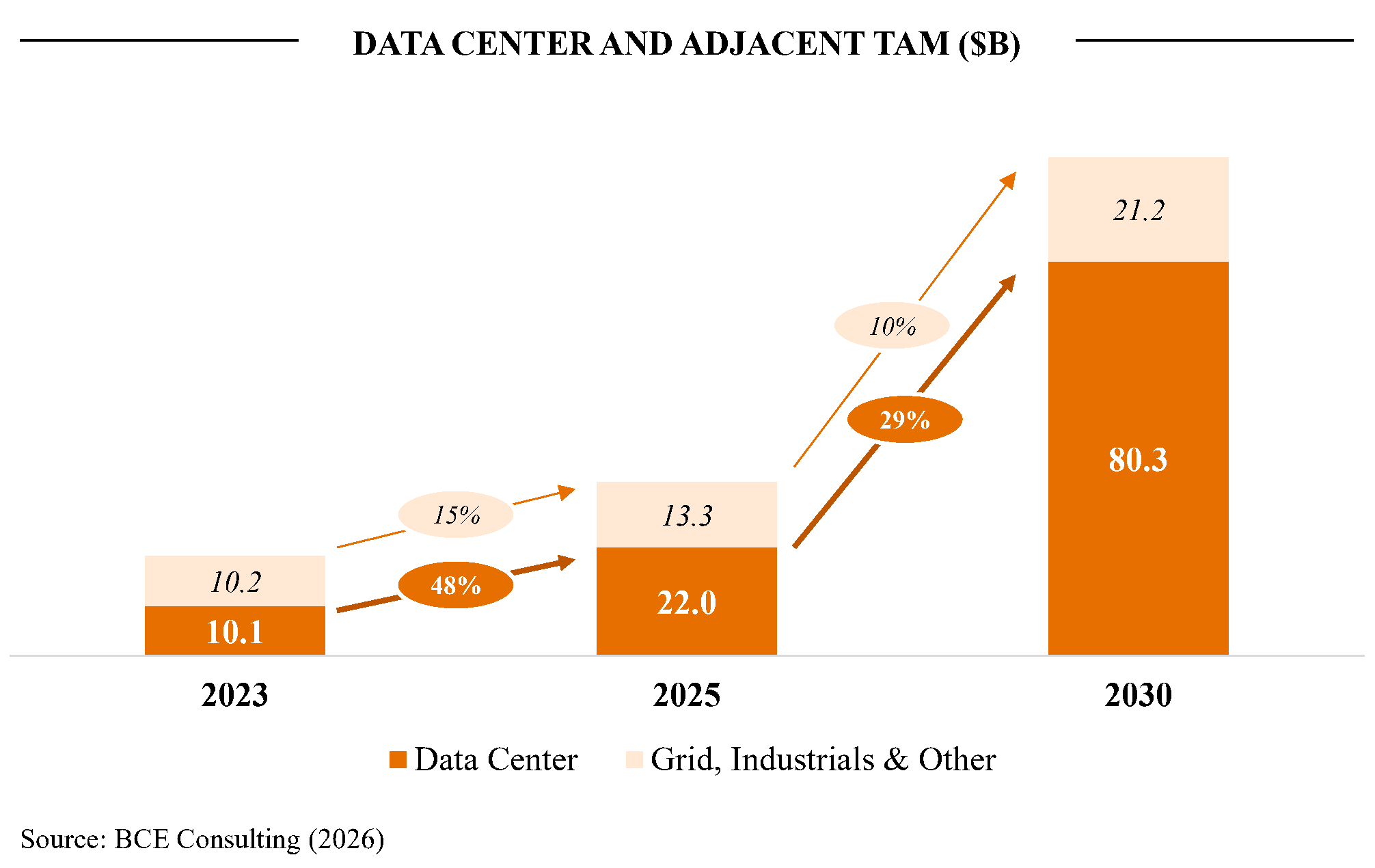
We operate in a large and rapidly expanding market, with BCE estimating our actionable data center total addressable market (“TAM”) to be $22.0 billion in 2025, with growth projected at an estimated 30% compound annual growth rate (“CAGR”) to approximately $80 billion by 2030. This growth is driven by cloud computing, AI, enterprise digitization and broader digital workloads, all of which require greater data center capacity, more advanced infrastructure and continued investment across power distribution, modular infrastructure, thermal management, design and services.
As customers race to bring new compute capacity online, traditional manufacturing models, fragmented supply chains and multi-vendor delivery approaches are often not built to support the unprecedented speed, customization and coordination required for next-generation data center deployments. We believe these fragmented models impose a “complexity tax” on customers, including additional coordination burden, vendor handoffs, schedule friction, field rework, change-order risk and reduced accountability across connected scopes of work. These challenges are becoming more acute as white space infrastructure becomes more complex and demanding, with AI-driven and high-density deployments requiring greater power density, more advanced cooling architectures, liquid-cooling readiness and tighter coordination across power, cooling and structural systems. At the same time, chip architectures, power requirements, cooling methods and customer-specific standards continue to evolve, exposing the limitations of catalog-based approaches and disconnected suppliers.
Driven by an entrepreneurial culture of relentless execution and continuous innovation, we believe Accelevation is optimally positioned to address these challenges through our vertically integrated “Design. Manufacture. Install.” operating model. By replacing a fragmented set of suppliers with a unified operating partner across engineering, manufacturing, electrical scope, installation and project coordination, we believe we reduce deployment complexity, improve schedule control, accelerate installation timelines and enable faster adaptation to evolving customer requirements and changing job-site conditions.
We believe our combination of culture, vertical integration, customer responsiveness and execution discipline enables us to help hyperscale, colocation, AI, cloud and enterprise data center customers deploy mission-critical infrastructure with greater speed, flexibility and certainty.
9
Our Offerings
The following table summarizes our primary offerings:
| Offerings | Description | Key Applications | ||||||||||||
| Infrastructure Solutions | Integrated white space infrastructure solutions delivered either as part of modular, factory-built solutions, including SkyBridge, or through a traditional field-built approach. | Turnkey white space deployment, modular deployment, field-built fit-out, high-density and AI-ready environments, lifecycle support. | ||||||||||||
| Infrastructure Products | TechFrame steel structures, conveyance systems, rack and cabinet support, cabinet docking, caging / enclosure systems, cable and fiber routing components and other modular infrastructure components. | White space structural platform, equipment support, organized power / cooling / network pathways, modular and field-built deployment support. | ||||||||||||
| Thermal Management Products | Containment, airflow management and liquid-cooling-ready products integrated into white space infrastructure systems or sold separately. | Airflow optimization, thermal containment, liquid-cooling readiness, heat isolation and high-density deployment support. | ||||||||||||
| Installation and Maintenance Services | Field installation, electrical fit-out, cabling, rack integration, commissioning, inspection, maintenance, reconfiguration and decommissioning services. | Project delivery, white space fit-up, commissioning, lifecycle services and reconfiguration support. | ||||||||||||
| Power Products | Branch circuit whips, remote power panels (“RPPs”), high-density remote power panels (“HD-RPPs”), power distribution units (“PDUs”), related monitoring technologies and adjacent upstream power distribution products. | Power delivery, monitoring, white space power distribution, factory-wired whips and integrated modular power solutions. | ||||||||||||
Platform Differentiators
Our platform combines deeply embedded customer relationships, in-house engineering and design expertise, scaled U.S. manufacturing, modular and prefabricated delivery, a growing Power Products portfolio and nationwide field execution capabilities. By integrating these capabilities, we are able to shift substantial portions of traditionally field-built work into controlled manufacturing environments, reduce on-site labor demands, simplify coordination and support faster, more predictable deployment of complex data center infrastructure with greater customization and accountability.
Time to Market and Customer-Tailored Delivery
We engage strategically across the data center ecosystem, including hyperscale operators, colocation providers, end users and general contractors. As of June 2026, we have engaged with three hyperscalers at the total platform design level and deployed Accelevation-engineered systems for those customers, helping inform future-state program designs that may be incorporated into customer technical standards and project specifications. These relationships provide insight into evolving technical requirements, project timelines and deployment priorities, and allow us to support customers from planning and specification through manufacturing, installation and commissioning.
Our integrated delivery model provides a single point of accountability across a broader scope of products and services. Rather than requiring customers to coordinate multiple vendors across infrastructure, thermal management, power, monitoring, fabrication, logistics and on-site execution, we provide a unified platform designed to reduce handoffs, improve coordination and support faster deployment. Many of our customers’ programs span multiple
10
years and involve recurring expansion phases, which we believe supports planning, capacity investment and disciplined execution, and puts us in an advantageous position to secure additional work.
Engineering, Design and Customization Capabilities
Our engineering and design organization is a core competitive asset. We employed a growing team of more than 40 engineers and technical designers as of June 2026, who have developed an extensive library of reference designs and deliver nearly 700 custom designs annually. Our capabilities span mechanical design, electrical engineering, structural analysis, thermal modeling and installation planning. We use advanced CAD/CAM systems, parametric design tools and digital engineering workflows to accelerate turnaround times while maintaining accuracy, manufacturability and execution discipline.
Data center infrastructure requirements are evolving rapidly, including increasing power density, higher thermal loads, broader adoption of liquid-cooled and hybrid architectures and continuous changes in chip architectures and related equipment. Our team is able to rapidly design and deliver solutions intended to meet these requirements, and our solutions-oriented approach supports customer outcomes focused on performance, reliability, scalability and speed of deployment. Because job sites and customer requirements change frequently, our short lead times, domestic manufacturing footprint and integrated engineering model allow us to respond to change orders and modify solutions during execution, reducing field modifications, rework and commissioning delays.
Scaled U.S. Manufacturing, Modularity and Workforce Excellence
We operate a scaled, domestic manufacturing platform designed to support large hyperscale and data center customers that require speed, flexibility and scale. Our manufacturing operations allow us to shorten supply chains, improve production coordination and shift substantial portions of traditionally field-built work into controlled manufacturing environments. We believe customers increasingly value suppliers that can grow with them across multiple sites, execute at scale and deliver domestically manufactured solutions on compressed timelines.
Our modular, factory-assembled approach is designed to reduce the amount of work required at the job site by moving more assembly activity into controlled manufacturing environments. For certain modular scopes, we estimate this approach can improve field installation productivity by up to approximately 84% compared with traditional field-built methods, thereby reducing field installation time from weeks to as few as eight days. By reducing on-site labor intensity, simplifying installation and limiting the number of trades and hand-offs required in the field, our modular approach can improve safety, enhance constructability and support more predictable deployment schedules. In parallel, we are investing directly in U.S. manufacturing talent through internal training academies, apprenticeship-style programs and on-the-job development that upskill teammates in welding, electrical work, manufacturing operations, field services and safety.
Portfolio Evolution Through Power Products
Our Power Products portfolio, including branch circuit whips, RPPs, HD-RPPs, PDUs, related monitoring technologies and adjacent upstream power distribution products, is a core element of our integrated white space solutions platform. These products may be sold on a standalone basis, but are increasingly integrated with our modular infrastructure, thermal management and field services capabilities to deliver a more complete, coordinated solution for data center customers.
We believe our ability to introduce differentiated products, including DC-capable RPPs, PDUs and a proprietary power quality monitoring system, can increase power content per data hall, deepen customer engagement in design and specification decisions, enable more power content to be integrated into modular assemblies for rapid deployment and create additional lifecycle service, retrofit and reconfiguration opportunities as our installed base grows. Over time, while our primary focus remains data centers, we believe our Power Products platform may also support disciplined expansion into select adjacent mission-critical power infrastructure applications.
Our Market Opportunity
We operate in the large and rapidly growing data center infrastructure market. The convergence of cloud computing, AI and enterprise digitization is driving significant demand for new data center capacity, the expansion
11
and upgrade of existing facilities and related investments in power distribution, modular infrastructure, thermal management, design and services. BCE forecasts that annual U.S. data center new IT load capacity, including both new construction and retrofit capacity, will grow from approximately 6.5 gigawatts in 2025 to approximately 14.8 gigawatts by 2030, representing an 18% CAGR.
Across our offerings, BCE estimates our actionable TAM in data centers at $22.0 billion in 2025, with substantial growth projected through the end of the decade at an estimated 30% CAGR. In addition, in the future we may decide to pursue adjacent applications for our Power Products portfolio across grid, industrial and other end markets, representing attractive additional potential growth vectors.
Focusing on modular infrastructure solutions in the white space, we estimate the U.S. market at approximately $3.9 billion in 2025, growing at an approximately 35% CAGR to approximately $17.7 billion in 2030. Data center infrastructure has become increasingly critical as customers invest in higher-density compute environments, seek faster time-to-capacity and address rising power, cooling and resiliency requirements, driving adoption of modular and prefabricated infrastructure. We believe these dynamics are creating a sustained, multi-year demand environment for our offerings, with the following demand drivers being of particular relevance to our business:
Continued investment in new data center capacity. Rapid growth in cloud computing, AI and broader digital workloads is driving significant investment in new data center capacity. AI workloads, including model training, inference, generative AI and machine learning applications, require greater compute intensity and power density than traditional enterprise workloads. At the same time, cloud migration, cybersecurity, analytics, software development, streaming, connected devices and other digital workloads continue to create a baseline source of demand independent of AI. BCE estimates that hyperscalers will account for over 70% of U.S. new IT load additions from 2025 through 2030, more than doubling their equipment spend, across both self-built facilities and hyperscaler-related colocation deployments. As a result, suppliers that can meet hyperscaler requirements for scale, quality, customization, supply-chain reliability and delivery certainty are positioned to participate in a disproportionate share of future market growth.
12
More infrastructure required per megawatt of capacity. Data centers are becoming more power-intensive and technically complex. BCE indicates that enterprise and cloud applications often operate at 20 to 40 kilowatts per rack, while AI and high-performance computing applications are running at approximately 40 to 135 kilowatts per rack. BCE also notes that industry sources see rack densities potentially reaching 250+ kilowatts per rack by 2027 or 2028, 600+ kilowatts per rack by 2028 and, in niche cases, one megawatt per rack by 2031. Higher-density compute increases the amount and complexity of electrical distribution, cooling, containment, monitoring and supporting infrastructure required per megawatt of capacity.
Greater emphasis on speed, capacity and execution certainty. As demand for AI and cloud infrastructure accelerates, customers are increasingly prioritizing speed-to-capacity, on-time delivery, available manufacturing capacity and supply-chain reliability, with BCE indicating that these factors have become more important than cost for certain hyperscale customers because delayed capacity can defer GPU deployment and related revenue generation. Although our solutions generally represent approximately 9-12% of total data center construction cost, based on company estimates, they are often installed on the critical path before customers can deploy revenue-generating IT equipment. Because our infrastructure must be installed before customers can energize and deploy revenue-generating compute capacity, delays in our scope can directly impact deployment schedules and time-to-revenue. As a result, operators are increasingly willing to pay premiums for suppliers that can reduce coordination risk, compress installation timelines and bring capacity online faster. We believe this dynamic increases the value of infrastructure providers that combine engineering support, manufacturing capacity, supply-chain reliability and field execution, supporting value-based procurement decisions, disciplined pricing and favorable margin capture for scaled suppliers that can deliver speed, quality and execution certainty.
Increasing modularization and prefabrication. Data center operators are increasingly adopting modular, prefabricated and factory-built infrastructure inside the white space to reduce field labor requirements, compress deployment timelines, improve safety and improve execution certainty. Remote locations, labor scarcity and extended lead times further reinforce the value of modular solutions for operators prioritizing speed to deployment. BCE estimates that modular solutions are currently used in approximately 70% of new data center builds and projects penetration to increase to approximately 85% by 2030. Within new construction, BCE expects a meaningful mix shift toward more integrated deployments, with end-to-end modular solutions increasing from approximately 15% of projects in 2025 to approximately 30% by 2030. Although retrofit deployments are more constrained by existing space, layout and electrical infrastructure, BCE expects end-to-end modular adoption in retrofits to continue increasing as the installed base expands and operators seek faster, more predictable upgrade paths. Modular solutions can command a substantial premium over equivalent component costs, reflecting the value of design, integration, safety and deployment speed, as customers are increasingly willing to pay more to accelerate time-to-capacity.
Increasing need for customized and engineered-to-order infrastructure. Higher-density data centers, evolving power and cooling architectures and customer-specific design standards are increasing the need for customized white space infrastructure across both Infrastructure Solutions and Power Products. BCE estimates that many relevant data center power products are customized 40% or more of the time, with particularly high customization levels for power distribution units and power skids. Infrastructure Solutions are also increasingly customer- and site-specific, varying by cooling architecture, rack density, aisle and containment configuration, seismic and structural load requirements, cable pathway routing, material and finish specifications, compliance requirements, monitoring integration and deployment sequencing. We believe this trend favors suppliers with engineering depth, flexible domestic manufacturing capabilities, modular and prefabricated delivery expertise, field execution capabilities and the ability to support repeatable customization at scale across integrated structural, thermal, power, monitoring and services scopes.
Greater power and cooling complexity. As AI and other high-density workloads increase rack-level power requirements, data center operators are rethinking the design of the data hall. Higher-density deployments require more electrical distribution infrastructure, more advanced cooling approaches and tighter coordination across power, containment, structural infrastructure and field execution. Power products are one of the clearest beneficiaries of this shift. BCE estimates that AI-oriented deployments require roughly 2.5x the electrical distribution spend of non-AI deployments and that the TAM for power products deployed in data centers will grow from approximately $10.4 billion in 2025 to approximately $35.5 billion by 2030. Power architecture is also becoming a more important design
13
variable, with BCE estimating that approximately 25% of new high-density deployments in 2025 evaluated or adopted AC/DC or hybrid power architectures, with penetration potentially reaching approximately 75% by 2030. As customers evaluate these architectures, power distribution, monitoring, branch circuiting, modular integration and commissioning decisions become more complex and more closely tied to the overall white space design. Higher-density environments are also accelerating demand for more advanced cooling infrastructure. BCE identifies liquid cooling as a meaningful greenfield equipment opportunity across high-density data center builds and identifies coolant distribution units and secondary fluid networks as among the fastest-growing product categories in the data center infrastructure market. We believe these shifts directly reinforce the value of Accelevation’s integrated platform. As power, cooling, containment and white space layouts become more interdependent, customers increasingly need partners that can coordinate design, manufacturing and installation across multiple infrastructure systems. This complexity also expands the opportunity for related services, including design, installation, retrofit and deployment support, which BCE expects to grow from approximately $7.8 billion in 2025 to approximately $27.1 billion in 2030, representing a CAGR of more than 25%.
Growing refresh, retrofit and replacement demand. The expanding installed base of data centers is creating a growing opportunity for refresh, refurbishment and retrofit activity. As server and GPU architectures evolve, customers need to modify white space layouts, power distribution and thermal infrastructure in shorter cycles than historical data center refresh models. BCE estimates that certain chip and server platforms may be replaced on approximately three-to-five-year cycles, and that new GPU architectures may require changes in power and thermal architecture. Where a customer rips and replaces server infrastructure, we believe the required reconfiguration of white space infrastructure can represent a revenue opportunity similar in scope to portions of the initial build.
Adjacent power infrastructure markets. In addition to data centers, relevant power infrastructure markets provide an expansion opportunity for our Power Products portfolio. BCE estimates that adjacent markets across grid, industrial and other mission-critical/commercial applications, including financial institutions, represent an incremental TAM of approximately $13.3 billion as of 2025, which is forecasted to grow to approximately $21.2 billion by 2030, representing an approximately 10% CAGR. While data centers represent our primary growth opportunity, these adjacent markets provide additional secular demand drivers tied to electrification, grid modernization, resiliency and the need for reliable power infrastructure.
Our Competitive Strengths
We believe Accelevation’s platform is differentiated by a set of strengths that support rapid, reliable delivery of mission-critical data center infrastructure.
Experienced, Founder-Led Management Team and Entrepreneurial Culture Focused on Speed, Execution and Fearless Innovation
We believe our management team has the experience required to scale an integrated manufacturing and services platform serving mission-critical infrastructure markets. Our founder-led team is supported by experienced executives across operations, delivery, commercial leadership, finance and Power Products. We intentionally hire builders, maintain a flat organization and emphasize speed, entrepreneurial ownership and rapid problem solving. We believe our leadership provides the ability to:
•Execute with founder-led vision and operating discipline. Our co-founder and Chief Executive Officer, Michael Rubiera, has led Accelevation since its founding in 2017 and has overseen the company’s growth from less than $3.0 million in revenue in 2021 to $447.8 million in 2025. He is supported by an experienced management team with deep expertise across finance, operations, engineering, commercial execution and project delivery.
•Commercialize and scale new offerings. Our leadership team has demonstrated the ability to bring new products and capabilities to market as customer requirements evolve, including standing up new business lines, obtaining certifications and converting prototypes into revenue-generating products on compressed timelines. The majority of our current backlog is driven by new products launched since mid-2025. The business also has a robust pipeline of new products scheduled to launch in late 2026 through mid-2027 across power distribution, modular infrastructure and thermal management product lines.
14
•Manage complexity across an integrated platform. Scaling a design-manufacture-install platform requires coordination across engineering, manufacturing, supply chain and field execution, and we believe our leadership team is organized to manage this complexity effectively.
•Use selective acquisitions to add capabilities. Since 2023, we have completed strategic acquisitions, including Aura Energy in January 2025 for total consideration of $18.7 million and SteelPro in October 2025 for total consideration of $43.5 million, to expand manufacturing capacity, add technical capabilities and accelerate our organic strategy.
•Integrate acquired capabilities into the broader platform. We believe our management team is well-positioned to integrate acquired businesses, align them with our operating model and translate those capabilities into broader commercial and execution benefits. We generally prefer to build capabilities organically when doing so can meet customer timelines and use acquisitions selectively to add intellectual property, talent, capacity or a foundation that allows us to move faster.
Entrenched Customer Relationships, Go-to-Market Reach and Healthy Pipeline Visibility
We believe our durable, entrenched customer relationships and visibility into future demand provide us with important competitive advantages in mission-critical data center markets. Substantially all of our revenue is derived from data center customers, and we serve many of the world’s most demanding hyperscale operators, leading developers, colocation providers and other large-scale participants. These customers typically require rapid innovation, large-scale capacity, deep technical engagement, direct access to decision-makers and high execution certainty, and we believe our ability to win work from them demonstrates the differentiation of our platform.
Our go-to-market model is supported by relationships across the data center ecosystem, including hyperscale operators, colocation providers, end users and general contractors. We do not rely solely on one channel to market. Instead, our customer engagement spans operators, end users, colocation providers and construction partners, allowing us to support customer needs from planning and specification through manufacturing, installation and commissioning. We believe this customer position enables us to:
•Maintain multi-year visibility through order book, commitments and pipeline. As of March 31, 2026, we had approximately $650.4 million of backlog, supplemented by a healthy pipeline significantly tied to large hyperscale operators and colocation providers. Many of these programs span multiple years and involve recurring expansion phases, which we believe supports planning, capacity investment and disciplined execution.
•Increase revenue per customer and expand scope across offerings. Average revenue per customer increased from approximately $0.7 million in 2023 to approximately $3.9 million in 2025, demonstrating strong scope expansion.
•Expand across sites and programs. We work with major hyperscale operators and believe consistent execution, direct engagement, speed and an expanding product portfolio enable us to extend relationships across additional customer sites and multi-site programs.
•Benefit from vendor consolidation trends. Hyperscale operators are increasingly concentrating spend with fewer, larger infrastructure partners that can offer single-source accountability, scaled manufacturing capacity, nationwide installation capabilities and the balance sheet required to support working capital and bonding needs across multi-site, multi-year programs. As projects grow larger, customers may require suppliers to bid on an entire building, multiple buildings or broader campus scope, which naturally reduces the number of eligible suppliers. On certain large gigawatt-scale campus buildouts, we increasingly compete in limited bidder sets as smaller players often lack the manufacturing capacity, working capital or organizational depth required to execute at that scale.
Vertically Integrated, Customized Solutions Designed for Next-Generation Infrastructure
We provide a differentiated, end-to-end solution that integrates the design, manufacturing and installation of Infrastructure Solutions and Power Products under a single operating platform.
15
Data center infrastructure requirements are evolving rapidly, including increasing power density, higher thermal loads, broader adoption of liquid-cooled and hybrid architectures and continuous changes in chip architectures and related equipment. We design and deliver solutions intended to meet these requirements, and our solutions-oriented approach supports customer outcomes focused on performance, reliability, scalability and speed of deployment. Our patent-pending SkyBridge platform and related customer-specific modular systems exemplify this approach by combining structure, containment, thermal management readiness and power distribution into a pre-engineered system designed to be manufactured and deployed as a single coordinated platform.
We believe the combination of integrated capabilities, operating processes and skilled resources required to deliver consistently across large, multi-site deployments is difficult to replicate. Our vertically integrated model enables us to:
•Provide single-source accountability across products and services. Customers can procure a broader scope from one provider rather than coordinating across multiple vendors for infrastructure, thermal management, power, monitoring, fabrication, logistics and on-site execution. We believe this reduces potential points of failure, simplifies accountability and creates meaningful switching costs for customers who would otherwise need to interface with multiple vendors across connected scopes of work.
•Compress delivery timelines. By controlling design, component fabrication, manufacturing and installation in-house, and by buying and converting many readily available raw materials directly, we believe we reduce coordination delays and hand-off friction inherent in a multi-vendor approach, enabling customers to bring data center capacity online faster.
•Deliver customized solutions for site-specific and customer-specific requirements. We work with customers to tailor solutions to the physical and operational constraints of each data hall environment, including customer architecture, layout, access, deployment sequencing, thermal approach, power topology and commissioning requirements. Our role as a single-source provider positions us as a strategic partner rather than a commodity supplier.
•Design with next-generation requirements in mind. Our products and configurations are intended to support evolving infrastructure architectures, including higher-density deployments, airflow-to-liquid thermal transitions, changing chip architectures and changing power distribution approaches associated with AI-oriented data center environments. Because job sites and customer requirements change frequently, our domestic manufacturing footprint, engineering capabilities and integrated operating model allow us to respond to changes during execution, reducing field modifications, rework and commissioning delays.
•Support modular, configurable deployments with reduced on-site labor and improved safety. Modular product architecture allows customers to tailor infrastructure layouts, power density and cooling configurations using standardized components that can be prefabricated, factory-assembled and, in many cases, delivered with integrated power content, shortening installation timelines and shifting labor from the field to controlled manufacturing environments.
•Accelerate innovation through integrated feedback loops. Close coordination between engineering, manufacturing, field teams, customers and end users allows us to incorporate lessons learned, improve designs and introduce enhancements more efficiently than models that depend on third parties. We believe our platform enables us to translate internally developed and acquired capabilities into commercial product offerings on a compressed timeline, supporting customer responsiveness and expanding our addressable opportunity set.
Scaled U.S. Manufacturing Capabilities and Workforce Excellence
Our manufacturing operations are purpose-built for hyperscale customers that require speed, flexibility and scale that most legacy manufacturers are not well suited to serve. As of June 2026, we had a manufacturing footprint of approximately 1.1 million square feet, consisting of approximately 625,000 square feet in southwest Ohio, 225,000 square feet in Memphis, Tennessee, 220,000 square feet in Houston, Mississippi, 57,000 square feet in Richmond, Virginia and additional warehouse capacity, compared with less than 170,000 square feet at the beginning of 2025. This rapid expansion has been relatively capital-light, with capital expenditures remaining below
16
3% of revenue. We continue to add capacity on a regular cadence to stay ahead of customer demand, supporting lead times that we believe compare favorably to industry norms across our principal product offerings. We complement this footprint with ongoing investments in training, safety, workforce quality, robotics and automation. We believe our manufacturing scale and operating model enables us to:
•Support accelerated customer build schedules. Our domestic manufacturing base reduces reliance on third-party, offshore manufacturing capacity and helps us align production with customer timelines.
•Increase throughput while maintaining flexibility. Our manufacturing operations are intended to support scalable production across multiple product lines, including the ability to add capacity and adjust production mix in response to customer demand and evolving product requirements.
•Leverage the Accelevation Academy to develop skilled labor. Launched in early 2026, the Accelevation Academy is a structured, paid, in-house training program focused on building skills across welding, manufacturing, field installation and electrical. The creation of the Accelevation Academy represents a fundamental commitment to both our people and our communities and helps ensure that we are creating the skilled-trade workforce needed to support our future growth.
•Maintain a skilled, safety-oriented workforce. We support our labor force through above-market compensation, incentive structures, meaningful internal training investment and a safety-focused culture, which we believe strengthens execution and supports efficient scaling. We currently have more than 800 field services employees, compared with approximately 140 at year-end 2024. Electricians represented approximately 25% of our field service workforce as of March 31, 2026.
•Shift labor from field to factory through prefabrication. Greater use of factory-built assemblies increases quality control, reduces on-site labor requirements, improves safety, lowers field-labor cost exposure and supports more predictable delivery and installation outcomes.
Growing Share of Power Products and New Product Introductions
We have expanded our Power Products portfolio as part of a strategy to deepen our leadership in white space power distribution and selectively expand into broader upstream power distribution categories. We believe this can increase revenue per project, expand scope per megawatt, improve margin capture and embed us earlier in the design and specification cycle. Speed is critical in this category, particularly as customers face long lead times and increasing power complexity in AI-oriented deployments. We believe our power strategy enables us to:
•Increase customer spend and expand our influence in the design cycle. Power Products expand our scope in customer deployments, can pull us earlier into specification decisions, increase planning and revenue visibility and provide opportunities to deliver broader integrated solutions alongside modular infrastructure, installation and start-up services.
•Offer differentiated products for high-density environments. Our current Power Products portfolio is anchored by high density compact electrical distribution: RPP platforms and branch circuit whips, with adjacent upstream offerings such as PDUs and low voltage distribution panels being commercialized over time. Our Core RPP is a modular electrical distribution solution with current ratings from 225 to 800 amps. Our High Density RPP is engineered for standard and AI-oriented rack densities and delivers 1,200 amps of distribution capacity in a compact footprint. It is engineered with a top-mounted connection interface that accepts our custom-sized branch circuit whips through a single mating motion, eliminating field-built terminations. Many of these products can be integrated into modular assemblies or otherwise configured for rapid deployment inside the data hall.
•Provide flexible and technically advanced solutions. Our High Density RPP is Underwriters Laboratories (“UL”)-listed and pre-tested and features a universal panel adapter that accepts breakers from major manufacturers, supporting supply-chain flexibility and shorter lead times. Our branch circuit whips are UL-listed, pre-tested and custom assembled to project-specific length, wire gauge, conduit size and labeling specifications to facilitate faster field identification and installation.
17
•Expand upstream beginning in 2026+ into adjacent, higher-value offerings. Our roadmap begins with downstream white space power content and extends selectively upstream into adjacent higher-amperage distribution categories. We believe this progression can position us earlier in customer design cycles, increase dollar content per megawatt and create pull-through opportunities for the broader power portfolio.
•Improve lead times and project control through internal fabrication and sourcing. We internally fabricate a growing share of components and assemblies that are often externally sourced and have invested meaningfully in vertical integration, which enhances quality control, delivery speed, supply-chain resilience and coordination across projects.
Our Growth Strategies
We have developed the following strategies to continue to grow our revenues and improve our profitability:
Expand Infrastructure Solutions Through Modular and Prefabricated Delivery
We believe modularization and prefabrication are among the clearest ways to help customers accelerate deployment in the latter stages of data center development. Our strategy is to expand our modular solutions offering, led by SkyBridge and customer-specific modular systems, and use factory assembly to win new programs and larger scopes where speed, safety, labor availability and schedule certainty are prioritized. Unlike modularity outside the building shell, which is more established, our focus is on applying modularity inside the data hall white space. Key elements of this strategy include:
•increasing throughput of modular assemblies and related prefabricated infrastructure across our manufacturing lines;
•shifting additional work from the field to the factory, including power and thermal content where feasible; and
•leveraging repeatable modular designs and customer-specific variants to support multi-site rollouts, remote locations and faster deployment across hyperscale programs.
Deepen White Space Power Distribution Leadership and Expand Upstream to Capture Long Lead Time Demand
A central element of our growth strategy is to deepen our position in white space power while expanding selectively upstream into broader distribution categories. We believe this can increase wallet share, improve mix, serve markets characterized by long lead times and rising technical requirements and embed us earlier in design and specification cycles. Our strategy includes:
•maintaining leadership in high-density, AI-optimized RPPs, branch circuit whips and DC-capable RPPs;
•commercializing PDUs and other adjacent higher-amperage distribution offerings over time, without losing focus on our current white space power opportunity;
•using internal fabrication, sourcing and modular integration to improve speed, quality control and delivery performance; and
•integrating Power Products with Infrastructure Solutions to deepen customer entrenchment and expand lifecycle service opportunities.
Leverage Power Products Platform into Adjacent End Markets
We believe our expanding Power Products platform is creating opportunities to serve select applications in the broader commercial, industrial, government, grid, solar and institutional electrical infrastructure market. Our approach to this opportunity is to:
•build on our in-house Power Products capabilities, including RPPs, PDUs and related upstream distribution offerings;
18
•leverage our existing manufacturing, engineering and supply-chain infrastructure to address customer needs in adjacent markets; and
•pursue any such expansion in a disciplined manner while maintaining our primary focus on supporting data center customers.
Expand Thermal and Liquid Cooling-Ready Capabilities to Increase Scope and Content
The adoption of liquid-cooled architectures in high-density, AI-oriented data centers is increasing the importance of coordinated thermal infrastructure within the white space. Our thermal capabilities have historically focused on airflow and containment, but we expect customer demand to move increasingly toward liquid cooling-ready solutions. Certain thermal products may be sold on a standalone basis, but a significant portion of our thermal content is integrated into our factory-built modular infrastructure solutions. We believe this can increase content per deployment, improve coordination across design and installation and position us to capture a greater share of cooling-related scope. Our strategy includes:
•expanding thermal products from airflow and containment toward liquid cooling-ready solutions and adjacent thermal categories;
•integrating thermal management features, monitoring components and sensors into SkyBridge and other prefabricated modular systems to enable factory-built, high-density deployments;
•expanding installation, testing, commissioning support, inspection and modification capabilities for thermal systems as part of our services offering; and
•supporting higher-density deployments by delivering integrated solutions across power, thermal management and structural infrastructure.
Deepen Relationships and Increase Wallet Share with Hyperscalers
Significant growth opportunities exist within our existing customer base as hyperscalers and other large data center customers expand footprint, increase power density and replicate deployment patterns across multiple sites. Many of these customers historically work with much larger suppliers, and we believe our ability to serve them demonstrates the differentiation of our speed, customization and execution model. Our strategy is to increase the number and type of products and services we provide to each customer by:
•expanding scope across Infrastructure Solutions and Power Products, particularly through modular solutions;
•increasing average project size by delivering more integrated solutions under a single contract; and
•engaging early in white space planning and fit-out design, often 12 months before larger campus go-live dates, to improve constructability, embed our solutions in specifications and support repeat business across additional sites and regions.
Expand Capacity, Workforce and Execution Throughput
We intend to continue expanding manufacturing capacity, labor quality, automation and execution throughput to support accelerating hyperscale and AI-driven demand. Our strategy includes:
•adding production capacity and operational infrastructure to support increased project volume, complexity and geographic reach while leveraging available capacity and maintaining a capital-light expansion model;
•investing in training, safety, above-market compensation, incentives and workforce development to scale execution quality as we grow;
•maintaining flexibility to adjust production mix and deploy field resources without compromising schedule, quality or margin discipline;
19
•continuing to shift appropriate work from the field to controlled manufacturing environments through prefabrication and modular assembly; and
•deploying robotics, automation and welding process improvements to increase throughput, reduce labor constraints and improve lead times.
Expand Services and Lifecycle Offerings
We believe services represent an opportunity to increase the durability and profitability of our revenue base while strengthening customer relationships. In addition to installation, electrical fit-out and low-voltage services, we are building capabilities to install, start up, inspect, service, repair and reconfigure our products and related systems over time. Our strategy includes:
•expanding service offerings associated with the full lifecycle of the data hall and our Power Products, including installation, start-up, testing, commissioning support, regular inspection, maintenance, failed-equipment replacement, ongoing modifications and reconfigurations;
•increasing penetration of services sold as part of Infrastructure Solutions and alongside Power Products to provide customers with a unified scope and clearer accountability; and
•building additional field and support capabilities to expand responsiveness and capacity for repeat work, including lifecycle services on RPPs and other Power Products.
Expand Retrofit, Upgrade and Reconfiguration Solutions for Existing Data Centers
As the total base of data center capacity increases, this directly leads to long-term replacement/refresh spending. As customers increase compute density, adopt new architectures and reconfigure existing footprints, this drives changes to the needs of the white space infrastructure and power distribution. Retrofit opportunities could involve revenue scope similar to portions of the initial build where new architectures require substantial changes. Our strategy is to:
•support customers as they increase power density, change server architectures and modify white space layouts to accommodate next-generation workloads;
•leverage our single-source model to reduce downtime risk and execution complexity during live-environment upgrades; and
•offer and sell long-term maintenance contracts to existing and new campus builds.
Pursue Selective, Capability-Driven Acquisitions
Consistent with our platform strategy, we may selectively pursue acquisitions that add technical capabilities, manufacturing capacity, intellectual property, talent or product content that can be commercialized through our existing platform. We view acquisition as a supporting tool rather than a primary growth strategy and generally prefer to build capabilities organically when doing so can meet customer timelines. Our approach is expected to focus on opportunities that:
•add complementary capabilities, product foundations or technical expertise and accelerate time-to-market for new offerings;
•enhance technical, engineering or execution expertise in priority adjacencies; and
•can be integrated in a disciplined manner without diverting focus from organic growth, customer execution and our current white space opportunity.
We expect to maintain capital discipline and a measured pace as we evaluate any such opportunities.
20
Explore Selective International Expansion
While our primary focus remains on the North American data center infrastructure market, international data center construction will continue to expand over the long term. We may pursue selective international growth by:
•prioritizing regions with strong hyperscale demand and deployment characteristics similar to the United States; and
•leveraging our existing design, manufacturing and installation capabilities to support customers with global requirements.
Risk Factor Summary
There are a number of risks related to our business, this offering and our Class A common stock that you should consider before you decide to participate in this offering. You should carefully consider all the information presented in “Risk Factors” in this prospectus. Some of the principal risks related to our business include the following:
•a reduction in demand or slowdown in the growth of drivers of data center demand;
•changes in data center industry dynamics;
•negative publicity about us or our industry;
•our dependence on a limited number of large-scale data center customers;
•our dependence on a concentrated base of hyperscale and colocation customers;
•our backlog being subject to unexpected adjustments and cancellations;
•our ability to compete effectively;
•our failure to anticipate and adapt to rapid changes in data center technologies and architectures;
•our failure to secure new contracts;
•our ability to identify, integrate and realize the expected benefits of acquisitions;
•limitations on our indemnification rights in acquisition agreements;
•the success of our cost management strategies, vertically integrated operating model and modular infrastructure platform;
•extended sales cycles and irregular customer ordering patterns;
•our exposure to cost overruns and schedule penalties under fixed-price or committed-schedule arrangements;
•our dependence on the continued service of our founders and key leaders and our ability to recruit and retain skilled engineers, technicians and electricians;
•our ability to scale operations rapidly;
•any equipment failure, capacity constraints, labor availability and safety incidents;
•shortages, quality issues, price increases, transportation disruptions or government trade actions affecting raw materials and components in our supply chain;
•our reliance on contractors and subcontractors to supplement our own capabilities and to conduct aspects of our business;
•an economic downturn, tighter financing conditions or pricing challenges;
21
•geopolitical developments, trade policy shifts and macroeconomic volatility, including commodity price volatility;
•seasonal variations in operations and demand that affect construction activity;
•business disruption, natural disasters, public health events or other catastrophic events;
•our failure to adequately protect our intellectual property and other proprietary rights;
•claims alleging infringement, misappropriation or violation of third-party intellectual property rights;
•our failure to obtain or maintain sufficient insurance at acceptable cost;
•changes in laws, regulations and standards applicable to our business;
•disruption in our customers’ markets from future AI-related legislation and regulation and the impact it may have on demand for our products and services;
•product defects, installation errors or performance shortfalls resulting in warranty claims, reputational harm and liability;
•potential legal proceedings and disputes arising from our operations;
•misconduct or noncompliance by employees or subcontractors;
•our ability to comply with environmental, health and safety laws in our manufacturing facilities and at customer sites;
•our indebtedness and financing needs and the limitations our existing Credit Agreement imposes, and any future credit agreements may impose, on us;
•our inability to remediate our material weaknesses, or our failure to develop and maintain effective internal control over financial reporting;
•cybersecurity incidents or data privacy breaches; and
•risks and uncertainties related to the development and use of AI.
These and other risks are more fully described in “Risk Factors” in this prospectus. If any of these risks actually occurs, or if we are unable to adequately address these or other risks we face, our business, financial condition, results of operations, cash flows and prospects could be materially and adversely affected. As a result, you could lose all or part of your investment in our Class A common stock.
Our Principal Stockholder
We have a valuable relationship with our Principal Stockholder, Olympus. Olympus manages several private equity funds that own an interest in us (the “Olympus Funds”). Unless otherwise noted or the context otherwise requires, as used in this prospectus, “Olympus” refers to Olympus Partners, LP, the ultimate general partner of the Olympus Funds, and its affiliated entities, including the Olympus Funds. In connection with this offering, we will enter into a director nomination agreement (the “Director Nomination Agreement”) with Olympus that provides Olympus the right to designate nominees to our board of directors (the “Board”), subject to certain conditions. See “Certain Relationships and Related Party Transactions—Director Nomination Agreement” for more details with respect to the Director Nomination Agreement.
Olympus is a private equity firm focused on providing equity capital for middle market management buyouts and for growing companies. Olympus manages in excess of $12 billion mainly on behalf of corporate pension funds, endowment funds and state-sponsored retirement programs. Founded in 1988, Olympus is an active, long-term investor across a broad range of industries including business services, food services, consumer products, healthcare services, financial services, industrial services and manufacturing.
22
General Corporate Information
Our principal executive offices are located at 9555 N. Springboro Pike, Suite 400, Miamisburg, Ohio 45342. Our telephone number is (937) 258-0616. Our website address is www.accelevation.com. The information contained on, or that can be accessed through, our website is not incorporated by reference into this prospectus, and you should not consider any information contained on, or that can be accessed through, our website as part of this prospectus or in deciding whether to purchase our Class A common stock. We are a holding company and all of our business operations are conducted through, and substantially all of our assets are held by, our subsidiaries.
Status as a Controlled Company
Because Olympus will control approximately % of the voting power of our company following the completion of this offering (or % if the underwriters exercise their option to purchase additional shares in full), we will be a “controlled company” as of the completion of the offering under the Sarbanes-Oxley Act of 2002, as amended (the “Sarbanes-Oxley Act”), and the rules of . As a controlled company, we will not be required to have a majority of independent directors or to form an independent compensation committee or nominating and corporate governance committee. As a controlled company, we will remain subject to the rules of the Sarbanes-Oxley Act and be required to have an audit committee composed entirely of independent directors. Under these rules, we must have at least one independent director on our audit committee by the date our Class A common stock is listed on , at least two independent directors on our audit committee within 90 days of the listing date, and at least three directors, all of whom must be independent, on our audit committee within one year of the listing date. We expect to have independent directors upon the closing of this offering, of whom will qualify as independent for audit committee purposes.
If at any time we cease to be a controlled company, we will take all action necessary to comply with the Sarbanes-Oxley Act and the rules of , including by having a majority of independent directors and ensuring we have a compensation committee and a nominating and corporate governance committee, each composed entirely of independent directors, subject to a permitted “phase-in” period. See “Management—Corporate Governance—Controlled Company Status.”
Implications of Being an Emerging Growth Company
We qualify as an “emerging growth company” as defined in the Jumpstart Our Business Startups Act (the “JOBS Act”). We will remain an emerging growth company until the earlier of (i) the last day of the fiscal year following the fifth anniversary of the completion of this offering, (ii) the last day of the fiscal year in which we have total annual gross revenue of at least $1.235 billion, (iii) the date on which we are deemed to be a large accelerated filer (meaning the market value of common stock that is held by non-affiliates exceeds $700.0 million as of the end of the second quarter of that fiscal year) or (iv) the date on which we have issued more than $1.0 billion in non-convertible debt securities during the prior three-year period.
An emerging growth company may take advantage of reduced reporting and certain other requirements that are otherwise applicable to public companies. These provisions include, but are not limited to:
•not being required to comply with the independent registered public accounting firm attestation requirements of Section 404 of the Sarbanes-Oxley Act;
•only being required to present two years of audited financial statements, plus unaudited condensed financial statements for any interim period, and related management’s discussion and analysis of financial condition and results of operations;
•reduced disclosure obligations regarding executive compensation in our periodic reports, proxy statements and registration statements; and
•exemptions from the requirements of holding a nonbinding advisory vote on executive compensation and stockholder approval of any golden parachute payments not previously approved.
We have elected to take advantage of certain of the reduced disclosure obligations regarding financial statements and executive compensation in this prospectus and expect to elect to take advantage of other reduced
23
burdens in future filings. As a result, the information that we provide to our stockholders may be different than you might receive from other public reporting companies in which you hold equity interests.
Under the JOBS Act, emerging growth companies can delay adopting new or revised accounting standards until such time as those standards apply to private companies. We are electing to take advantage of this extended transition period for complying with new or revised accounting standards provided for by the JOBS Act. We will therefore comply with new or revised accounting standards when they apply to private companies. As a result, our financial statements may not be comparable with companies that comply with public company effective dates for accounting standards.
Ownership and Organizational Structure
Accelevation Holdings Corp. is a Delaware corporation formed to serve as a holding company that will hold an interest in Holdings LLC. Accelevation Holdings Corp. has not engaged in any business or other activities other than in connection with its formation and this offering. Upon consummation of this offering and the application of the net proceeds therefrom, we will be a holding company, our sole assets will be an equity interest in Holdings LLC and Instor, and we will operate and control all of the business and affairs and consolidate the financial results of Holdings LLC.
In connection with the Organizational Transactions:
•we will amend and restate the existing operating agreement of Holdings LLC (the “LLC Operating Agreement”) to, among other things, (i) modify the capital structure of Holdings LLC by replacing the current membership interests with a new class of common membership interests consisting of LLC Units and (ii) appoint Accelevation Holdings Corp. as the sole managing member of Holdings LLC. See “Organizational Structure—Amended and Restated Operating Agreement of Holdings LLC”;
•our Principal Stockholder and certain other holders of indirect interests in Holdings LLC will engage in a series of transactions, which may include one or more contributions, mergers or otherwise, that will result in (i) the formation of Accelevation Pubco Holdings LP (“Accelevation Pubco Holdings”) and Accelevation Investment Holdings LLC (“Investment Holdings”), entities controlled by our Principal Stockholder, (ii) the dissolution of Olympus Accelevation Holdings Aggregator LLC (“Olympus Holdings Aggregator”) and (iii) certain holders of an indirect interest in Holdings LLC exchanging a portion of such interest in Holdings LLC for a direct or indirect interest in Accelevation Pubco Holdings, which in turn will contribute such interests in Holdings LLC into Accelevation Holdings Corp. in exchange for shares of Class A common stock;
•we will amend and restate the certificate of incorporation of Accelevation Holdings Corp. to, among other things, provide for Class A common stock and Class B common stock. See “Description of Capital Stock”;
•we will issue shares of Class B common stock to Investment Holdings on a one-to-one basis with the number of LLC Units it owns, for nominal consideration;
•we will enter into an exchange agreement (the “Exchange Agreement”) with Investment Holdings and certain other existing owners of Holdings LLC, pursuant to which Investment Holdings and such existing owners (or certain permitted transferees thereof) will be entitled to exchange Series B Units of Holdings LLC, together with an equal number of shares of Class B common stock, for shares of Class A common stock on a one-for-one basis or, at our election, for cash, from a substantially concurrent public offering or private sale (based on the price of our Class A common stock in such public offering or private sale). See “Organizational Structure—Exchange Agreement”; and
•we will enter into a tax receivable agreement (the “Tax Receivable Agreement”) with certain of our existing direct and indirect owners, including Investment Holdings and certain other entities controlled by our Principal Stockholder and permitted transferees thereof (collectively, the “TRA Rights Holders”) that will require the payment by Accelevation Holdings Corp. to such persons of collectively % of certain tax savings (calculated using certain assumptions), if any, in U.S. federal, state and local income taxes we actually realize (or, under certain circumstances, are deemed to realize) as a result of (i) certain increases in
24
the tax basis of assets of Holdings LLC and its subsidiaries resulting from purchases or exchanges of LLC Units, (ii) certain other tax attributes of Holdings LLC and its subsidiaries that existed prior to this offering and (iii) certain other tax benefits related to our entering into the Tax Receivable Agreement, including tax benefits attributable to payments that we are required to make under the Tax Receivable Agreement. We retain the benefit of the remaining % of these tax savings, if any. If the Tax Receivable Agreement terminates early, we could be required to make a substantial, immediate lump-sum payment. See “Organizational Structure—Tax Receivable Agreement” and “Certain Relationships and Related Party Transactions—Tax Receivable Agreement.”
We estimate that the net proceeds to us from the sale of our Class A common stock in this offering, after deducting estimated underwriting discounts and commissions and estimated expenses payable by us, will be approximately $ million (or $ million if the underwriters exercise their option to purchase additional shares in full), based on an assumed initial public offering price of $ per share (which is the midpoint of the estimated public offering price range set forth on the cover page of this prospectus). We intend to use such net proceeds to acquire Series A Units of Holdings LLC (or Series A Units if the underwriters exercise their option to purchase additional shares in full) at a purchase price per Series A Unit equal to the initial public offering price per share of Class A common stock in this offering, less underwriting discounts and commissions.
In turn, Holdings LLC intends to apply the proceeds it receives from us (including any additional proceeds it may receive from us if the underwriters exercise their option to purchase additional shares) (i) to repay approximately $ of outstanding borrowings under our Credit Agreement, under which we had approximately $306.3 million outstanding under the Term Loan Facility and $20.0 million outstanding under the Revolving Credit Facility, and which each had a weighted average interest rate of 8.168% as of March 31, 2026, (ii) to pay expenses incurred in connection with this offering and the Organizational Transactions and (iii) for general corporate purposes. See “Use of Proceeds.”
We will not receive any of the proceeds from the sale of shares of Class A common stock by the selling stockholders in this offering.
The diagram below depicts our historical organizational structure prior to the completion of the Organizational Transactions. This diagram is provided for illustrative purposes only and does not purport to represent all legal entities owned or controlled by us, or owning a beneficial interest in us.
25
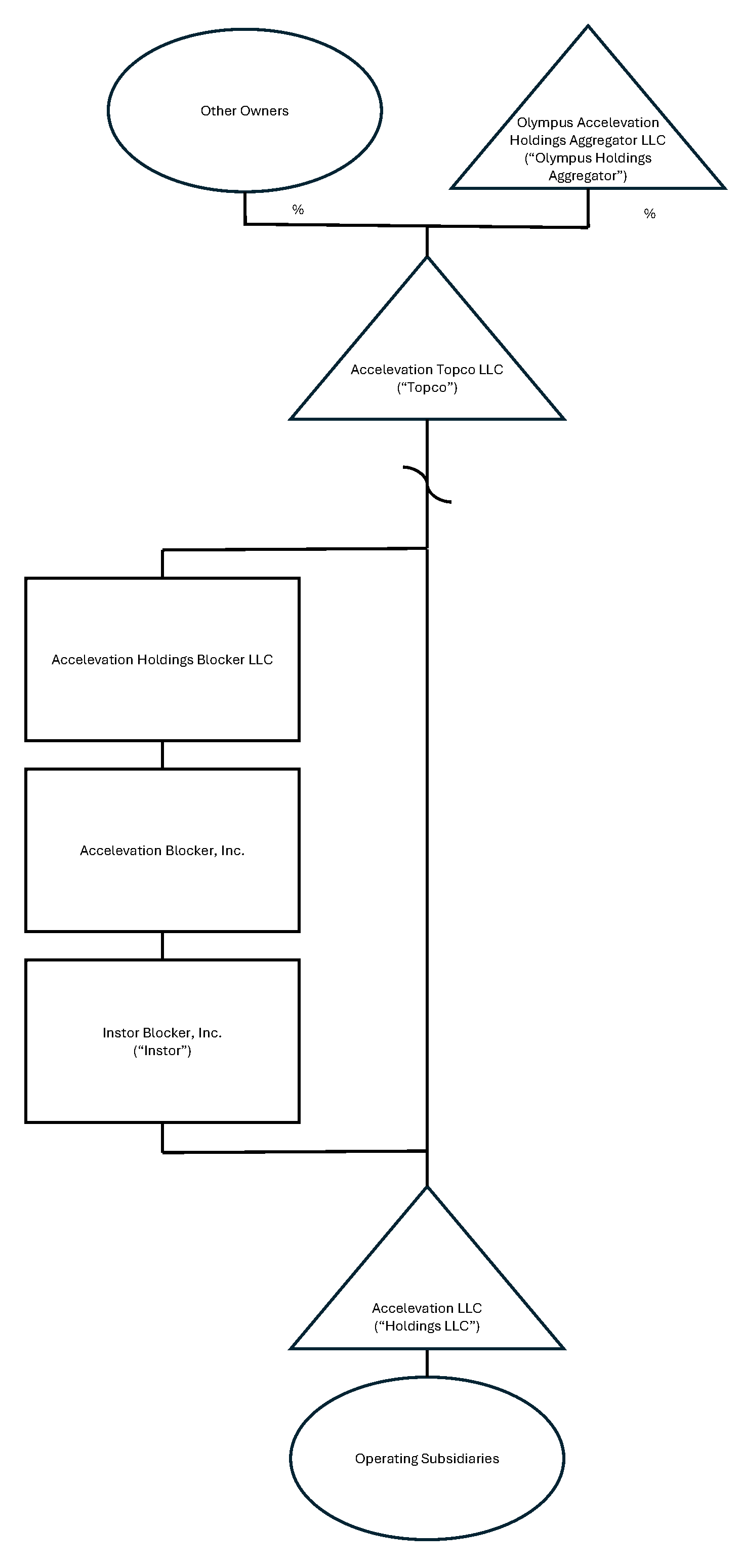
26
The diagram below depicts our expected organizational structure immediately following completion of the Organizational Transactions. This diagram is provided for illustrative purposes only and does not purport to represent all legal entities owned or controlled by us, or owning a beneficial interest in us.
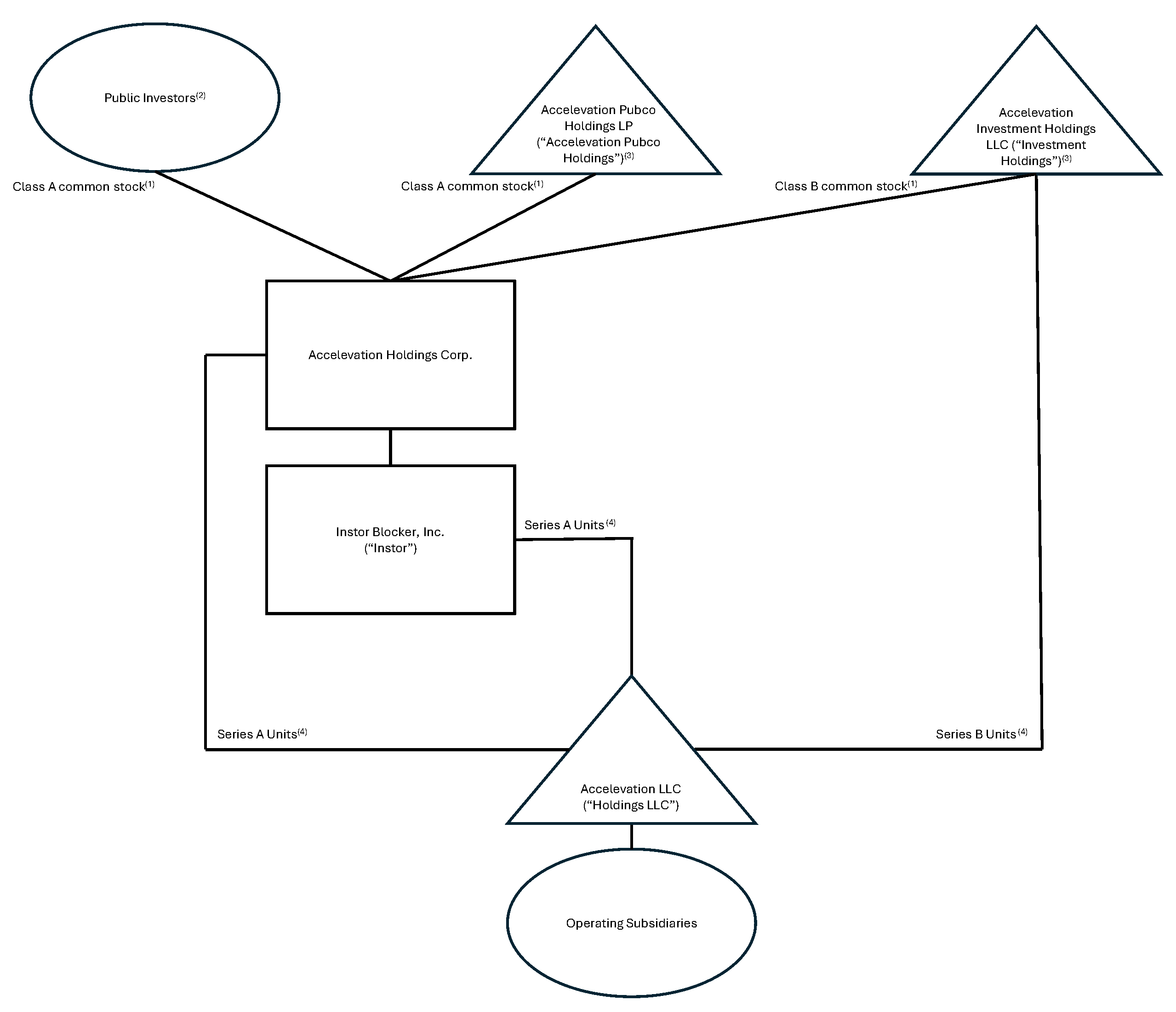
__________________
(1)Shares of Class A common stock and Class B common stock will vote as a single class. Each outstanding share of Class A common stock and Class B common stock will be entitled to one vote on all matters to be voted on by stockholders generally. The Class B common stock will not have any right to receive dividends or distributions upon the liquidation or winding up of Accelevation Holdings Corp. In accordance with the Exchange Agreement to be entered into in connection with the Organizational Transactions, Investment Holdings (and its permitted transferees) will be entitled to exchange its Series B Units of Holdings LLC, together with an equal number of shares of Class B common stock, for shares of Class A common stock determined in accordance with the Exchange Agreement or, at our election, for cash from a substantially concurrent public offering or private sale (based on the price of our Class A common stock in such public offering or private sale).
(2)Upon completion of this offering, the holders of Class A common stock, other than Accelevation Pubco Holdings, will have approximately % of the voting power in Accelevation Holdings Corp. (or approximately % if the underwriters exercise their option to purchase additional shares in full).
(3)Upon completion of this offering, our Principal Stockholder will control the voting power in Accelevation Holdings Corp. as follows: (a) approximately % (or approximately % if the underwriters exercise
27
their option to purchase additional shares in full) through its control of Accelevation Pubco Holdings, which will hold shares of Class A common stock of Accelevation Holdings Corp., and (b) approximately % (or approximately % if the underwriters exercise their option to purchase additional shares in full) through its control of Investment Holdings, which will hold shares of Class B common stock of Accelevation Holdings Corp. and Series B Units of Holdings LLC.
(4)Upon completion of this offering, (a) Investment Holdings will own approximately % (or approximately % if the underwriters exercise their option to purchase additional shares in full) of the LLC Units and (b) Accelevation Holdings Corp. and Instor will own approximately % (or approximately % if the underwriters exercise their option to purchase additional shares in full) of the LLC Units.
Our corporate structure following the offering, as described above, is commonly referred to as an “Up-C” structure, which is often used by partnerships and limited liability companies undertaking an initial public offering. Our Up-C structure, together with the Tax Receivable Agreement, will allow certain existing direct and indirect owners of Holdings LLC to continue to realize tax benefits associated with owning interests in an entity that is treated as a partnership, or “pass-through” entity, for income tax purposes following the offering. One of these benefits is that future taxable income of Holdings LLC that is allocated to such owners will be taxed on a flow-through basis and therefore will generally not be subject to corporate U.S. federal income taxes at the entity level. Additionally, because the Series B Units of Holdings LLC that Investment Holdings will continue to hold are exchangeable, the Up-C structure also provides certain existing direct and indirect owners of Holdings LLC with potential liquidity that holders of non-publicly traded limited liability companies are not typically afforded. See “Organizational Structure” and “Description of Capital Stock.”
Following this offering, Investment Holdings and certain other existing owners of Holdings LLC will hold a number of shares of our Class B common stock equal to the number of Series B Units of Holdings LLC that they own. Holders of our Class A common stock and Class B common stock will each be entitled to one vote per share on all matters on which stockholders are entitled to vote.
Accelevation Holdings Corp. will also hold LLC Units and therefore receive benefits on account of its ownership in an entity treated as a partnership, or a “pass-through” entity, for income tax purposes. As Accelevation Holdings Corp. acquires Series B Units of Holdings LLC from Investment Holdings (or any of its respective transferees) under the exchange mechanism described above, it will obtain a step-up in tax basis in its share of the assets of Holdings LLC and its flow-through subsidiaries. This step-up in tax basis will provide Accelevation Holdings Corp. with certain tax benefits, such as future depreciation and amortization deductions that can reduce the taxable income allocable to Accelevation Holdings Corp.
In connection with the consummation of this offering, we will enter into a Tax Receivable Agreement with the TRA Rights Holders under which Accelevation Holdings Corp. will agree to pay the TRA Rights Holders, collectively, % of certain tax benefits that Accelevation Holdings Corp. realized, or is deemed to realize (calculated using certain assumptions), as a result of (i) certain increases in the tax basis of assets of Holdings LLC and its subsidiaries resulting from purchases or exchanges of LLC Units, (ii) certain other tax attributes of Holdings LLC and its subsidiaries that existed prior to this offering and (iii) certain other tax benefits related to our entering into the Tax Receivable Agreement, including tax benefits attributable to payments that we are required to make under the Tax Receivable Agreement. We retain the benefit of the remaining % of these tax savings, if any. If the Tax Receivable Agreement terminates early, we could be required to make a substantial, immediate lump-sum payment.
We expect that the payments we may make under the Tax Receivable Agreement will be substantial. For example, if we acquire all of the Series B Units held by the TRA Rights Holders in taxable transactions as of this offering, based on an initial public offering price of $ per share (which is the midpoint of the estimated public offering price range set forth on the cover page of this prospectus) and certain other assumptions, including that (i) there are no material changes in relevant tax law and (ii) we earn sufficient taxable income in each year to realize on a current basis all tax benefits that are subject to the Tax Receivable Agreement, we would expect that the resulting reduction in tax payments for us, as determined for purposes of the Tax Receivable Agreement, would aggregate to approximately $ million, substantially all of which would be realized over the next 15 years, and we would be required to pay to the TRA Rights Holders % of such amount, or
28
$ million, over the same period. These amounts have been prepared for informational purposes only. The actual increases in tax basis with respect to future exchanges or purchases of LLC Units may differ materially from the amounts set forth above because the potential future reductions in our tax payments, as determined for purposes of the Tax Receivable Agreement, and the payment we will be required to make under the Tax Receivable Agreement, will each depend on a number of factors, including the market value of our Class A common stock at the time of the exchange or purchase, the prevailing federal tax rates applicable to us over the life of the Tax Receivable Agreement (as well as the assumed combined state and local tax rate), the amount and timing of the taxable income that we generate in the future and the extent to which future exchanges or purchases of LLC Units are taxable transactions. See “Organizational Structure—Tax Receivable Agreement” and “Certain Relationships and Related Party Transactions—Tax Receivable Agreement.”
As a result of the Organizational Transactions:
•the investors in this offering will collectively own shares of our Class A common stock and we will hold Series A Units of Holdings LLC;
•Accelevation Pubco Holdings will own shares of our Class A common stock;
•Investment Holdings will own Series B Units of Holdings LLC and shares of Class B common stock;
•our Class A common stock will collectively represent approximately % of the voting power in us, with shares of Class A common stock held by the public representing approximately % of the voting power in us; and
•our Class B common stock will collectively represent approximately % of the voting power in us.
29
THE OFFERING
Issuer | Accelevation Holdings Corp. | |||||||
| Class A common stock offered by us | shares. | |||||||
Class A common stock offered by the selling stockholders | shares. | |||||||
Underwriters’ option to purchase additional shares of Class A common stock from the selling stockholders | shares. | |||||||
Class A common stock to be outstanding immediately after this offering | shares (or shares if the underwriters exercise their option to purchase additional shares in full). If all outstanding LLC Units held by the LLC Unitholders were exchanged for newly issued shares of Class A common stock on a one-for-one basis, shares of Class A common stock would be outstanding. | |||||||
Class B common stock to be outstanding immediately after this offering | shares. Immediately after this offering, the LLC Unitholders will own 100% of the outstanding shares of our Class B common stock. | |||||||
Ratio of shares of Class A common stock to LLC Units | Our amended and restated certificate of incorporation and the amended and restated operating agreement of Holdings LLC will require that we and Holdings LLC at all times maintain a one-to-one ratio between the number of shares of Class A common stock issued by us and the number of LLC Units owned by us (subject to certain exceptions for treasury shares and shares underlying certain convertible or exchangeable securities). | |||||||
Voting | Each share of our Class A common stock entitles its holder to one vote on all matters to be voted on by stockholders generally. Each share of our Class B common stock entitles its holder to one vote on all matters to be voted on by stockholders generally. After this offering, each LLC Unitholder will hold a number of shares of Class B common stock equal to the number of LLC Units it owns. See “Description of Capital Stock—Class B Common Stock.” Holders of our Class A common stock and Class B common stock vote together as a single class on all matters presented to our stockholders for their vote or approval, except as otherwise required by applicable law. | |||||||
Voting power held by holders of Class A common stock immediately after this offering | %. | |||||||
Voting power held by holders of Class B common stock immediately after this offering | %. | |||||||
30
Use of proceeds | We estimate that the net proceeds to us from the sale of our Class A common stock in this offering, after deducting estimated underwriting discounts and commissions and estimated expenses payable by us, will be approximately $ million (or $ million if the underwriters exercise their option to purchase additional shares in full), based on an assumed initial public offering price of $ per share (which is the midpoint of the estimated public offering price range set forth on the cover page of this prospectus). We intend to use such net proceeds to acquire Series A Units of Holdings LLC (or Series A Units if the underwriters exercise their option to purchase additional shares in full) at a purchase price equal to the initial offering price per share of Class A common stock in this offering, less underwriting discounts and commissions. In turn, Holdings LLC intends to apply the balance of the net proceeds it receives from us (including any additional proceeds it may receive from us if the underwriters exercise their option to purchase additional shares) to: •repay approximately $ of outstanding borrowings under our Credit Agreement; and •apply the balance of the net proceeds it receives from us (including any additional proceeds it may receive from us if the underwriters exercise their option to purchase additional shares) to pay expenses incurred in connection with this offering and the Organizational Transactions and for general corporate purposes. We will not receive any of the proceeds from the sale of shares of Class A common stock by the selling stockholders in this offering. We will, however, bear the costs associated with the sale of shares of Class A common stock by the selling stockholders, other than underwriting discounts and commissions. See “Use of Proceeds” and “Organizational Structure.” | |||||||
Controlled company | After this offering, assuming an offering size as set forth in this section, Olympus will control approximately % of the voting power (or % if the underwriters exercise their option to purchase additional shares in full) in us. As a result, we expect to be a controlled company within the meaning of the corporate governance standards of . See “Management—Corporate Governance—Controlled Company Status.” | |||||||
Dividend policy | We currently intend to retain any future earnings for investment in our business and do not expect to pay any dividends in the foreseeable future. The declaration and payment of all future dividends, if any, will be at the discretion of our Board and will depend upon our financial condition, earnings, contractual conditions or applicable laws and other factors that our Board may deem relevant. See “Dividend Policy.” | |||||||
31
Exchange rights of holders of the LLC Units | Prior to this offering, we will enter into the Exchange Agreement with the LLC Unitholders, including Investment Holdings and certain existing owners of Holdings LLC, so that the LLC Unitholders (and any permitted transferee thereof) may exchange LLC Units, together with an equal number of shares of Class B common stock, for shares of Class A common stock on a one-for-one basis or, at our election, for cash from a substantially concurrent public offering or private sale (based on the price of our Class A common stock in such public offering or private sale). Any shares of Class B common stock so delivered will be cancelled. See “Organizational Structure—Exchange Agreement.” | |||||||
Tax Receivable Agreement | We will enter into a Tax Receivable Agreement with the TRA Rights Holders that will provide for the payment by us to such persons of % of the amount of certain tax savings (calculated using certain assumptions), if any, that Accelevation Holdings Corp. actually realizes (or in some circumstances is deemed to realize) as a result of (i) certain increases in the tax basis of assets of Holdings LLC and its subsidiaries resulting from purchases or exchanges of LLC Units, (ii) certain other tax attributes of Holdings LLC and its subsidiaries that existed prior to this offering and (iii) certain other tax benefits related to our entering into the Tax Receivable Agreement, including tax benefits attributable to payments that we make under the Tax Receivable Agreement. See “Organizational Structure—Tax Receivable Agreement” and “Certain Relationships and Related Party Transactions—Tax Receivable Agreement.” | |||||||
Registration Rights Agreement | We intend to enter into a registration rights agreement (the “Registration Rights Agreement”) with our Principal Stockholder in connection with this offering. The Registration Rights Agreement will provide our Principal Stockholder certain registration rights whereby, following our initial public offering and the expiration of any related lock-up period, our Principal Stockholder can require us to register under the Securities Act of 1933, as amended (the “Securities Act”), shares of Class A common stock (including shares issuable to the LLC Unitholders upon exchange of their LLC Units). The Registration Rights Agreement will also provide for piggyback registration rights for our Principal Stockholder. See “Certain Relationships and Related Party Transactions—Registration Rights Agreement.” | |||||||
Risk factors | Investing in our Class A common stock involves a high degree of risk. See “Risk Factors” elsewhere in this prospectus for a discussion of factors you should carefully consider before deciding to invest in our Class A common stock. | |||||||
Symbol for trading | “ .” | |||||||
Unless otherwise indicated, all information in this prospectus:
•assumes the effectiveness of the Organizational Transactions;
•assumes an initial public offering price of $ per share, which is the midpoint of the estimated public offering price range set forth on the cover page of this prospectus;
•assumes that the underwriters’ option to purchase additional shares of Class A common stock is not exercised;
•excludes the shares of Class A common stock that may be issuable upon exercise of exchange rights held by the LLC Unitholders; and
32
•excludes shares of Class A common stock reserved for future issuance under the Accelevation Holdings Corp. 2026 Omnibus Incentive Plan (the “2026 Plan”).
33
SUMMARY HISTORICAL AND UNAUDITED PRO FORMA FINANCIAL AND OTHER DATA
The following tables present, as of the dates and for the periods indicated: (i) the summary historical consolidated financial information of Accelevation Holding Company, LLC and its subsidiaries for the Predecessor period, (ii) the summary historical consolidated financial information of Holdings LLC and its subsidiaries for the Successor period and (iii) the summary unaudited pro forma financial data for Accelevation Holdings Corp. and its consolidated subsidiaries, including Holdings LLC. Holdings LLC is the predecessor of Accelevation Holdings Corp. for financial reporting purposes.
The summary historical consolidated statements of operations data and summary historical consolidated statements of cash flow data presented below for the years ended December 31, 2025 and 2024 and the consolidated balance sheet data as of December 31, 2025 and 2024 have been derived from, and should be read together with, our audited consolidated historical financial statements and the accompanying notes included elsewhere in this prospectus. Our historical results are not necessarily indicative of results to be expected in future periods.
The summary historical condensed consolidated statements of operations data and summary historical condensed consolidated statements of cash flow data presented below for the three months ended March 31, 2026 and 2025 and the condensed consolidated balance sheet data as of March 31, 2026 and 2025 have been derived from, and should be read together with, our unaudited condensed consolidated historical financial statements and the accompanying notes included elsewhere in this prospectus. Our historical results are not necessarily indicative of results to be expected in future periods.
The summary historical consolidated financial information of Accelevation Holdings Corp. has not been presented. Accelevation Holdings Corp. is a newly incorporated entity, has had no business transactions or activities to date and had no material assets or liabilities during the periods presented in this section.
This information is a summary only and should be read in conjunction with “Risk Factors,” “Capitalization,” “Dilution,” “Unaudited Consolidated Pro Forma Financial Information,” “Management’s Discussion and Analysis of Financial Condition and Results of Operations” and our consolidated financial statements and the accompanying notes included elsewhere in this prospectus.
The summary unaudited consolidated pro forma financial information of Accelevation Holdings Corp. presented below has been derived from the unaudited consolidated pro forma financial statements and notes included elsewhere in this prospectus. The summary unaudited consolidated pro forma financial information as of and for the year ended December 31, 2025, gives effect to the Organizational Transactions as described in “Organizational Structure,” including the consummation of this offering, the use of the net proceeds therefrom and related transactions, as described in “Use of Proceeds” and “Unaudited Consolidated Pro Forma Financial Information,” as if all such transactions had occurred or had become effective on January 1, 2025, with respect to the consolidated statement of operations data, and December 31, 2025, with respect to the consolidated balance sheet data. The unaudited consolidated pro forma financial information includes various estimates that are subject to material change and may not be indicative of what our results of operations or financial position would have been had this offering and related transactions taken place on the dates indicated, or that may be expected to occur in the
34
future. See “Unaudited Consolidated Pro Forma Financial Information” for a complete description of the adjustments and assumptions underlying the summary unaudited consolidated pro forma financial information.
| Historical | Pro Forma Accelevation Holdings Corp. | ||||||||||||||||||||||||||||||||||
| Year Ended December 31, | Three Months Ended March 31, | Year Ended December 31, | |||||||||||||||||||||||||||||||||
(in thousands, except per share data) | 2024 | 2025 | 2025 | 2026 | 2025 | ||||||||||||||||||||||||||||||
(Predecessor) | (Successor) | ||||||||||||||||||||||||||||||||||
| Consolidated Statements of Operations: | |||||||||||||||||||||||||||||||||||
| Revenue | $ | 181,350 | $ | 447,819 | $ | 57,818 | $ | 255,986 | |||||||||||||||||||||||||||
| Cost of goods sold | 122,494 | 303,122 | 36,533 | 188,229 | |||||||||||||||||||||||||||||||
| Gross profit | 58,856 | 144,697 | 21,285 | 67,757 | |||||||||||||||||||||||||||||||
| Operating expenses: | |||||||||||||||||||||||||||||||||||
| Selling, general and administrative expenses | 32,801 | 66,548 | 16,020 | 25,404 | |||||||||||||||||||||||||||||||
| Amortization of intangible assets | 7,121 | 32,832 | 7,723 | 8,927 | |||||||||||||||||||||||||||||||
| Related party expenses | 475 | 1,013 | 250 | 2,339 | |||||||||||||||||||||||||||||||
| Impairment on assets held for sale | — | 2,128 | |||||||||||||||||||||||||||||||||
| Total operating expenses | 40,397 | 100,393 | 23,993 | 38,798 | |||||||||||||||||||||||||||||||
| Operating income (loss) | 18,459 | 44,304 | (2,708) | 28,959 | |||||||||||||||||||||||||||||||
| Non-operating income (expenses) | |||||||||||||||||||||||||||||||||||
| Interest income | 6 | 347 | — | 173 | |||||||||||||||||||||||||||||||
| Interest expense | (9,436) | (22,084) | (5,112) | (7,090) | |||||||||||||||||||||||||||||||
| Other income, net | 706 | 108 | (414) | 188 | |||||||||||||||||||||||||||||||
| Total non-operating expenses, net | (8,724) | (21,629) | (5,526) | (6,729) | |||||||||||||||||||||||||||||||
| Income (loss) before income taxes | 9,735 | 22,675 | (8,234) | 22,230 | |||||||||||||||||||||||||||||||
| Provision for income taxes | $ | 326 | $ | 928 | $ | 136 | $ | 460 | |||||||||||||||||||||||||||
| Net income (loss) | 9,409 | 21,747 | (8,370) | 21,770 | |||||||||||||||||||||||||||||||
| Net income attributable to noncontrolling interest | $ | — | $ | 92 | $ | — | $ | 165 | |||||||||||||||||||||||||||
| Net income (loss) attributable to Accelevation LLC | $ | 9,409 | $ | 21,655 | $ | (8,370) | $ | 21,605 | |||||||||||||||||||||||||||
| Pro Forma Per Share Data (unaudited): | |||||||||||||||||||||||||||||||||||
| Earnings per share, basic and diluted | |||||||||||||||||||||||||||||||||||
| Weighted average common shares used in computing net earnings per share, basic and diluted | |||||||||||||||||||||||||||||||||||
35
| Historical | Pro Forma Accelevation Holdings Corp. | ||||||||||||||||||||||||||||
| As of December 31, | As of March 31, | As of , | |||||||||||||||||||||||||||
| (in thousands) | 2024 | 2025 | 2026 | 2026 | |||||||||||||||||||||||||
| (Predecessor) | (Successor) | ||||||||||||||||||||||||||||
| Consolidated Balance Sheet Data: | |||||||||||||||||||||||||||||
| Cash and cash equivalents | $ | 10,934 | $ | 16,267 | $ | 66,037 | |||||||||||||||||||||||
| Total assets | $ | 189,720 | $ | 722,947 | $ | 824,275 | |||||||||||||||||||||||
| Total liabilities | $ | 149,292 | $ | 415,788 | $ | 511,982 | |||||||||||||||||||||||
| Debt, including current portion | $ | 72,655 | $ | 272,557 | $ | 321,579 | |||||||||||||||||||||||
| Total members' equity | $ | 40,428 | $ | 301,242 | $ | 306,428 | |||||||||||||||||||||||
| Noncontrolling interest | $ | — | $ | 5,917 | $ | 5,865 | |||||||||||||||||||||||
| Total equity | $ | 40,428 | $ | 307,159 | $ | 312,293 | |||||||||||||||||||||||
| Historical | |||||||||||||||||||||||||||||
| Year Ended December 31, | Three Months Ended March 31, | ||||||||||||||||||||||||||||
| (in thousands) | 2024 | 2025 | 2025 | 2026 | |||||||||||||||||||||||||
| (Predecessor) | (Successor) | ||||||||||||||||||||||||||||
| Consolidated Statements of Cash Flows Data: | |||||||||||||||||||||||||||||
| Net cash provided by (used in) operating activities | $ | 10,747 | $ | (7,221) | $ | (7,957) | $ | 8,894 | |||||||||||||||||||||
| Net cash used in investing activities | $ | (4,272) | $ | (442,526) | $ | (397,027) | $ | (2,840) | |||||||||||||||||||||
| Net cash (used in) provided by financing activities | $ | (2,743) | $ | 466,014 | $ | 415,217 | $ | 43,716 | |||||||||||||||||||||
| Increase in cash and cash equivalents | $ | 3,732 | $ | 16,267 | $ | 10,233 | $ | 49,770 | |||||||||||||||||||||
| Cash and cash equivalents, beginning of year | $ | 7,202 | $ | — | $ | — | $ | 16,267 | |||||||||||||||||||||
| Cash and cash equivalents, end of year | $ | 10,934 | $ | 16,267 | $ | 10,233 | $ | 66,037 | |||||||||||||||||||||
| Historical | |||||||||||||||||||||||||||||
| Year Ended December 31, | Three Months Ended March 31, | ||||||||||||||||||||||||||||
| (in thousands, except for percentages) | 2024 | 2025 | 2025 | 2026 | |||||||||||||||||||||||||
| (Predecessor) | (Successor) | ||||||||||||||||||||||||||||
| Non-GAAP and Other Financial Measures: | |||||||||||||||||||||||||||||
Adjusted EBITDA(1) | $ | 29,618 | $ | 90,867 | $ | 11,264 | $ | 43,712 | |||||||||||||||||||||
Adjusted EBITDA Margin(2) | 16 | % | 20 | % | 19 | % | 17 | % | |||||||||||||||||||||
Adjusted Net Income(3) | $ | 18,708 | $ | 64,893 | $ | 5,241 | $ | 35,180 | |||||||||||||||||||||
Free Cash Flow(4) | $ | 6,475 | $ | (16,385) | $ | (8,980) | $ | 6,054 | |||||||||||||||||||||
Backlog(5) | $ | 63,167 | $ | 419,327 | $ | 146,867 | $ | 650,439 | |||||||||||||||||||||
_______________
(1)Adjusted EBITDA is a non-GAAP financial measure. We define Adjusted EBITDA as net income (loss) adjusted for interest income and expense, provision for income taxes, depreciation and amortization expense, equity-based compensation expense, public company readiness costs, strategic acquisition costs, sponsor fees and expenses, change in fair value of acquisition earnout and asset impairment, as well as certain non-recurring items, including payments to Olympus that are expected to cease upon the occurrence of this offering. For a reconciliation of Adjusted EBITDA to the most directly comparable financial measure calculated and presented in accordance with GAAP, see “Management’s Discussion and Analysis of Financial Condition and Results of Operations—Non-GAAP Financial Measures.”
36
(2)Adjusted EBITDA Margin is a non-GAAP financial measure. We define Adjusted EBITDA Margin as Adjusted EBITDA divided by revenue. For a reconciliation of Adjusted EBITDA Margin to the most directly comparable financial measure calculated and presented in accordance with GAAP, see “Management’s Discussion and Analysis of Financial Condition and Results of Operations—Non-GAAP Financial Measures.”
(3)Adjusted Net Income is a non-GAAP financial measure. We define Adjusted Net Income as net income (loss) plus or minus (i) amortization of intangibles, (ii) equity-based compensation, (iii) sponsor fees and expenses, (iv) public company readiness costs, (v) strategic transaction-related costs, (vi) changes in the fair value of contingent consideration liabilities, (vii) asset impairments, (viii) other non-recurring items, and (ix) tax impact of adjustments. For a reconciliation of Adjusted Net Income to the most directly comparable financial measure calculated and presented in accordance with GAAP, see “Management’s Discussion and Analysis of Financial Condition and Results of Operations—Non-GAAP Financial Measures.”
(4)Free Cash Flow is a non-GAAP financial performance measure. We define Free Cash Flow as net cash (used in) provided by operating activities adjusted for purchase of property and equipment. For a reconciliation of Free Cash Flow to the most directly comparable financial measure calculated and presented in accordance with GAAP, see “Management’s Discussion and Analysis of Financial Condition and Results of Operations—Non-GAAP Financial Measures.”
(5)Backlog is given as of the end of each period presented. Backlog consists of the remaining unrecognized revenue on executed contracts and purchase orders, as well as letters of intent and notices to proceed with respect to purchase orders received in writing.
37
RISK FACTORS
This offering and an investment in our Class A common stock involve a high degree of risk. You should carefully consider the risks and uncertainties described below, together with the financial and other information contained elsewhere in this prospectus, including our consolidated financial statements and the related notes thereto, before making a decision to invest in our Class A common stock. The risks and uncertainties described below are not the only ones we face. Additional risks and uncertainties that we are unaware of, or that we currently believe are not material, may also become important factors that affect us. If any of the following risks actually occur, our business, financial condition, results of operations, cash flows and prospects could be materially adversely affected. As a result, the trading price of our Class A common stock could decline, and you could lose all or part of your investment.
Because of the following factors, as well as other factors affecting our business, financial condition, operating results and prospects, past financial performance should not be considered a reliable indicator of future performance, and investors should not rely on historical trends to anticipate trends or results in the future. You should also carefully review the cautionary statements referred to under “Forward-Looking Statements.”
Risks Related to Our Business and Industry
Our business depends on continued investment in data center construction and capacity, and any reduction in demand or slowdown in the growth of drivers of data center demand could materially and adversely affect our business and prospects.
A substantial portion of our revenue is derived from hyperscale, colocation and other large-scale data center customers, and reductions in new construction, retrofit activity and new market development could decrease orders and negatively affect our revenues and cash flows. Adverse developments in the data center infrastructure market or in the industries in which our customers operate could lead to a decrease in the demand for data center resources, including our offerings, which would have a material adverse effect on our business and results of operations. Certain risks to the data center infrastructure market include, but are not limited to:
•a downturn in the market for data centers generally, which could be caused by an oversupply of or reduced demand for data center capacity;
•a decline in the development of the AI industry, reduced interest in AI, government regulation that limits the use of AI or AI’s failure to deliver expected results;
•any transition by our customers from contracting with us to constructing and outfitting data centers using in-house resources;
•reduction in demand for large-scale, high-capacity data center solutions, AI developers and other technology companies due to improved computational efficiency from emerging technologies;
•the rapid development of new technologies, software or models, or the adoption of new industry standards that render our or our customers’ current products and services obsolete or unmarketable, and that could also contribute to a downturn in our customers’ businesses, which would negatively affect demand for our offerings;
•technological advancements that result in more power being required than our existing products can support;
•technological advancements that result in less data center capacity and power being required;
•the availability and affordability of electric power;
•the availability and cost of labor and supplies; and
•volatility in interest rates and other macroeconomic conditions resulting in reduced customer capital expenditures, which would negatively affect demand for our offerings.
38
We focus on data center infrastructure and strategically position ourselves to support accelerating demand for data center capacity driven by numerous factors, including cloud computing, AI and enterprise digitization, but any downturns or reductions in projected investment levels would affect our sales, realization of our pipeline and growth prospects. As cloud computing, AI and enterprise digitization deployments scale, we seek to expand our solutions into further categories, but slower-than-expected adoption of cloud computing solutions, AI and enterprise digitization could have a negative effect on the data center infrastructure market generally, which would in turn reduce demand for our offerings and limit our ability to realize the benefits of current industry and macroeconomic trends. Demand forecasts for data center capacity can change rapidly, and customers may defer, resize or cancel projects if expected compute demand, tenant leasing activity, power availability or financing conditions do not support their original development plans. Any material slowdown in data center investment would negatively impact demand for our offerings, and our business, financial condition, and results of operations could suffer as a result.
Changes in data center industry dynamics, including increased siting constraints or community opposition could reduce data center construction or retrofit deployments and negatively affect demand for our offerings.
The data center industry faces increasing community scrutiny related to the resource requirements and local impacts of data center development, and such scrutiny could reduce, delay or prevent data center projects where our offerings are deployed. In certain markets, residents and local stakeholders have raised concerns regarding the potential effects of data center development on electricity costs, water availability, noise levels, air quality and local land use. Data centers require significant electrical and water resources for their operations, and a significant number of data centers are facing regulatory or community attention regarding power and water allocation.
Within the data center infrastructure industry generally, these concerns have contributed to legal challenges, local moratoria and project cancellations or delays. As concerns regarding data center development are raised, elected officials at local, state and federal levels may respond to such concerns by pursuing additional regulatory or permitting requirements. Local governments may also enact zoning restrictions, require community benefits agreements, impose performance standards or condition approvals on infrastructure commitments that could constrain or increase the cost and timeline of data center siting and construction, which could have a negative impact on demand for our offerings.
Further, power grid constraints, power availability limitations or the inability of local utilities to provide sufficient and reliable power for growing data center needs may have a negative impact on installation timelines. Large campus projects are increasingly conditioned on power availability, development and integration of power grids and community acceptance, and deterioration in any of these factors could delay our builds and projects, which would negatively affect our ability to realize revenues. To the extent that electricity rate increases associated with data center demand are passed through to other consumers, community concerns may be heightened and potentially lead to regulatory actions that could increase the cost and complexity of data center development for our customers. This would in turn materially adversely affect our business, financial condition and results of operations.
Negative publicity or reputational concerns affecting the data center industry, our customers or our offerings could reduce demand for our products and services and harm our relationships with customers.
Our business and offerings are focused on power distribution and white space infrastructure products for large-scale data center customers, and negative publicity concerning data center resource utilization, environmental impacts, siting, industry practices or perceived community burdens could reduce public support for our customers’ projects and our offerings. For example, press coverage or public statements suggesting that data center growth is contributing to higher electricity prices, grid reliability concerns or strains on local infrastructure could cause customers, utilities, regulators or community stakeholders to subject data center projects to increased scrutiny, even where a particular project has obtained required permits and is not directly subject to local opposition. Similarly, adverse publicity involving one of our top customers, a major data center operator or the broader data center infrastructure supply chain could affect customer procurement decisions, delay new programs, reduce public support for future projects or make customers more cautious in selecting suppliers associated with mission-critical deployments.
In addition, product performance issues, project delays, safety incidents or disputes can also generate adverse attention and affect customer perceptions of our reliability. Any of these factors could result in reputational damage
39
which could lead to reduced project awards, greater pricing pressure, burdensome contractual requirements, re-allocations of capital investment and increased costs of capital, any of which could materially adversely affect our business, financial condition and results of operations.
We depend on a limited number of large-scale data center developer customers for a substantial portion of our revenue, and the loss of, delays or cancellations by, or a significant reduction in orders from, any key customer could materially and adversely affect our business.
For the year ended December 31, 2025, we had two customers that together accounted for approximately 61.2% of our direct revenue, and we expect a significant portion of our revenue to remain concentrated among a relatively small number of key customers. We anticipate that we will continue to be dependent on a limited number of customers for a significant portion of our revenue in the future, and in some cases, the portion of our revenue attributable to certain customers may increase in the future. However, we may not be able to maintain or increase the volume of work received from certain of our top customers for a variety of reasons, including the following:
•our customers’ demand for our products and services may be volatile; and
•many of our top customers have pre-existing or concurrent relationships with our current or potential competitors that may affect such customers’ decision to purchase our products.
We serve large-scale data center developers, often as a single-source partner, for the design and manufacture of mission-critical data center infrastructure and other project components. Large customers have substantial negotiating leverage and may impose stringent delivery, documentation and performance requirements that increase our costs of execution, including potential penalties for any product or service failures or the failure to timely deliver products. As we seek to sell more products and services to such customers, they may impose terms and conditions that are less favorable to us, which could affect the timing of our cash flows and our ability to recognize revenue.
We engage early with design teams, which can require substantial pre-award engineering and coordination, and if certain projects or programs are reallocated or bidding pools narrow, we may fail to realize returns on these costs at the levels we expect or at all. Any program or commissioning delays, field rework or cancellations could materially and negatively affect our revenues, and any failure by us to meet delivery timelines, performance specifications or commissioning requirements can lead to claims for damages, warranty claims or reputational harm.
Our customers often rely on third-party financing to pay for their data center construction projects. If these customers are unable to raise capital on acceptable terms when needed, whether due to elevated interest rates, tightened credit markets or other factors, they could be required to delay the development and construction of projects, reduce the scope of those projects or take other actions that may limit the amount of work available to us. Our customers’ ability to fund new projects is dependent upon many factors, including general economic and capital market conditions, credit availability, investor confidence, their own financial health and the success of their business operations. Even where our customers are well-capitalized, internal capital allocation decisions or changes in expected returns may cause them to shift work among sites, delay releases under master programs or reduce near-term purchases from us.
If a large customer were to experience difficulties in fulfilling their obligations to us, cease doing business with us, significantly reduce the amount of their purchases from us, favor competitors, change their purchasing patterns or impose unexpected fees on us, our ability to meet our contract requirements may be adversely affected, which would have a negative effect on our business and results of operations. The loss of any one customer or multiple customers, or a significant reduction in spending by any of our customers, could have an outsized impact on our results of operations. Any significant reduction in orders from a leading customer or loss of a major program would materially adversely affect our business, financial condition and results of operations.
Substantially all of our revenue is concentrated in the hyperscale and colocation data center industry and adverse developments affecting that industry could materially and adversely affect our business.
For the year ended December 31, 2025, the vast majority of our revenue was derived from hyperscale and colocation end users, and we expect to remain heavily dependent on the hyperscale and colocation data center industry for the foreseeable future. Because our revenue is concentrated in a single industry, we are particularly
40
vulnerable to adverse developments affecting that sector and we have limited ability to offset a downturn in hyperscale and colocation demand with revenue from other end markets.
Changes in our end users’ investment priorities, including shifts in the level or focus of spending on cloud computing, AI, enterprise digitization or other technology projects, or in the types of facilities they deploy, may result in reduced demand or increased pricing pressure for certain of our offerings, even if overall technology spending remains robust. A broad slowdown in hyperscale and colocation capital spending, an oversupply of data center capacity, consolidation among hyperscale operators and colocation providers or changes in the way the industry procures and deploys white space infrastructure could each reduce demand for our offerings across our customer base.
Because we do not currently derive meaningful revenue from industries outside of the data center sector, adverse developments affecting the hyperscale and colocation industry would have an outsized impact on our business, and we may be unable to redeploy our manufacturing capacity, engineering resources or workforce to other end markets on a timely basis or at all. Any such developments, or a reduced level of project awards across the industry, could materially and adversely affect our business, financial condition and results of operations.
Our backlog is subject to unexpected adjustments and cancellations and may not result in actual revenue or profits.
Our backlog represents the remaining unrecognized revenue on executed contracts and purchase orders, as well as letters of intent and notices to proceed with respect to purchase orders received in writing. Timing and conversion of backlog is subject to numerous risks and uncertainties and is not necessarily indicative of the amount of revenue to be earned in the upcoming fiscal year. As a result, we cannot guarantee that the revenue projected in our backlog will be realized or profitable or will not be subject to delay or suspension. As of March 31, 2026, our backlog was $650.4 million. Although terms are agreed upon for contract values, project cancellations, scope adjustments, deferrals or changes in customer phasing may occur with respect to contracts reflected in our backlog, which could reduce the dollar amount of our backlog and the revenue and profits that we actually earn. Additionally, amounts included in backlog may be subject to cancellation at a customer’s convenience without a significant corresponding cancellation penalty. Finally, poor project or contract performance could also impact our backlog and profits. Any of these occurrences could have an adverse effect on our ability to convert backlog into revenue, and ultimately have a negative effect on our business, financial condition and results of operations.
Additionally, amounts included in our backlog may not result in revenue or generate profits in the amount we expect or on the timeframe we anticipate. Projects may remain in our backlog for an extended period of time, and the timing of our recognition of backlog is subject to a variety of factors, including project delays, changes in customer orders, external factors including power availability and availability of raw materials and macroeconomic conditions beyond our or our customers’ control. During periods of economic slowdown, the risk of projects being suspended, delayed or cancelled generally increases. Moreover, if we were to experience a significant number of cancellations or reductions in customer orders, it would reduce our backlog and, consequently, our revenues and results of operations. Delays in our backlog conversion may also lead to fluctuations in our results of operations from quarter to quarter, making it difficult to predict our financial performance on a quarterly basis. If our backlog fails to result in revenue in the amount we expect or on the timeframe we anticipate, we may not be able to achieve continued growth, which could have a material adverse effect on our business, financial condition and results of operations.
We face intense and increasing competition and may be unable to compete effectively on speed-to-capacity, on-time delivery, customization, integration and price.
We compete with large data center infrastructure companies that can provide scaled manufacturing capacity and significant working capital to supply broad product and services solutions and manufacturing capacity for large programs. We also compete with regional specialists that target specific product niches. These competitors include large-scale, global companies as well as offering-specific competitors focused on a particular product or service segment who may apply targeted resources in ways that we do not, potentially leading to more competitive pricing. Some of our competitors may have greater resources than we do and could focus these resources on developing a competitive advantage. Smaller competitors may have a lower cost structure, or be able to adapt to the constantly
41
changing demand of the market more quickly. Our competitors may also offer services at prices below cost, devote significant sales resources to competing with us or attempt to recruit our key personnel by increasing compensation, any of which could improve their competitive positions.
Industry consolidation may also impact our competitive position by creating larger competitors in the markets in which we operate. As hyperscale and colocation customers increasingly concentrate spend with fewer, larger data center infrastructure partners that can offer scaled manufacturing capacity, nationwide installation capabilities and the financial capacity required to support working capital needs across multi-site, multi-year programs, the number of eligible suppliers for certain large programs may decrease. On certain large-scale campus buildouts, we compete in limited bidder sets, and if we are unable to maintain the manufacturing capacity, working capital or organizational sophistication required to participate in such programs, we may be excluded from significant revenue opportunities.
A significant element of our competitive strategy is focused on delivering reliable, high-quality products and solutions with speed. However, if competitors develop comparable integrated delivery capabilities, increase their manufacturing capacity, improve lead times, invest in domestic manufacturing capacity, adopt more efficient delivery models or otherwise reduce the differentiation of our offerings, we may experience increased pricing pressure and loss of market share. In addition, if competitors are able to match or exceed our speed of execution, customers may have less incentive to select us or pay a premium for our offerings. If our offerings and cost structure do not enable us to compete successfully, or if we fail to differentiate on speed-to-capacity, reliability and integration, we may experience a decline in revenue and a corresponding material adverse effect on our business, financial condition and results of operations.
If we do not anticipate and adapt to rapid changes in data center technologies and architectures, demand for our offerings could decline.
The current market landscape for data center construction and outfitting, as well as the underlying businesses of and industries served by our customers, are characterized by rapidly changing technology, evolving industry standards, frequent new service introductions, shifting distribution channels and changing customer demands. As a result, the infrastructure of our end-to-end solutions may become less marketable due to demand for new processes and technologies, including, without limitation:
•new processes to deliver power to, or eliminate heat from, IT equipment;
•customer demand for additional redundant capacity;
•new technology that exceeds what our solutions are currently designed to provide; and
•an inability of the power supply to support new, updated or upgraded technology.
We may not be able to adapt to changing technologies or meet customer demands for new processes or technologies in a timely and cost-effective manner, if at all, which would adversely affect our revenues and results of operations. Our engineering and product roadmaps must keep pace with evolving data center technologies and architectures, increasing power densities and other rapid technological advancements, which require continuous updates to product designs and new product introductions. Our SkyBridge platform, branch circuit whips, RPPs, HD-RPPs, PDUs, related monitoring technologies and adjacent upstream power distribution products are designed for high-density environments, but challenges in adhering to customer specifications or standards could limit our customers’ adoption of our designs and integrations. Developments and other changes in energy and power requirements, compute architecture, energy efficiency or power conversion methods could result in reduced demand for certain categories of our products. In addition, continued developments in electrical distribution equipment could shift demand to products we do not currently offer, and the value of past designs may decline quickly as standards evolve, requiring additional engineering investment without certainty of a return on investment. If we fail to anticipate shifts in technology or market needs and opportunities, including rapid developments in the data center industry, or fail to develop new and improved offerings in a timely manner, we may not be able to compete effectively, and our revenues and financial condition may suffer.
In addition, new technologies and evolving industry standards have the potential to gain widespread acceptance, and either replace or provide potentially lower-cost alternatives to our current solutions. The adoption of such new
42
technologies could render some or all of the products and services we provide obsolete or unmarketable, or require us to significantly increase investment in developing or adopting new technologies or industry standards. We may be required to redesign products, retool manufacturing processes, obtain additional certifications, qualify new suppliers or incur significant engineering costs to satisfy changing customer requirements, and we may not be able to recover these costs through pricing. We cannot guarantee that we will be able to identify the emergence of all of these new service alternatives successfully, modify services accordingly or develop and bring new services to market in a timely and cost-effective manner to address these changes. If and when we identify the emergence of new product alternatives and introduce new services, those new services may need to be made available at lower price points than current services. Failure to provide solutions to compete with new technologies or the obsolescence of existing solutions could result in a loss of current and potential customers or could cause us to incur substantial and unexpected costs, which could reduce our revenues and have a material adverse effect on our business, financial condition, and results of operations.
Changing industry standards as well as potential future regulations that apply to our operations and our data center customers’ operations may require further specific requirements which we or our customers may be unable to provide. These may include additional physical security and privacy and security regulations. If these regulations are adopted or extra requirements are demanded by our customers, we may lose certain customers or be unable to fulfill our contractual obligations under existing service arrangements.
A failure to secure new contracts may adversely affect our cash flows and financial results.
Much of our revenue is derived from projects that are awarded through a competitive bid process. Contract bidding and negotiations are affected by a number of factors, including our own cost structure and bidding policies. The failure to bid and be awarded projects, cancellations of projects or delays in project start dates could affect our ability to deploy our assets profitably. In addition, our ability to secure new contracts depends on our ability to maintain all required electrical, construction, mechanical and business licenses. If we fail to successfully transfer, renew or obtain such licenses where applicable, we may be unable to compete for new business. Further, when we are awarded contracts, we face additional risks that could affect whether, or when, work will begin. We could experience a decrease in profitability if we are unable to replace cancelled, completed or expired contracts with new work.
If we fail to identify, integrate and realize the expected benefits of acquisitions, our business and financial results could be adversely affected.
Since 2023, we have completed strategic acquisitions, including the acquisitions of Aura Energy, Earnest Solutions and SteelPro, to add manufacturing capacity and technical capabilities, and future acquisitions may continue to support our strategy. In particular, given the size of the SteelPro acquisition, our future results depend in part on our ability to integrate SteelPro’s operations, personnel, customer relationships, production capabilities, facilities and supplier base into our operations while maintaining the quality, speed and reliability expected by our customers. Successful growth through acquisitions depends upon our ability to identify suitable acquisition targets, conduct due diligence, negotiate transactions on favorable terms and ultimately complete such transactions and integrate the acquired target successfully. Acquisitions may expose us to significant risks and uncertainties, including competition for acquisition targets, which may lead to substantial increases in purchase price or terms that are less attractive to us; dependence on external sources of capital to finance the purchase price of acquisitions; an acquired company’s previous failure to comply with applicable regulatory requirements; failure to timely integrate an acquired company’s strategies, functions and products into our own; diversion of our management’s attention from existing operations to the acquisition and integration process; a failure to accurately predict or realize expected growth opportunities, cost savings, synergies or market acceptance of an acquired company’s products; a failure to identify material problems or liabilities during due diligence review; expenses, delays and difficulties in integrating acquired businesses into our existing businesses; and difficulties in retaining key customers and personnel.
The integration of engineering, power product development, steel fabrication and field operations into our solutions is complex and may divert management attention from organic growth and customer execution. If we overestimate growth opportunities or cost savings, or if integration takes longer or costs more than anticipated, our margins and return on investment could be reduced. Additionally, our financial results could be adversely affected
43
by unanticipated liability issues, transaction-related charges, integration costs, amortization related to intangibles and charges for impairment of long-lived assets due to diminished strategic benefits of integrated business or our failure to successfully integrate acquired capabilities into cohesive commercial offerings. Various assessments and assumptions regarding SteelPro and other acquisition targets may prove to be incorrect, and actual developments may differ significantly from our expectations.
Our indemnification rights in acquisition agreements may be limited, and former owners may be unable or unwilling to satisfy indemnity obligations.
While acquisition agreements may include indemnification for certain pre-closing liabilities, such protections are typically subject to caps, baskets, time limitations, exclusions and the creditworthiness of the indemnitors. If indemnification is unavailable, insufficient or disputed, we could be responsible for remediation costs, third-party claims or compliance matters relating to pre-acquisition periods. Disputes regarding purchase price adjustments, earnouts or transition services can consume management time and result in legal and other expenses, and unresolved liabilities can delay the realization of integration benefits. Any such outcomes could adversely affect our financial condition and divert attention from our ongoing operations, which in turn could materially adversely affect our business, financial condition, and results of operations.
If our cost management strategies, vertically integrated operating model and modular infrastructure platform do not yield the results and efficiencies we expect, our growth prospects, financial position and results of operations could suffer.
We operate in the large and rapidly growing data center infrastructure market, and take steps to improve quality, lead times and cost predictability through our vertically integrated model. If our initiatives do not scale as planned, if our growth is slower than anticipated, or if changes in production mix increase complexity faster than we are able to improve our processes, our costs could be higher than expected and our financial condition and results of operations could be adversely affected. Our failure to continually innovate and realize efficiencies as a result of our business model and initiatives could slow our growth, reduce our competitiveness on price and delivery timelines and materially adversely affect our business, financial condition, and results of operations.
Our modular infrastructure platform, including customer-specific modular systems, depends on increased adaptation and development of factory-assembled systems that shift substantial portions of traditionally field-built work into controlled manufacturing environments. However, insufficient design capabilities could result in the need to utilize more field resources than planned, potentially resulting in increased costs and delays in delivery timelines. Integration of new product lines and acquired capabilities requires cross-functional coordination among our engineering, manufacturing, supply chain and installation teams, and any failures in coordination can increase the potential for errors in specifications and lead to field remediation work and increased costs. Any of these factors could have a material adverse effect on our customer relationships, revenues and results of operations.
To support accelerating hyperscale demand, we continue to add production capacity, operational infrastructure and field resources, but ramping capacity requires effective commissioning, staffing and process stabilization. If new lines, facilities or suppliers come online more slowly than expected, the anticipation of customer demand does not materialize or if customer programs are delayed, our pipeline and backlog conversion, and revenue realization timing, may shift or our ability to recognize revenues may be negatively affected. Additionally, significant capital investment may be required to expand our business or meet increased demand, and if we fail to effectively deploy such capital, our returns and growth could be adversely affected. Any of these developments could materially adversely affect our growth prospects, business, financial condition and results of operations. Conversely, if we underestimate demand or fail to add capacity quickly enough, we may be unable to accept or timely fulfill customer orders, which could harm customer relationships and allow competitors to capture future opportunities.
Extended sales cycles for some of our offerings, combined with irregular customer ordering patterns, may result in significant quarter-to-quarter fluctuations in our revenue recognition and operating results.
The long sales cycles for certain of our offerings, as well as unpredictable ordering patterns by customers, particularly for larger or longer-term projects, may cause our revenue recognition and operating results to vary significantly from quarter to quarter. A customer’s decision to purchase infrastructure solutions may involve a
44
lengthy design, budgeting and qualification process. In addition, the exact timing of customer orders can vary significantly based on factors outside of our control, including permitting and construction delays, availability of specialized workers or contractors to install equipment, availability of financing for the project, availability of adequate power utilities and community acceptance. Consequently, our order booking and sales recognition process may be uncertain and unpredictable, with some customers placing large orders with short lead times on short advance notice and others requiring lengthy processes that may change depending on economic conditions or factors specific to the customer’s project. The variability of customer orders may cause our revenues and results of operations to vary unexpectedly from quarter to quarter, making our future results of operations less predictable. Any cancellation or deferral of our customers’ orders can also lead to downstream cancellation fees imposed by our vendors, or result in excess inventory and additional costs which, in combination with lost revenues on cancelled orders, could have a material adverse effect on our business, financial condition and results of operations.
Our fixed-price or committed-schedule arrangements expose us to cost overruns and schedule penalties.
We frequently commit to deliver our offerings to customer specifications within defined timelines, and increases in labor, materials or logistics costs can exceed our estimates. It is important for us to accurately estimate and control our contract costs so that we can maintain positive operating margins and profitability. Under fixed-price or committed-schedule contracts, we receive a fixed price irrespective of the actual costs we incur and, consequently, we are exposed to a number of risks. We realize a profit on such contracts only if we can control our costs and prevent cost overruns. Fixed-price contracts require cost and scheduling estimates that are based on a number of assumptions, including those related to future economic conditions, our overhead costs, the utilization and availability of labor, equipment and materials and other unknown factors. We could experience cost overruns if these estimates are originally inaccurate or become inaccurate as a result of a change in circumstances following the submission of the estimate. Design changes, interface risks in multi-party environments or site access constraints can raise execution costs, elevate the risk of field rework and compress margins on committed projects. Some of the specific risks associated with our fixed-price or committed-schedule arrangements include difficulties encountered on large-scale projects related to the procurement of materials or due to schedule disruptions, product performance failures or unforeseen site conditions; our inability to obtain compensation for additional work we perform or expenses we incur as a result of unanticipated technical issues or our customers providing deficient design, engineering information, products or materials, reliance on historical cost or execution data that is not representative of current conditions, including as a result of inflation and increases in labor and material costs, delays or productivity issues caused by weather conditions or other force majeure events and difficulties in engaging third-party subcontractors, product manufacturers or materials suppliers, or failures by such parties to perform, any of which could result in project delays and cause us to incur additional costs. Accounting for a contract requires judgment to evaluate the contract’s estimated risks, revenue, costs and other technical issues, and due to the size and nature of many of our contracts, the estimation of overall risk, revenue and cost at completion is subject to many variables. Changes in underlying assumptions, circumstances, or estimates may also adversely affect future period financial performance. As a result of one or more of these factors, we may incur losses, or contracts may not be as profitable as we expect, which could materially adversely affect our business, financial condition, and results of operations.
Our success depends on the continued service of our founders and key leaders and our ability to recruit and retain skilled engineers, technicians and electricians.
We are a founder-led business and depend on experienced executives across operations, delivery, engineering, finance and other departments to execute and scale our integrated platform. Our co-founder and Chief Executive Officer, Michael Rubiera, has led Accelevation since its founding in 2017, and the loss of his services or those of other key leaders could materially impact our strategic direction and execution capabilities. We also recently hired a new Chief Financial Officer, Kenneth Krause. Our success will depend, in part, on our ability to integrate their leadership successfully into our organization. Integrating new key leaders can cause disruptions to processes, projects, priorities and culture, and new leaders may not perform as expected, may not fit culturally or may make changes that are not embraced by existing employees.
We also rely on our ability to continue to attract and retain engineers, designers, licensed electricians, installation technicians and manufacturing, field or other talent to meet demand and sustain our quality standards.
45
Competition for skilled labor is intense, particularly in data center construction markets, and higher wages or increased turnover could elevate costs and impair our ability to realize projects on the timelines or to the standards our customers expect. Our business may be adversely affected by temporary work stoppages, labor disputes and other matters associated with our labor force or the labor force of our customers, any of which could reduce our productivity, increase our costs or impair our ability to meet customer delivery commitments.
If we lose the services of key personnel or fail to maintain our core values and leadership as we grow, our operations and strategic initiatives could be adversely affected. Existing employees may not embrace new leaders, priorities, methods, processes or other changes, and any difficulty adjusting to leadership transitions could result in reduced productivity, employee departures, internal control deficiencies or disruption to financial reporting and other business processes. Inadequate staffing could also limit our ability to expand our product offerings, pursue further development opportunities in the rapidly scaling data center market, and support the customers and business programs that contribute to our growth.
Rapid scaling of our operations requires significant investment in workforce development, operating infrastructure and cross-functional coordination, and any failures in these areas could increase costs and materially adversely affect our financial results.
As we scale, we must continue to invest in training programs, workforce development and operating infrastructure to sustain our current business outlook and growth objectives, while preserving flexibility, efficiency and responsiveness in our commercial operations and internal organization. If we fail to maintain our speed and reliability while scaling our business, or if we are unable to recruit and retain experienced leaders across our organizational structure, our ability to deliver on customer expectations may be negatively affected, which could cause our financial results to suffer. Rapid growth and scaling of operations to keep pace with the data center industry’s current trends and trajectory may also increase pressure on our internal teams and organizational structure, potentially requiring additional investment in hiring and operations and resulting in distractions to management’s time and attention, any of which could have a material adverse effect on our business, financial condition and results of operations.
Our manufacturing and field operations are subject to risks of equipment failure, capacity constraints, labor availability and safety incidents, including physical hazards inherent to our industry, that could delay deliveries and increase costs.
Our manufacturing footprint supports a wide range of product lines, including structures, containment and Power Products, and we must balance various priorities, including product integration, flexibility and quality as we scale to meet demand, including that of our hyperscale customers. Equipment failures, yield challenges on new products or commissioning delays on capacity additions can compress schedules and elevate overtime or expedite costs. A work stoppage, labor shortage or other production limitation affecting our manufacturing facilities and capabilities could materially adversely affect our reputation and market position. We depend on maintaining a skilled, safety-oriented workforce, supported by training initiatives such as our welder trainee program, and labor shortages or increased turnover could limit our capacity and execution quality. The impact of these risks is heightened if our production capacity is at or near full utilization and could result in our inability to accept orders or deliver products in a timely manner.
Additionally, hazards related to our products and industry include, but are not limited to, electrocutions, power surges, arc flashes, fires, injuries involving ladders and machinery, installation errors, mechanical or structural failures and transportation accidents. These hazards can cause personal injury and loss of life, severe damage to or destruction of property and equipment and suspension of operations. While we have invested significant efforts in our safety programs in an effort to minimize safety risks, we may experience serious accidents in the future. Serious accidents may subject us to penalties or claims and extensive litigation. In addition, if our safety record were to substantially deteriorate over time, our customers could cancel our contracts or choose to not award us future business, which could have a material adverse effect on our business, financial condition, and results of operations.
46
Our supply chain strategy depends on both internal fabrication and third-party sources; shortages, quality issues, price increases, transportation disruptions or government trade actions affecting raw materials and components could harm our business.
We internally fabricate a growing share of components and assemblies but rely on external suppliers for a significant quantity of raw materials such as steel, aluminum, copper, electrical components, polycarbonate and fuel, and for third-party components including circuit breakers and electrical parts. Prices of these raw materials and components may be affected by supply constraints or other market factors from time to time, and we do not enter into hedging arrangements to mitigate commodity risk. Significant price changes for these raw materials and components could reduce our operating margins if we are unable to recover such increases from our customers and could harm our business, financial condition and results of operations. Any widespread shortage of raw materials can impede deliveries or require less efficient substitutions. Our reliance on third-party suppliers, service providers and commodity markets to secure raw materials and key components exposes us to volatility in the prices and availability of these materials. Commodity price increases for metals, cabling and other components can outpace our ability to reprice our products, resulting in increased costs that we may not be able to pass on to our customers. We operate in a supply constrained environment where we are facing, and may continue to face, supply-chain shortages, inflationary pressures, shortages of skilled labor, transportation and logistics challenges and manufacturing disruptions that could impact our revenues, profitability, cash flow and delivery schedules.
As we rely on our vendor partners to timely deliver equipment and raw materials used in connection with our operations, if any of our suppliers fail to deliver on a timely basis or perform the agreed-upon services, our ability to fulfill our obligations to our customers may be jeopardized and we may be required to purchase the supplies or services from another source at a higher price. To the extent we are unable to acquire equipment and materials at reasonable costs or if we experience significant delays in procurement, including as a result of material shortages, trade disputes, tariffs, supply chain disruptions or other factors, we could encounter increased material costs, delays in customer timelines and other negative effects on our business and operations. This may reduce the revenue to be realized on any particular project or result in a loss on a project, which could have a material adverse effect on our business, financial condition and results of operations.
Further constraints, allocations or quality issues at suppliers can delay production, increase costs or require redesigns, while commodity price volatility can pressure margins on fixed-price or committed schedules. Transportation disruptions can further extend lead times and increase costs, particularly for large modular assemblies intended to reduce on-site labor. We depend on multiple modes of transport to acquire components and materials used in our operations, and we are vulnerable to disruptions in transport and logistics activities due to weather-related problems, strikes, lockouts or inadequacy of roadways or port facilities. During transport and shipping, our products or their components and materials may become damaged, which could result in liability and reputational harm. Underperformance or failures to deliver by third-party suppliers could materially impact our ability to perform obligations to our customers, which could result in a customer terminating their contract with us, exposing us to liability and substantially impairing our ability to compete for future contracts and orders. Prolonged supply disruptions could also limit the expansion of our offering and modular infrastructure solutions. Any of these factors could have a material adverse effect on our business, financial condition and results of operations.
We rely on contractors and subcontractors to supplement our own capabilities and to conduct aspects of our business.
We utilize in-house personnel, including trade professionals, technicians and other specialized labor, and where appropriate we supplement capacity with third parties, including temporary staffing agencies, which can result in variability of the availability of labor and other personnel, or the availability of reliable labor and personnel on a regular basis. Disruptions, delays, safety incidents or quality deficiencies by third parties can result in increased costs, including if we are required to invest additional resources into certain projects, and also lead to penalties or delays in timelines that could also contribute to increased costs that we may not be able to pass through to our customers. The ability of our teams to execute in the field also depends on site access and coordination with third parties throughout the project cycle, which can exacerbate the negative effects of project delays. Additionally, any inability to retain qualified third parties, or if our third parties do not perform in accordance with their obligations, may cause us to incur additional costs or experience delays in project execution, which could subject us to
47
contractual penalties. Any sustained issues in subcontractor or temporary employee performance, failure to retain, or disputes over changes in customer orders, could strain customer relationships and materially adversely affect our results of operations.
In some locations, we rely on third-party staffing companies to provide us with contingent workers, and our failure to manage such workers effectively could have a material adverse effect on our business, financial condition and results of operations. We may in the future be exposed to various legal claims relating to the status of contingent workers, even if we are indemnified. We may also be subject to labor shortages, oversupply or fixed contractual terms relating to the contingent workforce, and our ability to manage the size of, and costs for, such contingent workforce may be further constrained by local laws or future changes to such laws. In addition, our customers may impose obligations on us with regard to our workforce and working conditions.
Additionally, we may have disputes with our subcontractors or temporary staffing agencies or employees arising from, among other things, the quality and timeliness of work performed by the subcontractor or employee, customer concerns or our failure to extend existing task orders under a subcontract. To the extent that we cannot subcontract or fulfill other staffing needs at reasonable costs or if we experience delays in the procurement of subcontractors and temporary employees, our ability to complete a project in a timely fashion or at a profit may be impaired.
In addition, if third-party providers fail to comply with applicable wage and hour, safety, immigration, licensing or other legal requirements, we may be subject to claims, penalties or reputational harm, even where the underlying conduct is outside our direct control. Increased reliance on third parties may also make it more difficult to maintain consistent quality, safety culture and schedule discipline across customer sites.
An economic downturn, tighter financing conditions or pricing challenges could reduce demand for our products and services.
Negative macroeconomic conditions, including volatility in interest rates, pricing pressures and rapid market growth may adversely impact our ability to operate our business or secure working capital, surety bonding and the credit support needed to support hyperscale programs. If AI-driven or cloud-driven demand decreases relative to current expectations, announced campus projects are resized or deferred or power-grid constraints lengthen schedules, our addressable opportunities may be reduced or shift into later periods. The level of new data center construction in the United States has been and continues to be sensitive to macroeconomic conditions, including U.S. GDP growth, interest rates, capital availability, energy prices and government spending, and reductions in demand often lead to greater price competition. Any sustained downturn in the U.S. or global economy could slow the growth of our manufacturing footprint and have a negative effect on our financial condition and results of operations, particularly if we maintain capacity and workforce levels based on prior demand expectations.
Further, prices for data center infrastructure solutions have benefitted from strong demand dynamics over recent periods. If current demand levels are reduced, industry supply increases faster than demand or if our competitors add significant capacity, we may not be able to effectively price our products, or we may experience pricing pressure, which would have a negative impact on our results of operations. Additionally, a significant amount of our revenue relates to new data center construction projects, and if financing is not available, or is not available on favorable terms, for customers to complete such projects, there may be less demand for our products. We expect to continue to add capacity to meet growing demand for our offerings, and if the data center industry adds capacity faster than demand grows, we could experience increased price competition. If prices for our products decline, both our revenue growth and profit margins would be significantly impacted, which could have a material adverse effect on our business, financial condition and results of operations.
Geopolitical developments, trade policy shifts and macroeconomic volatility, including commodity price volatility, can disrupt supply chains, increase costs and affect customer investment decisions.
Our products and assemblies use significant quantities of raw materials, and tariffs, sanctions or trade restrictions affecting metals, electrical components or industrial equipment could increase input costs or reduce availability of raw materials, impairing our ability to meet our customers’ timelines or meet specified performance standards. When projects are priced under fixed or committed schedules, our ability to pass through cost increases
48
may be limited, requiring us to absorb increased costs. Further, we and our customers are affected by general business and economic conditions in the United States and globally, including short-term and long-term interest rates, inflationary pressures, supply chain issues, money supply, fluctuations in debt and equity capital markets, broad trends in industry and finance, and prolonged periods of inflation and cost increases.
Geopolitical conflicts, including those in Ukraine, Iran, the Middle East and other regions, escalating tensions between China and Taiwan, and related logistics disruptions could lengthen shipping times for imported components or raw materials and elevate freight costs. The consequences of such conflicts, including sanctions, export controls and other measures imposed by the United States, the European Union and other countries, have caused and may continue to cause disruption and instability in global markets, supply chains and industries that could negatively impact our operations and financial performance. Trade restrictions, including new or increased tariffs or quotas, retaliatory tariffs or other retaliatory measures, border taxes, embargoes, safeguards and customs restrictions against certain components and materials, as well as labor strikes and work stoppages, could also increase the cost or reduce or delay the supply of raw materials and components available to us. Our procurement costs and the prices of raw materials and other components that we use in production may increase and be susceptible to significant fluctuations due to trends in supply and demand, commodity prices, currency exchange rates, transportation costs, government regulations and tariffs, price controls and economic conditions. Sustained tariff-related cost inflation could reduce our price competitiveness and delay customer decisions, particularly on large programs with tight budgets. Additionally, supply chain pressures and commodity price volatility could materially adversely affect our business, financial condition and results of operations in the future.
Macroeconomic volatility can also affect customers’ financing and timing decisions for data center investment and may have an adverse effect on our ability to realize our backlog. Prolonged uncertainty could have a material adverse effect on our business financial condition and results of operations.
Our business is subject to seasonal variations in operations and demand that affect construction activity.
Adverse weather conditions, including rain, severe heat or cold, ice or snow, could delay our work and contribute to project inefficiency, negatively impacting our schedules and profitability, including by delaying the work of other trades on a construction site. Our installation services, which are performed in the field at customer data center sites, are particularly sensitive to weather-related disruptions and seasonal construction patterns. If we experience delays earlier in the construction or buildout timeline due to seasonal or weather factors, our delivery windows could become compressed and result in increased costs that we may not be able to pass onto our customers under our arrangements. In addition, cooler or hotter than normal temperatures could reduce demand for certain of our services during affected periods. These seasonal and weather-related variations may cause fluctuations in our quarterly or annual results of operations.
Business disruption, natural disasters, public health events or other catastrophic events could materially disrupt our manufacturing operations, supply chain, field services or logistics and adversely affect our results.
Our business depends on design, manufacturing and installation activities executed across our physical locations in the United States and active customer sites in the field. Significant disruptions from severe weather, natural disasters, power outages, public health emergencies or other catastrophic events could impair our production capabilities and delivery schedules. Pandemics and similar public health events can affect labor availability in factories and field operations, disrupt supplier activities and restrict site access, resulting in delays and additional costs to execute our projects. Such events can also shift customer schedules and logistics availability, increasing the unpredictability of our ability to realize our backlog. Prolonged disruptions could harm our reputation for speed and reliability and materially affect our financial performance.
Any disruption or extended interruption at one of our major hubs where we perform a significant portion of data center fabrication and component assembly, including our principal operating location in Dayton, Ohio and other key operating hubs in Ohio, Mississippi and Virginia, would delay project execution, reduce our ability to deliver products to our customers and potentially jeopardize our ability to meet customers’ expectations. Extreme weather conditions, including hurricanes, floods, tornadoes, wildfires and severe winter weather, have from time to time impacted, and may in the future have a negative impact on, our business, including by limiting the availability of resources, increasing our production and services costs, damaging property, disrupting our workforce or causing
49
projects to be delayed or cancelled. To the extent climate change results in an increase in extreme weather events or adverse weather conditions, the likelihood of a negative impact on our results of operations would increase.
Additionally, our installation services rely on access to customer sites and the availability of skilled technicians. Restrictions on on-site work, unsafe outdoor conditions or quarantines would increase costs and negatively affect revenues and results of operations. Our customers’ projects also depend on coordination among multiple third parties, so disruptions elsewhere in the supply chain can affect our schedules, elevate the risk of field remediation work and reduce our margins. Prolonged disruptions could undermine our reputation for speed and reliability, negatively affect our relationships with customers and potentially lead to claims or warranty exposure under delivery commitments. Any of these factors could cause a significant interruption in our or our customers’ business, damage or destroy our or our customers’ facilities or cause us to incur significant costs, which could in turn harm our business, financial condition and results of operations. The activities of our third-party vendors and other suppliers, manufacturers and business partners may be similarly disrupted. Any insurance we maintain against such risks may not be adequate to cover losses in any particular case, and such insurance may become increasingly expensive or unavailable.
Failure to adequately protect our intellectual property and other proprietary rights could adversely affect our business, results of operations, financial condition and future prospects.
Our success depends, in part, on our ability to protect our intellectual property and other proprietary rights. We offer a patent-pending SkyBridge platform and have developed proprietary power distribution and monitoring features for high-density environments. We rely on patent, trademark and trade secret laws, as well as contractual provisions, to protect our intellectual property and other proprietary rights, including by entering into intellectual property assignment agreements and/or agreements containing confidentiality provisions with our employees and third parties who contribute to the development of our intellectual property and other proprietary rights and/or have access to our confidential information. However, our efforts to protect our intellectual property and other proprietary rights may afford only limited protection and may not prevent our competitors from duplicating our processes or technology, gaining access to our proprietary information or otherwise hindering our competitive advantage. For example, our pending patent applications may not successfully result in issued patents or provide us with significant competitive advantage. We also cannot provide any assurances that all confidentiality agreements with such employees and third parties have been duly executed or guarantee that such confidentiality agreements will be enforceable under applicable law. Furthermore, enforcing a claim that a party illegally disclosed or misappropriated trade secrets is difficult, expensive and time-consuming, and the outcome is unpredictable. If any of our trade secrets were to be lawfully obtained or independently developed by a competitor or other third party, we would have no right under trade secret laws to prevent them from using that technology or information to compete with us. Third parties may also challenge the validity, enforceability or scope, as well as our ownership rights or other rights to use, our intellectual property and other proprietary rights.
Furthermore, the laws of some foreign jurisdictions do not protect intellectual property or other proprietary rights to the same extent as the laws of the United States, and enforcement of intellectual property and other proprietary rights would in any event be likely to involve material cost and expense and to materially divert the attention of our management team. If, either in the United States or in a foreign jurisdiction, we are unable to prevent unauthorized disclosure or use of our trade secrets or other uses or commercialization of our intellectual property or other proprietary rights, or if the costs of doing so would be excessive, our competitive position could be harmed, which could have an adverse effect on our business, financial condition and results of operations.
We may need to defend ourselves against third-party claims that we are infringing, misappropriating or otherwise violating others’ intellectual property or other proprietary rights, which could divert management’s attention, cause us to incur significant costs and prevent us from selling or using the technology to which such rights relate.
Third parties could allege that our products or integrated assemblies infringe their patents or other intellectual property and other proprietary rights, and defending such claims can be costly, time-consuming and disruptive regardless of their merit. If we do not successfully defend or settle an intellectual property claim, we could face significant monetary damages and could be prohibited from continuing to use certain technology, or from making,
50
selling or incorporating certain components, features or capabilities into the products we offer. As a result, we could be forced to redesign our products or seek licenses from third parties, which could require us to pay significant royalties or licensing fees, which would ultimately result in increases to our operating expenses. If a license is not available, either on reasonable terms or at all, we may be required to develop or license a non-violating alternative, which could require significant effort and expense and undermine the competitiveness of our products. As a result, intellectual property claims against us could have a material adverse effect on our business, financial condition, and results of operations.
We may not be able to obtain or maintain sufficient insurance at acceptable cost, and our insurance may not cover all risks.
Although we maintain insurance coverage that we believe is appropriate, coverage may be unavailable, insufficient or subject to increased premiums and deductibles. Certain types of losses, generally of a catastrophic nature, such as losses due to wars, acts of terrorism, severe weather events including earthquakes, floods or hurricanes, pollution and environmental conditions, may be either uninsurable or not economically insurable, or subject to limitations including large deductibles or sublimits. Accordingly, our insurance does not cover all types or amounts of liabilities. We may elect not to purchase insurance for certain business risks and expenses where we believe we can adequately address the anticipated exposure or where insurance coverage is either not available at all or not available on a cost-effective basis. External market conditions have resulted in an insurance market that is characterized by higher premiums, diminished capacity and more conservative underwriting, and such conditions may persist. Our third-party insurance is subject to deductibles, and we are effectively self-insured for typical claims up to those deductibles, and no assurance can be given that our insurance or our provisions for incurred claims will be adequate to cover all losses or liabilities we may incur in our operations. Large claims or multiple incidents could exceed policy limits or fall within exclusions, resulting in significant uninsured losses. A partially or completely uninsured claim, if successful and of significant magnitude, could have an adverse impact on our business and outlook. If any of our third-party insurers fail, suddenly cancel our coverage or otherwise are unable to provide us with adequate insurance coverage, then our overall risk exposure and operational expenses would increase. In addition, if we expand into new markets, we may not be able to obtain insurance coverage for these new activities. Increases in insurance costs would also raise our operating expenses.
Legal, Regulatory and Reputational Risks
Changes in laws, regulations and standards applicable to our business could increase costs, constrain operations or delay projects.
We must comply with a range of codes and standards relevant to our products and services, including a range of applicable electrical, safety and building codes and industry standards such as those set by the National Electrical Code (“NEC”) and UL, and changes can require design updates, process changes or re-certifications. Installation services must be performed by licensed electricians and trained technicians in applicable jurisdictions, and evolving licensure and safety standards can increase compliance costs. Building code and permitting changes can also affect customer project schedules and our ability to perform on our customers’ timelines and to their specifications. The cumulative impact of regulatory changes could increase costs and complexity and reduce our flexibility in product design and execution.
In addition, we are subject to numerous federal, state and local laws and regulations in the jurisdictions in which we operate, including those relating to data privacy and security, employment and labor relations, construction and building maintenance, immigration, taxation, anti-corruption, import-export controls, trade restrictions and state and local licensing regulations. Although we have policies and procedures directed at complying with such laws, a violation of such laws could subject us and our employees to civil or criminal penalties, including substantial monetary fines, or other adverse actions, and could damage our reputation and our ability to do business. Furthermore, we and certain of our clients operate in regulated environments, which require us or our clients to obtain, maintain and comply with, federal, state and local government permits and approvals. These permits or approvals are subject to denial, revocation or modification under various circumstances. Failure to obtain, maintain or comply with the conditions of such permits or approvals subjects us to the risk of penalties, cessation of
51
operations or other liabilities which could have a material adverse effect on our business, financial condition and results of operations.
AI-related legislation and regulation could disrupt our customers’ markets, resulting in declines in demand for our products and services.
Various laws and governmental regulations, both in the United States and abroad, governing AI, machine learning, data privacy, cybersecurity and related digital infrastructure remain largely unsettled and are evolving rapidly. New or proposed AI-related laws and regulations, including executive actions, agency guidance or industry standards, as well as new applications of existing laws and regulations, could affect the development, deployment, financing or operation of AI workloads and the data centers that support them. Because a portion of current and expected demand for data center capacity is driven by AI training, interference and computing applications, laws and regulations that limit the use of AI or impose restrictions on AI models or training data may increase compliance obligations for AI developers or cloud service providers, restrict access to advanced chips, limit energy use by AI infrastructure or otherwise slow AI adoption, and therefore could reduce our customers’ capital expenditures or delay, resize or cancel data center projects. AI-related laws and regulations may also increase scrutiny of power usage, cooling requirements, environmental impacts, data security and critical infrastructure resiliency associated with AI data centers, which could increase permitting complexity and project costs for our customers. Current and future laws and regulations could therefore impose additional costs on our business, disrupt our customers’ markets or require us to make changes in our operations, any of which could adversely affect our operations and performance.
Product defects, installation errors or performance shortfalls could result in warranty claims, reputational harm and liability.
Our products and integrated assemblies are critical to our customers’ operations, and defects, performance issues or nonconformance can lead to disruptions and claims by our customers against us. We produce sophisticated and engineered solutions and provide specialized offerings and installation services for complex data center infrastructure projects, and a serious product or execution failure could result in a range of adverse outcomes, including data center downtime, widespread equipment damage, project delivery delays or other systemic issues, and could have an adverse effect on our business, reputation, financial position, cash flows and results of operations. Our regular testing and quality control efforts may not be effective in controlling or detecting all quality issues or errors, particularly with respect to faulty components manufactured by third parties.
Actual or perceived design, production, performance or other quality issues related to new product introductions or existing product lines can result in direct warranty, maintenance and other claims for damages, including costs associated with project delays, repairs or replacements, some of which can be for significant amounts, and an inability to correct a product defect could result in the failure of a product line, temporary or permanent withdrawal from a product category or market, delays in customer payments, increased inventory costs and product reengineering expenses. Quality issues can also negatively impact customer satisfaction and sentiment, generate adverse publicity, reduce future sales opportunities and damage our reputation. Our customers’ installation projects are time-sensitive, and errors, remediation work or project delays can result in increased costs or negatively affect our reputation for speed and reliability. Significant claims could increase costs, reduce future awards and lead to higher insurance premiums or deductibles. Product liability and product recall insurance coverage is expensive and may not be available on acceptable terms, in sufficient amounts or at all, and we may not be able to limit or exclude liability for personal injury or property damage to third parties under the laws of all jurisdictions in which we do business.
We may become involved in legal proceedings and disputes arising from our operations, which could be costly and divert management attention.
We may face claims related to contracts, change orders, warranties, employment, acquisitions or other matters. From time to time, we are involved in lawsuits, regulatory proceedings, investigations, enforcement actions and other legal proceedings brought or threatened against us in the ordinary course of business. Our business is subject to the risk of claims involving current and former employees, customers, affiliates, subcontractors, suppliers, competitors, equity holders, government regulatory agencies or others through private actions, class actions,
52
whistleblower claims, administrative proceedings, regulatory actions or other proceedings. As a public company, we may face the risk of stockholder lawsuits and other related litigation, particularly if we experience declines in the trading price of our Class A common stock.
The outcome of litigation, particularly class action lawsuits and regulatory actions, is often difficult to assess or quantify, as plaintiffs may seek injunctive relief or recovery of very large or indeterminate amounts, and the magnitude of the potential loss may remain unknown for substantial periods of time. We may be involved in commercial litigation or disputes where the initial amounts claimed by counterparties are large, even if ultimately our liability or a resolution of such claims is significantly lower. In addition, plaintiffs in many types of actions may seek punitive damages, civil penalties, consequential damages or other losses, or injunctive or declaratory relief. These proceedings or actions could result in substantial cost and may require us to devote substantial resources to defend ourselves and distract our management from the operation of our business. While we maintain insurance for certain potential liabilities, such insurance does not cover all types and amounts of potential liabilities and is subject to various exclusions as well as caps on amounts recoverable. We may therefore incur significant expenses defending any such suit or government charge and may be required to pay amounts or otherwise change our operations in ways that could materially adversely affect our business, financial condition, results of operations and cash flows.
We obtain surety bonds, the unavailability of which could adversely affect our ability to operate, our cash flows and our results of operations.
We obtain surety bonds to secure our performance under customer contracts and as part of fronting arrangements with our insurance carriers. As of March 31, 2026, we had outstanding surety bonds of $199.9 million. Our ability to obtain surety bonds primarily depends upon our credit rating, financial condition, past performance, interest rates fluctuations, government regulations and the capacity of the surety market and the underwriting practices of surety bond issuers. The ability to obtain surety bonds also can be impacted by the willingness of insurance companies to issue performance bonds for transportation activities. If we are unable to obtain surety bonds when required, our ability to operate could be restricted and our cash flows and results of operations would be adversely affected.
In addition, if our credit rating is significantly downgraded or if there is a deterioration in the surety market, the cost to obtain surety bonds may increase, or we may be required to post collateral to secure our surety bonds or to obtain additional surety bonds. We may be required to incur indebtedness, the proceeds of which would be used to cash collateralize such surety bonds, which would reduce our cash flows to reinvest in the business.
Misconduct or noncompliance by employees, subcontractors or other partners could expose us to legal, financial and reputational harm.
We depend on the integrity and compliance of our workforce and third parties across manufacturing and field operations. Misconduct, fraud or other improper activities caused by our employees’, subcontractors’, partners’, customers’, vendors’, or consultants’ failure to comply with laws or regulations could have a significant negative impact on our business. Such misconduct could include the failure to comply with environmental, health and safety regulations, laws or procedures regarding the protection of sensitive information, regulations on the pricing of labor and other costs in government contracts and anti-corruption and other applicable laws or regulations. We employ a large number of individuals on customer job sites where we provide installation services, and the actions of any such individuals could expose us to liability or reputational harm. As we integrate acquisitions and scale operations, maintaining consistent compliance culture, training and oversight becomes more challenging and requires continued investment. Our failure to comply with applicable laws, regulations or procedures, misconduct by any of our employees, subcontractors, partners or consultants, or our failure to make timely and accurate certifications regarding misconduct or potential misconduct could subject us to fines and penalties, cancellation of contracts, loss of eligibility and suspension or debarment from contracting with certain customers, any of which could materially adversely affect our business, financial condition and results of operations.
53
We are subject to environmental, health and safety laws in our manufacturing facilities and at customer sites.
Our operations include metal fabrication, coating, assembly and installation, which involve environmental permitting, hazardous materials handling and workplace safety obligations. We are subject to federal, state and local environmental, health and safety laws and regulations, including those relating to the use, handling, generation, storage and disposal of hazardous materials, emissions and discharges of pollutants to the environment, remediation of contaminated soil and groundwater and occupational health and safety. Such laws and regulations may impose obligations and liabilities on us for the use or generation of chemicals contained in materials and products sourced in connection with our manufacturing and services operations, and if new or revised standards are adopted they may create additional liability, impact product design, manufacturing or servicing and materially adversely affect our financial results.
Various federal, state and local environmental laws may impose liability for property damage and costs of investigation and cleanup of hazardous or toxic substances at properties currently or previously owned, leased or operated by us or at third-party sites. These laws may impose responsibility and liability without regard to our knowledge of the presence of contaminants, and the liability under these laws may be joint and several. We currently own, lease and operate, and have formerly owned, leased and operated, facilities where industrial activities have occurred, and such industrial activities have resulted, and may in the future result, in contamination at some of these properties. Violations of, or liabilities under, these laws and regulations may result in restrictions being imposed on our operations or subject us to adverse publicity, substantial fines, penalties, criminal proceedings, third-party property damage or personal injury claims, cleanup costs or other costs. Under some circumstances, we could also be held liable for any damages resulting from our workforce’s occupational exposure to contamination or harmful chemicals associated with our manufacturing processes. Environmental, health and safety laws and regulations require us to obtain, maintain and renew environmental permits, licenses and approvals from governmental authorities, and these authorities can modify or revoke such permits and can enforce compliance by issuing orders and assessing fines.
Changes in environmental, health and safety laws and regulations, remediation obligations, enforcement actions, stricter interpretations of existing requirements, discovery of contamination or claims for damages could result in material costs and liabilities that we currently do not anticipate. Noncompliance or accidental releases could result in remediation costs, penalties or operational restrictions. We invest in training and safety culture, but as we scale and add facilities, sustaining quality environmental, health and safety performance requires continued focus and resources. Any perceived or actual employee safety issues could result in substantial fines, penalties or costs to us that may be material, harm our reputation or potentially affect our ability to continue operating in certain jurisdictions. Adverse environmental, health and safety incidents could harm our reputation and customer relationships.
Financial and Tax Risks
Our indebtedness and financing needs could limit our operational flexibility and increase our vulnerability to adverse business conditions.
We are investing in capacity, workforce and product development to support growth in our product offerings, which requires working capital and capital expenditures, and we may use debt financing to fund aspects of this strategy. As of March 31, 2026, we had approximately $306.3 million outstanding under our Term Loan Facility and $20.0 million outstanding under our Revolving Credit Facility. We intend to use a portion of the net proceeds received by us from this offering to repay approximately $ million of outstanding borrowings under our Credit Agreement. See “Use of Proceeds.”
Our ability to generate cash to make scheduled payments on the principal of, to pay interest on, or to refinance our indebtedness depends on our future performance, which is subject to economic, financial, competitive, legislative, regulatory and other factors beyond our control. Our business may not continue to generate sufficient cash flow from operations in the future and future borrowings may not be available to us in an amount sufficient to service our indebtedness, make necessary capital expenditures, complete acquisitions or fund our other liquidity needs. Higher debt levels increase interest expense, reduce financial flexibility and may constrain our ability to
54
invest in growth or pursue acquisitions. Deterioration in macroeconomic conditions, increased interest rates or underperformance could increase refinancing costs. If we cannot access capital on acceptable terms, including surety bonds or other credit support needed, we may need to slow expansion or reprioritize initiatives, which could materially adversely affect our growth.
Our existing Credit Agreement imposes, and any future credit agreements may impose restrictive covenants that limit our ability to operate our business and pursue our strategy.
Our existing Credit Agreement includes, any future credit agreements may include, covenants restricting, among other things, additional indebtedness, liens, asset sales, investments, acquisitions and restricted payments, as well as financial maintenance requirements. These covenants may limit our ability to respond to business opportunities or changing market conditions and could require us to maintain liquidity buffers or reduce leverage through actions adverse to growth. A breach of covenants, if not cured or waived, could result in acceleration of indebtedness and enforcement of security interests. Complying with evolving capital needs while maintaining covenant compliance could increase our financing costs and reduce strategic flexibility.
We may incur impairment charges related to goodwill and other intangible assets arising from acquisitions.
We have completed multiple acquisitions to expand capacity and capabilities, which have resulted in recognition of goodwill and identifiable intangibles subject to impairment testing. We test goodwill for impairment at least annually, and assess intangible assets for impairment whenever events or changes in circumstances indicate that their carrying value may not be recoverable. If our acquisitions do not perform as expected, or if macroeconomic conditions, discount rates or outlook change, we may record impairment charges that could be material. Changes in market conditions, integration challenges, delays in commercializing acquired technologies, lower-than-expected synergies, declining financial performance or deterioration in our operational environment could also adversely affect fair value assessments. Future events or decisions may lead to asset impairments or related charges, and certain non-cash impairments may result from changes in our strategic goals, business direction or other factors relating to the overall business environment. Material impairment charges could materially adversely affect our results of operations for the periods recognized.
Changes in tax laws or their interpretation could increase our tax burden and adversely affect results.
We are subject to U.S. federal, state and local taxes, and future changes in tax rates, regulations or administrative practices could increase our effective tax rate. As we integrate acquisitions and potentially consider limited international activities, the complexity of our tax profile may increase, elevating compliance costs and uncertainty. Adverse tax outcomes or audit adjustments could result in additional tax liabilities and interest.
We have identified material weaknesses in our internal control over financial reporting, and if we are unable to remediate the material weaknesses, or if we fail to develop and maintain effective internal control over financial reporting, our ability to produce timely and accurate financial statements or comply with applicable laws and regulations could be impaired, which may adversely affect investor confidence in us and/or the value of our Class A common stock.
As a private company, we designed our management processes and related internal controls to meet the requirements of our private owners and were not required to evaluate our internal control over financial reporting in a manner that meets the standards of publicly traded companies required by Section 404(a) of the Sarbanes-Oxley Act. As we prepare to be effective as an SEC registrant, we are investing in our internal controls, specifically regarding the effective design and operation of internal control over financial reporting and the evaluation and management certification thereof in accordance with Sarbanes-Oxley Act rules. In conjunction with the preparation of our consolidated financial statements as of and for the years ended December 31, 2025 and 2024, we identified material weaknesses in our internal control over financial reporting. A material weakness is a deficiency, or a combination of deficiencies, in internal control over financial reporting such that there is a reasonable possibility that a material misstatement of our annual or interim consolidated financial statements will not be prevented or detected on a timely basis.
55
We identified a material weakness in our entity-level controls related to governance, financial reporting oversight and risk assessment. Specifically, governance controls, including the formalization of oversight structures and responsibilities, are not sufficiently established or documented. In addition, we do not maintain a sufficient complement of personnel with accounting knowledge, experience and training to appropriately analyze, record and disclose certain accounting matters to provide reasonable assurance of preventing material misstatements. Additionally, management has not implemented a formal risk assessment that addresses risks relevant to financial reporting objectives, including fraud risks.
Additionally, we have not designed, documented and maintained formal accounting policies, procedures and controls over significant accounts and disclosures to achieve complete, accurate and timely financial accounting, reporting and disclosures. Specifically, the deficiencies were identified related to: (i) preparation, review and approval of account reconciliations, journal entries and period-end close procedures, including appropriate segregation of duties; and (ii) significant accounting estimates and accruals.
We have also not designed and maintained effective controls over information technology general controls for information systems that are relevant to the preparation of our consolidated financial statements. Specifically, deficiencies were identified related to: (i) user access controls, including inappropriate access provisioning and segregation of duties conflicts; (ii) change management controls over system implementations and modifications; and (iii) IT operations controls, including the monitoring and oversight of system activities.
Each of the material weaknesses described above could result in misstatements of our account balances and disclosures that would result in a material misstatement to the annual or interim consolidated financial statements that would not be prevented or detected.
We intend to remediate the material weaknesses through the development and implementation of processes and controls, both holistically and transactionally. We have begun the process of conducting a formal risk assessment and implementation of a plan to remediate these material weaknesses. These remediation measures are ongoing and include the following steps: hiring additional accounting and financial reporting personnel with appropriate technical accounting knowledge and public company experience in financial reporting; designing, documenting and implementing effective processes and controls over significant accounts and disclosures, establishment of formal accounting policies and procedures, financial reporting controls and controls to account for and disclose complex transactions; and designing, documenting, and implementing an IT General Controls framework to support the evaluation, monitoring and effectiveness of key application controls, access controls, program changes and key reports.
While new controls are being designed and implemented, they have not operated for a sufficient period to demonstrate their effectiveness. Accordingly, if we are unable to remedy these or any future material weakness, our ability to produce timely and accurate financial statements or comply with applicable laws and regulations could be impaired, which may adversely affect investor confidence in us and, as a result, the value of our Class A common stock.
We qualify as an emerging growth company and may take advantage of reduced reporting requirements, which could make our stock less attractive to some investors.
As an emerging growth company, we may provide reduced disclosures, delay adoption of new or revised accounting standards, and forgo certain governance-related votes, which may limit information available to investors. Electing these accommodations could make our Class A common stock less attractive to investors who prefer the additional information and safeguards afforded by full public company requirements. Loss of emerging growth company status will also increase our compliance obligations and associated costs.
Cybersecurity and Information Technology Risks
Cybersecurity incidents or data privacy breaches could have a material adverse effect on our business, financial condition and results of operations.
As part of our business, we collect, receive, use, store, and otherwise process certain data, including confidential or proprietary information and personal information of our employees, service providers, customers and business
56
contacts. Despite the security measures we have in place, our and our service providers’ systems may be vulnerable to security breaches, acts of vandalism, computer viruses or other malware, misplaced or lost data, programming and human errors or other similar events, and our employees, contractors or third parties with which we do business may purposefully or inadvertently cause a breach or other compromise of our systems and data, any of which could result in the accidental or intentional/unlawful destruction, loss, alteration, unauthorized disclosure or use of or access to such information. We and our service providers’ systems may also be vulnerable to interruption from hardware and software defects, misconfigurations or third-party technology failures. Any of the foregoing may pose risks to our security and the security of our customers’, partners’, suppliers’ and third-party service providers’ infrastructure, products, systems and networks, and the confidentiality, availability and integrity of our data.
As the perpetrators of such attacks become more sophisticated, including state or state-affiliated actors, and as critical infrastructure increasingly becomes digitized, the risks in this area continue to grow. Electronic security attacks designed to gain access to sensitive information by breaching mission-critical systems are constantly evolving, and high-profile electronic security breaches leading to unauthorized disclosures of confidential information have occurred at a number of major companies. The risk of cybersecurity attacks may further increase as AI capabilities improve and are increasingly used to identify vulnerabilities and construct increasingly sophisticated and complex attacks. As we scale our product offerings and integrate acquired capabilities, our cyber and IT risk profile expands and requires continuous investment in controls, monitoring, training and incident response. We also rely on software, hardware and other material components from third parties, and a material cyber incident resulting in a supplier’s prolonged inability to manufacture or ship such components could impact our ability to manufacture our products.
Although we are continuing to develop and implement our cybersecurity risk management program and processes, there can be assurance that such program and processes will be fully implemented, complied with or effective in protecting our or our service providers’ data or information technology systems. A significant security breach or prolonged system disruption could lead to production downtime, loss of intellectual property, misappropriation of sensitive or confidential data, including the unauthorized release of personally identifiable information, reputational harm, contractual penalties, legal exposure, loss of business and incremental remediation costs, and could expose us to potential liability, including possible punitive damages. As a result, we could be subject to demands, claims and litigation by private parties and investigations, related actions and penalties by regulatory authorities. The costs associated with the investigation, remediation and potential notification of a breach to affected persons, customers, regulators and counterparties could have a negative effect on our business or results of operations. Compliance with evolving data protection and breach-notification requirements, including various and often overlapping federal, state and local privacy laws and regulations, including those relating to unauthorized access to, or use or disclosure of, personal information, may further increase operational complexity and cost.
Risks and uncertainties related to the development and use of AI may present business, compliance and reputational risks.
We utilize AI in our business. For example, certain of our information technology platforms, such as Microsoft Copilot, contain embedded AI capabilities designed to support the productivity of our personnel. Recent technological advances in AI and machine-learning technology have presented opportunities for us to drive internal efficiencies in our business operations, but there can be no assurance that our use of AI will enhance our business or operations. Additionally, if we fail to keep pace with rapidly evolving technological developments in AI, our competitive position and business results may suffer, particularly if our competitors more effectively use AI to drive their business efficiencies or create new or enhanced products or services that we are unable to compete against in terms of cost, quality or other attributes. The introduction of AI technologies into internal processes or new and existing offerings may result in new or expanded risks and liabilities, including due to enhanced governmental or regulatory scrutiny, litigation, compliance issues, ethical concerns, confidentiality or security risks, intellectual property ownership issues, as well as other factors that could adversely affect our business, reputation and financial results. The use of AI may also give rise to risks related to harmful content, bias, false or “hallucinatory inferences or outputs” or other inaccuracies or errors in the output of such technologies. Furthermore, any confidential or personal information that is used to train or prompt or otherwise in connection with a third-party AI platform could become available to or benefit others, which could result in loss or theft of intellectual property or subject us to data privacy and cybersecurity risks.
57
In addition, the technologies underlying AI and its uses are subject to a variety of rapidly evolving laws and regulations, including those relating to intellectual property, privacy, data protection and cybersecurity, consumer protection, competition and equal opportunity laws, and are expected to be subject to increased regulation and new laws or new applications of existing laws. The rapidly evolving legal and regulatory environment relating to AI, in the United States and globally, could impact our implementation of AI technology, increase compliance costs and increase the risk of non-compliance.
Disruptions or inefficiencies in our or our service providers’ IT and business systems could disrupt our business and reduce our revenue or profitability.
We depend on our and our service providers’ IT systems to manage many aspects of our business, including to operate and provide our products, process and record transactions, enable effective communication systems and manage engineering changes, supply chain, procurement and scheduling, logistics and financial controls. We are dependent on the integrity, security and consistent operations of these systems and errors, interruptions or outages, which may result from a variety of causes (including power outages, security breaches, viruses or other defects, catastrophic natural events, acts of war or terrorism and errors or misconduct by employees or contractors) can cascade across functions.
As we integrate acquired businesses and add product lines, we must ensure data consistency and process alignment to maintain accurate quoting, order fulfillment and cost tracking. If system implementations or upgrades take longer or cost more than expected, or if data quality issues persist across systems, our ability to scale efficiently and maintain internal controls could be affected.
Any material compromises, interruptions, shutdowns or other deficiencies of our or our service providers’ systems could result in delays or other interruptions in our business operations, including production delays, inventory imbalances, or inaccurate financial information, any of which could harm our business and reputation, and have a material adverse effect on our business, financial condition and results of operations.
Failure to comply with current or future laws, regulations and industry standards relating to privacy, data protection and consumer protection could materially adversely affect our business.
We are subject to various laws, regulations and industry standards that govern the collection, use, processing, retention, sharing and security of personal and confidential data. A variety of federal, state and foreign laws and regulations govern these areas, and the legal and regulatory environment related to privacy, data protection and consumer protection is increasingly rigorous, with new and constantly changing requirements applicable to our business. Any current or future laws and regulations relating to privacy, data protection and consumer protection, as well as any changes to existing laws and regulations, could impose significant limitations on our business, require changes to our business or restrict our use or storage of personal and confidential data, any of which may increase our compliance expenses and make our business more costly or less efficient to conduct.
Various U.S. state privacy, data protection and consumer protection laws and regulations, such as the California Consumer Privacy Act, as amended by the California Privacy Rights Act, set forth comprehensive privacy and security obligations regarding the collection and processing of personal data, and these laws and regulations may require us to modify our data processing practices and policies, incur substantial compliance-related expenses and otherwise adversely affect our business.
As we scale our operations and integrate acquisitions, the scope and complexity of data we process may increase, heightening the risk of data breaches or noncompliance, whether actual or perceived. Any failure or perceived failure to comply with applicable privacy, data protection or consumer protection laws and regulations, or any security incident involving the misappropriation, loss or other unauthorized processing of sensitive or confidential information, whether by us, one of our third-party service providers or another third party, could have a material adverse effect on our business, financial condition, results of operations, reputation and customer relationships, including by subjecting us to negative publicity, potential loss of business and legal proceedings (including class actions) or other actions by individuals or governmental authorities.
58
Risks Related to Our Organizational Structure
Our principal asset is our interest in Holdings LLC, and, accordingly, we depend on distributions from Holdings LLC to pay our taxes and expenses, including payments under the Tax Receivable Agreement. Holdings LLC’s ability to make such distributions may be subject to various limitations and restrictions.
We are a holding company and have no material assets other than our ownership of equity interests in Holdings LLC. As such, we have no independent means of generating revenue or cash flow, and our ability to pay our taxes, satisfy our obligations under the Tax Receivable Agreement and pay operating expenses or declare and pay dividends, if any, in the future depends on the financial results and cash flows of Holdings LLC and its subsidiaries and distributions we receive from Holdings LLC. There can be no assurance that Holdings LLC and its subsidiaries will generate sufficient cash flow to distribute funds to us or that applicable state law and contractual restrictions, including negative covenants in debt instruments of Holdings LLC and its subsidiaries, will permit such distributions.
Holdings LLC is treated as a partnership for U.S. federal income tax purposes and, as such, is not subject to any entity-level U.S. federal income tax. For U.S. federal income tax purposes, taxable income of Holdings LLC is allocated to the LLC Unitholders, including us. Accordingly, we incur income taxes on our distributive share of any net taxable income of Holdings LLC. Under the terms of the LLC Operating Agreement, Holdings LLC is obligated to make tax distributions to the LLC Unitholders, including us. In addition to tax and dividend payments, we also incur expenses related to our operations, including obligations to make payments under the Tax Receivable Agreement.
To the extent that Holdings LLC has available cash, we intend to cause Holdings LLC to make cash distributions to the owners of LLC Units, including us, in amounts sufficient to (i) fund all or part of their tax obligations in respect of taxable income allocated to them and (ii) cover our operating expenses, including payments under the Tax Receivable Agreement. Funds used by Holdings LLC to satisfy its tax distribution obligations will not be available for reinvestment in our business. Moreover, these tax distributions in certain periods are likely to exceed Accelevation Holdings Corp.’s tax liabilities and obligations to make payments under the Tax Receivable Agreement. Our Board will determine the appropriate uses for any excess cash so accumulated, which may include, among other uses, dividends, repurchases of our Class A common stock, repurchases of LLC Units and the payment of other expenses. We will have no obligation to distribute such cash (or other available cash other than any declared dividend) to our stockholders. No adjustments to the redemption or exchange ratio of LLC Units for shares of Class A common stock will be made as a result of either (x) any cash distribution by us or (y) any cash that we retain and do not distribute to stockholders. To the extent that we do not distribute such excess cash as dividends on our Class A common stock and instead, for example, hold such cash balances or lend them to Holdings LLC, holders of LLC Units would benefit from any value attributable to such cash balances as a result of their ownership of Class A common stock following an exchange of their LLC Units.
However, Holdings LLC’s ability to make such distributions may be subject to various limitations and restrictions, such as restrictions on distributions that would violate any contract or agreement to which Holdings LLC or its subsidiaries is then a party, including debt agreements, or any applicable law, or that would have the effect of rendering Holdings LLC or its subsidiaries insolvent. In addition, pursuant to the Bipartisan Budget Act of 2015, effective for taxable years beginning after December 31, 2017, the U.S. Internal Revenue Service (“IRS”) may impute liability for adjustments to a partnership’s tax return on the partnership itself in certain circumstances, absent an election to the contrary. Holdings LLC may be subject to material liabilities pursuant to this legislation and related guidance if, for example, its calculations of taxable income are incorrect. To the extent that we are unable to make payments under the Tax Receivable Agreement, such payments generally will be deferred and will accrue interest until paid.
Conflicts of interest could arise between our stockholders and the LLC Unitholders, which may impede business decisions that could benefit our stockholders.
The LLC Unitholders, who will be the only holders of LLC Units other than us upon consummation of this offering, have the right to consent to certain amendments to the LLC Operating Agreement, as well as to certain other matters. The LLC Unitholders may exercise these rights in a manner that conflicts with the interests of our
59
stockholders. Circumstances may arise in the future when the interests of the LLC Unitholders conflict with the interests of our stockholders. As we control Holdings LLC, we have certain obligations to the LLC Unitholders that may conflict with the fiduciary duties that our officers and directors owe to our stockholders. These conflicts may result in decisions that are not in the best interests of our stockholders.
The Tax Receivable Agreement requires us to make cash payments to the LLC Unitholders in respect of certain tax benefits to which we may become entitled, and we expect that the payments we will be required to make will be substantial.
Pursuant to the Tax Receivable Agreement, we will be required to make cash payments to the TRA Rights Holders equal to % of certain tax savings (calculated using certain assumptions), if any, that we actually realize, or, in some circumstances, are deemed to realize, as a result of (i) certain increases in the tax basis of assets of Holdings LLC and its subsidiaries resulting from purchases or exchanges of LLC Units, (ii) certain other tax attributes of Holdings LLC and its subsidiaries that existed prior to this offering and (iii) certain other tax benefits related to our entering into the Tax Receivable Agreement, including tax benefits attributable to payments that we make under the Tax Receivable Agreement. We retain the benefit of the remaining % of these cash savings, if any. If the Tax Receivable Agreement terminates early, we could be required to make a substantial, immediate lump-sum payment.
We expect that the payments we may make under the Tax Receivable Agreement could be substantial. For example, if we acquire all of the Series B Units held by the TRA Rights Holders in taxable transactions as of this offering, based on an initial public offering price of $ per share (which is the midpoint of the estimated public offering price range set forth on the cover page of this prospectus) and on certain assumptions, including that (i) there are no material changes in relevant tax law and (ii) we earn sufficient taxable income in each year to realize on a current basis all tax benefits that are subject to the Tax Receivable Agreement, we would expect that the resulting reduction in tax payments for us, as determined for purposes of the Tax Receivable Agreement, would aggregate to approximately $ million, substantially all of which would be realized over the next 15 years, and we would be required to pay to the TRA Rights Holders % of such amount, or $ million, over the same period. These amounts have been prepared for informational purposes only. The actual amounts may differ materially from the amounts set forth above because the potential future reductions in our tax payments, as determined for purposes of the Tax Receivable Agreement, and the payment we will be required to make under the Tax Receivable Agreement, will each depend on a number of factors, including the market value of our Class A common stock at the time of the exchange or purchase, the prevailing federal tax rates applicable to us over the life of the Tax Receivable Agreement (as well as the assumed combined state and local tax rate), the amount and timing of the taxable income that we generate in the future and the extent to which future exchanges or purchases of LLC Units are taxable transactions. See “Organizational Structure—Tax Receivable Agreement” and “Certain Relationships and Related Party Transactions—Tax Receivable Agreement.”
Payments under the Tax Receivable Agreement will be based on the tax reporting positions that we determine, which tax reporting positions will be based on the advice of our tax advisors. Any payments made by us to the TRA Rights Holders under the Tax Receivable Agreement will generally reduce the amount of overall cash flow that might have otherwise been available to us. To the extent that we are unable to make payments under the Tax Receivable Agreement, such payments generally will be deferred and will accrue interest until paid. Furthermore, our future obligation to make payments under the Tax Receivable Agreement could make us a less attractive target for an acquisition, particularly in the case of an acquirer that cannot use some or all of the tax benefits that may be deemed realized under the Tax Receivable Agreement. The payments under the Tax Receivable Agreement are not conditioned upon the TRA Rights Holders maintaining a continued ownership interest in Holdings LLC or us. There is no maximum term for the Tax Receivable Agreement, and the obligation to make payments to the TRA Rights Holders will terminate when all tax benefits payable to the TRA Rights Holders under the Tax Receivable Agreement have been paid in full.
In addition, the TRA Rights Holders will not reimburse us for any payments previously made if such tax basis increases or other tax benefits are subsequently disallowed by the IRS. Such amounts may reduce our future obligations, if any, under the Tax Receivable Agreement; however, a challenge to any tax benefits initially claimed by us may not arise for a number of years following the initial time of such payment or, even if challenged early,
60
such excess cash payment may be greater than the amount of future cash payments, if any, we might otherwise be required to make under the terms of the Tax Receivable Agreement and, as a result, there might not be future cash payments from which to net against. As a result, in such circumstances we could make payments to the TRA Rights Holders under the Tax Receivable Agreement that are greater than our actual cash tax savings and may not be able to recoup those payments, which could negatively impact our liquidity.
Finally, because we are a holding company with no operations of our own, our ability to make payments under the Tax Receivable Agreement is dependent on the ability of Holdings LLC to make distributions to us. We currently anticipate that Holdings LLC will use cash flows generated from our operations to fund tax distributions to us to enable us to make any required payments under the Tax Receivable Agreement. Our obligations under the Tax Receivable Agreement will also apply with respect to any person that becomes a party to the Tax Receivable Agreement in the future.
The amounts that we may be required to pay to certain of our existing direct and indirect owners under the Tax Receivable Agreement may be accelerated in certain circumstances and may also significantly exceed the actual tax benefits that we ultimately realize.
If the Tax Receivable Agreement terminates early, we could be required to make a substantial, immediate lump-sum payment. The Tax Receivable Agreement provides that (i) in the event that we breach any of our material obligations under the Tax Receivable Agreement, (ii) upon certain changes of control or (iii) if, with the written approval of a majority of our independent directors, we elect an early termination of the Tax Receivable Agreement, our obligations under the Tax Receivable Agreement (whether or not all LLC Units have been exchanged or acquired before or after such transaction) would accelerate and become payable in a lump sum amount equal to the present value of the anticipated future tax benefits calculated based on certain assumptions, including that we would have sufficient taxable income to fully utilize the deductions arising from the tax attributes subject to the Tax Receivable Agreement. These provisions in the Tax Receivable Agreement may result in situations where the TRA Rights Holders have interests that differ from or are in addition to those of our other stockholders. In these situations, our obligations under the Tax Receivable Agreement could have a substantial negative impact on our liquidity and could have the effect of delaying, deferring or preventing certain mergers, asset sales, other forms of business combinations or other changes of control. There can be no assurance that we will be able to fund our obligations under the Tax Receivable Agreement.
We may not be able to realize all or a portion of the tax benefits that are currently expected to result from the tax attributes covered by the Tax Receivable Agreement and from payments made under the Tax Receivable Agreement.
Our ability to realize the tax benefits that we currently expect to be available as a result of the attributes covered by the Tax Receivable Agreement, the payments made pursuant to the Tax Receivable Agreement, and the interest deductions imputed under the Tax Receivable Agreement all depend on a number of assumptions, including that we earn sufficient taxable income each year during the period over which such deductions are available and that there are no adverse changes in applicable law or regulations. Additionally, if our actual taxable income were insufficient or there were additional adverse changes in applicable law or regulations, we may be unable to realize all or a portion of the expected tax benefits and our cash flows and stockholders’ equity could be negatively affected. See “Organizational Structure—Tax Receivable Agreement.”
In certain circumstances, Holdings LLC will be required to make distributions to us and the LLC Unitholders, and these distributions may be substantial.
Holdings LLC is treated as a partnership for U.S. federal income tax purposes and, as such, is not subject to U.S. federal income tax. Instead, taxable income is allocated to its members, including us. To the extent Holdings LLC has available cash, we intend to cause Holdings LLC to make tax distributions to the LLC Unitholders (including us), generally on a pro rata basis based on Holdings LLC’s net taxable income. Funds used by Holdings LLC to satisfy its tax distribution obligations will not be available for reinvestment in our business. Moreover, these tax distributions may be substantial, and will likely exceed (as a percentage of Holdings LLC’s income) the overall effective tax rate applicable to a similarly situated corporate taxpayer. As a result, it is possible that we will receive distributions significantly in excess of our tax liabilities and obligations to make payments under the Tax Receivable
61
Agreement. While our Board may choose to distribute such cash balances as dividends on our Class A common stock, they will not be required to do so, and may in their sole discretion choose to use such excess cash for any purpose depending upon the facts and circumstances at the time of determination. See “Dividend Policy.”
Unanticipated changes in effective tax rates or adverse outcomes resulting from examination of our income or other tax returns could adversely affect our operating results and financial condition.
We are subject to income taxes in various jurisdictions. Our tax liabilities will be subject to the allocation of expenses in differing jurisdictions. Our future effective tax rates could be subject to volatility or adversely affected by a number of factors, including:
•changes in the valuation of our deferred tax assets and liabilities;
•expected timing and amount of the release of any tax valuation allowances;
•expiration of, or detrimental changes in, R&D tax credit laws; or
•changes in tax laws, regulations or interpretations thereof.
In addition, we may be subject to audits of our income, revenue and other transaction taxes by U.S. federal, state, local and foreign authorities. Outcomes from these audits could have an adverse effect on our operating results and financial condition.
If we were deemed to be an investment company under the Investment Company Act of 1940, as amended (the “1940 Act”), applicable restrictions could make it impractical for us to continue our business as contemplated and could have an adverse effect on our business, financial condition, results of operations, cash flows and prospects.
Under Sections 3(a)(1)(A) and (C) of the 1940 Act, a company generally will be deemed to be an “investment company” for purposes of the 1940 Act if it (i) is, or holds itself out as being, engaged primarily, or proposes to engage primarily, in the business of investing, reinvesting or trading in securities or (ii) is engaged, or proposes to engage, in the business of investing, reinvesting, owning, holding or trading in securities and it owns or proposes to acquire investment securities having a value exceeding 40% of the value of its total assets (exclusive of U.S. Government securities and cash items) on an unconsolidated basis. We do not believe that we are an “investment company,” as such term is defined in either of those sections of the 1940 Act.
As the sole managing member of Holdings LLC, we will control and manage Holdings LLC. On that basis, we believe that our interest in Holdings LLC is not an “investment security” under the 1940 Act. Therefore, we have less than 40% of the value of our total assets (exclusive of U.S. Government securities and cash items) in “investment securities.” However, if we were to lose the right to manage and control Holdings LLC, interests in Holdings LLC could be deemed to be “investment securities” under the 1940 Act.
We intend to conduct our operations so that we will not be deemed to be an investment company. However, if we were deemed to be an investment company, restrictions imposed by the 1940 Act, including limitations on our capital structure and our ability to transact with affiliates, could make it impractical for us to continue our business as contemplated and could have a material effect on our business, financial condition, results of operations, cash flows and prospects.
Risks Related to Our Class A Common Stock and This Offering
The requirements of being a public company may strain our resources and distract our management, which could make it difficult to manage our business, particularly after we are no longer an “emerging growth company.”
As a public company, we will incur incremental legal, governance, accounting and other expenses. We will become subject to the reporting requirements of the Exchange and the Sarbanes-Oxley Act, the listing requirements of and other applicable securities rules and regulations. Compliance with these rules and regulations will increase our legal and financial compliance costs, make some activities more difficult, time-consuming or costly and
62
increase demand on our systems and resources, particularly after we are no longer an “emerging growth company.” The Exchange Act requires that we file annual, quarterly and current reports with respect to our business, financial condition, results of operations, cash flows and prospects. The Sarbanes-Oxley Act requires, among other things, that we establish and maintain effective internal controls and procedures for financial reporting. Furthermore, the need to establish the corporate infrastructure demanded of a public company may divert our management’s attention from implementing our growth strategy, which could prevent us from improving our business, financial condition, results of operations, cash flows and prospects. We have made, and will continue to make, changes to our internal controls and procedures for financial reporting and accounting systems to meet our reporting obligations as a public company. However, the measures we take may not be sufficient to satisfy our obligations as a public company. In addition, these rules and regulations will increase our legal and financial compliance costs and will make some activities more time-consuming and costly. For example, we expect these rules and regulations to make it more difficult and more expensive for us to obtain director and officer liability insurance, and we may be required to incur substantial costs to maintain the same or similar coverage. These additional obligations could have an adverse effect on our business, financial condition, results of operations, cash flows and prospects.
In addition, changing laws, regulations and standards relating to corporate governance and public disclosure are creating uncertainty for public companies, increasing legal and financial compliance costs and making some activities more time-consuming. These laws, regulations and standards are subject to varying interpretations, in many cases due to their lack of specificity, and, as a result, their application in practice may evolve over time as new guidance is provided by regulatory and governing bodies. This could result in continuing uncertainty regarding compliance matters and higher costs necessitated by ongoing revisions to disclosure and governance practices. We intend to invest resources to comply with evolving laws, regulations and standards, and this investment may result in increased general and administrative expenses and a diversion of our management’s time and attention from revenue-generating activities to compliance activities. If our efforts to comply with new laws, regulations and standards differ from the activities intended by regulatory or governing bodies due to ambiguities related to their application and practice, regulatory authorities may initiate legal proceedings against us, which could have an adverse effect on our business, financial condition, results of operations, cash flows and prospects.
Olympus controls us, and its interests may conflict with ours or yours in the future.
Immediately following this offering, investment entities affiliated with Olympus will control approximately % of the voting power of our outstanding common stock, or % if the underwriters exercise their option to purchase additional shares in full, which means that, based on its percentage voting power controlled after the offering, Olympus will control the vote of all matters submitted to a vote of our stockholders. This control will enable Olympus to control the election of the members of our Board and all other corporate decisions. Even when Olympus ceases to control a majority of the total voting power, for so long as Olympus continues to own a significant percentage of our common stock, Olympus will still be able to significantly influence the composition of our Board and the approval of actions requiring stockholder approval. Accordingly, for such period of time, Olympus will have significant influence with respect to our management, business plans and policies, including the appointment and removal of our officers, decisions on whether to raise future capital and amending our charter and bylaws, which govern the rights attached to our common stock. In particular, for so long as Olympus continues to own a significant percentage of our common stock, Olympus will be able to cause or prevent a change of control of us or a change in the composition of our Board and could preclude any unsolicited acquisition of us. This concentration of ownership could deprive you of an opportunity to receive a premium for your shares of Class A common stock as part of a sale of us and ultimately might affect the market price of our Class A common stock.
In addition, in connection with this offering, we will enter into a Director Nomination Agreement with Olympus that provides Olympus the right to nominate to the Board a number of designees equal to at least: (i) 100% of the total number of directors comprising the Board, so long as Olympus beneficially owns shares of Class A common stock and Class B common stock representing at least % of the total amount of shares of Class A common stock and Class B common stock it beneficially owns as of the date of this offering (the “Original Amount”), (ii) % of the total number of directors, in the event that Olympus beneficially owns shares of Class A common stock and Class B common stock representing at least % but less than % of the Original Amount, (iii) % of the total number of directors, in the event that Olympus beneficially owns shares of Class A common stock and Class B common stock representing at least % but less than % of the Original Amount, (iv)
63
% of the total number of directors, in the event that Olympus beneficially owns shares of Class A common stock and Class B common stock representing at least % but less than % of the Original Amount and (v) one director, in the event that Olympus beneficially owns shares of Class A common stock and Class B common stock representing at least % of the Original Amount, in each case with respect to fractional amounts, rounded up to the nearest whole number. The Director Nomination Agreement will also provide that Olympus may assign such right to an Olympus affiliate. The Director Nomination Agreement will prohibit us from increasing or decreasing the size of our Board without the prior written consent of Olympus. See “Certain Relationships and Related Party Transactions—Director Nomination Agreement” for more details with respect to the Director Nomination Agreement.
Olympus and its affiliates engage in a broad spectrum of activities, including investments in our industry generally. In the ordinary course of their business activities, Olympus and its affiliates may engage in activities where their interests conflict with our interests or those of our other stockholders, such as investing in or advising businesses that directly or indirectly compete with certain portions of our business or are suppliers or customers of ours. Our certificate of incorporation to be effective at or prior to the consummation of this offering will provide that none of Olympus, any of its affiliates or any director who is not employed by us (including any non-employee director who serves as one of our officers in both his or her director and officer capacities) or its affiliates will have any duty to refrain from engaging, directly or indirectly, in the same business activities or similar business activities or lines of business in which we operate. Olympus also may pursue acquisition opportunities that may be complementary to our business, and, as a result, those acquisition opportunities may not be available to us. In addition, Olympus may have an interest in pursuing acquisitions, divestitures and other transactions that, in its judgment, could enhance its investment, even though such transactions might involve risks to you or may not prove beneficial.
Upon listing of our shares of Class A common stock on , we will be a “controlled company” within the meaning of the rules of and, as a result, we will qualify for, and intend to rely on, exemptions from certain corporate governance requirements. You will not have the same protections as those afforded to stockholders of companies that are subject to such governance requirements.
After completion of this offering, Olympus will continue to control a majority of the voting power of our outstanding common stock. As a result, we will be a “controlled company” within the meaning of the corporate governance standards of . Under these rules, a company of which more than 50% of the voting power for the election of directors is held by an individual, group or another company is a “controlled company” and may elect not to comply with certain corporate governance requirements, including:
•the requirement that a majority of our Board consist of independent directors;
•the requirement that we have a nominating and corporate governance committee that is composed entirely of independent directors with a written charter addressing the committee’s purpose and responsibilities;
•the requirement that we have a compensation committee that is composed entirely of independent directors with a written charter addressing the committee’s purpose and responsibilities; and
•the requirement for an annual performance evaluation of the nominating and corporate governance and compensation committees.
Following this offering, we intend to utilize these exemptions. As a result, we may not have a majority of independent directors on our Board, our compensation and nominating committee may not consist entirely of independent directors and our compensation and nominating committee may not be subject to annual performance evaluations. Accordingly, you will not have the same protections afforded to stockholders of companies that are subject to all of the corporate governance requirements of .
We may allocate the net proceeds from this offering in ways that you and other stockholders may not approve.
Our management will have broad discretion in the application of the net proceeds from this offering, including for any of the purposes described in “Use of Proceeds.” Because of the number and variability of factors that will determine our use of the net proceeds from this offering, their ultimate use may vary substantially from their
64
currently intended use. Our management might not apply our net proceeds in ways that ultimately increase the value of your investment, and the failure by our management to apply these funds effectively could harm our business. Pending their use, we may invest the net proceeds from this offering in short- and intermediate-term interest-bearing obligations, investment-grade instruments, certificates of deposit or direct or guaranteed obligations of the United States government. These investments may not yield a favorable return to our stockholders. If we do not invest or apply the net proceeds from this offering in ways that enhance stockholder value, we may fail to achieve expected results, which could cause our stock price to decline.
As a result of becoming a public company, we will be obligated to develop and maintain proper and effective internal control over financial reporting in order to comply with Section 404 of the Sarbanes-Oxley Act. We may not complete our analysis of our internal control over financial reporting in a timely manner, or these internal controls may not be effective, which may adversely affect investor confidence in us and, as a result, the value of our Class A common stock.
Our management is responsible for establishing and maintaining adequate internal control over financial reporting. Internal control over financial reporting is a process designed to provide reasonable assurance regarding the reliability of financial reporting and the preparation of financial statements in accordance with GAAP. We are in the very early stages of the costly and challenging process of compiling the system and processing documentation necessary to perform the evaluation needed to comply with Section 404 of the Sarbanes-Oxley Act. We may not be able to complete our evaluation and testing and remediation prior to becoming a public company or in a timely manner thereafter. If we are unable to assert that our internal control over financial reporting is effective, we could lose investor confidence in the accuracy and completeness of our financial reports, which could cause the price of our Class A common stock to decline, and we may be subject to investigation or sanctions by the SEC.
We will be required, pursuant to Section 404 of the Sarbanes-Oxley Act, to furnish a report by management on, among other things, the effectiveness of our internal control over financial reporting as of the end of the fiscal year that coincides with the filing of our second Annual Report on Form 10-K. This assessment will need to include disclosure of the material weaknesses identified in our internal control over financial reporting. We will also be required to disclose changes made in our internal control and procedures on a quarterly basis. However, our independent registered public accounting firm will not be required to report on the effectiveness of our internal control over financial reporting pursuant to Section 404 of the Sarbanes-Oxley Act until the filing of our second Annual Report on Form 10-K required to be filed with the SEC. At such time, our independent registered public accounting firm may issue a report that is adverse in the event it is not satisfied with the level at which our controls are documented, designed or operating.
Additionally, the existence of the material weaknesses in internal control over financial reporting we identified may require management to devote significant time and incur significant expense to remediate the material weaknesses, and management may not be able to remediate the material weaknesses in a timely manner. The existence of the material weaknesses in our internal control over financial reporting could also result in errors in our financial statements that could require us to restate our financial statements and cause us to fail to meet our reporting obligations, and may cause stockholders to lose confidence in our reported financial information, all of which could materially and adversely affect our business and the price of our Class A common stock. To comply with the requirements of being a public company, we may need to undertake various costly and time-consuming actions, such as implementing new internal controls and procedures and hiring accounting or internal audit staff which may adversely affect our business, financial position and results of operations. See “Risk Factors—Financial and Tax Risks— We have identified material weaknesses in our internal control over financial reporting, and if we are unable to remediate the material weaknesses, or if we fail to develop and maintain effective internal control over financial reporting, our ability to produce timely and accurate financial statements or comply with applicable laws and regulations could be impaired, which may adversely affect investor confidence in us and/or the value of our Class A common stock.”
65
We are an “emerging growth company,” and we expect to elect to comply with reduced public company reporting requirements, which could make our Class A common stock less attractive to investors.
We are an “emerging growth company,” as defined in the JOBS Act. For as long as we continue to be an emerging growth company, we are eligible for certain exemptions from various public company reporting requirements. These exemptions include, but are not limited to, (i) not being required to comply with the auditor attestation requirements of Section 404 of the Sarbanes-Oxley Act, (ii) reduced disclosure obligations regarding executive compensation in our periodic reports, proxy statements and registration statements and (iii) exemptions from the requirements of holding a nonbinding advisory vote on executive compensation and stockholder approval of any golden parachute payments not previously approved. We could be an emerging growth company for up to five years after the first sale of our Class A common stock pursuant to an effective registration statement under the Securities Act. However, if certain events occur prior to the end of such five-year period, including if we become a “large accelerated filer,” our annual gross revenue exceeds $1.235 billion or we issue more than $1.0 billion of non-convertible debt in any three-year period, we would cease to be an emerging growth company prior to the end of such five-year period. We have made certain elections with regard to the reduced disclosure obligations regarding executive compensation in this prospectus and may elect to take advantage of other reduced disclosure obligations in future filings. As a result, the information that we provide to holders of our common stock may be different than you might receive from other public reporting companies in which you hold equity interests. We cannot predict if investors will find our Class A common stock less attractive as a result of reliance on these exemptions. If some investors find our Class A common stock less attractive as a result of any choice we make to reduce disclosure, there may be a less active trading market for our Class A common stock and the market price for our Class A common stock may be more volatile.
The JOBS Act also permits an emerging growth company like us to take advantage of an extended transition period to comply with new or revised accounting standards applicable to public companies. We are electing to take advantage of this extended transition period for complying with new or revised accounting standards provided for by the JOBS Act. We will therefore comply with new or revised accounting standards when they apply to private companies. As a result, our financial statements may not be comparable with companies that comply with public company effective dates for accounting standards.
Provisions of our corporate governance documents could make an acquisition of us more difficult and may prevent attempts by our stockholders to replace or remove our current management, even if beneficial to our stockholders.
In addition to Olympus’ beneficial ownership of % of our common stock after this offering (or % if the underwriters exercise their option to purchase additional shares in full), our certificate of incorporation and bylaws to be effective at or prior to the consummation of this offering and the Delaware General Corporation Law (the “DGCL”) contain provisions that could make it more difficult for a third party to acquire us, even if doing so might be beneficial to our stockholders.
Among other things, these provisions:
•allow us to authorize the issuance of undesignated preferred stock, the terms of which may be established and the shares of which may be issued without stockholder approval, and which may include supermajority voting, special approval, dividend, or other rights or preferences superior to the rights of stockholders;
•provide for a classified board of directors with staggered three-year terms;
•provide that, at any time when Olympus controls, in the aggregate, less than % of the outstanding shares of our Class A common stock, directors may only be removed for cause, and only by the affirmative vote of holders of at least 66 2/3% in voting power of all the then-outstanding shares of our stock entitled to vote thereon, voting together as a single class;
•prohibit stockholder action by written consent from and after the date on which Olympus controls, in the aggregate, less than % in voting power of our stock entitled to vote generally in the election of directors;
66
•provide that for as long as Olympus controls, in the aggregate, at least % in voting power of our stock entitled to vote generally in the election of directors, any amendment, alteration, rescission or repeal of our bylaws by our stockholders will require the affirmative vote of a majority in voting power of the outstanding shares of our capital stock and at any time when Olympus controls, in the aggregate, less than % in voting power of all outstanding shares of our stock entitled to vote generally in the election of directors, any amendment, alteration, rescission or repeal of our bylaws by our stockholders will require the affirmative vote of the holders of at least 66 2/3% in voting power of all the then-outstanding shares of our stock entitled to vote thereon, voting together as a single class; and
•establish advance notice requirements for nominations for elections to our Board or for proposing matters that can be acted upon by stockholders at stockholder meetings; provided, however, at any time when Olympus controls, in the aggregate, at least % in voting power of our stock entitled to vote generally in the election of directors, such advance notice procedure will not apply to Olympus.
We will opt out of Section 203 of the DGCL (“Section 203”), which generally prohibits a Delaware corporation from engaging in any of a broad range of business combinations with any interested stockholder for a period of three years following the date on which the stockholder became an interested stockholder. However, our certificate of incorporation to be effective in connection with the closing of this offering will contain a provision that provides us with protections similar to Section 203, and will prevent us from engaging in a business combination with a person (excluding Olympus and any of its direct or indirect transferees and any group as to which such persons are a party) who acquires at least 85% of our common stock for a period of three years from the date such person acquired such common stock, unless board or stockholder approval is obtained prior to the acquisition. See “Description of Capital Stock—Anti-Takeover Provisions.” These provisions could discourage, delay or prevent a transaction involving a change in control of our company. These provisions could also discourage proxy contests and make it more difficult for you and other stockholders to elect directors of your choosing and cause us to take other corporate actions you desire, including actions that you may deem advantageous, or negatively affect the trading price of our Class A common stock. In addition, because our Board is responsible for appointing the members of our management team, these provisions could in turn affect any attempt by our stockholders to replace current members of our management team.
These and other provisions in our certificate of incorporation, bylaws and Delaware law could make it more difficult for stockholders or potential acquirers to obtain control of our Board or initiate actions that are opposed by our then-current Board, including actions to delay or impede a merger, tender offer or proxy contest involving the Company. The existence of these provisions could negatively affect the price of our Class A common stock and limit opportunities for you to realize value in a corporate transaction.
For information regarding these and other provisions, see “Description of Capital Stock.”
Our certificate of incorporation will designate the Court of Chancery of the State of Delaware as the exclusive forum for certain litigation that may be initiated by our stockholders and the federal district courts of the United States as the exclusive forum for litigation arising under the Securities Act, which could limit our stockholders’ ability to obtain a favorable judicial forum for disputes with us.
Pursuant to our certificate of incorporation, which we will adopt at or prior to the consummation of this offering, unless we consent in writing to the selection of an alternative forum, the Court of Chancery of the State of Delaware will be the sole and exclusive forum for any claims in state court for (i) any derivative action or proceeding brought on our behalf, (ii) any action asserting a claim of breach of a fiduciary duty owed by any of our directors, officers or other employees to us or our stockholders, (iii) any action asserting a claim against us arising pursuant to any provision of the DGCL, our certificate of incorporation or our bylaws or (iv) any other action asserting a claim against us that is governed by the internal affairs doctrine; provided that for the avoidance of doubt, the forum selection provision that identifies the Court of Chancery of the State of Delaware as the exclusive forum for certain litigation, including any “derivative action,” will not apply to suits to enforce a duty or liability created by the Securities Act, the Exchange Act or any other claim for which the federal courts have exclusive jurisdiction. Our certificate of incorporation will also provide that, unless we consent in writing to the selection of an alternative forum, the federal district courts of the United States shall be the exclusive forum for the resolution of any complaint asserting a cause of action arising under the Securities Act. However, Section 22 of the Securities Act creates
67
concurrent jurisdiction for federal and state courts over all suits brought to enforce a duty or liability created by the Securities Act or the rules and regulations thereunder; accordingly, we cannot be certain that a court would enforce such provision. Our certificate of incorporation will further provide that any person or entity purchasing or otherwise acquiring any interest in shares of our capital stock is deemed to have notice of and consented to the provisions of our certificate of incorporation described above. However, our stockholders will not be deemed to have waived (and cannot waive) compliance with federal securities laws and the rules and regulations thereunder. See “Description of Capital Stock—Forum Selection.” The forum selection provisions in our certificate of incorporation may have the effect of discouraging lawsuits against us or our directors and officers and may limit our stockholders’ ability to obtain a favorable judicial forum for disputes with us. If the enforceability of our forum selection provisions were to be challenged, we may incur additional costs associated with resolving such challenge. While we currently have no basis to expect any such challenge would be successful, if a court were to find our forum selection provisions to be inapplicable or unenforceable with respect to one or more of these specified types of actions or proceedings, we may incur additional costs associated with having to litigate in other jurisdictions, which could have an adverse effect on our business, financial condition, results of operations, cash flows and prospects and result in a diversion of the time and resources of our employees, management and Board.
If you purchase shares of Class A common stock in this offering, you will suffer immediate and substantial dilution of your investment.
The initial public offering price of our Class A common stock is substantially higher than the net tangible book value per share of our Class A common stock. Therefore, if you purchase shares of our Class A common stock in this offering, you will pay a price per share that substantially exceeds our net tangible book value per share after this offering. Based on an assumed initial public offering price of $ per share, which is the midpoint of the estimated public offering price range set forth on the cover page of this prospectus, you will experience immediate dilution of $ per share, representing the difference between our pro forma net tangible book value per share at , 2026 after giving effect to this offering and the initial public offering price. In addition, purchasers of Class A common stock in this offering will have contributed % of the aggregate price paid by all purchasers of our Class A common stock but will own only approximately % of our Class A common stock outstanding after this offering. See “Dilution” for more detail.
An active, liquid trading market for our Class A common stock may not develop, which may limit your ability to sell your shares.
Prior to this offering, there was no public market for our Class A common stock. Although we intend to apply to list our Class A common stock on under the trading symbol “ ,” an active trading market for our Class A common stock may never develop or, if developed, be sustained following this offering. The initial public offering price will be determined by negotiations between us and the underwriters and may not be indicative of market prices of our Class A common stock that will prevail in the open market after the offering. A public trading market having the desirable characteristics of depth, liquidity and orderliness depends upon the existence of willing buyers and sellers at any given time, such existence being dependent upon the individual decisions of buyers and sellers over which neither we nor any market maker has control. The failure of an active and liquid trading market to develop and continue would likely have an adverse effect on the value of our Class A common stock. The market price of our Class A common stock may decline below the initial public offering price, and you may not be able to sell your shares of our Class A common stock at or above the price you paid in this offering, or at all. An inactive market may also impair our ability to raise capital to continue to fund operations by issuing additional shares of our Class A common stock or other equity or equity-linked securities and may impair our ability to acquire other companies or technologies by using any such securities as consideration.
Our operating results and stock price may be volatile, and the market price of our Class A common stock after this offering may drop below the price you pay.
Our quarterly operating results are likely to fluctuate in the future. In addition, securities markets worldwide have experienced, and are likely to continue to experience, significant price and volume fluctuations. This market volatility, as well as general economic, market or political conditions, could subject the market price of our Class A
68
common stock to wide price fluctuations regardless of our operating performance. Our operating results and the trading price of our Class A common stock may fluctuate in response to various factors, including:
•market conditions in our industry or the broader stock market;
•actual or anticipated fluctuations in our quarterly financial and operating results;
•introduction of new products or services by us or our competitors;
•issuance of new or changed securities analysts’ reports or recommendations;
•sales, or anticipated sales, of large blocks of our common stock;
•additions or departures of key personnel;
•regulatory or political developments;
•litigation and governmental investigations;
•changing economic conditions;
•investors’ perception of us;
•events beyond our control such as weather, war and health crises such as the COVID-19 pandemic; and
•any default on our indebtedness.
These and other factors, many of which are beyond our control, may cause our operating results and the market price and demand for our Class A common stock to fluctuate substantially. Fluctuations in our quarterly operating results could limit or prevent investors from readily selling their shares of Class A common stock and may otherwise negatively affect the market price and liquidity of our shares of Class A common stock. In addition, in the past, when the market price of a stock has been volatile, holders of that stock have sometimes instituted securities class action litigation against the company that issued the stock. If any of our stockholders brought a lawsuit against us, we could incur substantial costs defending the lawsuit. Such a lawsuit could also divert the time and attention of our management from our business, which could significantly harm our profitability and reputation.
A significant portion of our total outstanding shares of Class A common stock are restricted from immediate resale but may be sold into the market in the near future. This could cause the market price of our Class A common stock to drop significantly, even if our business is doing well.
Sales of a substantial number of shares of our Class A common stock in the public market could occur at any time. These sales, or the perception in the market that the holders of a large number of shares of Class A common stock intend to sell shares, could reduce the market price of our Class A common stock. After this offering, we will have outstanding shares of Class A common stock based on the number of shares outstanding as of , 2026. This includes shares of Class A common stock that we and the selling stockholders are selling in this offering, which may be resold in the public market immediately. Following the consummation of this offering, shares that are not being sold in this offering will be subject to a 180-day lock-up period provided under lock-up agreements executed in connection with this offering described in “Underwriting” and restricted from immediate resale under the federal securities laws as described in “Shares Eligible for Future Sale.” All of these shares of Class A common stock will, however, be able to be resold after the expiration of the lock-up period, as well as pursuant to customary exceptions thereto or upon the waiver of the lock-up agreement by on behalf of the underwriters. We also intend to register shares of Class A common stock that we may issue under our equity compensation plans. Once we register these shares, they can be freely sold in the public market upon issuance, subject to the lock-up agreements. As restrictions on resale end, the market price of our Class A common stock could decline if the holders of currently restricted shares of Class A common stock sell them or are perceived by the market as intending to sell them.
69
Because we have no current plans to pay regular cash dividends on our Class A common stock following this offering, you may not receive any return on investment unless you sell your Class A common stock for a price greater than that which you paid for it.
We do not anticipate paying any regular cash dividends on our Class A common stock following this offering. Any decision to declare and pay dividends in the future will be made at the discretion of our Board and will depend on, among other things, our results of operations, financial condition, cash requirements, contractual restrictions and other factors that our Board may deem relevant. In addition, our ability to pay dividends is, and may be, limited by covenants of existing and any future outstanding indebtedness we or our subsidiaries incur, including under our Credit Agreement. Therefore, any return on investment in our Class A common stock is solely dependent upon the appreciation of the price of our Class A common stock on the open market, which may not occur. See “Dividend Policy” for more detail.
If securities or industry analysts do not publish research or reports about our business, if they publish unfavorable research or reports, or if they adversely change their recommendations regarding our Class A common stock or if our results of operations do not meet their expectations, our stock price and trading volume could decline.
The trading market for our Class A common stock will be influenced by the research and reports that industry or securities analysts publish about us or our business. The analysts’ estimates are based upon their own opinions and are often different from our estimates or expectations. We do not have any control over these analysts. If one or more of these analysts cease coverage of us or fail to publish reports on us regularly, we could lose visibility in the financial markets, which in turn could cause our stock price or trading volume to decline. Moreover, if one or more of the analysts who cover us downgrade our stock or otherwise publish unfavorable research or reports, or if our results of operations do not meet their expectations, our stock price could decline.
We may issue shares of preferred stock in the future, which could make it difficult for another company to acquire us or could otherwise adversely affect holders of our Class A common stock, which could depress the price of our Class A common stock.
Our certificate of incorporation will authorize us to issue one or more series of preferred stock. Our Board will have the authority to determine the preferences, limitations and relative rights of the shares of preferred stock and to fix the number of shares constituting any series and the designation of such series, without any further vote or action by our stockholders. Our preferred stock could be issued with voting, liquidation, dividend and other rights superior to the rights of our Class A common stock. The potential issuance of preferred stock may delay or prevent a change in control of us, discouraging bids for our Class A common stock at a premium to the market price, and adversely affect the market price and the voting and other rights of the holders of our Class A common stock.
Our certificate of incorporation will contain a provision renouncing our interest and expectancy in certain corporate opportunities.
Under our certificate of incorporation, neither Olympus nor any of its respective portfolio companies, funds or other affiliates, nor any of its officers, directors, employees, agents, stockholders, members or partners will have any duty to refrain from engaging, directly or indirectly, in the same business activities, similar business activities or lines of business in which we operate. In addition, our certificate of incorporation provides that, to the fullest extent permitted by law, no officer or director of ours who is also an officer, director, employee, agent, stockholder, member, partner or affiliate of Olympus will be liable to us or our stockholders for breach of any fiduciary duty by reason of the fact that any such individual directs a corporate opportunity to Olympus, instead of to us, or does not communicate information regarding a corporate opportunity to us that the officer, director, employee, agent, stockholder, member, partner or affiliate has directed to Olympus. For example, a director of our Company who also serves as an officer, director, employee, agent, stockholder, member, partner or affiliate of Olympus, or any of its respective portfolio companies, funds or other affiliates, may pursue certain acquisitions or other opportunities that may be complementary to our business and, as a result, such acquisition or other opportunities may not be available to us. These potential conflicts of interest could have an adverse effect on our business, financial condition, results of operations or prospects if attractive corporate opportunities are allocated by Olympus to itself or its respective
70
portfolio companies, funds or other affiliates instead of to us. A description of our obligations related to corporate opportunities under our certificate of incorporation are more fully described in “Description of Capital Stock—Corporate Opportunity Doctrine.”
71
FORWARD-LOOKING STATEMENTS
This prospectus contains forward-looking statements that are subject to risks and uncertainties. All statements other than statements of historical fact included in this prospectus are forward-looking statements. Forward-looking statements give our current expectations and projections relating to our financial condition, results of operations, plans, objectives, future performance and business. You can identify forward-looking statements by the fact that they do not relate strictly to historical or current facts. These statements may include words such as “anticipate,” “estimate,” “expect,” “project,” “plan,” “intend,” “believe,” “may,” “will,” “should,” “can have,” “likely” and other words and terms of similar meaning in connection with any discussion of the timing or nature of future operating or financial performance or other events. For example, all statements we make relating to our estimated and projected costs, expenditures, cash flows, growth rates and financial results, our plans and objectives for future operations, growth or initiatives or strategies are forward-looking statements. All forward-looking statements are subject to risks and uncertainties that may cause actual results to differ materially from those that we expected, including:
•a reduction in demand or slowdown in the growth of drivers of data center demand;
•changes in data center industry dynamics, including increased siting constraints or community opposition;
•negative publicity about us or our industry;
•our dependence on a limited number of large-scale data center customers;
•our dependence on a concentrated base of hyperscale and colocation customers;
•our backlog being subject to unexpected adjustments and cancellations;
•our ability to compete effectively on speed-to-capacity, on-time delivery, customization, integration and price against intense and increasing competition;
•our failure to anticipate and adapt to rapid changes in data center technologies and architectures;
•our failure to secure new contracts;
•our ability to identify, integrate and realize the expected benefits of acquisitions;
•limitations on our indemnification rights in acquisition agreements;
•the success of our cost management strategies, vertically integrated operating model and modular infrastructure platform;
•extended sales cycles and irregular customer ordering patterns;
•our exposure to cost overruns and schedule penalties under fixed-price or committed-schedule arrangements;
•our dependence on the continued service of our founders and key leaders and our ability to recruit and retain skilled engineers, technicians and electricians;
•our ability to scale operations rapidly, including investment in workforce development, operating infrastructure and cross-functional coordination;
•any equipment failure, capacity constraints, labor availability and safety incidents, including physical hazards inherent to our industry;
•shortages, quality issues, price increases, transportation disruptions or government trade actions affecting raw materials and components in our supply chain;
•our reliance on contractors and subcontractors to supplement our own capabilities and to conduct aspects of our business;
•an economic downturn, tighter financing conditions or pricing challenges;
72
•geopolitical developments, trade policy shifts and macroeconomic volatility, including commodity price volatility;
•seasonal variations in operations and demand that affect construction activity;
•business disruption, natural disasters, public health events or other catastrophic events;
•our failure to adequately protect our intellectual property and other proprietary rights;
•claims alleging infringement, misappropriation or violation of third-party intellectual property rights;
•our failure to obtain or maintain sufficient insurance at acceptable cost;
•changes in laws, regulations and standards applicable to our business;
•disruption in our customers’ markets from future AI-related legislation and regulation and the impact it may have on demand for our products and services;
•product defects, installation errors or performance shortfalls resulting in warranty claims, reputational harm and liability;
•potential legal proceedings and disputes arising from our operations;
•misconduct or noncompliance by employees or subcontractors;
•our ability to comply with environmental, health and safety laws in our manufacturing facilities and at customer sites;
•our indebtedness and financing needs and the limitations our existing Credit Agreement imposes, and any future credit agreements may impose, on us;
•our inability to remediate our material weaknesses, or our failure to develop and maintain effective internal control over financial reporting;
•cybersecurity incidents or data privacy breaches;
•risks and uncertainties related to the development and use of AI, which may present business, compliance and reputational risks; and
•other factors disclosed under “Risk Factors” and elsewhere in this prospectus.
We derive many of our forward-looking statements from our operating budgets and forecasts, which are based on many detailed assumptions. While we believe that our assumptions are reasonable, we caution that it is very difficult to predict the impact of known factors, and it is impossible for us to anticipate all factors that could affect our actual results. Important factors that could cause actual results to differ materially from our expectations, or cautionary statements, are disclosed under the sections entitled “Risk Factors” and “Management’s Discussion and Analysis of Financial Condition and Results of Operations” in this prospectus. All written and oral forward-looking statements attributable to us, or persons acting on our behalf, are expressly qualified in their entirety by these cautionary statements as well as other cautionary statements that are made from time to time in our other SEC filings and public communications. You should evaluate all forward-looking statements made in this prospectus in the context of these risks and uncertainties.
We caution you that the important factors referenced above may not contain all of the factors that are important to you. In addition, we cannot assure you that we will realize the results or developments we expect or anticipate or, even if substantially realized, that they will result in the consequences or affect us or our operations in the way we expect. The forward-looking statements included in this prospectus are made only as of the date hereof. We undertake no obligation to update or revise any forward-looking statement as a result of new information, future events or otherwise, except as otherwise required by law.
73
USE OF PROCEEDS
We estimate that the net proceeds to us from the sale of our Class A common stock in this offering, after deducting estimated underwriting discounts and commissions and estimated expenses payable by us, will be approximately $ million (or $ million if the underwriters exercise their option to purchase additional shares in full), based on an assumed initial public offering price of $ per share (which is the midpoint of the estimated public offering price range set forth on the cover page of this prospectus).
We intend to use such net proceeds to acquire Series A Units of Holdings LLC (or Series A Units if the underwriters exercise their option to purchase additional shares in full) at a purchase price equal to the initial offering price per share of Class A common stock in this offering, less underwriting discounts and commissions.
In turn, Holdings LLC intends to apply the balance of the net proceeds it receives from us (including any additional proceeds it may receive from us if the underwriters exercise their option to purchase additional shares) (i) to repay approximately $ of outstanding borrowings under our Credit Agreement, (ii) to pay expenses incurred in connection with this offering and the Organizational Transactions and (iii) for general corporate purposes. As of March 31, 2026, we had approximately $306.3 million outstanding under our Term Loan Facility and $20.0 million outstanding under our Revolving Credit Facility. As of March 31, 2026, the weighted average interest rate for the Term Loan Facility and for amounts drawn under the Revolving Credit Facility was approximately 8.168%. The Term Loan Facility and the Revolving Credit Facility have a maturity date of January 2, 2031.
Each $1.00 increase or decrease in the assumed initial public offering price of $ per share, which is the midpoint of the estimated public offering price range set forth on the cover page of this prospectus, would increase or decrease the net proceeds to us from this offering by approximately $ million, assuming the number of shares of Class A common stock offered, as set forth on the cover page of this prospectus, remains the same and after deducting the underwriting discounts and estimated offering expenses payable by us.
Each 1,000,000 share increase or decrease in the number of shares of Class A common stock offered in this offering would increase or decrease the net proceeds to us from this offering by approximately $ million, based on the assumed initial public offering price of $ per share, which is the midpoint of the estimated public offering price range set forth on the cover page of this prospectus, and after deducting the underwriting discounts and estimated offering expenses payable by us.
We will not receive any of the proceeds from the sale of shares of Class A common stock by the selling stockholders in this offering. We will, however, bear the costs associated with the sale of shares of Class A common stock by the selling stockholders, other than underwriting discounts and commissions.
74
DIVIDEND POLICY
We currently intend to retain all available funds and any future earnings to fund the development and growth of our business and to repay indebtedness and, therefore, we do not anticipate paying any cash dividends in the foreseeable future. Additionally, because we are a holding company, our ability to pay dividends on our Class A common stock is limited by restrictions on the ability of our subsidiaries to pay dividends or make distributions to us. Any future determination to pay dividends will be at the discretion of our Board, subject to compliance with requirements under Delaware law and covenants in current and future agreements governing our and our subsidiaries’ indebtedness, including our Credit Agreement, and will depend on our results of operations, financial condition, capital requirements and other factors that our Board may deem relevant. Additionally, our Credit Agreement places restrictions on the ability of our subsidiaries to pay cash dividends or make distributions to us. See “Description of Certain Indebtedness.” Because we have no current plans to pay regular cash dividends on our Class A common stock following this offering, you may not receive any return on investment unless you sell your Class A common stock for a price greater than what you paid for it.
75
CAPITALIZATION
The following table describes our cash and cash equivalents and consolidated capitalization as of , 2026:
•of Holdings LLC and its subsidiaries on an actual historical basis;
•of Accelevation Holdings Corp. on a pro forma basis, after giving effect to the Organizational Transactions; and
•of Accelevation Holdings Corp. on a pro forma as adjusted basis, after giving effect to the Organizational Transactions, our sale of shares of Class A common stock in this offering at an assumed initial public offering price of $ per share (which is the midpoint of the estimated public offering price range set forth on the cover page of this prospectus) after deducting the estimated underwriting discounts and commissions and estimated offering expenses payable by us (assuming no exercise of the underwriters’ option to purchase additional shares) and the application of the net proceeds of the offering as set forth in “Use of Proceeds.”
The capitalization in the table below is illustrative only and will be adjusted based on the actual initial public offering price and other terms of this offering determined at pricing. You should read this table in conjunction with the audited consolidated financial statements and the related notes, “Use of Proceeds,” “Organizational Structure,” “Unaudited Consolidated Pro Forma Financial Information” and “Management’s Discussion and Analysis of Financial Condition and Results of Operations” included elsewhere in this prospectus.
As of , 2026 | |||||||||||||||||
(in thousands, except share data and par value) | Historical Holdings LLC | Pro Forma for the Organizational Transactions (Unaudited) | Pro Forma As Adjusted for the Organizational Transactions and this Offering (Unaudited) | ||||||||||||||
Cash and cash equivalents | $ | $ | $ | ||||||||||||||
Indebtedness (including current maturities): | |||||||||||||||||
Notes payable(1) | $ | $ | $ | ||||||||||||||
Credit Agreement(1) | |||||||||||||||||
Total indebtedness (including current maturities) | $ | $ | $ | ||||||||||||||
Members’ / Stockholders’ equity: | |||||||||||||||||
Class A common units, no par value, units authorized and units issued and outstanding, on an actual basis; no units authorized, issued and outstanding, on a pro forma and pro forma as adjusted basis | $ | $ | $ | ||||||||||||||
Class A common stock, $ par value per share, no shares authorized, issued or outstanding, on an actual basis; shares authorized, shares issued and outstanding, on a pro forma basis; shares authorized; shares issued and outstanding, on a pro forma as adjusted basis | — | ||||||||||||||||
Class B common stock, $ par value per share, no shares authorized, issued or outstanding, on an actual basis; shares authorized; shares issued and outstanding, on a pro forma basis; shares authorized; shares issued and outstanding, on a pro forma as adjusted basis | — | ||||||||||||||||
Additional paid-in capital | — | ||||||||||||||||
Contributed capital | — | — | |||||||||||||||
Accumulated other comprehensive loss | |||||||||||||||||
Retained earnings (deficit) | |||||||||||||||||
Total members’/stockholders’ equity (deficit) | |||||||||||||||||
76
As of , 2026 | |||||||||||||||||
(in thousands, except share data and par value) | Historical Holdings LLC | Pro Forma for the Organizational Transactions (Unaudited) | Pro Forma As Adjusted for the Organizational Transactions and this Offering (Unaudited) | ||||||||||||||
Non-controlling interests(2) | — | ||||||||||||||||
Total capitalization | $ | $ | $ | ||||||||||||||
(1)The Credit Agreement consists of: (i) the Term Loan Facility maturing in January 2031, (ii) the Revolving Credit Facility maturing in January 2031, (iii) the Fourth Amendment Term Loan Facility and (iv) the Fourth Amendment Delayed Draw Term Loan Facility. See “Description of Certain Indebtedness.”
(2)On a pro forma as adjusted basis, includes the Holdings LLC interests not owned by us, which represents % of Holdings LLC’s LLC Units. The LLC Unitholders will hold the non-controlling economic interest in Holdings LLC. Accelevation Holdings Corp. will hold % of the economic interest in Holdings LLC.
A $1.00 increase or decrease in the assumed initial public offering price of $ per share (which is the midpoint of the estimated public offering price range set forth on the cover page of this prospectus) would increase or decrease each of cash and cash equivalents, additional paid-in capital, total stockholders’ equity and total capitalization on a pro forma basis by approximately $ million, assuming the number of shares of Class A common stock offered, as set forth on the cover page of this prospectus, remains the same, and after deducting the estimated underwriting discounts and commissions and estimated offering expenses payable by us. Each 1,000,000 increase or decrease in the number of shares of Class A common stock offered in this offering would increase or decrease each of cash and cash equivalents, additional paid-in capital, total stockholders’ equity and total capitalization on a pro forma basis by approximately $ million, based on an assumed initial public offering price of $ per share, which is the midpoint of the estimated public offering price range set forth on the cover page of this prospectus, and after deducting the estimated underwriting discounts and estimated offering expenses payable by us.
The number of shares of Class A common stock to be outstanding after the completion of this offering excludes shares of Class A common stock that may be issuable upon exercise of redemption and exchange rights held by the LLC Unitholders as of , 2026 and shares of Class A common stock reserved for future issuance under the 2026 Plan.
77
DILUTION
Because the LLC Unitholders do not own any Class A common stock or other economic interests in Accelevation Holdings Corp., we have presented dilution in pro forma net tangible book value per share after this offering assuming that the LLC Unitholders had all of their LLC Units redeemed or exchanged for newly issued shares of Class A common stock on a one-for-one basis (rather than for cash and based upon an assumed offering price of $ per share, which is the midpoint of the estimated public offering price range set forth on the cover page of this prospectus) and the cancellation for no consideration of all of its shares of Class B common stock (which are not entitled to receive distributions or dividends, whether cash or stock, from Accelevation Holdings Corp.) in order to more meaningfully present the dilutive impact to the investors in this offering. We refer to the assumed redemption or exchange of all LLC Units for shares of Class A common stock as described in the previous sentence as the “Assumed Redemption.”
Dilution results from the fact that the initial public offering price per share of the Class A common stock is substantially in excess of the pro forma net tangible book value per share of Class A common stock after this offering. Net tangible book value (deficit) per share represents the amount of our total tangible assets, less total liabilities, divided by the number of shares of Class A common stock outstanding. If you invest in our Class A common stock in this offering, your ownership interest will be immediately diluted to the extent of the difference between the initial public offering price per share of our Class A common stock and the pro forma net tangible book value per share of our Class A common stock after this offering.
Pro forma net tangible book value per share is determined at any date by subtracting our total liabilities from the total book value of our tangible assets and dividing the difference by the number of shares of Class A common stock, after giving effect to the Organizational Transactions, including the sale of shares of Class A common stock in this offering at the assumed initial public offering price of $ per share, which is the midpoint of the estimated public offering price range set forth on the cover page of this prospectus, the application of the proceeds from this offering as described in “Use of Proceeds” and the Assumed Redemption. Our pro forma net tangible book value (deficit) after this offering as of , 2026 was $ million, or $ per share of Class A common stock. This represents an immediate increase in our net tangible book value to the LLC Unitholders, including our Principal Stockholder, of $ per share and an immediate dilution to new investors in this offering of $ per share. We determine dilution by subtracting the pro forma net tangible book value per share after this offering from the amount of cash that a new investor paid for a share of Class A common stock. The following table illustrates this dilution:
Assumed initial public offering price per share | $ | |||||||
Pro forma net tangible book value (deficit) per share as of , 2026 prior to this offering(1) | $ | |||||||
Increase in net tangible book value (deficit) per share attributable to the investors in this offering | $ | |||||||
Pro forma net tangible book value (deficit) per share after giving effect to this offering | $ | |||||||
Dilution in net tangible book value (deficit) per share to the investors in this offering | $ | |||||||
_______________
(1)The computation of pro forma net tangible book value per share as of , 2026 prior to this offering is set forth below:
(in thousands, except share and per share data) | ||||||||
Book value of tangible assets(a) | $ | |||||||
Less: total liabilities(a) | $ | |||||||
Pro forma net tangible book value (deficit)(a) | $ | |||||||
Shares of Class A common stock outstanding(a) | ||||||||
Pro forma net tangible book value (deficit) per share prior to this offering | $ | |||||||
_______________
(a)Gives pro forma effect to the Organizational Transactions (other than this offering) and the Assumed Redemption.
The following table summarizes as of , 2026, after giving effect to the Organizational Transactions (including this offering) and the Assumed Redemption, the number of shares of Class A common stock purchased
78
from us, the total consideration paid, or to be paid, to us and the average price per share paid, or to be paid, by the LLC Unitholders and our Principal Stockholder and by the purchasers in this offering, based upon an assumed initial public offering price of $ per share (which is the midpoint of the estimated public offering price range set forth on the cover page of this prospectus) and before deducting estimated underwriting discounts and commissions and offering expenses, after giving effect to the Assumed Redemption:
Shares of Class A common stock Purchased | Total Consideration | Average Price Per Share | |||||||||||||||||||||||||||
Number | Percentage | Amount | Percentage | ||||||||||||||||||||||||||
Existing owners | % | % | $ | ||||||||||||||||||||||||||
Investors in this offering | |||||||||||||||||||||||||||||
Total | % | % | $ | ||||||||||||||||||||||||||
Each $1.00 increase (decrease) in the assumed initial public offering price of $ per share, which is the midpoint of the estimated price range set forth on the cover page of this prospectus, would increase (decrease) the total consideration paid by new investors and the total consideration paid by all stockholders by $ million, in each case assuming the number of shares of our Class A common stock offered by us and the selling stockholders, as set forth on the cover page of this prospectus, remains the same and after deducting the underwriting discounts and commissions but before estimated offering expenses.
The discussion and tables above assume no exercise of the underwriters’ option to purchase additional shares. In addition, the discussion and tables above exclude shares of Class B common stock, because holders of the Class B common stock are not entitled to distributions or dividends, whether cash or stock, from Accelevation Holdings Corp. If the underwriters exercise their option to purchase additional shares in full, after giving effect to the Assumed Redemption, the LLC Unitholders, including our Principal Stockholder, would own approximately % and the investors in this offering would own approximately % of the total number of shares of our Class A common stock outstanding after this offering. If the underwriters exercise their option to purchase additional shares in full, after giving effect to the Assumed Redemption, the pro forma net tangible book value (deficit) per share after this offering would be $ per share, and the dilution in the pro forma net tangible book value (deficit) per share to the investors in this offering would be $ per share.
The tables and calculations above are based on the number of shares of Class A common stock outstanding as of , 2026 (after giving effect to the Organizational Transactions) and shares of Class A common stock reserved for issuance under the 2026 Plan. To the extent that any new options or other equity incentive grants are issued in the future with an exercise price or purchase price below the initial public offering price, new investors will experience further dilution.
We may choose to raise additional capital due to market conditions or strategic considerations even if we believe we have sufficient funds for our current or future operating plans. To the extent additional capital is raised through the sale of equity or equity-linked securities, the issuance of these securities could result in further dilution to our stockholders.
79
UNAUDITED CONSOLIDATED PRO FORMA FINANCIAL INFORMATION
The unaudited pro forma consolidated balance sheet as of December 31, 2025, and the unaudited pro forma consolidated statement of operations for the year ended December 31, 2025, present our financial position and results of operations after giving effect to the following pro forma transactions (the “Pro Forma Transactions”):
(1)the Organizational Transactions described under “Organizational Structure”;
(2)the effects of the Tax Receivable Agreement, as described under “Certain Relationships and Related Party Transactions—Tax Receivable Agreement”;
(3)a provision for corporate income taxes on the income attributable to us at a tax rate of % as of December 31, 2025, inclusive of all U.S. federal, state, local and foreign income taxes; and
(4)this offering and the application of the estimated net proceeds from this offering as described under “Use of Proceeds.”
The unaudited pro forma consolidated statement of operations for the year ended December 31, 2025 give effect to the Pro Forma Transactions (as defined above) as if the Pro Forma Transactions had occurred or had become effective as of January 1, 2025. The unaudited pro forma consolidated balance sheet gives effect to the Pro Forma Transactions as if the Pro Forma Transactions had occurred or had become effective as of December 31, 2025.
Our historical consolidated financial information has been derived from our consolidated financial statements and accompanying notes to the consolidated financial statements included elsewhere in this prospectus. Accelevation Holdings Corp. was formed on June 15, 2026 and will have no material assets or results of operations until the completion of this offering. Therefore, Accelevation Holdings Corp.’s historical financial information is not included in the unaudited pro forma consolidated financial information.
The unaudited pro forma consolidated financial information has been prepared on the basis that we will be taxed as a corporation for U.S. federal and state income tax purposes and, accordingly, will become a taxpaying entity subject to U.S. federal, state and foreign income taxes. The presentation of the unaudited pro forma consolidated financial information is prepared in conformity with Article 11 of Regulation S-X and is based on currently available information and certain estimates and assumptions. See the accompanying notes to the Unaudited Consolidated Pro Forma Financial Information for a discussion of assumptions made.
The unaudited pro forma consolidated financial information is not necessarily indicative of financial results that would have been attained had the Pro Forma Transactions occurred on the dates indicated above or that could be achieved in the future. The unaudited pro forma consolidated financial information also does not give effect to the potential impact of any anticipated synergies, operating efficiencies or cost savings that may result from the Pro Forma Transactions. Future results may vary significantly from the results reflected in the unaudited pro forma consolidated statement of operations and should not be relied on as an indication of our results after the consummation of this offering and the other transactions contemplated by such unaudited pro forma consolidated financial information. However, management believes that the assumptions provide a reasonable basis for presenting the significant effects of the Pro Forma Transactions as contemplated and that the pro forma adjustments give appropriate effect to those assumptions and are properly applied in the unaudited pro forma consolidated financial information.
As a public company, we will be implementing additional procedures and processes for the purpose of addressing the standards and requirements applicable to public companies. We expect to incur additional annual expenses related to these steps and, among other things, additional directors’ and officers’ liability insurance costs, director fees, fees to comply with the reporting requirements of the SEC, transfer agent fees, costs relating to the hiring of additional accounting, legal and administrative personnel, increased auditing and legal fees and similar expenses. We have not included any pro forma adjustments relating to these costs.
For purposes of the unaudited pro forma consolidated financial information, we have assumed that we will issue shares of Class A common stock at a price of $ per share, which is the midpoint of the estimated public offering price range set forth on the cover page of this prospectus, and, as a result, immediately
80
following the completion of this offering, the ownership percentage represented by LLC Units not held by us will be %, and the net income attributable to LLC Units not held by us will accordingly represent % of our net income or loss. Except as otherwise indicated, the unaudited pro forma consolidated financial information presented assumes no exercise by the underwriters of their option to purchase additional shares of Class A common stock.
As described in greater detail in “Certain Relationships and Related Party Transactions—Tax Receivable Agreement,” in connection with the consummation of this offering, we will enter into a Tax Receivable Agreement with the TRA Rights Holders that will require us to pay such persons % of certain tax savings (calculated using certain assumptions), if any, in U.S. federal, state and local income taxes we actually realize (or under certain circumstances are deemed to realize) as a result of (i) certain increases in the tax basis of assets of Holdings LLC and its subsidiaries resulting from purchases or exchanges of LLC Units, (ii) certain other tax attributes of Holdings LLC and its subsidiaries that existed prior to this offering and (iii) certain other tax benefits related to our entering into the Tax Receivable Agreement, including tax benefits attributable to payments that we make under the Tax Receivable Agreement.
We retain the remaining % of cash savings, if any. If the Tax Receivable Agreement terminates early, we could be required to make a substantial, immediate lump-sum payment. As a result of the Organizational Transactions, we are recording a liability under the Tax Receivable Agreement of $ million as described in more detail below. Due to the uncertainty in the amount and timing of future exchanges of LLC Units by the LLC Unitholders and purchases of LLC Units from the LLC Unitholders, the unaudited pro forma consolidated financial information assumes that no future exchanges or purchases of LLC Units have occurred and therefore no increases in tax basis in the Holdings LLC assets or other tax benefits that may be realized thereunder have been assumed in the unaudited pro forma consolidated financial information.
However, if all of the LLC Unitholders were to exchange or sell us all of their remaining LLC Units, we would recognize a deferred tax asset of approximately $ million and a liability under the Tax Receivable Agreement of approximately $ million, assuming: (i) all exchanges or purchases occurred on the same day; (ii) a price of $ per share; (iii) a corporate tax rate of %; (iv) that we will have sufficient taxable income to fully utilize the tax benefits; and (v) no material changes in tax law. These amounts are estimates and have been prepared for informational purposes only. The actual amount of deferred tax assets and related liabilities that we will recognize will differ based on, among other things, the timing of the exchanges, the price per share of our Class A common stock at the time of the exchange, and the tax rates then in effect.
The unaudited pro forma consolidated financial information should be read together with “Organizational Structure,” “Use of Proceeds,” “Capitalization,” “Management’s Discussion and Analysis of Financial Condition and Results of Operations,” “Certain Relationships and Related Party Transactions” and the audited annual consolidated financial statements of Holdings LLC and related notes thereto which are included elsewhere in this prospectus.
81
UNAUDITED CONSOLIDATED PRO FORMA BALANCE SHEET AS OF DECEMBER 31, 2025
| (in thousands, except per share data) | Accelevation LLC | Organizational Transaction Adjustments | Note Ref | Offering Transactions Adjustments | Note Ref | Accelevation Holdings Corp. Pro Forma | ||||||||||||||||||||||||||||||||
| ASSETS | (1) | (5) | ||||||||||||||||||||||||||||||||||||
| Current assets | ||||||||||||||||||||||||||||||||||||||
| Cash and cash equivalents | ||||||||||||||||||||||||||||||||||||||
| Accounts receivable, net of allowance for doubtful accounts | ||||||||||||||||||||||||||||||||||||||
| Contract assets | ||||||||||||||||||||||||||||||||||||||
| Inventories | ||||||||||||||||||||||||||||||||||||||
| Prepaid expenses and other current assets | (6) | |||||||||||||||||||||||||||||||||||||
| Assets held for sale | ||||||||||||||||||||||||||||||||||||||
| Total current assets | ||||||||||||||||||||||||||||||||||||||
| Property, plant and equipment, net | ||||||||||||||||||||||||||||||||||||||
| Right-of-use assets - operating leases | ||||||||||||||||||||||||||||||||||||||
| Goodwill | ||||||||||||||||||||||||||||||||||||||
| Intangible assets, net | ||||||||||||||||||||||||||||||||||||||
| Other long-term assets | ||||||||||||||||||||||||||||||||||||||
| Total assets | ||||||||||||||||||||||||||||||||||||||
| LIABILITIES AND MEMBERS' EQUITY | ||||||||||||||||||||||||||||||||||||||
| Current liabilities | ||||||||||||||||||||||||||||||||||||||
| Accounts payable | ||||||||||||||||||||||||||||||||||||||
| Accrued expenses and other current liabilities | (6) | |||||||||||||||||||||||||||||||||||||
| Contract liabilities | ||||||||||||||||||||||||||||||||||||||
| Loss contracts reserve | ||||||||||||||||||||||||||||||||||||||
| Related party payable | ||||||||||||||||||||||||||||||||||||||
| Current maturities of long-term debt | ||||||||||||||||||||||||||||||||||||||
| Current portion of operating lease liabilities | ||||||||||||||||||||||||||||||||||||||
| Liabilities held for sale | ||||||||||||||||||||||||||||||||||||||
| Total current liabilities | ||||||||||||||||||||||||||||||||||||||
| Other liabilities | ||||||||||||||||||||||||||||||||||||||
| Long-term debt, net | ||||||||||||||||||||||||||||||||||||||
| Related party long-term debt, net | ||||||||||||||||||||||||||||||||||||||
| Operating lease liabilities, net | ||||||||||||||||||||||||||||||||||||||
| Deferred tax liabilities | ||||||||||||||||||||||||||||||||||||||
| Other long-term liabilities | ||||||||||||||||||||||||||||||||||||||
| Total other liabilities | ||||||||||||||||||||||||||||||||||||||
| Members' equity | ||||||||||||||||||||||||||||||||||||||
| Members' equity | (5) | |||||||||||||||||||||||||||||||||||||
| Notes receivable | (1) | |||||||||||||||||||||||||||||||||||||
| Retained earnings | (4) | (8) | ||||||||||||||||||||||||||||||||||||
| Total members' equity | ||||||||||||||||||||||||||||||||||||||
| Noncontrolling interest | (3) | |||||||||||||||||||||||||||||||||||||
| Total equity | ||||||||||||||||||||||||||||||||||||||
| Total liabilities and equity | ||||||||||||||||||||||||||||||||||||||
82
NOTES TO UNAUDITED CONSOLIDATED PRO FORMA BALANCE SHEET
Organizational Transaction Adjustments
(1)Reflects the issuance of Class B common stock to the LLC Unitholders, on a one-to-one basis with the number of LLC Units they own, in exchange for cash consideration of $ million equal to the par value of the Class B common stock issued, as described in greater detail under “Organizational Structure.”
(2)Subsequent to the Organizational Transactions, Accelevation Holdings Corp. will have no material assets other than its interest in Holdings LLC and Instor. Holdings LLC will continue to be treated as a partnership for tax purposes and will not be subject to U.S. federal income tax, but may be subject to certain U.S. state and local taxes. Accelevation Holdings Corp. is a domestic corporation that will be subject to U.S. corporate income tax on its earnings, including its allocable share of the income from Holdings LLC.
In connection with the Organizational Transactions, Accelevation Holdings Corp. will record a deferred tax asset adjustment of $ million, with a corresponding adjustment to additional paid-in capital. The deferred tax asset is measured based on the following: (i) differences between financial reporting and tax basis associated with the Company’s investment in Holdings LLC and (ii) tax benefits from future deductions attributable to payments under the Tax Receivable Agreement as a result of the Organizational Transactions.
In connection with the Organizational Transactions, Accelevation Holdings Corp. will enter into a Tax Receivable Agreement with the TRA Rights Holders, including our Principal Stockholder. The Tax Receivable Agreement liability will be accounted for as a contingent liability, with amounts accrued when considered probable and reasonably estimable. We will record a $ million liability, with a corresponding adjustment to additional paid-in capital, based on our estimate of the aggregate amount that it will pay to the LLC Unitholders under the Tax Receivable Agreement as a result of the Organizational Transactions.
(3)As a result of the Organizational Transactions, the limited liability company agreement of Holdings LLC will be amended and restated to, among other things, designate Accelevation Holdings Corp. as the sole managing member of Holdings LLC. As sole managing member, Accelevation Holdings Corp. will exclusively operate and control the business and affairs of Holdings LLC. The LLC Units owned by the LLC Unitholders will be considered noncontrolling interests in the consolidated financial statements of Accelevation Holdings Corp. The adjustments to (i) noncontrolling interests of $ million, (ii) additional paid-in capital of $ million, (iii) retained earnings of $ million and (iv) accumulated other comprehensive income of $ million reflect the proportional interest in the pro forma consolidated total equity of Holdings LLC owned by the LLC Unitholders.
(4)The following table is a reconciliation of the adjustments impacting additional paid-in capital (in millions):
Net adjustment from recognition of deferred tax assets and payable to related parties pursuant to the Tax Receivable Agreement | (2) | |||||||
Adjustment for noncontrolling interests | (3) | |||||||
Net additional paid-in capital pro forma adjustment | $ | |||||||
Offering Transactions Adjustments
(5)We estimate that the proceeds to us from this offering will be approximately $ million, based on an assumed initial public offering price of $ per share, which is the midpoint of the estimated public offering price range set forth on the cover page of this prospectus, after deducting $ million of estimated underwriting discounts and commissions. We intend to use such net proceeds to acquire Series A Units of Holdings LLC (or Series A Units if the underwriters exercise their option to purchase additional shares in full) at a purchase price equal to the initial offering price per share of Class A common stock in this offering, less underwriting discounts and commissions. In turn, Holdings LLC intends to apply the balance of the net proceeds it receives from us (including any additional proceeds it
83
may receive from us if the underwriters exercise their option to purchase additional shares) (i) to repay approximately $ of outstanding borrowings under our Credit Agreement, (ii) to pay expenses incurred in connection with this offering and the Organizational Transactions and (iii) for general corporate purposes. See “Use of Proceeds.”
(6)We are deferring certain costs associated with this offering. These costs primarily represent legal, accounting and other costs directly associated with this offering. As of December 31, 2025, $ million of these costs were recorded to prepaid expenses and other current assets, and an additional $ million of capitalizable costs were incurred subsequent to December 31, 2025. Upon completion of this offering, these deferred costs will be charged against the proceeds from this offering with a corresponding reduction to additional paid-in capital as discussed in note (9). After December 31, 2025, we incurred an additional $ million of costs associated with this offering that were not eligible for capitalization. These costs were expensed as incurred and were recorded to accrued expenses and retained earnings.
(7)Following the offering transactions, Accelevation Holdings Corp. will record an additional deferred tax asset of $ million, with a corresponding adjustment to additional paid-in capital, which is primarily attributable to the differences between financial reporting and tax basis associated with the Company’s investment in Holdings LLC and the tax benefits from future deductions attributable to payments under the Tax Receivable Agreement.
As described in note (2) above, we will enter into a Tax Receivable Agreement with certain of our pre-IPO owners that provides for the payment by Accelevation Holdings Corp. to such pre-IPO owners of % of certain tax benefits, if any, that the Company actually realizes, as a result of (i) Accelevation Holdings Corp.’s allocable share of existing tax basis in Holdings LLC assets acquired in this offering, (ii) increases in Accelevation Holdings Corp.’s allocable share of existing tax basis and tax basis adjustments to the assets of Holdings LLC as a result of sales or exchanges of LLC Units in connection with or after this offering and (iii) certain other tax benefits related to entering into the Tax Receivable Agreement, including tax benefits attributable to payments under the Tax Receivable Agreement. Following the offering transactions, Accelevation Holdings Corp. will record an additional payment of $ million, with a corresponding adjustment to additional paid-in capital.
The Tax Receivable Agreement will be accounted for as a contingent liability, with amounts accrued when considered probable and reasonably estimable. Due to the uncertainty in the amount and timing of future exchanges of LLC Units by certain of our existing direct and indirect owners and purchases of LLC Units from such owners, the unaudited condensed consolidated pro forma financial information assumes that no future exchanges or purchases of LLC Units have occurred. However, if the LLC Unitholders were to exchange all of the LLC Units that they will hold immediately following this offering for shares of Class A common stock immediately following the completion of this offering, we would recognize an incremental deferred tax asset of approximately $ million and a noncurrent liability of approximately $ million based on the Company’s estimate of the aggregate amount that it will pay under the Tax Receivable Agreement as a result of such hypothetical exchange, assuming: (i) a price of $ per share of our Class A common stock; (ii) a constant corporate tax rate of %; (iii) we will have sufficient taxable income to fully utilize the tax benefits; and (iv) no material changes in tax law. These amounts are estimates and have been prepared for informational purposes only. The actual amount of deferred tax assets and related noncurrent liabilities that we will recognize as a result of any such future exchanges will differ based on, among other things: (i) the amount and timing of future exchanges of LLC Units by LLC Unitholders, and the extent to which such exchanges are taxable; (ii) the price per share of our Class A common stock at the time of the exchanges; (iii) the amount and timing of future income against which to offset the tax benefits; and (iv) the tax rates then in effect.
(8)The following table is a reconciliation of the adjustments impacting additional paid-in capital (in millions):
84
Net proceeds from offering of Class A common stock | (5) | |||||||
Reclassification of deferred costs incurred in this offering to additional paid-in capital | (6) | |||||||
Net adjustment from recognition of deferred tax assets and payable to related parties pursuant to the Tax Receivable Agreement | (8) | |||||||
Net additional paid-in capital pro forma adjustment | $ | |||||||
85
UNAUDITED CONSOLIDATED PRO FORMA STATEMENT OF OPERATIONS FOR THE YEAR ENDED DECEMBER 31, 2025
| (in thousands, except per share data) | Holdings LLC As Reported | Organizational Transaction Adjustments | Note Ref | Offering Transactions Adjustments | Note Ref | Accelevation Holdings Corp. Pro Forma | ||||||||||||||||||||
Total revenue | ||||||||||||||||||||||||||
Total cost of revenue | ||||||||||||||||||||||||||
Gross profit | ||||||||||||||||||||||||||
| Operating Expenses: | ||||||||||||||||||||||||||
| Selling, general and administrative | ||||||||||||||||||||||||||
| Research and development | ||||||||||||||||||||||||||
| Amortization of intangible assets | ||||||||||||||||||||||||||
| Total operating expenses | ||||||||||||||||||||||||||
| Income from operations | ||||||||||||||||||||||||||
| Other income (expense): | ||||||||||||||||||||||||||
| Interest expense | ||||||||||||||||||||||||||
| Interest income | ||||||||||||||||||||||||||
| Other income, net | ||||||||||||||||||||||||||
| Total non-operating expenses, net | ||||||||||||||||||||||||||
| Loss before income taxes | ||||||||||||||||||||||||||
| Income tax (benefit) expense | (1) | (2) | ||||||||||||||||||||||||
| Net income (loss) | ||||||||||||||||||||||||||
| Net income (loss) attributable to noncontrolling interests | (3) | (3) | ||||||||||||||||||||||||
| Net income (loss) attributable to Accelevation Holdings Corp. | ||||||||||||||||||||||||||
Pro Forma Earnings Per Share | ||||||||||||||||||||||||||
Basic | $ | |||||||||||||||||||||||||
Diluted | $ | |||||||||||||||||||||||||
Pro Forma Number of Shares Used in Computing EPS | ||||||||||||||||||||||||||
Basic | $ | |||||||||||||||||||||||||
Diluted | $ | |||||||||||||||||||||||||
86
NOTES TO UNAUDITED CONSOLIDATED PRO FORMA STATEMENTS OF OPERATIONS
(1)Following the Organizational Transactions, Accelevation Holdings Corp. will be subject to U.S. federal, state and local income taxes with respect to its allocable share of taxable income generated by Holdings LLC. As a result, the unaudited pro forma condensed consolidated statement of operations reflects adjustments to record Accelevation Holdings Corp. income tax expense attributable to its allocable share of income, at a blended U.S. federal and state statutory tax rate of %.
(2)Following the offering transactions, Accelevation Holdings Corp. will have additional income subject to U.S. federal, state and local income taxes with respect to its allocable share of taxable income generated by Holdings LLC. As a result, the unaudited pro forma condensed consolidated statement of operations reflects an additional adjustment of $ million to record Accelevation Holdings Corp. income tax expense attributable to its allocable share of income, at a blended U.S. federal and state statutory tax rate of %.
(3)Following the Organizational Transactions, Accelevation Holdings Corp. will become the sole managing member of Holdings LLC, and upon consummation of this offering, Accelevation Holdings Corp. will initially own approximately % of the economic interest in Holdings LLC but will have 100% of the voting power and control the management of Holdings LLC. The ownership percentage held by the noncontrolling interest, the LLC Unitholders, will be approximately %. Net income attributable to the noncontrolling interest will represent approximately % of net income.
(4)The weighted average number of shares underlying the basic earnings per share calculation reflects only the shares of Class A common stock outstanding after the offering as they are the only outstanding shares which participate in distributions or dividends by Accelevation Holdings Corp. The net proceeds from the sale of shares of Class A common stock in this offering will be used to acquire Series A Units of Holdings LLC (or Series A Units if the underwriters exercise their option to purchase additional shares in full) at a purchase price per Series A Unit equal to the initial offering price per share of Class A common stock in this offering, less underwriting discounts and commissions. Pro forma diluted earnings per share is computed by adjusting pro forma net income attributable to Accelevation Holdings Corp. and the weighted average shares of Class A common stock outstanding to give effect to potentially dilutive securities that qualify as participating securities using the treasury stock method, as applicable. Shares of Class B common stock are not participating securities and therefore are not included in the calculation of pro forma basic earnings per share. LLC Units, together with an equal number of shares of Class B common stock, may be exchanged, at our option, for shares of our Class A common stock or for cash. After evaluating the potential dilutive effect under the if-converted method, the outstanding LLC Units for the assumed exchange of noncontrolling interests were determined to be antidilutive and thus were excluded in the computation of diluted earnings per share. The following table sets forth a reconciliation of the numerators and denominators used to compute pro forma basic and diluted earnings per share.
| Twelve months ended December 31, 2025 | ||||||||
Earnings (loss) per share of common stock | ||||||||
Numerator: | ||||||||
Net income (loss) attributable to Accelevation Holdings Corp.’s stockholders (basic and diluted) | $ | |||||||
Denominator: | ||||||||
Weighted average of shares of common stock outstanding (basic) | ||||||||
Incremental common shares attributable to dilutive instruments | ||||||||
Weighted average of shares of common stock outstanding (diluted) | ||||||||
Basic earnings (loss) per share | $ | |||||||
Diluted earnings (loss) per share | $ | |||||||
87
MANAGEMENT’S DISCUSSION AND ANALYSIS OF FINANCIAL CONDITION AND RESULTS OF OPERATIONS
The following Management’s Discussion and Analysis of Financial Condition and Results of Operations (“MD&A”) summarizes the significant factors affecting the consolidated operating results, financial condition, liquidity and cash flows of the Company as of and for the periods presented below. The following discussion and analysis of our financial condition and results of operations should be read together with (i) our audited consolidated financial statements for the years ended December 31, 2025 and 2024, including the related notes, (ii) our unaudited condensed consolidated financial statements for the three months ended March 31, 2026 and 2025, including the related notes and (iii) the other financial information included elsewhere in this prospectus.
The following discussion contains forward-looking statements related to our current plans, estimates and assumptions, and events and financial trends that may affect our future operating results or financial position. We may use terminology such as “aim,” “anticipate,” “assume,” “believe,” “contemplate,” “continue,” “could,” “design,” “due,” “estimate,” “expect,” “goal,” “intend,” “may,” “objective,” “plan,” “positioned,” “potential,” “predict,” “seek,” “should,” “target,” “will,” “would” and other similar expressions to identify forward-looking statements. The forward-looking statements contained herein involve risks and uncertainties. Actual results and timing of selected events could differ materially from those discussed or implied by the forward-looking statements as a result of various factors, including those discussed below and detailed elsewhere in this prospectus, particularly in the sections entitled “Risk Factors” and “Forward-Looking Statements.”
Unless we state otherwise or the context otherwise requires, the terms “we,” “us,” “our,” “our business,” “the Company,” “Accelevation” and similar references refer: (i) on or following the consummation of the Organizational Transactions, including this offering, to Accelevation Holdings Corp. and its consolidated subsidiaries, including Holdings LLC, and (ii) prior to the consummation of the Organizational Transactions, including this offering, to (a) Accelevation Holding Company and its consolidated subsidiaries for the Predecessor period and (b) Holdings LLC and its consolidated subsidiaries for the Successor period.
Overview
We are a vertically integrated infrastructure platform that designs, manufactures and installs power distribution and white space infrastructure products for mission-critical environments. We help hyperscale, colocation, AI, cloud and other large-scale data center customers accelerate deployment through integrated, factory-built solutions designed for speed, scalability and deployment certainty. As customers race to bring new compute capacity online, white space infrastructure is becoming more complex and demanding than ever before. AI-driven deployments require greater power density, more advanced cooling architectures, liquid-cooling readiness and tighter coordination across power, cooling and structural systems, while chip architectures, power requirements, cooling methods and customer-specific standards continue to evolve. Customers increasingly need partners that can move quickly, adapt in real time and coordinate across design, manufacturing, power, cooling, structure and installation, while existing catalog-based approaches are often not built for the speed, customization or accountability required in next-generation data center deployments.
Our Power Products portfolio, including branch circuit whips, RPPs, HD-RPPs, PDUs, related monitoring technologies and adjacent upstream power distribution products, is a core element of our integrated white space solutions platform. These products may be sold on a standalone basis, but are increasingly integrated with our modular infrastructure, thermal management and field services capabilities to deliver a more complete, coordinated solution for data center customers.
We believe Accelevation is optimally positioned to address these challenges through our vertically integrated “Design. Manufacture. Install.” operating model. By bringing engineering, manufacturing, electrical scope, installation and project coordination together under a single platform, we provide customers with a unified partner across an expanding portion of the white space infrastructure stack. We believe this model reduces deployment complexity, improves schedule control, accelerates installation timelines and enables faster adaptation to evolving customer requirements and changing job-site conditions.
88
We are headquartered in Miamisburg, Ohio, and our principal manufacturing and operating facilities are located in southwest Ohio, Tennessee, Mississippi and Virginia. As of June 2026, we had a manufacturing footprint of approximately 1.1 million square feet, consisting of approximately 625,000 square feet in southwest Ohio, 225,000 square feet in Memphis, Tennessee, 220,000 square feet in Houston, Mississippi, 57,000 square feet in Richmond, Virginia and additional warehouse capacity, compared with less than 170,000 square feet at the beginning of 2025. This rapid expansion has been relatively capital-light, and we believe our revenue per square foot and available capacity compare favorably to narrower competitors. From 2024 to 2025, our revenues grew 146.9% to $447.8 million.
Key Factors Affecting Our Performance
We believe that the performance of our business and our future success depend upon several critical factors. While each presents significant opportunities, they also pose important challenges that we must successfully address to sustain growth and improve our results of operations.
Data Center Capital Investment and AI-Driven Demand
We derive substantially all of our revenue from our offerings sold into the data center industry. Demand for our products is being driven by the rapid growth of cloud computing, AI and broader digital workloads driving significant investment in new data center capacity. AI workloads, including model training, inference, generative AI and machine learning applications require greater compute intensity and power density than traditional enterprise workloads. At the same time, cloud migration, cybersecurity, analytics, software development, streaming, connected devices and other digital workloads continue to create a baseline source of demand independent of AI. Levels of investment in new data center capacity are influenced by the pace of innovation in compute architectures, the availability of power and land in target markets, the cost and availability of capital and the regulatory environment for new construction.
Customer Concentration and Hyperscale Program Cadence
A significant portion of our revenue is generated from a relatively small number of hyperscale and colocation customers, and we expect this concentration to persist. Our revenue in any given quarter or year can be materially affected by the pace at which individual customers release purchase orders on multi-building campus programs and by their decisions to accelerate, delay or reallocate phases of those programs. As we secure additional framework arrangements with major hyperscale operators, we believe the size and lead-time visibility of our backlog should improve, although period-to-period results may continue to reflect program irregularities.
Product Offering Mix and Impact on Margins
The profit margins we earn vary based on the mix between Infrastructure Solutions and Power Products, the proportion of revenue derived from on-site installation and integration services, the size and manufacturing content of individual orders and the degree of customization. We typically earn higher gross margins on engineered, factory-finished products (including our SkyBridge modular platform, high-density RPPs and Power Products integrated into modular deployments) than on installed services and certain resold or pass-through items. As we continue to shift work from the field into controlled manufacturing environments through greater modular and prefabricated content, we expect to improve operating leverage across our platform. Our overall gross margins can vary meaningfully between periods based on offering mix related to projects completed within a particular period.
Cost of Raw Material and Labor Inputs
Our largest raw material exposures are structural steel, copper, aluminum and the electrical components used in our Power Products, including busbars, electrical accessories and monitoring electronics. Steel and copper prices are subject to significant volatility, and our component supply is exposed to global supply chain conditions and to the imposition of tariffs on imported goods. The cost of hourly manufacturing labor in the markets where our facilities are located, including southwest Ohio, Mississippi and Virginia also affects our profit margins, particularly as we add personnel to support capacity expansion. Our profit margins are influenced by our ability to pass through changes in raw material and component costs to our customers, by the structure of our supply agreements, and by our ability to manage inventory levels through periods of volatile pricing.
89
Capacity Expansion and Utilization
We have undertaken a significant expansion of our manufacturing footprint to address the demand we are seeing from hyperscale and colocation customers. From the start of 2025 to June 2026, our operating footprint has expanded from less than 270,000 square feet to approximately 1.5 million square feet. This rapid expansion has been relatively capital-light, and we have purpose-built this footprint to support hyperscalers’ specific needs, with fast and flexible production lines, domestic manufacturing, shorter supply chains and the ability to innovate and adjust products quickly. Higher capacity utilization across our facilities typically improves our gross margins through better fixed-cost absorption, while periods of rapid capacity additions can temporarily compress margins as new facilities ramp. We continue to add capacity on a regular cadence to stay ahead of customer demand, and we believe continued investments in automation, robotics and welding efficiency initiatives can increase throughput, reduce lead times and further improve margins.
Our profit margins also benefit from the degree to which we manufacture the key sub-assemblies of our products in-house rather than rely on third-party suppliers; for example, we fabricate our TechFrame and SkyBridge structural systems and build our RPPs and branch circuit whips at our own facilities. Changes in our capacity utilization and the level of in-house versus purchased content in our products can influence our pricing and gross margins in any given period.
Key Business Metrics
We review the following key metrics to evaluate our business, measure our performance, identify trends affecting our business, formulate business plans and make strategic decisions. Certain of these measures are not financial measures calculated in accordance with GAAP and should not be considered as substitutes for financial measures that have been calculated in accordance with GAAP.
The following table sets forth certain financial highlights for the periods indicated:
| December 31, 2025 | December 31, 2024 | March 31, 2026 | March 31, 2025 | ||||||||||||||||||||||||||
| (in thousands) | (Successor) | (Predecessor) | |||||||||||||||||||||||||||
| Revenue | $ | 447,819 | $ | 181,350 | $ | 255,986 | $ | 57,818 | |||||||||||||||||||||
| Net Income (loss) | $ | 21,747 | $ | 9,409 | $ | 21,770 | $ | (8,370) | |||||||||||||||||||||
| Net cash (used in) provided by operating activities | $ | (7,221) | $ | 10,747 | $ | 8,894 | $ | (7,957) | |||||||||||||||||||||
Adjusted EBITDA(1) | $ | 90,867 | $ | 29,618 | $ | 43,712 | $ | 11,264 | |||||||||||||||||||||
Adjusted EBITDA Margin(1) | 20 | % | 16 | % | 17 | % | 19 | % | |||||||||||||||||||||
Adjusted Net Income(1) | $ | 64,893 | $ | 18,708 | $ | 35,180 | $ | 5,241 | |||||||||||||||||||||
Free Cash Flow(1) | $ | (16,385) | $ | 6,475 | $ | 6,054 | $ | (8,980) | |||||||||||||||||||||
Backlog(2) | $ | 419,327 | $ | 63,167 | $ | 650,439 | $ | 146,867 | |||||||||||||||||||||
______________
(1)Adjusted EBITDA, Adjusted EBITDA Margin, Adjusted Net income and Free Cash Flow are non-GAAP financial measures. Refer to the subsequent discussion of “Non-GAAP Financial Measures” for additional information regarding the calculation of each of these non-GAAP measures and why these non-GAAP measures have been determined to be meaningful to investors, as well as for reconciliations of these non-GAAP measures to the most directly comparable GAAP financial measures.
(2)Backlog consists of the remaining unrecognized revenue on executed contracts and purchase orders, as well as letters of intent and notices to proceed with respect to purchase orders received in writing. We utilize backlog to provide additional insights regarding trends in our future revenue and our market penetration.
90
Trends and Factors Impacting Our Results of Operations
Impacts of Expansion and Integration of Product Offerings and Related Growth
After June 30, 2024, we began to experience significant growth in the revenue generated from customized solutions that include the integration and installation of several of our product offerings. These solutions typically reflect larger scale projects, with higher contract values, for which revenue is recognized over time as costs are incurred. This shift results in contract values and progress on delivery against contracts having a significantly greater impact on reported revenue than contract volume.
Expansion of Internal Labor and Manufacturing Capacity
In response to the growth we experienced, we significantly increased the size of our manufacturing and delivery workforce, including through the use of contract labor. This increase in the size of our workforce has resulted in, and we expect will continue to result in, an increase in labor costs (wages and benefits) recognized in costs of goods sold in our consolidated statements of operations compared to historical reporting periods.
Additionally, we have expanded the manufacturing capacity of our operations. During the first half of fiscal year 2025, the lease of a newly constructed, over 264,000 square foot manufacturing facility commenced, representing our largest manufacturing facility and lease commitment at the time of lease commencement. In May 2026, the lease of an additional newly constructed, over 286,000 square foot manufacturing facility commenced. We have also executed a lease for an additional 286,000 square foot manufacturing facility that is expected to commence in 2027. These leases, combined with the associated fixed asset purchases, represent an increase in fixed overhead costs that will continue to impact costs of goods sold in our consolidated statements of operations.
We will continue to increase the size of our workforce and manufacturing capacity commensurate with the growing demand for its products. The timing of our hiring and leasing could impact our gross profit and/or gross profit margin in future periods.
Activities Related to This Offering
During the three months ended March 31, 2026, we began to incur significant third-party legal, accounting, audit and consulting costs related to the preparation of regulatory filings required for purposes of this offering and activities commenced as we prepared for the increased regulatory, governance and reporting requirements to which we will be subject as a publicly-traded company. We expect these costs to continue as we expand the executive management team, establish a board of directors, invest in additional internal resources, expand insurance coverage, establish an equity incentive plan and issue awards, and lease additional space in our headquarters building. See Note 1 – Description of Business and Basis of Presentation to our unaudited condensed consolidated financial statements included elsewhere in this prospectus.
Change in Control Transaction / Acquisitions
During the year ended December 31, 2025, we (i) experienced a change in control and (ii) consummated various acquisitions as part of its vertical integration strategy. A description of these transactions, as well as their financial effects, is as follows:
•On January 2, 2025, we experienced a change in control (the “Change in Control Transaction”), resulting in a change in basis in the carrying value of our assets and liabilities—most significantly impacting the carrying values and remaining useful lives of our reported intangible assets, as well as the related amortization costs reported in our consolidated statements of operations. In addition, this transaction resulted in the extinguishment of our debt that was outstanding as of December 31, 2024, and the replacement of the debt with a substantially greater amount of debt, significantly increasing our periodic interest expense and payments. The cost increases attributable to the Change in Control Transaction will continue to be a part of our cost structure in future reporting periods.
•On January 29, 2025, we acquired 100% of the assets of Aura Energy, LLC (“Aura”), a manufacturer of high-density power distribution products. Total consideration for this acquisition was $18.7 million, consisting of $5.3 million of cash, rollover equity with an acquisition-date estimated fair value of $5.3
91
million and contingent consideration, to be settled over a period of five years, with an acquisition-date estimated fair value of $8.2 million. The purpose of this acquisition was to enhance our data center power offerings, adding the design, manufacture and installation of custom power distribution units, remote power panels and other UL-certified power distribution solutions to our portfolio of Power Products and solutions. At the time of acquisition, Aura was pre-revenue, and this acquisition did not contribute materially to our reported revenue or costs of goods sold between the date of acquisition and December 31, 2025. The acquisition of Aura has contributed to an increase in our reported selling, general and administrative expense (“SG&A”)—primarily wages and benefits—for the periods subsequent to the acquisition date. These cost increases related to the acquisition of Aura will continue to be a part of our cost structure in future reporting periods.
•On April 28, 2025, we acquired the assets of Earnest Solutions, LLC (“Earnest”), a power consulting, design, integration and implementation firm. Total consideration for this acquisition was $6.0 million, which we made to enhance our ability to develop and deliver customer power distribution solutions at scale for data center environments.
•On October 6, 2025, we acquired SteelPro LLC and SteelPro Memphis, LLC (collectively “SteelPro”), a designer and fabricator of structural steel solutions for both commercial and industrial markets. Total consideration for this acquisition was $43.5 million, consisting of $35.4 million of cash and rollover equity with an acquisition-date estimated fair value of $8.1 million. The purpose of this acquisition was to vertically integrate SteelPro, a supplier prior to consummation of the acquisition, into our existing operations, as well as to expand our operating capacity. The acquisition of SteelPro contributed to an increase in our reported costs of goods sold and selling, general and administrative expense—primarily wages and benefits and depreciation expense—for the periods subsequent to the acquisition date. Our reported results of operations for the year ended December 31, 2025 include $5.9 million and $0.8 million of revenue and net loss, respectively, related to the operations of SteelPro subsequent to the acquisition date.
In addition to the financial effects described above, acquisition-related costs recognized during the year ended December 31, 2025 in connection with the consummation of the Change in Control Transaction and the acquisitions of Aura, Earnest and SteelPro totaled $7.1 million. See Note 3 – Acquisitions to our audited consolidated financial statements included elsewhere in this prospectus.
92
Key Components of Results of Operations
The following discussion describes certain line items in our consolidated statements of operations.
Revenue—Revenue consists of amounts earned from the manufacture and sale of customized infrastructure solutions, as well as amounts earned from the sale and delivery of standard products. We recognize revenue related to our customized infrastructure solutions contracts on an over-time basis, and recognize revenue related to our standard product contracts as of a point in time. Contract values attributable to our customized infrastructure solution contracts are generally significantly higher than the contract values attributable to our standard products. This is due to the substantially greater amount of materials, labor, customization and integration of our products, increased complexity and longer periods of delivery, inclusive of installation periods, attributable to the delivery of our customized infrastructure solutions. Due to the significantly higher contract values, period-over-period changes in the volume or size of our customized infrastructure solutions contracts can have a materially greater impact on our reported revenue. Point-in-time revenue is more significantly impacted by the volume of the standard products that we deliver, whether due to an increase in the number of contracts executed or the volume of our standard products that we deliver per contract.
Customized Infrastructure Solutions
Customized infrastructure solutions consist of integrated “white space” systems that may include any combination of structural infrastructure for power, cooling and fiber/cable conveyance, thermal containment, design, installation and lifecycle services and certain third-party monitoring components. These customized infrastructure solutions are by their nature, generally, delivered over a longer term. The promise to manufacture and install an integrated white space is considered a single performance obligation, for which we recognize revenue over time using the cost-to-cost method (an input method). Under the cost-to-cost method, progress on a contract is measured based on costs incurred relative to total estimated costs to complete the contract, as control has been deemed to transfer continuously to the customer as we perform, these arrangements have been deemed to have no alternative use, and we have an enforceable right to payment upon customer termination.
Standard Products
Standard products primarily consist of access panels, containment panels and systems, doors, including dual sliding doors and Power Products, such as power panels and branch circuit whips, sold on a standalone basis under contracts that do not require significant customization and have shorter manufacturing and delivery cycles. Revenue for these products is recognized at a point in time when control transfers to the customer, which generally occurs upon shipment or delivery, depending on contractual shipping terms.
Costs of Goods Sold—Cost of goods sold consists primarily of direct costs and allocated indirect costs related to the sale of our products. Direct costs include purchased materials, labor, and shipping, as well as other costs directly related to the execution of a specific contract. Indirect costs include manufacturing facility lease costs, depreciation and overhead expenses. Our reported costs of goods sold are affected by our sales volumes, the cost of raw materials, including steel, aluminum, copper, electrical components, polycarbonate and other key raw materials, the cost of components, fuel costs and other items. We currently do not hedge against changes in the price of raw materials.
Selling, General and Administrative Expenses—Selling, general and administrative expenses consist primarily of salaries, commissions expense, share based compensation, employee benefits and payroll taxes related to our executives and our sales, finance, accounting, human resources, IT, engineering and legal organizations, travel expenses, corporate office facility costs, marketing expenses, costs incurred for professional services and other costs that do not relate directly to the manufacturing of our products. Costs incurred for professional services include audit, legal, tax and consulting fees.
Amortization of Intangible Assets—Costs attributable to the amortization of intangible assets are non-cash in nature and primarily relate to the amortization of customer relationship, acquired technology and trade name intangible assets recognized in connection with acquisition transactions.
Related Party Expenses—Related party expenses consist of fees and expense reimbursements paid to our Principal Stockholder under management services agreements. Related party expenses also include costs incurred for services provided by (i) entities that have been deemed affiliates (e.g., based upon common ownership) or (ii) entities for
93
which it has been determined that either we or the entity has the ability to exert significant influence (e.g., due to common management team members or familial relationships).
Impairment of Assets Held for Sale—Consists of impairment charges against a subsidiary based on its estimated fair value less cost to sell.
Interest Income—Consists primarily of interest income earned on cash and cash equivalents.
Interest Expense—Interest expense consists primarily of amounts incurred on borrowings under our Credit Agreement. Interest expense also consists of swap receipts and/or payments and changes in the fair value of our interest rate swaps. See Note 14 – Fair Value Measurement to our audited consolidated financial statements included elsewhere in this prospectus.
Other Income, net—Reflects miscellaneous income and expense unrelated to our core business activities.
94
Results of Operations
Operating Results for the Three Months Ended March 31, 2026 Compared to the Three Months Ended March 31, 2025
The following table summarizes our results of operations for the three months ended March 31, 2026 and March 31, 2025, and the changes between those periods. This information is derived from our accompanying unaudited condensed consolidated financial statements included elsewhere in this prospectus and prepared in accordance with GAAP. The period-to-period comparisons of our historical results are not necessarily indicative of the results that may be expected in the future, including for the reasons described above under “Trends and Factors Impacting Our Results of Operations”.
| (Unaudited) | ||||||||||||||||||||||||||
| (in thousands) | March 31, 2026 | March 31, 2025 | $ Change | % Change | ||||||||||||||||||||||
| Revenue | $ | 255,986 | $ | 57,818 | $ | 198,168 | 342.7 | % | ||||||||||||||||||
| Cost of goods sold | 188,229 | 36,533 | 151,696 | 415.2 | % | |||||||||||||||||||||
| Gross profit | 67,757 | 21,285 | 46,472 | 218.3 | % | |||||||||||||||||||||
| Operating expense | ||||||||||||||||||||||||||
| Selling, general, and administrative expenses | 25,404 | 16,020 | 9,384 | 58.6 | % | |||||||||||||||||||||
| Amortization of intangible assets | 8,927 | 7,723 | 1,204 | 15.6 | % | |||||||||||||||||||||
| Related party expenses | 2,339 | 250 | 2,089 | 835.6 | % | |||||||||||||||||||||
| Impairment of assets held for sale | 2,128 | — | 2,128 | n/m | ||||||||||||||||||||||
| Total operating expenses | 38,798 | 23,993 | 14,805 | 61.7 | % | |||||||||||||||||||||
| Operating income (loss) | 28,959 | (2,708) | 31,667 | n/m | ||||||||||||||||||||||
| Non-operating income (loss) | ||||||||||||||||||||||||||
| Other income (expense) | ||||||||||||||||||||||||||
| Interest income | 173 | — | 173 | n/m | ||||||||||||||||||||||
| Interest expense | (7,090) | (5,112) | (1,978) | 38.7 | % | |||||||||||||||||||||
| Other income (expense), net | 188 | (414) | 602 | n/m | ||||||||||||||||||||||
| Total non-operating expense, net | (6,729) | (5,526) | (1,203) | (21.8) | % | |||||||||||||||||||||
| Income (loss) before income taxes | 22,230 | (8,234) | 30,464 | n/m | ||||||||||||||||||||||
| Provision for income taxes | 460 | 136 | 324 | 238.2 | % | |||||||||||||||||||||
| Net income (loss) | 21,770 | (8,370) | 30,140 | n/m | ||||||||||||||||||||||
| Net income attributable to non-controlling interest | 165 | — | 165 | n/m | ||||||||||||||||||||||
| Net income (loss) attributable to Accelevation LLC | $ | 21,605 | $ | (8,370) | $ | 29,975 | n/m | |||||||||||||||||||
______________
n/m – Used here and throughout this MD&A to denote amounts determined to be not meaningful, as they would reflect percentages determined based upon (i) division by $0 or (ii) comparisons of amounts with opposite signs.
Revenue
The following table presents the changes in the amounts of revenue that we recognized on an over-time basis and on a point-in-time basis for the three months ended March 31, 2026, as compared to the three months ended March 31, 2025, as well as the changes in the mix of our revenue recognized on an over-time basis versus point-in-time basis for each respective period.
95
| Three Months Ended March 31, | Change | |||||||||||||||||||||||||||||||||||||
| (in thousands) | 2026 | % of Total | 2025 | % of Total | $ | % | ||||||||||||||||||||||||||||||||
| Over-time revenue | $ | 205,540 | 80.3 | % | $ | 50,439 | 87.2 | % | $ | 155,101 | 307.5 | % | ||||||||||||||||||||||||||
| Point-in-time revenue | 50,446 | 19.7 | % | 7,379 | 12.8 | % | 43,067 | 583.6 | % | |||||||||||||||||||||||||||||
| Total revenue | $ | 255,986 | 100.0 | % | $ | 57,818 | 100.0 | % | $ | 198,168 | 342.7 | % | ||||||||||||||||||||||||||
For the three months ended March 31, 2026, revenue increased $198.2 million, or 342.7%, as compared to the three months ended March 31, 2025. This increase in revenue for the three months ended March 31, 2026 was driven by (i) a $155.1 million, or 307.5%, increase in over-time revenue attributable to customized infrastructure solutions recognized on an over-time basis and (ii) a $43.1 million, or 583.6%, increase in revenue attributable to standard products recognized on a point-in-time basis.
The $155.1 million increase in revenue attributable to our customized infrastructure solutions for the three months ended March 31, 2026 was driven by both (i) an increase in the volume of active customized infrastructure solutions contracts during the three months ended March 31, 2026 and (ii) an increase in average contract values. The increase in the volume of active customized infrastructure solutions contracts during the three months ended March 31, 2026 is due to the timing of when we began to execute more contracts of this nature, which was not until the back half of the year ended December 31, 2024. This is a growing part of our business and corresponds with greater demand for integrated product and delivery models that require the involvement of fewer individual vendors. The increase in average customized infrastructure solutions contract values during the three months ended March 31, 2026 was due to an increase in the scale of customer projects, expanded offerings within our solutions and additional manufacturing capacity.
The $43.1 million increase in our point-in-time revenue for the three months ended March 31, 2026, as compared to the three months ended March 31, 2025, was substantially driven by an increase in revenue from our power and containment products sold on a standalone basis. For the three months ended March 31, 2026, contract values for these products were significantly greater due to higher volumes within orders. The significance of the increase in our point-in-time revenue for the three months ended March 31, 2026 resulted in point-in-time revenue increasing to 19.7% of total revenue for the period, as compared to 12.8% of total revenue for the three months ended March 31, 2025.
Cost of goods sold
| Three Months Ended March 31, | Change | |||||||||||||||||||||||||
| (in thousands) | 2026 | 2025 | $ | % | ||||||||||||||||||||||
| Cost of goods sold | $ | 188,229 | $ | 36,533 | $ | 151,696 | 415.2 | % | ||||||||||||||||||
For the three months ended March 31, 2026, cost of goods increased $151.7 million, or 415.2%, as compared to the three months ended March 31, 2025. This increase in cost of goods sold for the three months ended March 31, 2026 was most significantly driven by the 342.7% increase in revenue recognized for the period, as compared to the three months ended March 31, 2025. However, the amount of increase in certain components of costs of goods sold, when measured as a percentage of the total costs recognized for such component during the three months ended March 31, 2025, exceeded the 342.7% increase in revenue recognized for the three months ended March 31, 2026.
96
The following table presents the amounts recognized for, and the variances in, the components of our costs of goods sold for the three months ended March 31, 2026, as compared to the three months ended March 31, 2025.
| Three Months Ended March 31, | Change | |||||||||||||||||||||||||
| (in thousands) | 2026 | 2025 | $ | % | ||||||||||||||||||||||
| Material costs | $ | 108,594 | $ | 19,514 | $ | 89,080 | 456.5 | % | ||||||||||||||||||
| Labor costs | 57,776 | 13,244 | 44,532 | 336.2 | % | |||||||||||||||||||||
| Other costs of goods sold | 21,859 | 3,775 | 18,084 | 479.0 | % | |||||||||||||||||||||
| Total change | $ | 188,229 | $ | 36,533 | $ | 151,696 | 415.2 | % | ||||||||||||||||||
Material costs increased $89.1 million, or 456.5%, for the three months ended March 31, 2026, as compared to the three months ended March 31, 2025. The 456.5% increase in materials costs for the period, exceeded the 342.7% increase in revenue for the period, due primarily to a less favorable mix.
Labor costs increased $44.5 million, or 336.2%, for the three months ended March 31, 2026, as compared to the three months ended March 31, 2025. This increase in labor costs was relatively commensurate with the 342.7% increase in revenue for the three months ended March 31, 2026.
Other costs of goods sold increased $18.1 million, or 479.0%, for the three months ended March 31, 2026, as compared to the three months ended March 31, 2025. The $18.1 million increase in other costs of goods sold primarily relates to (i) a $6.5 million increase in travel costs, corresponding to the significant increase in revenue generated from our customized infrastructure solution projects, which have required extensive travel of field workers to the related job sites; (ii) the recognition of an $8.7 million contract loss provision on certain customized infrastructure solutions contracts for which total contract costs at completion are expected to exceed total transaction price; (iii) a $1.2 million increase in equipment rental expense, attributable to the significant increase in revenue generated from our customized infrastructure solution projects which, at times, have required rentals at the job sites; and (iv) a $1.1 million increase in facility lease expense, which is primarily attributable to the commencement of the lease of a primary manufacturing facility in March 2025, for which lease costs were incurred for the full three months ended March 31, 2026, as well as the commencement of several other warehouse and assembly leases later in the year ended December 31, 2025.
Gross profit and gross profit margin
| Three Months Ended March 31, | Change | |||||||||||||||||||||||||
| (dollars in thousands) | 2026 | 2025 | $ | % | ||||||||||||||||||||||
| Gross profit | $ | 67,757 | $ | 21,285 | $ | 46,472 | 218.3 | % | ||||||||||||||||||
| Gross profit margin | 26.5 | % | 36.8 | % | (10.3) | % | (28.1) | % | ||||||||||||||||||
Gross profit
For the three months ended March 31, 2026, gross profit increased $46.5 million, or 218.3%, as compared to the three months ended March 31, 2025. This increase in gross profit was primarily driven by the 342.7% increase in revenue recognized for the three months ended March 31, 2026, as compared to the three months ended March 31, 2025. Gross profit for the three months ended March 31, 2026 was reduced by the $8.7 million contract loss provision described above. We did not recognize a contract loss provision on any contracts during the three months ended March 31, 2025. Refer to (1) the prior discussion of “Costs of goods sold” for the three months ended March 31, 2026, as compared to the three months ended March 31, 2025, and (2) the subsequent discussion of “Gross margin” for the three months ended March 31, 2026, as compared to the three months ended March 31, 2025, for additional details regarding factors that resulted in us not realizing an increase in gross profit for the three months ended March 31, 2026 that was commensurate with the increase in revenue for the period.
Gross profit margin
Gross profit margin for the three months ended March 31, 2026 decreased by 10.3% to 26.5%, as compared to a realized gross margin of 36.8% for the three months ended March 31, 2025. Aggregate contract loss provisions of
97
$8.7 million recognized during the three months ended March 31, 2026, which related to customized infrastructure solutions contracts for which total contract costs at completion are expected to exceed their total transaction prices, contributed to a 3.4% reduction to gross profit margin for the period. See above for additional discussion of cost of goods sold impacting gross profit margin.
Selling, general and administrative expense
SG&A expense increased $9.4 million, or 58.6% to 25.4 million for the three months ended March 31, 2026, as compared to $16.0 million for the three months ended March 31, 2025. The primary drivers of the $9.4 million increase in SG&A expense reported for the three months ended March 31, 2026 are as follows:
| (in thousands) | Increase / (Decrease) | |||||||
Wages and benefit costs | $ | 9,727 | ||||||
Professional services fees | 2,168 | |||||||
Acquisition-related costs | (6,003) | |||||||
Other | 3,492 | |||||||
Total change | $ | 9,384 | ||||||
The $9.7 million increase in wages and benefits costs for the three months ended March 31, 2026, as compared to the three months ended March 31, 2025, was primarily driven by (i) a $5.5 million increase in sales commission expense related to revenue growth and (ii) a significant increase in ordinary salaries, wages, and benefits expense due to a significant increase in headcount. Costs attributable to professional services increased $2.2 million for the three months ended March 31, 2026, as compared to the three months ended March 31, 2025, primarily driven by third-party services acquired in connection and in preparation for this offering, including higher accounting, audit and tax fees. Acquisition-related costs decreased $6.0 million for the three months ended March 31, 2026, as compared to the three months ended March 31, 2025, due to the Change in Control Transaction consummated on January 2, 2025 and the acquisition of Aura consummated on January 29, 2025.
Amortization of intangible assets
| Three Months Ended March 31, | Change | |||||||||||||||||||||||||
| (in thousands) | 2026 | 2025 | $ | % | ||||||||||||||||||||||
| Amortization of intangible assets | $ | 8,927 | $ | 7,723 | $ | 1,204 | 15.6 | % | ||||||||||||||||||
The $1.2 million, or 15.6%, increase in intangible asset amortization expense for the three months ended March 31, 2026, as compared to the three months ended March 31, 2025, primarily relates to the timing and impacts of our acquisitions of Aura, Earnest and SteelPro, which resulted in the recognition of incremental intangible assets with aggregate initial carry values of $14.5 million, $0.2 million and $13.6 million as of their respective acquisition dates. The $7.7 million of intangible asset amortization expense recognized for the three months ended March 31, 2025 only includes two months of amortization expense related to the intangible assets recorded in connection with the acquisition of Aura, and does not include any amortization expense related to the intangible assets recorded in connection with the acquisitions of Earnest and SteelPro; whereas, the $8.9 million of intangible asset amortization expense recognized for the three months ended March 31, 2026 reflects the recognition of amortization expense related to the intangible assets recorded in connection with the Aura, Earnest and SteelPro acquisitions over the entire reporting period.
Refer to Note 2 – Acquisitions to our unaudited condensed consolidated financial statements for the three months ended March 31, 2026 for additional details regarding the intangible assets recorded upon consummation of each of the Aura, Earnest and SteelPro acquisitions.
98
Related party expenses
| Three Months Ended March 31, | Change | |||||||||||||||||||||||||
| (in thousands) | 2026 | 2025 | $ | % | ||||||||||||||||||||||
| Related party expenses | $ | 2,339 | $ | 250 | $ | 2,089 | 835.6 | % | ||||||||||||||||||
The $2.1 million, or 836%, increase in related party expense for the three months ended March 31, 2026, as compared to the three months ended March 31, 2025, primarily relates to $2.1 million of consulting and professional services fees incurred by one of our affiliates for assistance with activities commenced during the three months ended March 31, 2026 related to this offering. We expect to continue to incur significant related party expenses through the completion of this offering. We incurred approximately $0.3 million of management fees related to services provided by our private equity sponsor and majority equity holder during each of the three month periods ended March 31, 2026 and 2025.
Impairment of assets held for sale
| Three Months Ended March 31, | Change | |||||||||||||||||||||||||
| (in thousands) | 2026 | 2025 | $ | % | ||||||||||||||||||||||
| Impairment of assets held for sale | $ | 2,128 | $ | — | $ | 2,128 | n/m | |||||||||||||||||||
During the three months ended March 31, 2026, we recorded a $2.1 million impairment charge to reduce the carry value of Workplace Modular Systems, LLC (“WMS”) — our subsidiary that previously had been classified as held for sale to its estimated fair value less cost to sell. The $2.1 million impairment charge was triggered by the continued negotiations for the sale of WMS to the eventual buyer of the subsidiary. We did not report any assets (or asset groups) as held for sale as of March 31, 2025, nor did we recognize any similar impairment charges during the three months ended March 31, 2025.
Refer to Note 3 – Assets Held for Sale to our unaudited condensed consolidated financial statements for the three months ended March 31, 2026 for additional details regarding the classification of WMS as held for sale.
Non-operating income (expense)
| Three Months Ended March 31, | Change | |||||||||||||||||||||||||
| (in thousands) | 2026 | 2025 | $ | % | ||||||||||||||||||||||
| Interest income | $ | 173 | $ | — | $ | 173 | n/m | |||||||||||||||||||
| Interest expense | (7,090) | (5,112) | (1,978) | 38.7 | % | |||||||||||||||||||||
| Other income (expense), net | 188 | (414) | 602 | n/m | ||||||||||||||||||||||
| Total non-operating expense, net | $ | (6,729) | $ | (5,526) | $ | (1,203) | 21.8 | % | ||||||||||||||||||
Interest income
The $0.2 million increase in interest income for the three months ended March 31, 2026 reflects interest earned through sweep accounts during the period; whereas, we did not earn any interest on its deposited cash during the three months ended March 31, 2025. We also maintained a substantially higher cash balance as of the three months ended March 31, 2026, as compared to the three months ended March 31, 2025.
Interest expense
The $2.0 million, or 38.7%, increase in interest expense for the three months ended March 31, 2026, as compared to the three months ended March 31, 2025, primarily relates to an increase in our outstanding debt balance to $321.6 million as of March 31, 2026, as compared to $202.4 million as of March 31, 2025, inclusive of incremental net borrowings of $50.0 million during the three months ended March 31, 2026. Our outstanding debt as of both March 31, 2026 and March 31, 2025 was subject to variable interest rates, and variable interest rates charged on outstanding borrowings, excluding borrowings outstanding under our Revolving Credit Facility, were 8.17% and
99
9.32% as of March 31, 2026 and March 31, 2025, respectively. The decrease in interest rates between March 31, 2025 and March 31, 2026 partially offset the increase in interest expense attributable to the higher outstanding debt balance as of March 31, 2026.
Tax provision
The effective tax rate for the three months ended March 31, 2026 and 2025 was 2.1% and (1.7)%, respectively, which is significantly below the combined federal and state statutory tax rate because we are a pass-through entity for federal tax purposes.
100
Operating Results of the Year Ended December 31, 2025 Compared to the Year Ended December 31, 2024
The table that follows summarizes our consolidated results of operations for the years ended December 31, 2025 and December 31, 2024, and the changes between those periods. This information is derived from our accompanying audited consolidated financial statements included elsewhere in this prospectus and prepared in accordance with GAAP. The period-to-period comparisons of our historical results are not necessarily indicative of the results that may be expected in the future, including for the reasons described above under “Trends and Factors Impacting Our Results of Operations”.
In addition, as a result of the Change in Control Transaction consummated on January 2, 2025 (Refer to Note 3 – Acquisitions to our annual consolidated financial statement for the year ended December 31, 2025) and the corresponding change in the carrying basis of our assets and liabilities due to the application of push down accounting, our operating results for the period from January 1, 2024 through December 31, 2024 and for the period from January 2, 2025 are not comparable and have been separated by a “black line”. Our results of operations for the period from January 1, 2024 through December 31, 2024 have been identified as the “Predecessor”, and are those of Accelevation Holding Company, LLC. Our results of operations for the period from January 2, 2025 through December 31, 2025 have been identified as the “Successor”, and are those of Accelevation LLC. Although the Predecessor’s activities and financial results extend one day beyond the year ended December 31, 2024 to include January 1, 2025, no financial results have been presented for January 1, 2025, which was a holiday on which no material operating activities occurred and, accordingly, there are no material financial results to report.
| (in thousands) | December 31, 2025 | December 31, 2024 | $ Change | % Change | |||||||||||||||||||||||||
| (Successor) | (Predecessor) | ||||||||||||||||||||||||||||
| Revenue | $ | 447,819 | $ | 181,350 | $ | 266,469 | 146.9 | % | |||||||||||||||||||||
| Cost of goods sold | 303,122 | 122,494 | 180,628 | 147.5 | % | ||||||||||||||||||||||||
| Gross profit | 144,697 | 58,856 | 85,841 | 145.8 | % | ||||||||||||||||||||||||
| Operating expenses | |||||||||||||||||||||||||||||
| Selling, general, and administrative expenses | 66,548 | 32,801 | 33,747 | 102.9 | % | ||||||||||||||||||||||||
| Amortization of intangible assets | 32,832 | 7,121 | 25,711 | 361.1 | % | ||||||||||||||||||||||||
| Related party expenses | 1,013 | 475 | 538 | 113.3 | % | ||||||||||||||||||||||||
| Total operating expenses | 100,393 | 40,397 | 59,996 | 148.5 | % | ||||||||||||||||||||||||
| Operating income (loss) | 44,304 | 18,459 | 25,845 | 140.0 | % | ||||||||||||||||||||||||
| Non-operating income (expense) | |||||||||||||||||||||||||||||
| Other income (expense) | |||||||||||||||||||||||||||||
| Interest income | 347 | 6 | 341 | 5,683.3 | % | ||||||||||||||||||||||||
| Interest expense | (22,084) | (9,436) | (12,648) | 134.0 | % | ||||||||||||||||||||||||
| Other income (expense), net | 108 | 706 | (598) | (84.7) | % | ||||||||||||||||||||||||
| Total non-operating expense, net | (21,629) | (8,724) | (12,905) | 147.9 | % | ||||||||||||||||||||||||
| Income before income taxes | 22,675 | 9,735 | 12,940 | 132.9 | % | ||||||||||||||||||||||||
| Provision for income taxes | 928 | 326 | 602 | 184.7 | % | ||||||||||||||||||||||||
| Net income | 21,747 | 9,409 | 12,338 | 131.1 | % | ||||||||||||||||||||||||
| Net income attributable to non-controlling interest | 92 | — | 92 | n/m | |||||||||||||||||||||||||
| Net income attributable to Accelevation LLC | $ | 21,655 | $ | 9,409 | $ | 12,246 | 130.2 | % | |||||||||||||||||||||
______________
n/m – Used here and throughout this MD&A to denote amounts determined to be not meaningful, as they would reflect percentages determined based upon (i) division by $0 or (ii) comparisons of amounts with opposite signs.
101
Revenue
We recognize revenue related to our customized infrastructure solutions contracts on an over-time basis, and recognize revenue related to our standard product contracts as of a point in time. Contract values attributable to our customized infrastructure solution contracts are generally significantly higher than the contract values attributable to our standard products. This is due to the substantially greater amount of customization and integration of our products, increased complexity, and longer periods of delivery, inclusive of installation periods, attributable to the delivery of our customized infrastructure solutions. Due to the significantly higher contract values, period-over-period changes in the volume or size of our customized infrastructure solutions contracts can have a materially greater impact on our reported revenue. Point-in-time revenue is more significantly impacted by the volume of the standard products that we deliver, whether due to an increase in the number of contracts executed or the volume of our standard products that we deliver per contract.
The following table presents the changes in the amounts of revenue that we recognized on an over-time basis and on a point-in-time basis for the year ended December 31, 2025, as compared to the year ended December 31, 2024, as well as the changes in the mix of our revenue recognized on an over-time basis versus point-in-time basis for each respective period.
| Year Ended December 31, | Change | ||||||||||||||||||||||||||||||||||||||||
| (in thousands) | 2025 | % of Total | 2024 | % of Total | $ | % | |||||||||||||||||||||||||||||||||||
| Over-time revenue | $ | 376,228 | 84.0 | % | $ | 109,082 | 60.1 | % | $ | 267,146 | 244.9 | % | |||||||||||||||||||||||||||||
| Point-in-time revenue | 71,591 | 16.0 | % | 72,268 | 39.9 | % | (677) | (0.9) | % | ||||||||||||||||||||||||||||||||
| Total revenue | $ | 447,819 | 100.0 | % | $ | 181,350 | 100.0 | % | $ | 266,469 | 146.9 | % | |||||||||||||||||||||||||||||
For the year ended December 31, 2025, revenue increased $266.5 million, or 146.9%, as compared to the year ended December 31, 2024. This increase in revenue for the year ended December 31, 2025 was primarily attributable to a $267.1 million, or 244.9%, increase in revenue recognized on an over-time basis, which relates to the delivery of our customized infrastructure solutions.
The $267.1 million increase in revenue attributable to our customized infrastructure solutions for the year ended December 31, 2025 was driven by both (i) an increase in the volume of customized infrastructure solutions contracts executed and commenced during the year ended December 31, 2025 and (ii) an increase in average contract values. The increase in the volume of executed and commenced customized infrastructure solutions contracts during the year ended December 31, 2025 is due to the timing of when we began to execute more contracts of this nature, which was not until back half of the year ended December 31, 2024, and corresponds with greater demand for integrated product and delivery models that require the involvement of less individual vendors. The increase in average customized infrastructure solutions contract values during the year ended December 31, 2025 was due to an increase in the size and scale of our projects under these contracts.
For the year ended December 31, 2025, we experienced a significant increase in the relative mix of our revenue from contracts recognized on an over-time basis, as compared to revenue from contracts recognized on a point-in-time basis. This was due to the significant growth in revenue recognized from customized infrastructure solutions; whereas, revenue recognized from standard products was relatively flat.
Cost of goods sold
| December 31, 2025 | December 31, 2024 | ||||||||||||||||||||||||||||
| (in thousands) | (Successor) | (Predecessor) | $ Change | % Change | |||||||||||||||||||||||||
| Cost of goods sold | $ | 303,122 | $ | 122,494 | $ | 180,628 | 147.5 | % | |||||||||||||||||||||
For the year ended December 31, 2025, cost of goods sold increased $180.6 million, or 147.5%, as compared to the year ended December 31, 2024. The total increase in cost of goods sold was primarily driven by the 146.9% increase in the revenue recognized for the year ended December 31, 2025, as compared to the year ended
102
December 31, 2024. The following table presents the amounts recognized for, and the variances in, the components of our costs of goods sold, for the year ended December 31, 2025, as compared to the year ended December 31, 2024:
| December 31, 2025 | December 31, 2024 | ||||||||||||||||||||||||||||
| (in thousands) | (Successor) | (Predecessor) | $ Change | % Change | |||||||||||||||||||||||||
| Material costs | $ | 159,702 | $ | 67,365 | $ | 92,337 | 137.1 | % | |||||||||||||||||||||
| Labor costs | 110,335 | 46,508 | 63,827 | 137.2 | % | ||||||||||||||||||||||||
| Other costs of goods sold | 33,085 | 8,621 | 24,464 | 283.8 | % | ||||||||||||||||||||||||
| Total | $ | 303,122 | $ | 122,494 | $ | 180,628 | 147.5 | % | |||||||||||||||||||||
Material costs increased $92.3 million, or 137.1%, for the year ended December 31, 2025, as compared to the year ended December 31, 2024. Material costs for the year ended December 31, 2025 increased less than the 146.9% increase in revenue for the period due to the increase in revenue earned on our customized integrated solutions projects, as a percentage of total revenue. Our higher margin customized integrated solution projects produced 84.0% of our total revenue for the year ended December 31, 2025, as compared to 60.1% of our total revenue for the year ended December 31, 2024.
Labor costs increased $63.8 million, or 137.2%, for the year ended December 31, 2025, as compared to the year ended December 31, 2024. For the year ended December 31, 2025, our labor costs increased at a rate that was commensurate with our revenue growth for the period.
Other costs of goods sold increased $24.5 million, or 283.8%, for the year ended December 31, 2025, as compared to the year ended December 31, 2024. The $24.5 million increase in other costs of goods sold primarily relates to (i) an $11.2 million increase in travel costs, corresponding to the significant increase in revenue generated from our customized infrastructure solution projects, which have required extensive travel of field workers to the related job sites; (ii) the recognition of a $3.1 million contract loss provision on certain customized infrastructure solutions contracts for which total contract costs at completion are expected to exceed total transaction price; and (iii) a $4.6 million increase in facility and equipment lease expense, which is primarily attributable to the commencement, or assumption through acquisition, of leases for approximately 447,000 square feet of manufacturing and warehouse space as well as the related equipment during fiscal year 2025
Gross profit
| December 31, 2025 | December 31, 2024 | ||||||||||||||||||||||||||||
| (in thousands) | (Successor) | (Predecessor) | $ Change | % Change | |||||||||||||||||||||||||
| Gross profit | $ | 144,697 | $ | 58,856 | $ | 85,841 | 145.8 | % | |||||||||||||||||||||
| Gross profit margin | 32.3 | % | 32.5 | % | (0.2) | % | (0.6) | % | |||||||||||||||||||||
For the year ended December 31, 2025, gross profit increased $85.8 million, or 145.8%, as compared to the year ended December 31, 2024. This increase in gross profit was primarily driven by, and is commensurate with, the 146.9% increase in the revenue recognized for the year ended December 31, 2025, as compared to the year ended December 31, 2024. Accordingly, gross profit margin remained relatively unchanged for the year ended December 31, 2025, as compared to the year ended December 31, 2024. The contract loss provision for the year ended December 31, 2025 reduced the gross profit margin by 0.7%, partially offset by the increase of customized infrastructure solutions revenue as a percentage of total revenue.
103
Selling, general, and administrative expense
SG&A expense increased $33.7 million, or 102.9%, to 66.5 million for the year ended December 31, 2025, as compared to $32.8 million for the year ended December 31, 2024. The primary drivers of the $33.7 million increase in SG&A expense reported for year ended December 31, 2025 are as follows:
| (in thousands) | Increase / (Decrease) | |||||||
Wages and benefit costs | $ | 20,935 | ||||||
Acquisition-related costs | 5,283 | |||||||
Change in fair value of contingent consideration | 2,110 | |||||||
Travel costs | 1,486 | |||||||
Other | 3,933 | |||||||
Total change | $ | 33,747 | ||||||
The $20.9 million increase in wages and benefits costs incurred for the year ended December 31, 2025 (Successor), as compared to the year ended December 31, 2024 was primarily driven by (i) a $10.4 million increase in our sales commission expense due to the significant increase in revenue and (ii) a significant increase in ordinary salaries, wages, and benefits expense primarily due to a significant year-over-year increase in our headcount across departments, aligned with our growth.
The $5.3 million increase in acquisition-related costs for the year ended December 31, 2025, as compared to the year ended December 31, 2024, was driven by the Change-in-Control Transaction and the acquisitions of Aura, Earnest, and SteelPro during the year ended December 31, 2025. Upon consummation of the acquisition of Aura on January 29, 2025, the Company recorded an $8.2 million liability related to contingent consideration with individually calculated annual settlement payments over the next five years. During the year ended December 31, 2025, the increase in fair value of $2.1 million resulted in a corresponding increase to selling, general, and administrative expense.
The $1.5 million increase in travel costs is primarily attributable to the growth of our operations, including the geographies served, driving increased travel of our sales and field service teams.
Amortization of intangible assets
| December 31, 2025 | December 31, 2024 | ||||||||||||||||||||||||||||
| (in thousands) | (Successor) | (Predecessor) | $ Change | % Change | |||||||||||||||||||||||||
| Amortization of intangible assets | $ | 32,832 | $ | 7,121 | $ | 25,711 | 361.1 | % | |||||||||||||||||||||
The $25.7 million, or 361.1%, increase in intangible asset amortization expense for the year ended December 31, 2025 as compared to the year ended December 31, 2024, primarily relates to the impacts of (i) the Change-in-Control Transaction consummated on January 2, 2025, which resulted in the measurement (or remeasurement) and recognition of all our identifiable intangible assets to their fair values as of the transaction date (a change in measurement basis) and (ii) the recognition of new intangible assets in connection with the subsequent acquisitions of Aura, Earnest and SteelPro on January 29, 2025, April 28, 2025 and October 6, 2025, respectively. The Change-in Control Transaction and the acquisitions of Aura, Earnest and SteelPro resulted in the recognition of intangible assets with aggregate initial carry values of $272.7 million, $14.5 million, $0.2 million and $13.6 million as of the respective acquisition dates; whereas, the aggregate gross carrying value of our intangibles was $67.3 million throughout the year ended December 31, 2024.
Refer to Note 3 – Acquisitions and Note 9 – Intangible Assets to our audited consolidated financial statements for the year ended December 31, 2025 for additional details regarding the impacts of the Change-in-Control Transaction and the acquisitions of Aura, Earnest and SteelPro on our reported intangible asset balances, as well as the related amortizable lives of the reported intangible assets, for the year ended December 31, 2025.
104
Related party expenses
| December 31, 2025 | December 31, 2024 | ||||||||||||||||||||||||||||
| (in thousands) | (Successor) | (Predecessor) | $ Change | % Change | |||||||||||||||||||||||||
| Related party expenses | $ | 1,013 | $ | 475 | $ | 538 | 113.3 | % | |||||||||||||||||||||
Related party expenses incurred during the years ended December 31, 2025 and December 31, 2024 related to management fees for services provided by our sponsor during each reporting period. The $0.5 million, or 113.3%, increase in related party expense for the year ended December 31, 2025 was driven by the execution of a new management fee agreement with our sponsor in connection with the Change in Control Transaction consummated on January 2, 2025.
Non-operating income (expense)
| December 31, 2025 | December 31, 2024 | ||||||||||||||||||||||||||||
| (in thousands) | (Successor) | (Predecessor) | $ Change | % Change | |||||||||||||||||||||||||
| Interest income | $ | 347 | $ | 6 | $ | 341 | $ | 3 | 5,683.3 | % | |||||||||||||||||||
| Interest expense | (22,084) | (9,436) | (12,648) | 134.0 | % | ||||||||||||||||||||||||
| Other income (expense), net | 108 | 706 | (598) | (84.7) | % | ||||||||||||||||||||||||
| Total non-operating expense, net | $ | (21,629) | $ | (8,724) | $ | (12,905) | 147.9 | % | |||||||||||||||||||||
Interest income
The $0.3 million increase in interest income for the year ended December 31, 2025 reflects interest income earned through sweep accounts during the period; whereas, we did not earn material interest income on its deposited cash during the year ended December 31, 2024.
Interest expense
The $12.6 million, or 134.0%, increase in interest expense for the year ended December 31, 2025, as compared to the year ended December 31, 2024, primarily relates to an increase in our outstanding debt balance to $272.6 million as of December 31, 2025, as compared to $83.6 million as of December 31, 2024. Our outstanding debt as of both December 31, 2025 and December 31, 2024 was subject to variable interest rates, and variable interest rates charged on outstanding borrowings were 8.33% and 9.67% as of December 31, 2025 and December 31, 2024, respectively. The decrease in interest rates between December 31, 2025 and December 31, 2024 partially offset the increase in interest expense attributable to the higher outstanding debt balance as of December 31, 2025.
Tax provision
The effective tax rate for the year-ended December 31, 2025 and 2024 is 4.1% and 3.3%, respectively, which is significantly below the combined federal and state statutory tax rate because we are a pass-through entity for federal tax purposes.
Non-GAAP Financial Measures
We report our financial results in accordance with GAAP; however, management believes evaluating Accelevation’s ongoing operating results may be enhanced if investors have additional non-GAAP financial measures. Specifically, management reviews Adjusted EBITDA, Adjusted EBITDA Margin, Adjusted Net Income, and Free Cash Flow, which are non-GAAP financial measures, to manage our business, make planning decisions, evaluate our performance and allocate resources and, for the reasons described below, considers them to be effective indicators, for both management and investors, of our financial performance over time.
We believe these metrics help investors and analysts in comparing our results across reporting periods on a consistent basis. These non-GAAP financial measures have limitations as analytical tools and should not be
105
considered in isolation from, or as a substitute for, the analysis of other GAAP financial measures, including net income and cash flow from operating activities. Other companies in our industry may calculate these metrics differently, limiting their usefulness as a comparative measure. Our presentation of these measures should not be construed as an inference that future results will be unaffected by unusual or non-recurring items.
Adjusted EBITDA and Adjusted EBITDA Margin
Adjusted EBITDA is defined as net income (loss) adjusted for interest income and expense, provision for income taxes, depreciation and amortization expense, equity-based compensation expense, public company readiness costs, strategic acquisition costs, sponsor fees and expenses, change in fair value of acquisition earnout and asset impairment, as well as certain non-recurring items, including payments to Olympus that are expected to cease upon the occurrence of this offering. Adjusted EBITDA margin is calculated as Adjusted EBITDA divided by revenue. These definitions and the inclusion of related items are applied consistently for each financial reporting period.
Among other limitations, Adjusted EBITDA and Adjusted EBITDA Margin do not reflect our cash expenditures, or future requirements, for capital expenditures or contractual commitments, non-cash charges for depreciation and amortization, and do not reflect the impact of certain cash charges resulting from matters we consider not to be indicative of our ongoing operations such as interest expense. Adjusted EBITDA and Adjusted EBITDA Margin also do not reflect income tax expense or benefit.
We believe that Adjusted EBITDA and Adjusted EBITDA Margin are important metrics for management and investors as they (i) adjust for the impact of items that we do not believe are indicative of our core operating results or the overall health of our company and (ii) allow for consistent comparison of our operating results over time. In addition, we use Adjusted EBITDA in evaluating management’s performance when determining incentive compensation and to evaluate the effectiveness of our business strategies.
The following table reconciles net income (loss) to Adjusted EBITDA and EBITDA Margin for the periods indicated:
| Year Ended | Three Months Ended | ||||||||||||||||||||||||||||
| December 31, 2025 | December 31, 2024 | March 31, 2026 | March 31, 2025 | ||||||||||||||||||||||||||
(in thousands) | (Successor) | (Predecessor) | |||||||||||||||||||||||||||
Net income (loss) | $ | 21,747 | $ | 9,409 | $ | 21,770 | $ | (8,370) | |||||||||||||||||||||
Interest expense | 22,084 | 9,436 | 7,090 | 5,112 | |||||||||||||||||||||||||
Interest income | (347) | (6) | (173) | — | |||||||||||||||||||||||||
Provision for income taxes | 928 | 326 | 460 | 136 | |||||||||||||||||||||||||
Depreciation expense | 1,975 | 866 | 740 | 354 | |||||||||||||||||||||||||
Amortization of intangibles | 32,832 | 7,121 | 8,927 | 7,723 | |||||||||||||||||||||||||
Equity-based compensation | 439 | 360 | 431 | 56 | |||||||||||||||||||||||||
Strategic acquisition costs | 7,118 | 1,631 | — | 6,003 | |||||||||||||||||||||||||
Sponsor fees and expenses(1) | 1,013 | 475 | 256 | 250 | |||||||||||||||||||||||||
Public company readiness costs(2) | — | — | 2,083 | — | |||||||||||||||||||||||||
Change in fair value of acquisition earnout | 2,110 | — | — | — | |||||||||||||||||||||||||
Asset impairment | — | — | 2,128 | — | |||||||||||||||||||||||||
Other(3) | 968 | — | — | — | |||||||||||||||||||||||||
Adjusted EBITDA | $ | 90,867 | $ | 29,618 | $ | 43,712 | $ | 11,264 | |||||||||||||||||||||
| Revenue | $ | 447,819 | $ | 181,350 | $ | 255,986 | $ | 57,818 | |||||||||||||||||||||
| Adjusted EBITDA Margin | 20.3 | % | 16.3 | % | 17.1 | % | 19.5 | % | |||||||||||||||||||||
106
______________
(1)Represents fees and expense reimbursements paid to our sponsor, which will no longer be paid following the consummation of this offering.
(2)Represents non-recurring professional service fees related to this offering and our IPO readiness.
(3)Other for the year ended December 31, 2025 primarily includes disposals of fixed assets due to a one-time policy change in our capitalization thresholds and abandonment of certain fixed assets. These expenses are non-recurring.
Adjusted Net Income
Adjusted Net Income is calculated as net income (loss) plus or minus (i) amortization of intangibles, (ii) equity-based compensation, (iii) sponsor fees and expenses, (iv) public company readiness costs, (v) strategic transaction-related costs, (vi) changes in the fair value of contingent consideration liabilities, (vii) asset impairments, (viii) other non-recurring items, and (ix) tax impact of adjustments.
Among other limitations, Adjusted Net Income does not reflect all our cash expenditures, future requirements, for capital expenditures or contractual commitments, does not reflect certain recurring noncash charges, and does not reflect the impact of certain cash charges resulting from matters we consider not to be indicative of our ongoing operations.
We present Adjusted Net Income because we believe it assists investors and analysts in comparing our performance across reporting periods on a consistent basis by excluding items that we do not believe are indicative of our core operating performance. Adjusted Net Income is used by management to evaluate the effectiveness of our business strategies.
The following table reconciles net income to Adjusted Net Income for the periods indicated:
| Year Ended | Three Months Ended | ||||||||||||||||||||||||||||
| December 31, 2025 | December 31, 2024 | March 31, 2026 | March 31, 2025 | ||||||||||||||||||||||||||
(in thousands) | (Successor) | (Predecessor) | |||||||||||||||||||||||||||
Net income (loss) | $ | 21,747 | $ | 9,409 | $ | 21,770 | $ | (8,370) | |||||||||||||||||||||
Amortization of intangibles | 32,832 | 7,121 | 8,927 | 7,723 | |||||||||||||||||||||||||
Equity-based compensation | 439 | 360 | 431 | 56 | |||||||||||||||||||||||||
Sponsor fees and expenses(1) | 1,013 | 475 | 256 | 250 | |||||||||||||||||||||||||
Public company readiness costs(2) | — | — | 2,083 | — | |||||||||||||||||||||||||
Strategic transaction costs | 7,118 | 1,631 | — | 6,003 | |||||||||||||||||||||||||
Change in fair value of acquisition earnout | 2,110 | — | — | — | |||||||||||||||||||||||||
Asset impairment | — | — | 2,128 | — | |||||||||||||||||||||||||
Other(3) | 968 | — | — | — | |||||||||||||||||||||||||
Tax impact of adjustments | (1,334) | (288) | (415) | (421) | |||||||||||||||||||||||||
Adjusted Net income | $ | 64,893 | $ | 18,708 | $ | 35,180 | $ | 5,241 | |||||||||||||||||||||
______________
(1)Represents fees and expense reimbursements paid to our sponsor, which will no longer be paid following the consummation of this offering.
(2)Represents non-recurring professional service fees related to this offering and our IPO readiness.
(3)Other for the year ended December 31, 2025 primarily includes disposals of fixed assets due to a one-time policy change in our capitalization thresholds and abandonment of certain fixed assets. These expenses are non-recurring.
Free Cash Flow
We define Free Cash Flow as net cash (used in) provided by operating activities adjusted for purchase of property and equipment. Management uses Free Cash Flow to provide insight into our liquidity, our cash-generating
107
capability, as well as demonstrate our ability to fund future growth. Free Cash Flow should be considered in addition to, rather than as a substitute for, net cash provided by operating activities as a measure of our liquidity. Additionally, our definition of Free Cash Flow is limited, in that it does not represent residual cash flows available for discretionary expenditures, due to the fact that the measure does not deduct the payments required for debt service and other contractual obligations or payments made for business acquisitions. Therefore, management believes it is important to view Free Cash Flow as a measure that provides supplemental information to our consolidated statements of cash flows.
The following table reconciles net cash (used in) provided by operating activities to Free Cash Flow for the periods indicated:
| Year Ended | Three Months Ended | ||||||||||||||||||||||||||||
| December 31, 2025 | December 31, 2024 | March 31, 2026 | March 31, 2025 | ||||||||||||||||||||||||||
(in thousands) | (Successor) | (Predecessor) | |||||||||||||||||||||||||||
Net cash (used in) provided by operating activities | $ | (7,221) | $ | 10,747 | $ | 8,894 | $ | (7,957) | |||||||||||||||||||||
Purchase of property and equipment | (9,164) | (4,272) | (2,840) | (1,023) | |||||||||||||||||||||||||
Free Cash Flow | $ | (16,385) | $ | 6,475 | $ | 6,054 | $ | (8,980) | |||||||||||||||||||||
Liquidity and Capital Resources
Liquidity
We measure liquidity in terms of our ability to fund the cash requirements of our business operations, including working capital needs, capital expenditures, contractual obligations, debt service, acquisitions and other commitments.
Sources of cash
Our primary sources of cash are amounts generated through our operations, as well as our borrowing capacity under our Credit Agreement.
Uses of cash
Our primary cash requirements:
•cash required to execute against our customer contracts, including to fund inventory purchases, labor costs and facility costs;
•cash required for the expansion of capacity and capital expenditures aligned to our growth, including for new lease commitments;
•cash required to fund our internal sales, engineering and administrative functions; and
•cash required for and to maintain our debt facilities, including to service interest expense and principal payment obligations, as well as to maintain borrowing capacity under our Revolving Credit Facility.
Tax Receivable Agreement
After the consummation of this offering, Accelevation Holdings Corp. will be a holding company and will have no material assets other than its ownership of equity interests in Holdings LLC and Instor. Accelevation Holdings Corp. will have no independent means of generating revenue or cash flow. Under the terms of the LLC Operating Agreement and the Tax Receivable Agreement that will be in effect at the time of the consummation of this offering, Holdings LLC will be obligated to make tax distributions to the LLC Unitholders, including us. To the extent that Holdings LLC has available cash, we intend to cause Holdings LLC to make cash distributions to the LLC Unitholders, including us, in amounts sufficient to (i) fund all or part of their tax obligations in respect of taxable
108
income allocated to them and (ii) cover our operating expenses, including payments under the Tax Receivable Agreement.
The actual amount and timing of any payments under the Tax Receivable Agreement will vary depending upon a number of factors, including the timing of exchanges by the LLC Unitholders, the amount of gain recognized by the LLC Unitholders, the amount and timing of the taxable income we generate in the future and the federal tax rates then applicable. However, we expect that the payments Accelevation Holdings Corp. will be required to make under the Tax Receivable Agreement will be substantial and could materially affect our liquidity. Assuming (i) there are no material changes in relevant tax law, (ii) that we earn sufficient taxable income in each year to realize on a current basis all tax benefits that are subject to the Tax Receivable Agreement, and (iii) that all exchanges or redemptions would occur immediately after the initial public offering, we would expect that the resulting reduction in tax payments for us, as determined for purposes of the Tax Receivable Agreement, would aggregate to approximately $ million, substantially all of which would be realized over the next 15 years, and we would be required to pay to the TRA Rights Holders % of such amount, or $ million, over the same period. These amounts have been prepared for informational purposes only. There can be no assurance that Holdings LLC and its subsidiaries will generate sufficient cash flow to distribute funds to us or that applicable state law and contractual restrictions, including negative covenants in debt instruments of Holdings LLC and its subsidiaries, will permit such distributions.
Any payments made by us under the Tax Receivable Agreement will generally reduce the amount of overall cash flow that might have otherwise been available to use and, to the extent that we are unable to make payments under the Tax Receivable Agreement for any reason, the unpaid amounts generally will be deferred and will accrue interest until paid by us. If Accelevation Holdings Corp. does not have sufficient funds to pay taxes, payments under the Tax Receivable Agreement or other liabilities or to fund its operations, it may have to borrow funds, which could materially adversely affect its liquidity and financial condition and subject it to various restrictions imposed by any such lenders.
Debt
As of March 31, 2026, our total outstanding borrowings (principal amount) totaled $326.3 million. On June 25, 2026, we entered into the Fourth Amendment (as defined in “Description of Certain Indebtedness”). The Fourth Amendment provided incremental term loans of an aggregate principal amount of $346.0 million and an additional $10.0 million in delayed draw term loan commitments. The proceeds from this amendment were primarily used to fund a distribution to certain members.
Operational Factors that Impact Our Liquidity
Due to the nature of our operations, our liquidity is significantly impacted by (i) the timing of the collection of cash on our contracts for which we recognized revenue over-time, including the timing of milestone payments and whether we are able to collect upfront cash deposits and (ii) the timing upon which we are required to expend cash, including for labor and materials, when delivering upon contracts for which we recognized revenue over-time. We support our liquidity position through the maintenance of the Revolving Credit Facility and additional capacity within delayed draw term loans available under our Credit Agreement. As of March 31, 2026, we had $50.0 million of available borrowing capacity under the Revolving Credit Facility and approximately $27.0 million available under the delayed draw term loan commitments. The availability of borrowings under the delayed draw term loans will expire on January 2, 2027.
We believe that our cash and cash equivalents maintained as of March 31, 2026, the cash generated from our operations, and the availability under the Revolving Credit Facility and Delayed Draw Term Loan Facility are sufficient to fund our near-term and long-term liquidity needs.
Cash Flows
The following table summarizes our cash flows for the three months ended March 31, 2026 and March 31, 2025, and the changes between those periods:
109
| Three Months Ended March 31, | ||||||||||||||||||||
| (in thousands) | 2026 | 2025 | Change | |||||||||||||||||
| Net cash provided by (used in) operating activities | $ | 8,894 | $ | (7,957) | $ | 16,851 | ||||||||||||||
| Net cash used in investing activities | $ | 2,840 | $ | 397,027 | $ | (394,187) | ||||||||||||||
| Net cash provided by financing activities | $ | 43,716 | $ | 415,217 | $ | (371,501) | ||||||||||||||
Operating Activities
For the three months ended March 31, 2026, operating activities provided $8.9 million of cash, as compared to the use of $8.0 million for operating activities for the three months ended March 31, 2025. The $16.9 million improvement from an $8.0 million use of cash in operations for the three months ended March 31, 2025, to $8.9 million of cash provided by operations for the three months ended March 31, 2026, was primarily driven by the $30.1 million improvement in our reported net income for the three months ended March 31, 2026. The improvement in operating performance increases further upon the exclusion of the non-cash operating expenses and charges presented on our condensed consolidated statements of cash flows for the three months ended March 31, 2026 and 2025.
Partially offsetting the impact of the improvement in our net income for the three months ended March 31, 2026, as compared to the three months ended March 31, 2025, is a significant increase in our working capital (excluding cash) as of March 31, 2026. While we reported a significant increase in revenue for the three months ended March 31, 2026, contributing to the increase in net income reported for the period, we also reported significant increases in its accounts receivable and contract asset balances, which reflect portions of recognized revenue for which cash has not been collected. Increases in our accounts receivable and contract asset balances are reflective of a combination of our growth and milestone and longer billing and collection cycles associated with our larger customized integrated solution projects that have been driving a significant portion of our growth. Partially offsetting the significant increases in our accounts receivable and contract asset balances during the three months ended March 31, 2026 are favorable changes in working capital, inclusive of the collection of a $15.8 million upfront payment related to one of our large customized integration solutions projects.
Investing Activities
Net cash used in investing activities for the three months ended March 31, 2026 was $2.8 million, as compared to $397.0 million for the three months ended March 31, 2025. The decrease in the use of cash for investing activities for the three months ended March 31, 2026 primarily reflects the impact of not consummating any acquisitions during this period. During the three months ended March 31, 2025, we used $396.0 million, which amount is net of cash acquired or retained by us, to pay for the acquisitions of Accelevation Holding Company, LLC (the Change in Control Transaction) and Aura.
The decrease in cash used for acquisitions (as described above) was partially offset by a $2.0 million increase in capital expenditures for the three months ended March 31, 2026, as compared to March 31, 2025. This increase in cash used for capital expenditures corresponds with our growth and related expansion of capacity.
Financing Activities
Net cash provided by financing activities for the three months ended March 31, 2026 was $43.7 million, as compared to net cash provided by financing activities of $415.2 million for the three months ended March 31, 2025. The cash provided by financing activities for the three-months ended March 31, 2025 primarily reflects proceeds received to fund the Change in Control Transaction that occurred on January 2, 2025. In connection with the Change in Control Transaction, we received net proceeds of $194.8 million from the issuance of long-term debt and $215.0 million from equity issuances. This total cash inflow of $409.8 million was used to fund the acquisition of Accelevation Holding Company, LLC and certain related acquisition costs.
The net cash inflows of $43.7 million for the three months ended March 31, 2026 was primarily driven by $48.8 million of net proceeds received from the issuance and repayment of debt used to finance our operations and growth plans, offset by (i) $4.4 million in tax distributions paid to our members on a periodic basis and (ii) member redemptions of $0.3 million.
110
The following table summarizes our cash flows for the periods indicated:
| December 31, 2025 | December 31, 2024 | ||||||||||||||||||||||
| (in thousands) | (Successor) | (Predecessor) | $ Change | ||||||||||||||||||||
| Net cash (used in) provided by operating activities | $ | (7,221) | $ | 10,747 | $ | (17,968) | |||||||||||||||||
| Net cash used in investing activities | (442,526) | (4,272) | (438,254) | ||||||||||||||||||||
| Net cash provided by (used in) financing activities | 466,014 | (2,743) | 468,757 | ||||||||||||||||||||
Operating Activities
For the year ended December 31, 2025, we used $7.2 million of cash for operating activities, as compared to operating activities providing $10.7 million of cash for the year ended December 31, 2024. Changes in our working capital position resulted in this shift from cash provided by operating activities for the year ended December 31, 2024 to cash used in operating activities for the year ended December 31, 2025, despite the $12.3 million increase in net income for the year ended December 31, 2025. While we reported a significant increase in revenue for the year ended December 31, 2025, contributing to the increase in net income reported for the period, we also reported (i) significant increases in its accounts receivable and contract asset balances, which reflect portions of recognized revenue for which cash has not been collected, (ii) a significant increase in inventory purchased during the period, and (iii) a significant decrease in contract liabilities, reflecting an unfavorable change in advance collections from customers. Increases in our accounts receivable and contract asset balances are reflective of a combination of our growth and milestone and longer billing and collection cycles associated with our larger customized integrated solution projects that have been driving a significant portion of our growth. Partially offsetting the increases in accounts receivable, contract assets, and inventory was a significant increase in working capital payable and accrual balances, reflecting purchases of inventory and recognized expenses for which cash has not yet been expended.
Investing Activities
Net cash used in investing activities for the year ended December 31, 2025 totaled $442.5 million, as compared to $4.3 million for the year ended December 31, 2024. The increase in the use of cash for investing activities for the year ended December 31, 2025 was primarily driven by acquisition activity, including the Change in Control Transaction, as we did not acquire any businesses during the year ended December 31, 2024. During the year ended December 31, 2025, we used $433.4 million, net of cash acquired, for the acquisitions of Accelevation Holding Company, LLC, Aura, SteelPro and Earnest. For the year ended December 31, 2025, expenditures for property and equipment also increased by $4.6 million due to expansion of and improvements in our manufacturing capacity.
Financing Activities
Net cash provided by financing activities for the three months ended December 31, 2025 was $466.0 million, as compared to net cash used in financing activities of $2.7 million for the year ended December 31, 2024. The cash provided during the year-ended December 31, 2025 was primarily driven by the proceeds received in connection with the Change in Control Transaction that occurred on January 2, 2025. In connection with the Change in Control Transaction we received net proceeds from the issuance of $194.8 million long-term debt and $215 million associated with our acquisition capitalization. The total $409.8 million was used to fund the acquisition of Accelevation Holding Company, LLC. Additional net cash proceeds on our Credit Agreement of $129.1 million were primarily drawn to finance our acquisition strategy during the year-ended December 31, 2025. The cash used in financing activities during the year-ended December 31, 2024 was primarily driven by $6.5 million of member redemptions and $3.4 million of tax distributions paid to our members on a periodic basis. Tax distributions paid to our members increased by $12.1 million year over year primarily as a result of our growth.
Off-Balance Sheet Arrangements
As of March 31, 2026 and December 31, 2025 and 2024, we had no material off-balance sheet arrangements that have or are reasonably likely to have a current or future material effect on our financial condition, changes in financial condition, revenues or expenses, results of operations, liquidity, capital expenditures or capital resources.
111
Critical Accounting Policies and Estimates
Our consolidated financial statements have been prepared in accordance with U.S. GAAP. Preparation of the financial statements requires our management to make judgments, estimates, and assumptions that impact the reported amount of revenue and expenses, assets and liabilities, and the disclosure of contingent assets and liabilities. We consider an accounting judgment, estimate or assumption to be critical when the estimate or assumption is complex in nature or requires a high degree of judgment, and the use of different judgments, estimates, and assumptions could have a material impact on our consolidated financial statements. We periodically review our estimates and make adjustments when facts and circumstances dictate. To the extent that there are material differences between these estimates and actual results, our financial condition or results of operations will be affected.
Business Combinations
We had a change in control on January 2, 2025 (“Inception”) resulting in a new basis of accounting, and we completed three additional acquisitions for an aggregate purchase price of $548.8 million from Inception to December 31, 2025. In accordance with ASC 805 Business Combinations, total consideration was first allocated to the fair value of assets acquired and liabilities assumed, with the excess being recorded as goodwill. Intangible assets have been determined to be separately identifiable and recognized apart from goodwill whenever an acquired intangible asset arises from contractual or other legal rights, or whenever it is capable of being separated or divided from the acquired entity.
We use our best estimates and assumptions to assign fair values to the tangible and intangible assets acquired and liabilities assumed at the acquisition date. Determining these fair values and estimated lives required us to make significant estimates and assumptions, particularly with respect to acquired intangible assets. The fair value of the identifiable intangible assets has been estimated using the multi-period excess earnings method (customer relationships and order backlog) and relief from royalty method (trade name and technology). Significant inputs used in valuing intangible assets we have acquired include but are not limited to: (i) estimated revenue and expenses based on actuals and forecasts, (ii) royalty rates, (iii) discount rates and (iv) customer attrition rates. The determination of fair value and estimated lives required considerable judgment and were sensitive to changes in underlying assumptions, estimates and market factors.
As part of the acquisition of Aura in 2025, we agreed to pay contingent consideration to the sellers for a percentage of non-GAAP revenue generated from the sale of specified products (“In-Scope Products”) during the five-year period after the acquisition (“Earnout Period”). We are required to remeasure this contingent consideration at fair value as of each reporting period and record changes in the fair value in earnings through the date that the contingent consideration is fully settled. The estimation of the fair value the contingent consideration requires the application of significant judgment and estimates regarding the future non-GAAP revenues expected to be generated from In-Scope Products, for which there is no certainty. There is no defined limit regarding the amount of Contingent Consideration that could potentially become payable to the sellers of Aura on an annual basis or over the Earnout Period. The fair value of the Contingent consideration has been determined based upon non-GAAP revenue projections and projections of our related payment obligations to Aura’s sellers, discounted to reflect the present value of the projected payment obligations. We recognized $2.1 million of SG&A expense in our statement of operations for the year ended December 31, 2025 related to the remeasurement of this contingent consideration. Future revisions to our estimates of non-GAAP revenue expected to be generated from In-Scope Products could result in material changes to our estimates of our contingent consideration liability, triggering adjustments required to be recognized in our statements of operations in future periods.
Revenue Recognition
We account for a contract when it has approval and commitment from both parties, the rights of the parties are identified, payment terms are identified, the contract has commercial substance and collectability of consideration is probable. We recognize revenue upon satisfying the performance obligations identified in the contract, which is achieved as services are rendered, upon completion of a service, or through the transfer of control of the promised good or service to the customer either at a point in time or over time.
112
A significant portion of our revenue that is derived from the sales of our products is recognized over time as the work performed by us typically involves continuous transfer of control to the customer. For those customer contracts, this continuous transfer of control to the customer is supported by clauses in the contract that allow the customer to terminate the contract for convenience, while paying for costs incurred plus a reasonable profit. For revenue recognized under the right-to-invoice practical expedient, we have an unconditional right to invoice the customer at an amount that corresponds directly with the value of our performance completed to date. Our payment terms generally do not exceed 30 to 60 days.
Once we identify the performance obligations, we determine the transaction price, which includes estimating the amount of variable consideration to be included in the transaction price, if any. Our contracts generally do not contain penalties, credits, price concessions, or other types of potential variable consideration. Prices are fixed at contract inception and are not contingent on performance or any other criteria.
Control is transferred over time for certain contracts under which we produce products with no alternative use and for which it has an enforceable right to recover costs incurred plus a reasonable profit margin for work completed to date. Under the cost-to-cost method, revenue is recognized for these contracts based on our efforts toward satisfying a performance obligation relative to the total expected efforts, which is measured using the estimated progress towards completion (i.e., proportion of costs incurred to date to the total estimate at completion (“EAC”) of the performance obligation).
These cost projections require us to make numerous assumptions and estimates when determining the total estimated costs of completion, the nature and complexity of the work to be performed, subcontractor performance and the risk and impact of delayed performance. We review our cost estimates on a periodic basis, or when circumstances change and warrant a modification to a previous estimate. Cost estimates are largely based on negotiated or estimated purchase contract terms, historical performance trends, and other economic projections. For the year ended December 31, 2025, changes in the estimated progress towards completion due to aggregate unfavorable EAC adjustments across programs resulted in a less than $0.1 million decrease in revenue included within the results of operations for the year ended December 31, 2025. For the year ended December 31, 2024, changes in the estimated progress towards completion due to aggregate favorable EAC adjustments across programs resulted in immaterial changes to revenue included within the results of operations for the year ended December 31, 2024.
When changes in estimated total costs at completion or in estimated total transaction price are determined, the related impact on operating income is recognized on a cumulative basis. Cumulative EAC adjustments represent the cumulative effect of the changes on current and prior periods; revenue and operating margins in future periods are recognized as if the revised estimates had been used since contract inception. Any anticipated losses on these contracts are fully recognized in the period in which the losses become evident. As of December 31, 2025, the loss contract reserve balance was $ 1.2 million and is included in Loss contracts reserve in the consolidated balance sheet. There was no such loss contract reserve as of December 31, 2024.
Goodwill and Intangible Assets
Goodwill represents the excess of the cost of an acquired entity over the fair value of the acquired net assets. We test goodwill for impairment annually during the fourth quarter of our fiscal year or when events or circumstances change in a manner that indicates goodwill might be impaired.
For the impairment test, we first assess qualitative factors, macroeconomic conditions, industry and market considerations, triggering events, cost factors and overall financial performance, to determine whether it is necessary to perform a quantitative goodwill impairment test. Alternatively, we may bypass the qualitative assessment and apply the quantitative impairment test. If determined to be necessary, the quantitative impairment test shall be used to identify goodwill impairment and measure the amount of a goodwill impairment loss to be recognized (if any). For the quantitative impairment test, we estimate fair value using an income approach, market approach or combination thereof. These valuation approaches consider a number of factors that include, but are not limited to, prospective financial information, growth rates, terminal value, discount rates and comparable multiples from publicly traded companies in our industry and require us to make certain assumptions and estimates regarding industry economic factors and future profitability of our business. Based upon the annual qualitative goodwill
113
impairment testing performed during the fourth quarter of 2025 and 2024, we determined that there was no impairment of our goodwill during the years ended December 31, 2025 and 2024.
Acquired intangible assets include customer relationships, technology and trade names. Finite-lived intangible assets are amortized over their estimated useful lives using the straight-line method, which approximates the pattern in which the economic benefits of such assets are consumed. We assess amortized intangible assets for impairment when events or circumstances suggest that the carrying values may not be recoverable. This assessment involves comparing the carrying value of the assets or asset groups to their undiscounted expected future cash flows. If the total undiscounted future cash flows are less than the carrying amount, we recognize an impairment loss equal to the difference between the carrying amount and the fair value of the assets or asset groups. Determining fair value requires management to make estimates and judgments based on various factors, including projected revenues and associated earnings. We did not recognize any intangible assets impairment losses in the year ended December 31, 2025 or 2024.
Share Based Compensation
We recognize equity-based compensation expense related to profit interests in Accelevation Topco LLC (“Topco”) based on the grant date fair value of the profit interests. These profit interests represent a right to share in the future appreciation of the equity value of Topco. The determination of the fair value of profit interest awards issued to our employees is based upon the estimate enterprise value of Topco and the use of an option pricing model to allocate that enterprise value among Topco’s underlying classes of equity.
The enterprise value of Topco has been determined by management with the assistance of a third-party valuation provider. Given the absence of a public trading market for Topco’s common units, and in accordance with the American Institute of Certified Public Accountants Practice Aid, Valuation of Privately Held Company Equity Securities Issued as Compensation, we exercised reasonable judgment and considered numerous objective and subjective factors to determine the best estimate of the enterprise value of Topco. These factors included:
•actual operating and financial results of Topco, consisting primarily of our results;
•the likelihood of various potential liquidity events, including an initial public offering and prevailing market conditions;
•the lack of marketability of Topco’s equity;
•average historical stock price volatility of comparable publicly traded companies in its industry peer group; and
•the U.S and global economic and capital market conditions and outlook.
Since Topco is privately held, in order to estimate the value of the enterprise and determine the fair value of the underlying equity, we have historically used either the market approach, the income approach, or a combination thereof. During the year ended December 31, 2025, the enterprise value of Topco was based entirely on the market approach. For the market approach, we utilized the Guideline Company Method by selecting certain companies that we considered to be the most comparable to Topco in terms of size, growth, profitability, risk and return on investment, amongst other factors. We then used these guideline companies to develop relevant Adjusted EBITDA multiples, which were then adjusted to account for differences in growth prospects and risk profiles. The market multiples and ratios were applied to Topco’s financial projections based on assumptions at the time of the valuation in order to estimate our total enterprise value. The estimated enterprise value at each grant date was then allocated to each class of equity comprising Topco’s capital structure, with a discount for lack of marketability applied to the estimate fair value of the profits interest due to the lack of an active market for Topco’s equity.
Recent Accounting Pronouncements
Recently issued and adopted accounting standards are described in Note 2, “Summary of Significant Accounting Policies,” to our consolidated financial statements for the year ended December 31, 2025, which are included elsewhere in this prospectus.
114
Emerging Growth Company Accounting Election
Section 102(b)(1) of the JOBS Act exempts emerging growth companies from being required to comply with new or revised financial accounting standards until private companies are required to comply with the new or revised financial accounting standards. The JOBS Act provides that a company can choose not to take advantage of the extended transition period and comply with the requirements that apply to non-emerging growth companies, and any such election to not take advantage of the extended transition period is irrevocable. We are an “emerging growth company” as defined in Section 2(a) of the Securities Act of 1933, as amended, and have elected to take advantage of the benefits of this extended transition period, which means that when a standard is issued or revised and has different application dates for public and private companies, we, as an emerging growth company, may adopt the new or revised standard at the time private companies are required to adopt the new or revised standard. This may make it difficult or impossible to compare our financial results with the financial results of another public company that is either not an emerging growth company or is an emerging growth company that has chosen not to take advantage of the extended transition period exemptions for emerging growth companies because of the potential differences in accounting standards used.
Quantitative and Qualitative Disclosures About Market Risk
We are exposed to market risk in the ordinary course of our business. Market risk represents the risk of loss that may impact our financial position or operating results due to adverse changes in financial market prices and rates. Our market risk exposure is primarily a result of price fluctuations in raw materials such as electrical steel, carbon steel, aluminum, copper and specialized insulation materials, as well as key components such as circuit breakers. We do not hold or issue derivative financial instruments for trading purposes.
Commodity Price Risk
We are subject to risk from fluctuating market prices of certain raw materials such as steel, aluminum, copper, electrical components, polycarbonate, and fuel. Prices of these raw materials and components may be affected by supply constraints or other market factors from time to time, and we do not enter into hedging arrangements to mitigate commodity risk. Significant price changes for these raw materials and components could reduce our operating margins if we are unable to recover such increases from our customers and could harm our business, financial condition and results of operations.
Interest Rate Risk
As of March 31, 2026, our current and long-term debt totaled $321.6 million. We have interest rate exposure with respect to the entire balance as it is all variable interest rate debt. We manage, or hedge, interest rate risks related to certain of our borrowings by means of interest rate swap agreements. As discussed in Note 8 – Fair Value Measurement to our unaudited condensed consolidated financial statements for the three months ended March 31, 2026 included elsewhere in this prospectus, in September 2025, we entered into an interest rate swap to hedge our exposure to variability in cash flows from interest payments on the first $200.0 million of borrowings under our Credit Agreement. At March 31, 2026, we had $121.6 million in unhedged variable rate indebtedness with an average interest rate of 8.17%. A 100 basis point change in interest rates would have resulted in a change of approximately $2.4 million in our interest expense during the year ended December 31, 2025 and $0.8 million in our interest expense during the three months ended March 31, 2026.
115
BUSINESS
Our Company
Accelevation is a vertically integrated infrastructure platform that designs, manufactures and installs power distribution and white space infrastructure products for mission-critical environments. We help hyperscale, colocation, AI, cloud and other large-scale data center customers accelerate deployment through integrated, factory-built solutions designed for speed, scalability and deployment certainty. Our execution against these customer needs drove 147% year-over-year revenue growth from 2024 to 2025 and contributed to a backlog of approximately $650.4 million as of March 31, 2026.
We operate in a large and rapidly expanding market, with BCE estimating our actionable data center TAM to be $22.0 billion in 2025, with growth projected at an estimated 30% CAGR to approximately $80 billion by 2030. This growth is driven by cloud computing, AI, enterprise digitization and broader digital workloads, all of which require greater data center capacity, more advanced infrastructure and continued investment across power distribution, modular infrastructure, thermal management, design and services.
As customers race to bring new compute capacity online, traditional manufacturing models, fragmented supply chains and multi-vendor delivery approaches are often not built to support the unprecedented speed, customization and coordination required for next-generation data center deployments. We believe these fragmented models impose a “complexity tax” on customers, including additional coordination burden, vendor handoffs, schedule friction, field rework, change-order risk and reduced accountability across connected scopes of work. These challenges are becoming more acute as white space infrastructure becomes more complex and demanding, with AI-driven and high-density deployments requiring greater power density, more advanced cooling architectures, liquid-cooling readiness and tighter coordination across power, cooling and structural systems. At the same time, chip architectures, power requirements, cooling methods and customer-specific standards continue to evolve, exposing the limitations of catalog-based approaches and disconnected suppliers.
Driven by an entrepreneurial culture of relentless execution and continuous innovation, we believe Accelevation is optimally positioned to address these challenges through our vertically integrated “Design. Manufacture. Install.” operating model. By replacing a fragmented set of suppliers with a unified operating partner across engineering, manufacturing, electrical scope, installation and project coordination, we believe we reduce deployment complexity, improve schedule control, accelerate installation timelines and enable faster adaptation to evolving customer requirements and changing job-site conditions.
We believe our combination of culture, vertical integration, customer responsiveness and execution discipline enables us to help hyperscale, colocation, AI, cloud and enterprise data center customers deploy mission-critical infrastructure with greater speed, flexibility and certainty.
116
Our Offerings
The following table summarizes our primary offerings:
| Offerings | Description | Key Applications | ||||||||||||
| Infrastructure Solutions | Integrated white space infrastructure solutions delivered either as part of modular, factory-built solutions, including SkyBridge, or through a traditional field-built approach. | Turnkey white space deployment, modular deployment, field-built fit-out, high-density and AI-ready environments, lifecycle support. | ||||||||||||
| Infrastructure Products | TechFrame steel structures, conveyance systems, rack and cabinet support, cabinet docking, caging / enclosure systems, cable and fiber routing components and other modular infrastructure components. | White space structural platform, equipment support, organized power / cooling / network pathways, modular and field-built deployment support. | ||||||||||||
| Thermal Management Products | Containment, airflow management and liquid-cooling-ready products integrated into white space infrastructure systems or sold separately. | Airflow optimization, thermal containment, liquid-cooling readiness, heat isolation and high-density deployment support. | ||||||||||||
| Installation and Maintenance Services | Field installation, electrical fit-out, cabling, rack integration, commissioning, inspection, maintenance, reconfiguration and decommissioning services. | Project delivery, white space fit-up, commissioning, lifecycle services and reconfiguration support. | ||||||||||||
| Power Products | Branch circuit whips, RPPs, HD-RPPs, PDUs, related monitoring technologies and adjacent upstream power distribution products. | Power delivery, monitoring, white space power distribution, factory-wired whips and integrated modular power solutions. | ||||||||||||
Platform Differentiators
Our platform combines deeply embedded customer relationships, in-house engineering and design expertise, scaled U.S. manufacturing, modular and prefabricated delivery, a growing Power Products portfolio and nationwide field execution capabilities. By integrating these capabilities, we are able to shift substantial portions of traditionally field-built work into controlled manufacturing environments, reduce on-site labor demands, simplify coordination and support faster, more predictable deployment of complex data center infrastructure with greater customization and accountability.
Time to Market and Customer-Tailored Delivery
We engage strategically across the data center ecosystem, including hyperscale operators, colocation providers, end users and general contractors. As of June 2026, we have engaged with three hyperscalers at the total platform design level and deployed Accelevation-engineered systems for those customers, helping inform future-state program designs that may be incorporated into customer technical standards and project specifications. These relationships provide insight into evolving technical requirements, project timelines and deployment priorities, and allow us to support customers from planning and specification through manufacturing, installation and commissioning.
Our integrated delivery model provides a single point of accountability across a broader scope of products and services. Rather than requiring customers to coordinate multiple vendors across infrastructure, thermal management, power, monitoring, fabrication, logistics and on-site execution, we provide a unified platform designed to reduce handoffs, improve coordination and support faster deployment. Many of our customers’ programs span multiple years and involve recurring expansion phases, which we believe supports planning, capacity investment and disciplined execution, and puts us in an advantageous position to secure additional work.
117
Engineering, Design and Customization Capabilities
Our engineering and design organization is a core competitive asset. We employed a growing team of more than 40 engineers and technical designers as of June 2026, who have developed an extensive library of reference designs and deliver nearly 700 custom designs annually. Our capabilities span mechanical design, electrical engineering, structural analysis, thermal modeling and installation planning. We use advanced CAD/CAM systems, parametric design tools and digital engineering workflows to accelerate turnaround times while maintaining accuracy, manufacturability and execution discipline.
Data center infrastructure requirements are evolving rapidly, including increasing power density, higher thermal loads, broader adoption of liquid-cooled and hybrid architectures and continuous changes in chip architectures and related equipment. Our team is able to rapidly design and deliver solutions intended to meet these requirements, and our solutions-oriented approach supports customer outcomes focused on performance, reliability, scalability and speed of deployment. Because job sites and customer requirements change frequently, our short lead times, domestic manufacturing footprint and integrated engineering model allow us to respond to change orders and modify solutions during execution, reducing field modifications, rework and commissioning delays.
Scaled U.S. Manufacturing, Modularity and Workforce Excellence
We operate a scaled, domestic manufacturing platform designed to support large hyperscale and data center customers that require speed, flexibility and scale. Our manufacturing operations allow us to shorten supply chains, improve production coordination and shift substantial portions of traditionally field-built work into controlled manufacturing environments. We believe customers increasingly value suppliers that can grow with them across multiple sites, execute at scale and deliver domestically manufactured solutions on compressed timelines.
Our modular, factory-assembled approach is designed to reduce the amount of work required at the job site by moving more assembly activity into controlled manufacturing environments. For certain modular scopes, we estimate this approach can improve field installation productivity by up to approximately 84% compared with traditional field-built methods, thereby reducing field installation time from weeks to as few as eight days. By reducing on-site labor intensity, simplifying installation and limiting the number of trades and hand-offs required in the field, our modular approach can improve safety, enhance constructability and support more predictable deployment schedules. In parallel, we are investing directly in U.S. manufacturing talent through internal training academies, apprenticeship-style programs and on-the-job development that upskill teammates in welding, electrical work, manufacturing operations, field services and safety.
Portfolio Evolution Through Power Products
Our Power Products portfolio, including branch circuit whips, RPPs, HD-RPPs, PDUs, related monitoring technologies and adjacent upstream power distribution products, is a core element of our integrated white space solutions platform. These products may be sold on a standalone basis, but are increasingly integrated with our modular infrastructure, thermal management and field services capabilities to deliver a more complete, coordinated solution for data center customers.
We believe our ability to introduce differentiated products, including DC-capable RPPs, PDUs and a proprietary power quality monitoring system, can increase power content per data hall, deepen customer engagement in design and specification decisions, enable more power content to be integrated into modular assemblies for rapid deployment and create additional lifecycle service, retrofit and reconfiguration opportunities as our installed base grows. Over time, while our primary focus remains data centers, we believe our Power Products platform may also support disciplined expansion into select adjacent mission-critical power infrastructure applications.
Our Market Opportunity
We operate in the large and rapidly growing data center infrastructure market. The convergence of cloud computing, AI and enterprise digitization is driving significant demand for new data center capacity, the expansion and upgrade of existing facilities and related investments in power distribution, modular infrastructure, thermal management, design and services. BCE forecasts that annual U.S. data center new IT load capacity, including both
118
new construction and retrofit capacity, will grow from approximately 6.5 gigawatts in 2025 to approximately 14.8 gigawatts by 2030, representing an 18% CAGR.
Across our offerings, BCE estimates our actionable TAM in data centers at $22.0 billion in 2025, with substantial growth projected through the end of the decade at an estimated 30% CAGR. In addition, in the future we may decide to pursue adjacent applications for our Power Products portfolio across grid, industrial and other end markets, representing attractive additional potential growth vectors.
Focusing on modular infrastructure solutions in the white space, we estimate the U.S. market at approximately $3.9 billion in 2025, growing at an approximately 35% CAGR to approximately $17.7 billion in 2030. Data center infrastructure has become increasingly critical as customers invest in higher-density compute environments, seek faster time-to-capacity and address rising power, cooling and resiliency requirements, driving adoption of modular and prefabricated infrastructure. We believe these dynamics are creating a sustained, multi-year demand environment for our offerings, with the following demand drivers being of particular relevance to our business:
Continued investment in new data center capacity. Rapid growth in cloud computing, AI and broader digital workloads is driving significant investment in new data center capacity. AI workloads, including model training, inference, generative AI and machine learning applications, require greater compute intensity and power density than traditional enterprise workloads. At the same time, cloud migration, cybersecurity, analytics, software development, streaming, connected devices and other digital workloads continue to create a baseline source of demand independent of AI. BCE estimates that hyperscalers will account for over 70% of U.S. new IT load additions from 2025 through 2030, more than doubling their equipment spend, across both self-built facilities and hyperscaler-related colocation deployments. As a result, suppliers that can meet hyperscaler requirements for scale, quality, customization, supply-chain reliability and delivery certainty are positioned to participate in a disproportionate share of future market growth.
More infrastructure required per megawatt of capacity. Data centers are becoming more power-intensive and technically complex. BCE indicates that enterprise and cloud applications often operate at 20 to 40 kilowatts per rack, while AI and high-performance computing applications are running at approximately 40 to 135 kilowatts per
119
rack. BCE also notes that industry sources see rack densities potentially reaching 250+ kilowatts per rack by 2027 or 2028, 600+ kilowatts per rack by 2028 and, in niche cases, one megawatt per rack by 2031. Higher-density compute increases the amount and complexity of electrical distribution, cooling, containment, monitoring and supporting infrastructure required per megawatt of capacity.
Greater emphasis on speed, capacity and execution certainty. As demand for AI and cloud infrastructure accelerates, customers are increasingly prioritizing speed-to-capacity, on-time delivery, available manufacturing capacity and supply-chain reliability, with BCE indicating that these factors have become more important than cost for certain hyperscale customers because delayed capacity can defer GPU deployment and related revenue generation. Although our solutions generally represent approximately 9-12% of total data center construction cost, based on company estimates, they are often installed on the critical path before customers can deploy revenue-generating IT equipment. Because our infrastructure must be installed before customers can energize and deploy revenue-generating compute capacity, delays in our scope can directly impact deployment schedules and time-to-revenue. As a result, operators are increasingly willing to pay premiums for suppliers that can reduce coordination risk, compress installation timelines and bring capacity online faster. We believe this dynamic increases the value of infrastructure providers that combine engineering support, manufacturing capacity, supply-chain reliability and field execution, supporting value-based procurement decisions, disciplined pricing and favorable margin capture for scaled suppliers that can deliver speed, quality and execution certainty.
Increasing modularization and prefabrication. Data center operators are increasingly adopting modular, prefabricated and factory-built infrastructure inside the white space to reduce field labor requirements, compress deployment timelines, improve safety and improve execution certainty. Remote locations, labor scarcity and extended lead times further reinforce the value of modular solutions for operators prioritizing speed to deployment. BCE estimates that modular solutions are currently used in approximately 70% of new data center builds and projects penetration to increase to approximately 85% by 2030. Within new construction, BCE expects a meaningful mix shift toward more integrated deployments, with end-to-end modular solutions increasing from approximately 15% of projects in 2025 to approximately 30% by 2030. Although retrofit deployments are more constrained by existing space, layout and electrical infrastructure, BCE expects end-to-end modular adoption in retrofits to continue increasing as the installed base expands and operators seek faster, more predictable upgrade paths. Modular solutions can command a substantial premium over equivalent component costs, reflecting the value of design, integration, safety and deployment speed, as customers are increasingly willing to pay more to accelerate time-to-capacity.
Increasing need for customized and engineered-to-order infrastructure. Higher-density data centers, evolving power and cooling architectures and customer-specific design standards are increasing the need for customized white space infrastructure across both Infrastructure Solutions and Power Products. BCE estimates that many relevant data center power products are customized 40% or more of the time, with particularly high customization levels for power distribution units and power skids. Infrastructure Solutions are also increasingly customer- and site-specific, varying by cooling architecture, rack density, aisle and containment configuration, seismic and structural load requirements, cable pathway routing, material and finish specifications, compliance requirements, monitoring integration and deployment sequencing. We believe this trend favors suppliers with engineering depth, flexible domestic manufacturing capabilities, modular and prefabricated delivery expertise, field execution capabilities and the ability to support repeatable customization at scale across integrated structural, thermal, power, monitoring and services scopes.
Greater power and cooling complexity. As AI and other high-density workloads increase rack-level power requirements, data center operators are rethinking the design of the data hall. Higher-density deployments require more electrical distribution infrastructure, more advanced cooling approaches and tighter coordination across power, containment, structural infrastructure and field execution. Power products are one of the clearest beneficiaries of this shift. BCE estimates that AI-oriented deployments require roughly 2.5x the electrical distribution spend of non-AI deployments and that the TAM for power products deployed in data centers will grow from approximately $10.4 billion in 2025 to approximately $35.5 billion by 2030. Power architecture is also becoming a more important design variable, with BCE estimating that approximately 25% of new high-density deployments in 2025 evaluated or adopted AC/DC or hybrid power architectures, with penetration potentially reaching approximately 75% by 2030. As customers evaluate these architectures, power distribution, monitoring, branch circuiting, modular integration
120
and commissioning decisions become more complex and more closely tied to the overall white space design. Higher-density environments are also accelerating demand for more advanced cooling infrastructure. BCE identifies liquid cooling as a meaningful greenfield equipment opportunity across high-density data center builds and identifies coolant distribution units and secondary fluid networks as among the fastest-growing product categories in the data center infrastructure market. We believe these shifts directly reinforce the value of Accelevation’s integrated platform. As power, cooling, containment and white space layouts become more interdependent, customers increasingly need partners that can coordinate design, manufacturing and installation across multiple infrastructure systems. This complexity also expands the opportunity for related services, including design, installation, retrofit and deployment support, which BCE expects to grow from approximately $7.8 billion in 2025 to approximately $27.1 billion in 2030, representing a CAGR of more than 25%.
Growing refresh, retrofit and replacement demand. The expanding installed base of data centers is creating a growing opportunity for refresh, refurbishment and retrofit activity. As server and GPU architectures evolve, customers need to modify white space layouts, power distribution and thermal infrastructure in shorter cycles than historical data center refresh models. BCE estimates that certain chip and server platforms may be replaced on approximately three-to-five-year cycles, and that new GPU architectures may require changes in power and thermal architecture. Where a customer rips and replaces server infrastructure, we believe the required reconfiguration of white space infrastructure can represent a revenue opportunity similar in scope to portions of the initial build.
Adjacent power infrastructure markets. In addition to data centers, relevant power infrastructure markets provide an expansion opportunity for our Power Products portfolio. BCE estimates that adjacent markets across grid, industrial and other mission-critical/commercial applications, including financial institutions, represent an incremental TAM of approximately $13.3 billion as of 2025, which is forecasted to grow to approximately $21.2 billion by 2030, representing an approximately 10% CAGR. While data centers represent our primary growth opportunity, these adjacent markets provide additional secular demand drivers tied to electrification, grid modernization, resiliency and the need for reliable power infrastructure.
Our Competitive Strengths
We believe Accelevation’s platform is differentiated by a set of strengths that support rapid, reliable delivery of mission-critical data center infrastructure.
Experienced, Founder-Led Management Team and Entrepreneurial Culture Focused on Speed, Execution and Fearless Innovation
We believe our management team has the experience required to scale an integrated manufacturing and services platform serving mission-critical infrastructure markets. Our founder-led team is supported by experienced executives across operations, delivery, commercial leadership, finance and Power Products. We intentionally hire builders, maintain a flat organization and emphasize speed, entrepreneurial ownership and rapid problem solving. We believe our leadership provides the ability to:
•Execute with founder-led vision and operating discipline. Our co-founder and Chief Executive Officer, Michael Rubiera, has led Accelevation since its founding in 2017 and has overseen the company’s growth from less than $3.0 million in revenue in 2021 to $447.8 million in 2025. He is supported by an experienced management team with deep expertise across finance, operations, engineering, commercial execution and project delivery.
•Commercialize and scale new offerings. Our leadership team has demonstrated the ability to bring new products and capabilities to market as customer requirements evolve, including standing up new business lines, obtaining certifications and converting prototypes into revenue-generating products on compressed timelines. The majority of our current backlog is driven by new products launched since mid-2025. The business also has a robust pipeline of new products scheduled to launch in late 2026 through mid-2027 across power distribution, modular infrastructure and thermal management product lines.
•Manage complexity across an integrated platform. Scaling a design-manufacture-install platform requires coordination across engineering, manufacturing, supply chain and field execution, and we believe our leadership team is organized to manage this complexity effectively.
121
•Use selective acquisitions to add capabilities. Since 2023, we have completed strategic acquisitions, including Aura Energy in January 2025 for total consideration of $18.7 million and SteelPro in October 2025 for total consideration of $43.5 million, to expand manufacturing capacity, add technical capabilities and accelerate our organic strategy.
•Integrate acquired capabilities into the broader platform. We believe our management team is well-positioned to integrate acquired businesses, align them with our operating model and translate those capabilities into broader commercial and execution benefits. We generally prefer to build capabilities organically when doing so can meet customer timelines and use acquisitions selectively to add intellectual property, talent, capacity or a foundation that allows us to move faster.
Entrenched Customer Relationships, Go-to-Market Reach and Healthy Pipeline Visibility
We believe our durable, entrenched customer relationships and visibility into future demand provide us with important competitive advantages in mission-critical data center markets. Substantially all of our revenue is derived from data center customers, and we serve many of the world’s most demanding hyperscale operators, leading developers, colocation providers and other large-scale participants. These customers typically require rapid innovation, large-scale capacity, deep technical engagement, direct access to decision-makers and high execution certainty, and we believe our ability to win work from them demonstrates the differentiation of our platform.
Our go-to-market model is supported by relationships across the data center ecosystem, including hyperscale operators, colocation providers, end users and general contractors. We do not rely solely on one channel to market. Instead, our customer engagement spans operators, end users, colocation providers and construction partners, allowing us to support customer needs from planning and specification through manufacturing, installation and commissioning. We believe this customer position enables us to:
•Maintain multi-year visibility through order book, commitments and pipeline. As of March 31, 2026, we had approximately $650.4 million of backlog, supplemented by a healthy pipeline significantly tied to large hyperscale operators and colocation providers. Many of these programs span multiple years and involve recurring expansion phases, which we believe supports planning, capacity investment and disciplined execution.
•Increase revenue per customer and expand scope across offerings. Average revenue per customer increased from approximately $0.7 million in 2023 to approximately $3.9 million in 2025, demonstrating strong scope expansion.
•Expand across sites and programs. We work with major hyperscale operators and believe consistent execution, direct engagement, speed and an expanding product portfolio enable us to extend relationships across additional customer sites and multi-site programs.
•Benefit from vendor consolidation trends. Hyperscale operators are increasingly concentrating spend with fewer, larger infrastructure partners that can offer single-source accountability, scaled manufacturing capacity, nationwide installation capabilities and the balance sheet required to support working capital and bonding needs across multi-site, multi-year programs. As projects grow larger, customers may require suppliers to bid on an entire building, multiple buildings or broader campus scope, which naturally reduces the number of eligible suppliers. On certain large gigawatt-scale campus buildouts, we increasingly compete in limited bidder sets as smaller players often lack the manufacturing capacity, working capital or organizational depth required to execute at that scale.
Vertically Integrated, Customized Solutions Designed for Next-Generation Infrastructure
We provide a differentiated, end-to-end solution that integrates the design, manufacturing and installation of Infrastructure Solutions and Power Products under a single operating platform.
Data center infrastructure requirements are evolving rapidly, including increasing power density, higher thermal loads, broader adoption of liquid-cooled and hybrid architectures and continuous changes in chip architectures and related equipment. We design and deliver solutions intended to meet these requirements, and our solutions-oriented
122
approach supports customer outcomes focused on performance, reliability, scalability and speed of deployment. Our patent-pending SkyBridge platform and related customer-specific modular systems exemplify this approach by combining structure, containment, thermal management readiness and power distribution into a pre-engineered system designed to be manufactured and deployed as a single coordinated platform.
We believe the combination of integrated capabilities, operating processes and skilled resources required to deliver consistently across large, multi-site deployments is difficult to replicate. Our vertically integrated model enables us to:
•Provide single-source accountability across products and services. Customers can procure a broader scope from one provider rather than coordinating across multiple vendors for infrastructure, thermal management, power, monitoring, fabrication, logistics and on-site execution. We believe this reduces potential points of failure, simplifies accountability and creates meaningful switching costs for customers who would otherwise need to interface with multiple vendors across connected scopes of work.
•Compress delivery timelines. By controlling design, component fabrication, manufacturing and installation in-house, and by buying and converting many readily available raw materials directly, we believe we reduce coordination delays and hand-off friction inherent in a multi-vendor approach, enabling customers to bring data center capacity online faster.
•Deliver customized solutions for site-specific and customer-specific requirements. We work with customers to tailor solutions to the physical and operational constraints of each data hall environment, including customer architecture, layout, access, deployment sequencing, thermal approach, power topology and commissioning requirements. Our role as a single-source provider positions us as a strategic partner rather than a commodity supplier.
•Design with next-generation requirements in mind. Our products and configurations are intended to support evolving infrastructure architectures, including higher-density deployments, airflow-to-liquid thermal transitions, changing chip architectures and changing power distribution approaches associated with AI-oriented data center environments. Because job sites and customer requirements change frequently, our domestic manufacturing footprint, engineering capabilities and integrated operating model allow us to respond to changes during execution, reducing field modifications, rework and commissioning delays.
•Support modular, configurable deployments with reduced on-site labor and improved safety. Modular product architecture allows customers to tailor infrastructure layouts, power density and cooling configurations using standardized components that can be prefabricated, factory-assembled and, in many cases, delivered with integrated power content, shortening installation timelines and shifting labor from the field to controlled manufacturing environments.
•Accelerate innovation through integrated feedback loops. Close coordination between engineering, manufacturing, field teams, customers and end users allows us to incorporate lessons learned, improve designs and introduce enhancements more efficiently than models that depend on third parties. We believe our platform enables us to translate internally developed and acquired capabilities into commercial product offerings on a compressed timeline, supporting customer responsiveness and expanding our addressable opportunity set.
Scaled U.S. Manufacturing Capabilities and Workforce Excellence
Our manufacturing operations are purpose-built for hyperscale customers that require speed, flexibility and scale that most legacy manufacturers are not well suited to serve. As of June 2026, we had a manufacturing footprint of approximately 1.1 million square feet, consisting of approximately 625,000 square feet in southwest Ohio, 225,000 square feet in Memphis, Tennessee, 220,000 square feet in Houston, Mississippi, 57,000 square feet in Richmond, Virginia and additional warehouse capacity, compared with less than 170,000 square feet at the beginning of 2025. This rapid expansion has been relatively capital-light, with capital expenditures remaining below 3% of revenue. We continue to add capacity on a regular cadence to stay ahead of customer demand, supporting lead times that we believe compare favorably to industry norms across our principal product offerings. We complement
123
this footprint with ongoing investments in training, safety, workforce quality, robotics and automation. We believe our manufacturing scale and operating model enables us to:
•Support accelerated customer build schedules. Our domestic manufacturing base reduces reliance on third-party, offshore manufacturing capacity and helps us align production with customer timelines.
•Increase throughput while maintaining flexibility. Our manufacturing operations are intended to support scalable production across multiple product lines, including the ability to add capacity and adjust production mix in response to customer demand and evolving product requirements.
•Leverage the Accelevation Academy to develop skilled labor. Launched in early 2026, the Accelevation Academy is a structured, paid, in-house training program focused on building skills across welding, manufacturing, field installation and electrical. The creation of the Accelevation Academy represents a fundamental commitment to both our people and our communities and helps ensure that we are creating the skilled-trade workforce needed to support our future growth.
•Maintain a skilled, safety-oriented workforce. We support our labor force through above-market compensation, incentive structures, meaningful internal training investment and a safety-focused culture, which we believe strengthens execution and supports efficient scaling. We currently have more than 800 field services employees, compared with approximately 140 at year-end 2024. Electricians represented approximately 25% of our field service workforce as of March 31, 2026.
•Shift labor from field to factory through prefabrication. Greater use of factory-built assemblies increases quality control, reduces on-site labor requirements, improves safety, lowers field-labor cost exposure and supports more predictable delivery and installation outcomes.
Growing Share of Power Products and New Product Introductions
We have expanded our Power Products portfolio as part of a strategy to deepen our leadership in white space power distribution and selectively expand into broader upstream power distribution categories. We believe this can increase revenue per project, expand scope per megawatt, improve margin capture and embed us earlier in the design and specification cycle. Speed is critical in this category, particularly as customers face long lead times and increasing power complexity in AI-oriented deployments. We believe our power strategy enables us to:
•Increase customer spend and expand our influence in the design cycle. Power Products expand our scope in customer deployments, can pull us earlier into specification decisions, increase planning and revenue visibility and provide opportunities to deliver broader integrated solutions alongside modular infrastructure, installation and start-up services.
•Offer differentiated products for high-density environments. Our current Power Products portfolio is anchored by high density compact electrical distribution: RPP platforms and branch circuit whips, with adjacent upstream offerings such as PDUs and low voltage distribution panels being commercialized over time. Our Core RPP is a modular electrical distribution solution with current ratings from 225 to 800 amps. Our High Density RPP is engineered for standard and AI-oriented rack densities and delivers 1,200 amps of distribution capacity in a compact footprint. It is engineered with a top-mounted connection interface that accepts our custom-sized branch circuit whips through a single mating motion, eliminating field-built terminations. Many of these products can be integrated into modular assemblies or otherwise configured for rapid deployment inside the data hall.
•Provide flexible and technically advanced solutions. Our High Density RPP is UL-listed and pre-tested and features a universal panel adapter that accepts breakers from major manufacturers, supporting supply-chain flexibility and shorter lead times. Our branch circuit whips are UL-listed, pre-tested and custom assembled to project-specific length, wire gauge, conduit size and labeling specifications to facilitate faster field identification and installation.
•Expand upstream beginning in 2026+ into adjacent, higher-value offerings. Our roadmap begins with downstream white space power content and extends selectively upstream into adjacent higher-amperage
124
distribution categories. We believe this progression can position us earlier in customer design cycles, increase dollar content per megawatt and create pull-through opportunities for the broader power portfolio.
•Improve lead times and project control through internal fabrication and sourcing. We internally fabricate a growing share of components and assemblies that are often externally sourced and have invested meaningfully in vertical integration, which enhances quality control, delivery speed, supply-chain resilience and coordination across projects.
Our Growth Strategies
We have developed the following strategies to continue to grow our revenues and improve our profitability:
Expand Infrastructure Solutions Through Modular and Prefabricated Delivery
We believe modularization and prefabrication are among the clearest ways to help customers accelerate deployment in the latter stages of data center development. Our strategy is to expand our modular solutions offering, led by SkyBridge and customer-specific modular systems, and use factory assembly to win new programs and larger scopes where speed, safety, labor availability and schedule certainty are prioritized. Unlike modularity outside the building shell, which is more established, our focus is on applying modularity inside the data hall white space. Key elements of this strategy include:
•increasing throughput of modular assemblies and related prefabricated infrastructure across our manufacturing lines;
•shifting additional work from the field to the factory, including power and thermal content where feasible; and
•leveraging repeatable modular designs and customer-specific variants to support multi-site rollouts, remote locations and faster deployment across hyperscale programs.
Deepen White Space Power Distribution Leadership and Expand Upstream to Capture Long Lead Time Demand
A central element of our growth strategy is to deepen our position in white space power while expanding selectively upstream into broader distribution categories. We believe this can increase wallet share, improve mix, serve markets characterized by long lead times and rising technical requirements and embed us earlier in design and specification cycles. Our strategy includes:
•maintaining leadership in high-density, AI-optimized RPPs, branch circuit whips and DC-capable RPPs;
•commercializing PDUs and other adjacent higher-amperage distribution offerings over time, without losing focus on our current white space power opportunity;
•using internal fabrication, sourcing and modular integration to improve speed, quality control and delivery performance; and
•integrating Power Products with Infrastructure Solutions to deepen customer entrenchment and expand lifecycle service opportunities.
Leverage Power Products Platform into Adjacent End Markets
We believe our expanding Power Products platform is creating opportunities to serve select applications in the broader commercial, industrial, government, grid, solar and institutional electrical infrastructure market. Our approach to this opportunity is to:
•build on our in-house Power Products capabilities, including RPPs, PDUs and related upstream distribution offerings;
•leverage our existing manufacturing, engineering and supply-chain infrastructure to address customer needs in adjacent markets; and
125
•pursue any such expansion in a disciplined manner while maintaining our primary focus on supporting data center customers.
Expand Thermal and Liquid Cooling-Ready Capabilities to Increase Scope and Content
The adoption of liquid-cooled architectures in high-density, AI-oriented data centers is increasing the importance of coordinated thermal infrastructure within the white space. Our thermal capabilities have historically focused on airflow and containment, but we expect customer demand to move increasingly toward liquid cooling-ready solutions. Certain thermal products may be sold on a standalone basis, but a significant portion of our thermal content is integrated into our factory-built modular infrastructure solutions. We believe this can increase content per deployment, improve coordination across design and installation and position us to capture a greater share of cooling-related scope. Our strategy includes:
•expanding thermal products from airflow and containment toward liquid cooling-ready solutions and adjacent thermal categories;
•integrating thermal management features, monitoring components and sensors into SkyBridge and other prefabricated modular systems to enable factory-built, high-density deployments;
•expanding installation, testing, commissioning support, inspection and modification capabilities for thermal systems as part of our services offering; and
•supporting higher-density deployments by delivering integrated solutions across power, thermal management and structural infrastructure.
Deepen Relationships and Increase Wallet Share with Hyperscalers
Significant growth opportunities exist within our existing customer base as hyperscalers and other large data center customers expand footprint, increase power density and replicate deployment patterns across multiple sites. Many of these customers historically work with much larger suppliers, and we believe our ability to serve them demonstrates the differentiation of our speed, customization and execution model. Our strategy is to increase the number and type of products and services we provide to each customer by:
•expanding scope across Infrastructure Solutions and Power Products, particularly through modular solutions;
•increasing average project size by delivering more integrated solutions under a single contract; and
•engaging early in white space planning and fit-out design, often 12 months before larger campus go-live dates, to improve constructability, embed our solutions in specifications and support repeat business across additional sites and regions.
Expand Capacity, Workforce and Execution Throughput
We intend to continue expanding manufacturing capacity, labor quality, automation and execution throughput to support accelerating hyperscale and AI-driven demand. Our strategy includes:
•adding production capacity and operational infrastructure to support increased project volume, complexity and geographic reach while leveraging available capacity and maintaining a capital-light expansion model;
•investing in training, safety, above-market compensation, incentives and workforce development to scale execution quality as we grow;
•maintaining flexibility to adjust production mix and deploy field resources without compromising schedule, quality or margin discipline;
•continuing to shift appropriate work from the field to controlled manufacturing environments through prefabrication and modular assembly; and
126
•deploying robotics, automation and welding process improvements to increase throughput, reduce labor constraints and improve lead times.
Expand Services and Lifecycle Offerings
We believe services represent an opportunity to increase the durability and profitability of our revenue base while strengthening customer relationships. In addition to installation, electrical fit-out and low-voltage services, we are building capabilities to install, start up, inspect, service, repair and reconfigure our products and related systems over time. Our strategy includes:
•expanding service offerings associated with the full lifecycle of the data hall and our Power Products, including installation, start-up, testing, commissioning support, regular inspection, maintenance, failed-equipment replacement, ongoing modifications and reconfigurations;
•increasing penetration of services sold as part of Infrastructure Solutions and alongside Power Products to provide customers with a unified scope and clearer accountability; and
•building additional field and support capabilities to expand responsiveness and capacity for repeat work, including lifecycle services on RPPs and other Power Products.
Expand Retrofit, Upgrade and Reconfiguration Solutions for Existing Data Centers
As the total base of data center capacity increases, this directly leads to long-term replacement/refresh spending. As customers increase compute density, adopt new architectures and reconfigure existing footprints, this drives changes to the needs of the white space infrastructure and power distribution. Retrofit opportunities could involve revenue scope similar to portions of the initial build where new architectures require substantial changes. Our strategy is to:
•support customers as they increase power density, change server architectures and modify white space layouts to accommodate next-generation workloads;
•leverage our single-source model to reduce downtime risk and execution complexity during live-environment upgrades; and
•offer and sell long-term maintenance contracts to existing and new campus builds.
Pursue Selective, Capability-Driven Acquisitions
Consistent with our platform strategy, we may selectively pursue acquisitions that add technical capabilities, manufacturing capacity, intellectual property, talent or product content that can be commercialized through our existing platform. We view acquisition as a supporting tool rather than a primary growth strategy and generally prefer to build capabilities organically when doing so can meet customer timelines. Our approach is expected to focus on opportunities that:
•add complementary capabilities, product foundations or technical expertise and accelerate time-to-market for new offerings;
•enhance technical, engineering or execution expertise in priority adjacencies; and
•can be integrated in a disciplined manner without diverting focus from organic growth, customer execution and our current white space opportunity.
We expect to maintain capital discipline and a measured pace as we evaluate any such opportunities.
127
Explore Selective International Expansion
While our primary focus remains on the North American data center infrastructure market, international data center construction will continue to expand over the long term. We may pursue selective international growth by:
•prioritizing regions with strong hyperscale demand and deployment characteristics similar to the United States; and
•leveraging our existing design, manufacturing and installation capabilities to support customers with global requirements.
Sales and Marketing Strategy
We have an on-the-ground sales and marketing strategy that is built around dedicated customer pods that allocate our integrated commercial, engineering and program-management resources to key accounts. Our strategy is focused on end markets and direct customer engagement rather than selling through a third-party network. Our sales organization includes 15 account professionals that drive customer development and engagement. Our account professionals are organized by customer pods, and we allocate resources from our technical teams to facilitate early customer engagement and fit-out cycles. We believe our direct-to-customer sales approach supports our strong customer relationships and drives new sales, faster responses to design changes and overall customer satisfaction, while maintaining a lean sales team and lower marketing costs.
Customers
Our customers consist of hyperscale, colocation and other large-scale data center customers with whom we partner directly in the design, manufacturing and installation of integrated white space solutions. We maintain master supply agreements and preferred supplier relationships with leading hyperscale and cloud customers, with our solutions incorporated into approved specifications and basis-of-design standards for certain programs. We believe our customers value our vertically integrated platform, which combines the design, manufacture and installation of data center infrastructure under a single provider while maintaining the flexibility to quickly customize solutions to the precise specifications and needs of any given project. No single customer represented more than 45% of our revenue for the year ended December 31, 2025.
Manufacturing and Facilities
Since the beginning of 2025, we have significantly expanded our manufacturing footprint. We operate seven manufacturing facilities located in Ohio, Tennessee, Mississippi and Virginia providing approximately 1.1 million square feet of manufacturing space, plus additional warehouse capacity, compared to less than 170,000 square feet of manufacturing space at the beginning of 2025. We own our manufacturing facility located in Memphis, Tennessee and lease all of our other manufacturing locations. Generally, our lease agreements are typically span five to ten year terms, and certain lease agreements may include one or more options to extend or terminate a lease. We believe our existing campuses are in good condition and are sufficient and suitable for the conduct of our business for the foreseeable future. To the extent our needs change as our business grows, we expect that additional space and campuses will be available.
Our manufacturing capacity varies based on the mix of offerings we manufacture, the number of shifts we operate, the level of automation we employ and the square footage available for our production process. We believe our recent investments to expand our manufacturing capacity enable us to support faster lead times, larger order quantities, accelerated build schedules and increased customization.
We plan to continue expanding our manufacturing capacity to support accelerating hyperscale demand. This includes our “Third Flight” expansion in Miamisburg, Ohio, which is expected to provide approximately 286,000 additional square feet of manufacturing space and become operational in 2027. We are also investing in advanced manufacturing technologies, including the deployment of two robotic welding systems designed to increase throughput and allow skilled welders to focus on more complex, higher-value work. In support of our goal to continue growth, we are expanding our corporate headquarters, known as “The Pike,” which is expected to increase office capacity by approximately 100 employees, and we are continuing to invest in workforce development through Accelevation Academy, which is our internal training program focused on developing electrical, manufacturing and welding talent. We believe our continued investments in manufacturing capacity, automation, workforce
128
development and infrastructure strengthen our “Design. Manufacture. Install.” operating model and enhance our ability to meet customer timelines and specifications.
Our vertically integrated manufacturing process typically begins with early engagement between our design and engineering teams and white space designers, where our teams create detailed future-state program designs based on customer technical requirements and space specifications. Once a customer approves the design, we move into the manufacturing stage, including internal fabrication of components, factory assembly of modular systems, welding, painting and powder coating, testing, quality control and customer witness testing. We leverage our engineering-first approach to align our solutions to precise customer specifications while remaining capable of accommodating design changes throughout the manufacturing process. Our design-to-install workflow includes field installation of integrated solutions that support drop-in deployment of assembled modular systems. We maintain a rigorous quality assurance program that includes product qualification testing to applicable UL and Electrical Testing Laboratories (“ETL”) standards and comprehensive Factory Acceptance Testing (“FAT”) for every unit prior to shipment. FAT includes mechanical and electrical inspections to verify compliance with approved engineering drawings, customer specifications and applicable industry standards, and each product is supported by a certified test report to document compliance and performance. A core strength of our manufacturing process is our vertically integrated model and direct sourcing of readily available raw materials, including steel, aluminum, copper, electrical components, polycarbonate and fuel.
Our manufacturing campuses are designed to be highly flexible and have the capability to rapidly change what products they make as well as increase or decrease their production volume with minimal disruption to our operations. The flexibility and scalability of our manufacturing operations are reinforced by modern manufacturing methods and tech-enablement, including:
•Robotics and Automated Welding. Deployment of robotics, automation and welding process improvements to increase throughput, reduce labor constraints and improve lead times across production lines.
•Modular and Prefabricated Assembly. Factory-built modular assembly lines that shift substantial portions of traditional fieldwork into controlled manufacturing environments, enabling coordinated drop-in deployment and reducing on-site installation time.
•Internal Component Fabrication. In-house fabrication of key sub-assemblies and components (including TechFrame steel structures, SkyBridge modular platforms, RPPs and branch circuit whips) that are often externally sourced by competitors, supporting shorter lead times, quality control and coordination.
•Flexible, Multi-Product Production Lines. Purpose-built production lines designed to support scalable production across multiple product lines, with the ability to add capacity and adjust production mix in response to customer demand and evolving product requirements without compromising customer delivery timelines or customization capabilities.
•Workforce Development and Training (Accelevation Academy). A structured, paid in-house training program focused on building skills across welding, manufacturing and field installation to expand our skilled labor pool and support execution quality at scale.
•Capital-Light Expansion Model. Rapid expansion of our manufacturing footprint with capital expenditures remaining below 3% of revenue, purpose-built to support the specific needs of our current and prospective customers.
Suppliers
The materials and components we use in our products include steel, aluminum, copper, electrical components, polycarbonate and fuel. We generally source our key materials and components from a broad network of domestic suppliers. However, we rely on a single supplier for certain doors used in our products.
We typically do not enter into long-term contracts with our suppliers or sourcing partners. Instead, most raw materials and sourced goods are obtained on a “purchase order” basis; however, we may also fix prices with our suppliers for certain raw materials at the beginning of each year to reduce our exposure to changes in the price of those materials during the year. In addition, certain of the materials we use, such as copper, electrical steel, carbon
129
steel, aluminum and insulation are commodities subject to market price fluctuations, which can be substantial. To reduce our exposure to changes in the prices of these commodities, we incorporate current pricing into our customer quotes, provide quotes that are only valid for a limited period of time and incorporate into certain of our customer contracts provisions that adjust the final price of the product based on changes in key raw material input costs between the date of quotation and the date of shipment.
See “Risk Factors—Risks Related to Our Business and Industry—Our supply chain strategy depends on both internal fabrication and third-party sources; shortages, quality issues, price increases, transportation disruptions, or government trade actions affecting raw materials and components could harm our business.”
Research and Development
We perform research and development primarily in connection with customer projects, where our engineering teams design and develop customized data center infrastructure solutions tailored to specific customer and site requirements. We also invest in the development and enhancement of our power infrastructure products and modular infrastructure platforms to support increasing power density, scalability and deployment speed across next-generation data center environments.
We employ more than 40 engineers and technical designers who focus on product development and custom design. Our engineering team uses commercially available software tools, including SolidWorks, AutoCAD, Onshape, Bluebeam and Navisworks, together with advanced CAD/CAM systems, parametric design tools and digital engineering workflows, to design new products and customer-specific configurations. To develop new products and solutions, we leverage our sophisticated design and engineering teams, library of reference designs that span across our principal offerings.
Rather than maintain a traditional, centralized research and development function, our design and engineering, manufacturing and field execution teams collaborate to identify high-value opportunities to improve existing products, develop new offerings and refine our design, manufacture and installation processes.
Intellectual Property
The success of our business depends, in part, on our ability to maintain and protect our proprietary technologies, information, processes and know-how. We rely primarily on trademark, copyright and trade secret laws in the United States, confidentiality agreements and procedures and other contractual arrangements to protect our technology. Data center white space infrastructure is rapidly evolving and requires ongoing attention to the protection of proprietary designs, industry and technical know-how and trade secrets. As of March 31, 2026, we had 11 U.S. trademark registrations and 26 domain name registrations, all of which are related to U.S. applications.
We rely on trade secret protection and confidentiality agreements to safeguard our interests with respect to proprietary know-how that is not patentable and processes for which patents are difficult to enforce. We believe many elements of our manufacturing processes involve proprietary know-how, technology or data that are not covered by patents or patent applications, including technical processes and manufacturing and fabrication procedures. Our policy is for our employees to enter into confidentiality and proprietary information agreements with us to address intellectual property protection issues, and we require our employees to assign to us all of the inventions, designs and technologies they develop during the course of, and within the scope of, their employment with us.
See “Risk Factors—Risks Related to our Business and Industry—We may need to defend ourselves against third-party claims that we are infringing, misappropriating or otherwise violating others’ intellectual property or other proprietary rights, which could divert management’s attention, cause us to incur significant costs and prevent us from selling or using the technology to which such rights relate.”
Employees
As of June 2026, we had approximately 1,716 full-time employees, including approximately 800 field services employees and approximately 745 manufacturing employees. Our workforce is primarily based in North America and supports our manufacturing, field services, engineering, commercial and corporate functions. Approximately 47% of our employees support field services activities, approximately 43% support manufacturing operations and the remaining 10% support engineering, sales and marketing, customer service and general and administrative functions. We believe our workforce represents a competitive advantage and we prioritize attracting, developing and
130
retaining skilled talent through internal training academies, apprenticeship-style programs and on-the-job development opportunities. We seek to promote from within whenever possible while selectively recruiting experienced talent to expand our capabilities. We have not experienced any material labor disruptions or work stoppages.
Competition
Due to the nature of our offerings and the rapidly developing power distribution and white space infrastructure markets we serve, our competition can vary from similarly sized or larger national and multinational data infrastructure companies to smaller, regional and niche competitors. Larger competitors generally can offer broad offering portfolios and manufacturing capacity, but tend to emphasize standardized, mass-produced offerings with limitations on customization and integrated solutions. Smaller competitors typically operate with narrower breadth of offerings and limited manufacturing capacity and field installation and distribution capabilities.
In the data center white space infrastructure market, we compete with large-scale, global data center infrastructure companies and specialized white space infrastructure providers, including Vertiv, Schneider Electric, Eaton and Tate. In the broader data center power distribution market, we compete with critical power and electrical distribution equipment providers, including Vertiv, Schneider Electric, Eaton/PDI and Legrand/Starline, particularly as we expand our portfolio from white space power distribution products into gray space power products, such as PDUs, automatic transfer switches and switchboards. We also compete with a number of smaller regional companies and niche product specialists across certain of the product categories that we serve.
We believe our capacity to meet our customers’ specific specifications and customization requirements differentiates us from our competitors. Additionally, our early engagement strengthens our ability to deliver on customer needs for product development, specific buildout requirements and efficient execution across delivery timelines.
Regulation
Our business and operations are subject to laws, regulations and standards. Our manufacturing processes and offerings are subject to various regulations, such as environmental, health and safety considerations, permitting, quality controls, product specifications, market-related policies and distribution regulations. Our ability to market, manufacture and install our integrated solutions depends upon our compliance with laws and regulations in each jurisdiction. Complying with these requirements can impose significant costs, especially in jurisdictions where we do not have a significant physical presence.
We are subject to regulatory requirements including:
•Environmental Protection Agency (“EPA”) and Occupational Safety and Health Administration (“OSHA”) regulations, including the Spill Prevention, Control, and Countermeasure Regulation, requiring that the storage, handling, disposal and manifesting of chemicals adheres to specified procedures and is only performed by trained professionals with the correct personal protective equipment;
•EPA’s stormwater regulations requiring environmental, health and safety training, policies and practices to limit discharges of pollutants to storm water drains; and
•obligations under the Resource Conservation and Recovery Act regarding the control, handling, labeling and disposal of chemicals and hazardous materials through trained members and professionals.
We are compliant with applicable EPA, OSHA, NEC, UL and other regulatory and industry requirements governing our products and operations. These laws and regulations are subject to change at any time. We make the necessary adjustments to our processes to maintain compliance with the regulatory environment, which could have an impact on various aspects of our business and operations.
Environmental, Health and Safety
Our operations and manufacturing facilities are subject to federal, state and local laws and regulations relating to environmental protection, including laws and regulations governing air emissions, water discharges, waste management and workplace safety. We use and generate small quantities of hazardous waste, universal waste and non-regulated waste in our manufacturing operations, including in connection with metal fabrication, welding,
131
powder coating, painting, assembly processes, warehousing and material transportation. As a result, we could be subject to potential liabilities relating to the investigation and clean-up of contaminated properties and to claims alleging personal injury. We are required to conform our operations and properties to these laws and adapt to regulatory requirements in all jurisdictions in which we operate as these requirements change. Additionally, in connection with our acquisitions, we may assume environmental liabilities, some of which we may not be aware of, or may not be quantifiable, at the time of acquisition.
We believe we comply in all material respects with environmental, health and safety laws and regulations. Although we do not believe the costs of compliance with these laws and regulations will be material to the business or our operations, if new or revised standards are adopted, they may create additional liability, impact product design, manufacturing and/or servicing and negatively affect financial results.
We are committed to maintaining compliance with environmental, health and safety laws and regulations, including providing and promoting a safe and healthy working environment. Safety is incorporated into our operations and we prioritize safeguarding our employees and contractors. Our health and safety policies and practices include employee involvement and feedback, new hire on-boarding training, Accelevation Academy, contractor management and safety training, other specialized training, such as DOT/RCRA, HAZWOPER, Confined Space Entry, First Aid/AED/CPR, Fall Protection, Powered Industrial Trucks and related training programs to regularly train, verify and encourage compliance with health and safety procedures and regulations.
Permits and Licenses
Although our existing permits and licenses are routinely renewed by various regulators, renewal could be denied or jeopardized by various factors, including the failure to comply with any relevant laws and regulations, the failure to comply with permit conditions, violations found during inspections or otherwise and community, political or other opposition. The regulatory environment relating to such permits, authorizations and approvals is uncertain and there can be no assurance that all permits, authorizations and/or approvals have been obtained and can be obtained in the future. These authorities can modify or revoke such permits and can enforce compliance with environmental laws, regulations and permits by issuing orders and assessing fines. We incur capital and operating costs to comply with such laws, regulations and permits and develop our processes and procedures to comply with applicable laws and regulations as they pertain to the various stages of our design, manufacture and installation model.
We are also subject to permitting requirements under environmental, health and safety laws and regulations applicable in the jurisdictions in which we operate. Those requirements obligate us to obtain permits from one or more governmental agencies in order to conduct our operations. These permits are typically issued by state agencies, but permits and approvals may also be required from federal or local governmental agencies. We believe we comply in all material respects with applicable laws and regulations, including those relating to environmental, health and safety, data privacy laws, cybersecurity laws, anti-bribery laws and whistleblower directives, and possess the permits required to operate our manufacturing and other facilities.
Legal Proceedings
From time to time, we have been and may be involved in litigation relating to claims arising out of our operations and businesses that cover a wide range of matters, including, among others, contract and employment claims, personal injury claims, product liability claims and warranty claims and intellectual property matters. Currently, there are no claims or proceedings against us that we believe will have a material adverse effect on our business, financial condition, results of operations or cash flows. However, the results of any current or future litigation cannot be predicted with certainty and, regardless of the outcome, we may incur significant costs and experience a diversion of management resources as a result of litigation.
132
ORGANIZATIONAL STRUCTURE
Overview
Accelevation Holdings Corp. is a Delaware corporation formed to serve as a holding company that will hold an interest in Holdings LLC. Accelevation Holdings Corp. has not engaged in any business or other activities other than in connection with its formation and this offering. Upon consummation of this offering and the application of the net proceeds therefrom, we will be a holding company, our sole assets will be an equity interest in Holdings LLC and Instor, and we will operate and control all of the business and affairs and consolidate the financial results of Holdings LLC. Prior to the closing of this offering, the operating agreement of Holdings LLC will be amended and restated to, among other things, modify its capital structure by replacing the membership interests currently held by Holdings LLC’s existing owners with a new class of common ownership interests consisting of Series A Units and Series B Units.
We, Investment Holdings and certain existing owners of Holdings LLC, as holders of all of the outstanding Series B Units of Holdings, will also enter into an Exchange Agreement under which Investment Holdings and such existing owners of Holdings LLC (and certain permitted transferees thereof) may (subject to the terms of the Exchange Agreement) exchange Series B Units of Holdings LLC for shares of our Class A common stock on a one-for-one basis, or, at our election, for cash, from a substantially concurrent public offering or private sale (based on the price of our Class A common stock in such public offering or private sale). A holder of Series B Units of Holdings LLC will also be required to deliver to us an equivalent number of shares of Class B common stock to effectuate an exchange. Any shares of Class B common stock so delivered will be cancelled. As holders of Series B Units of Holdings LLC exchange those Series B Units, our interest in Holdings LLC will be correspondingly increased.
Upon completion of this offering, our Principal Stockholder will control the voting power in Accelevation Holdings Corp. as follows: (i) approximately % (or approximately % if the underwriters exercise their option to purchase additional shares in full) through its control of Investment Holdings, which holds shares of Class B common stock, and (ii) approximately % (or approximately % if the underwriters exercise their option to purchase additional shares in full) through its control of Accelevation Pubco Holdings, which holds shares of Class A common stock. See “Principal and Selling Stockholders” for additional information about our Principal Stockholder.
Incorporation of Accelevation Holdings Corp.
Accelevation Holdings Corp. was incorporated in Delaware on June 15, 2026, and has not engaged in any business or other activities except in connection with its formation and the offering. Our certificate of incorporation will be amended and restated at or prior to the consummation of this offering. Our amended and restated certificate of incorporation will authorize two classes of common stock, Class A common stock and Class B common stock, each having the terms described in “Description of Capital Stock.” In addition, our amended and restated certificate of incorporation will authorize shares of undesignated preferred stock, the rights, preferences and privileges of which may be designated from time to time by our Board.
Shares of our Class B common stock, which will not have any right to receive dividends or distributions upon the liquidation or winding up of Accelevation Holdings Corp, will be issued to Investment Holdings in connection with this offering. Each share of our Class B common stock entitles its holder to one vote on all matters to be voted on by stockholders generally. See “Description of Capital Stock—Class B Common Stock.” Holders of our Class A common stock and Class B common stock vote together as a single class on all matters presented to our stockholders for their vote or approval, except as otherwise required by applicable law.
Organizational Transactions
The following transactions, referred to collectively herein as the “Organizational Transactions,” will each be completed prior to or in connection with the completion of this offering.
133
Immediately prior to the effectiveness of this Registration Statement, we will take the following actions:
•we will amend and restate the LLC Operating Agreement to, among other things, (i) modify the capital structure of Holdings LLC by replacing the current membership interests with a new class of common membership interests consisting of LLC Units and (ii) appoint Accelevation Holdings Corp. as the sole managing member of Holdings LLC. See “Organizational Structure—Amended and Restated Operating Agreement of Holdings LLC”;
•our Principal Stockholder and certain other holders of indirect interests in Holdings LLC will engage in a series of transactions, which may include one or more contributions, mergers or otherwise, that will result in (i) the formation of Accelevation Pubco Holdings and Investment Holdings, entities controlled by our Principal Stockholder, (ii) the dissolution of Olympus Holdings Aggregator and (iii) certain holders of an indirect interest in Holdings LLC exchanging a portion of such interest in Holdings LLC for a direct or indirect interest in Accelevation Pubco Holdings, which in turn will contribute such interests in Holdings LLC into Accelevation Holdings Corp. in exchange for shares of Class A common stock;
•we will amend and restate the certificate of incorporation of Accelevation Holdings Corp. to, among other things, provide for Class A common stock and Class B common stock. See “Description of Capital Stock”;
•we will issue shares of Class B common stock to Investment Holdings, on a one-to-one basis with the number of LLC Units it owns, for nominal consideration;
•we will enter into the Exchange Agreement pursuant to which Investment Holdings and certain existing owners of Holdings LLC (and certain permitted transferees thereof) will be entitled to exchange Series B Units of Holdings LLC, together with an equal number of shares of Class B common stock, for shares of Class A common stock on a one-for-one basis or, at our election, for cash, from a substantially concurrent public offering or private sale (based on the price of our Class A common stock in such public offering or private sale). See “—Exchange Agreement”; and
•we will enter into the Tax Receivable Agreement with the TRA Rights Holders that will require the payment by Accelevation Holdings Corp. to such persons of collectively % of certain tax savings (calculated using certain assumptions), if any, in U.S. federal, state and local income taxes we actually realize (or, under certain circumstances, are deemed to realize) as a result of (i) certain increases in the tax basis of assets of Holdings LLC and its subsidiaries resulting from purchases or exchanges of LLC Units, (ii) certain other tax attributes of Holdings LLC and its subsidiaries that existed prior to this offering and (iii) certain other tax benefits related to our entering into the Tax Receivable Agreement, including tax benefits attributable to payments that we are required to make under the Tax Receivable Agreement. See “—Tax Receivable Agreement” and “Certain Relationships and Related Party Transactions.”
In connection with the completion of this offering, we will issue shares of our Class A common stock to the investors in this offering (or shares if the underwriters exercise their option to purchase additional shares in full) in exchange for net proceeds of approximately $ million (or approximately $ million if the underwriters exercise their option to purchase additional shares in full), after deducting underwriting discounts and commissions but before estimated offering expense payable by us.
Immediately following the completion of this offering, we will take the following actions:
•we will use the net proceeds of $ million from this offering to acquire Series A Units of Holdings LLC (or Series A Units if the underwriters exercise their option to purchase additional shares in full) at a purchase price per Series A Unit equal to the initial public offering price per share of Class A common stock in this offering, less underwriting discounts and commissions; and
•Holdings LLC intends to apply the proceeds it receives from us (including any additional proceeds it may receive from us if the underwriters exercise their option to purchase additional shares) (i) to repay approximately $ of outstanding borrowings under our Credit Agreement, under which we had approximately $306.3 million outstanding under the Term Loan Facility and $20.0 million outstanding under the Revolving Credit Facility, and which each had a weighted average interest rate of 8.168% as of
134
March 31, 2026, (ii) to pay expenses incurred in connection with this offering and the Organizational Transactions and (iii) for general corporate purposes. See “Use of Proceeds.”
As a result of the Organizational Transactions:
•the investors in this offering will collectively own shares of our Class A common stock and we will hold Series A Units of Holdings LLC;
•Accelevation Pubco Holdings will own shares of our Class A common stock;
•Investment Holdings will own Series B Units of Holdings LLC and shares of Class B common stock;
•certain existing owners of Holdings LLC will own Series B Units of Holdings LLC and shares of Class B common stock;
•our Class A common stock will collectively represent approximately % of the voting power in us; and
•our Class B common stock will collectively represent approximately % of the voting power in us.
The diagram below depicts our historical organizational structure prior to the completion of the Organizational Transactions. This diagram is provided for illustrative purposes only and does not purport to represent all legal entities owned or controlled by us, or owning a beneficial interest in us.
135
136
The diagram below depicts our expected organizational structure immediately following completion of the Organizational Transactions. This diagram is provided for illustrative purposes only and does not purport to represent all legal entities owned or controlled by us, or owning a beneficial interest in us.
_______________
(1)Shares of Class A common stock and Class B common stock will vote as a single class. Each outstanding share of Class A common stock and Class B common stock will be entitled to one vote on all matters to be voted on by stockholders generally. The Class B common stock will not have any right to receive dividends or distributions upon the liquidation or winding up of Accelevation Holdings Corp. In accordance with the Exchange Agreement to be entered into in connection with the Organizational Transactions, Investment Holdings (and its permitted transferees) will be entitled to exchange its Series B Units of Holdings LLC, together with an equal number of shares of Class B common stock, for shares of Class A common stock determined in accordance with the Exchange Agreement or, at our election, for cash from a substantially concurrent public offering or private sale (based on the price of our Class A common stock in such public offering or private sale).
(2)Upon completion of this offering, the holders of Class A common stock, other than Accelevation Pubco Holdings, will have approximately % of the voting power in Accelevation Holdings Corp. (or approximately % if the underwriters exercise their option to purchase additional shares in full).
(3)Upon completion of this offering, our Principal Stockholder will control the voting power in Accelevation Holdings Corp. as follows: (a) approximately % (or approximately % if the underwriters exercise
137
their option to purchase additional shares in full) through its control of Accelevation Pubco Holdings, which will hold shares of Class A common stock of Accelevation Holdings Corp., and (b) approximately % (or approximately % if the underwriters exercise their option to purchase additional shares in full) through its control of Investment Holdings, which will hold shares of Class B common stock of Accelevation Holdings Corp. and Series B Units of Holdings LLC.
(4)Upon completion of this offering, (a) Investment Holdings will own approximately % (or approximately % if the underwriters exercise their option to purchase additional shares in full) of the LLC Units and (b) Accelevation Holdings Corp. and Instor will own approximately % (or approximately % if the underwriters exercise their option to purchase additional shares in full) of the LLC Units.
Following the consummation of the Organizational Transactions, Accelevation Holdings Corp. will be a holding company and its sole assets will be its direct equity interest in Holdings LLC and Instor. As the sole managing member of Holdings LLC, Accelevation Holdings Corp. will operate and control all of the business and affairs of Holdings LLC and its subsidiaries. Accordingly, although Accelevation Holdings Corp. will initially own a minority economic interest in Holdings LLC following the consummation of this offering, Accelevation Holdings Corp. will have 100% of the voting power and will control management of Holdings LLC, subject to certain exceptions. The financial results of Holdings LLC and its consolidated subsidiaries will be consolidated in our financial statements.
Our post-offering organizational structure will allow each owner of Holdings LLC, initially Accelevation Holdings Corp., Investment Holdings and certain existing owners of Holdings LLC, to retain its equity ownership in Holdings LLC, an entity that is classified as a partnership for United States federal income tax purposes, in the form of LLC Units. Investors in this offering will, by contrast, hold their equity ownership in Accelevation Holdings Corp., a Delaware corporation that is a domestic corporation for United States federal income tax purposes, in the form of shares of Class A common stock. We believe that the LLC Unitholders generally will find it advantageous to hold their equity interests in an entity that is not taxable as a corporation for United States federal income tax purposes. The LLC Unitholders, like Accelevation Holdings Corp., will be allocated their proportionate share of any taxable income of Holdings LLC.
The LLC Unitholders will also hold shares of our Class B common stock. Although these shares of Class B common stock have only voting and no economic rights, they will allow the LLC Unitholders to exercise voting power over Accelevation Holdings Corp., the sole managing member of Holdings LLC, at a level that is greater than their overall equity ownership of our business. Class B common stock is entitled to one vote per share. When the LLC Unitholders exchange Series B Units of Holdings LLC for shares of our Class A common stock or, at our election, for cash from a substantially concurrent public offering or private sale (based on the price of our Class A common stock in such public offering or private sale), pursuant to the Exchange Agreement described below, they will also be required to deliver an equivalent number of shares of Class B common stock. Any shares of Class B common stock so delivered will be cancelled.
Amended and Restated Operating Agreement of Holdings LLC
In connection with the completion of this offering, we will amend and restate Holdings LLC’s existing operating agreement, which we refer to as the “LLC Operating Agreement.” The operations of Holdings LLC, and the rights and obligations of the LLC Unitholders, will be set forth in the LLC Operating Agreement. The LLC Operating Agreement will be filed as an exhibit to the registration statement of which this prospectus forms a part.
Sole Managing Member
In connection with this offering, we will become a member and the sole managing member of Holdings LLC. As the sole managing member, we will be able to control all of the day-to-day business affairs and decision-making of Holdings LLC without the approval of any other member, unless otherwise stated in the LLC Operating Agreement. As such, through our officers and directors, we will be responsible for all operational and administrative decisions of Holdings LLC and the day-to-day management of Holdings LLC’s business. Pursuant to the LLC Operating Agreement, we cannot be removed, under any circumstances, as the sole managing member of Holdings LLC except by our election.
138
Compensation
We will not be entitled to compensation for our services as managing member. We will be entitled to reimbursement by Holdings LLC for fees and expenses incurred on behalf of Holdings LLC, including all expenses associated with this offering and maintaining our corporate existence.
Capitalization of Holdings LLC Upon Completion of this Offering
The LLC Operating Agreement will authorize the issuance of an unlimited number of Series A Units and Series B Units. In connection with the completion of this offering, the LLC Operating Agreement will be amended and restated to recapitalize the interests currently held by the existing owners of Holdings LLC into new classes of common membership units, which are comprised of Series A Units and Series B Units and we refer to collectively as the “LLC Units.” The Series A Units and Series B Units each represent a substantially identical interest in Holdings LLC except that Series A Units will only be held by Accelevation Holdings Corp. and Series B Units will be held by other members of Holdings LLC who will also hold a corresponding number of shares of Class B common stock. Each LLC Unit will entitle the holder to a pro rata share of the net profits and net losses and distributions of Holdings LLC. Holders of LLC Units will have no voting rights, except as expressly provided in the LLC Operating Agreement. Series B Units will not be entitled to any voting rights as the holders of such units will be entitled to exercise voting rights through their corresponding shares of Class B common stock.
The LLC Operating Agreement will also reflect a split of LLC Units such that one LLC Unit can be acquired with the net proceeds received in the initial offering from the sale of one share of our Class A common stock.
In addition, the LLC Operating Agreement will authorize the issuance to us of an unlimited number of convertible preferred units and non-convertible preferred units (collectively, the “Holdings Preferred Units”). There will be no Holdings Preferred Units outstanding upon completion of this offering, however Holdings LLC may issue Holdings Preferred Units to us in connection with the future issuance by the Company of preferred stock or certain debt securities. See “Description of Capital Stock—Preferred Stock.”
Distributions
The LLC Operating Agreement will generally require quarterly “tax distributions” to be made by Holdings LLC to its members. Tax distributions generally will be made to each member of Holdings LLC, including us, on a pro rata basis among the LLC Unitholders based on Holdings LLC’s net taxable income at a tax rate that will be determined by us. The tax rate used to determine tax distributions will apply regardless of the actual final tax liability of any such member. We expect Holdings LLC may make distributions out of distributable cash periodically to the extent permitted by agreements governing indebtedness of Holdings LLC and necessary to enable Holdings LLC to cover its operating expenses and other obligations, including our tax liability and obligations under the Tax Receivable Agreement. Our Board will determine the appropriate uses for any excess cash so accumulated, which may include, among other uses, dividends, repurchases of our Class A common stock and the payment of other expenses. We will have no obligation to distribute such cash (or other available cash other than any declared dividend) to our stockholders. No adjustments to the redemption or exchange ratio of LLC Units for shares of Class A common stock will be made as a result of either (i) any cash distribution by us or (ii) any cash that we retain and do not distribute to stockholders. To the extent that we do not distribute such excess cash as dividends on our Class A common stock and instead, for example, hold such cash balances or lend them to Holdings LLC, holders of LLC Units would benefit from any value attributable to such cash balances as a result of their ownership of Class A common stock following an exchange of their LLC Units.
Exchange Rights
The LLC Operating Agreement provides that Investment Holdings and certain existing owners of Holdings LLC (and certain permitted transferees thereof) may, pursuant to the terms of the Exchange Agreement described below, exchange its Series B Units of Holdings LLC for shares of our Class A common stock on a one-for-one basis, or, at our election, for cash, from a substantially concurrent public offering or private sale (based on the price of our Class A common stock in such public offering or private sale). A holder of Series B Units of Holdings LLC will also be required to deliver to us an equivalent number of shares of Class B common stock to effectuate an exchange. As a
139
holder surrenders or exchanges its Series B Units of Holdings LLC, our interest in Holdings LLC will be correspondingly increased. See “—Exchange Agreement.”
Issuance of LLC Units Upon Exercise of Options or Issuance of Other Equity Compensation
Upon the exercise of options issued by us, or the issuance of other types of equity compensation by us (such as the issuance of restricted or non-restricted stock, payment of bonuses in stock or settlement of stock appreciation rights in stock), we will be required to acquire from Holdings LLC a number of Series A Units of Holdings LLC equal to the number of shares of Class A common stock being issued in connection with the exercise of such options or issuance of other types of equity compensation. When we issue shares of Class A common stock in settlement of stock options granted to persons that are not officers or employees of Holdings LLC or its subsidiaries, we will make, or be deemed to make, a capital contribution to Holdings LLC equal to the aggregate value of such shares of Class A common stock, and Holdings LLC will issue to us a number of Series A Units of Holdings LLC equal to the number of shares of Class A common stock we issued. When we issue shares of Class A common stock in settlement of stock options granted to persons that are officers or employees of Holdings LLC or its subsidiaries, we will be deemed to have sold directly to the person exercising such award a portion of the value of each share of Class A common stock equal to the exercise price per share, and we will be deemed to have sold directly to Holdings LLC (or the applicable subsidiary of Holdings LLC) the difference between the exercise price and market price per share for each such share of Class A common stock. In cases where we grant other types of equity compensation to employees of Holdings LLC or its subsidiaries, on each applicable vesting date we will be deemed to have sold to Holdings LLC (or such subsidiary) the number of vested shares of Class A common stock at a price equal to the market price per share, Holdings LLC (or such subsidiary) will deliver the shares to the applicable person, and we will be deemed to have made a capital contribution in Holdings LLC equal to the purchase price for such shares in exchange for an equal number of Series A Units of Holdings LLC.
Maintenance of One-to-One Ratio of Shares of Class A Common Stock and LLC Units Owned by Accelevation Holdings Corp.
Our amended and restated certificate of incorporation and the LLC Operating Agreement will require that (i) we at all times maintain a ratio of one Series A Unit of Holdings LLC owned by us for each share of Class A common stock issued by us (subject to certain exceptions for treasury shares and shares underlying certain convertible or exchangeable securities) and (ii) Holdings LLC at all times maintains (x) a one-to-one ratio between the number of shares of Class A common stock issued by us and the number of Holdings LLC Units owned by us and (y) a one-to-one ratio between the number of shares of Class B common stock issued and outstanding and the number of LLC Units owned by LLC Unitholders (other than us) and their permitted transferees, collectively.
Transfer Restrictions
The LLC Operating Agreement generally does not permit transfers of LLC Units by members, subject to limited exceptions. Any transferee of LLC Units must assume, by operation of law or written agreement, all of the obligations of a transferring member with respect to the transferred units, even if the transferee is not admitted as a member of Holdings LLC.
Dissolution
The LLC Operating Agreement will provide that the unanimous consent of all members holding voting units will be required to voluntarily dissolve Holdings LLC. In addition to a voluntary dissolution, Holdings LLC will be dissolved upon a change of control transaction under certain circumstances, as well as upon the entry of a decree of judicial dissolution or other circumstances in accordance with Delaware law. Upon a dissolution event, the proceeds of a liquidation will be distributed in the following order: (i) first, to pay the expenses of winding up Holdings LLC; (ii) second, to pay debts and liabilities owed to creditors of Holdings LLC, other than members; (iii) third, to pay debts and liabilities owed to members; and (iv) fourth, to the members pro rata in accordance with their respective percentage ownership interests in Holdings LLC (as determined based on the number of LLC Units held by a member relative to the aggregate number of all outstanding LLC Units).
140
Confidentiality
Each member will agree to maintain the confidentiality of Holdings LLC’s confidential information. This obligation excludes information independently obtained or developed by the members, information that is in the public domain or otherwise disclosed to a member, in either such case not in violation of a confidentiality obligation or disclosures required by law or judicial process or approved by our Chief Executive Officer.
Indemnification and Exculpation
The LLC Operating Agreement provides for indemnification of the manager, members and officers of Holdings LLC and their respective subsidiaries or affiliates. To the extent permitted by applicable law, Holdings LLC will indemnify us, as its managing member, its authorized officers, its other employees and agents from and against any losses, liabilities, damages, costs, expenses, fees or penalties incurred by any acts or omissions of these persons, provided that the acts or omissions of these indemnified persons are not the result of fraud, intentional misconduct or a violation of the implied contractual duty of good faith and fair dealing, or any lesser standard of conduct permitted under applicable law.
We, as the managing member, and the authorized officers and other employees and agents of Holdings LLC will not be liable to Holdings LLC, its members or their affiliates for damages incurred by any acts or omissions of these persons, provided that the acts or omissions of these exculpated persons are not the result of fraud, or intentional misconduct.
Amendments
The LLC Operating Agreement may be amended with the consent of the holders of a majority in voting power of the outstanding LLC Units. Notwithstanding the foregoing, no amendment to any of the provisions that expressly require the approval or action of certain members may be made without the consent of such members and no amendment to the provisions governing the authority and actions of the managing member or the dissolution of Holdings LLC may be amended without the consent of the managing member.
Tax Receivable Agreement
We intend to enter into a Tax Receivable Agreement with the TRA Rights Holders. The Tax Receivable Agreement will, among other things, provide for the payment by us to such persons of % of the amount of certain tax savings (calculated using certain assumptions), if any, that we actually realize as a result of (i) certain increases in the tax basis of assets of Holdings LLC and its subsidiaries resulting from purchases or exchanges of LLC Units, (ii) certain other tax attributes of Holdings LLC and its subsidiaries that existed prior to this offering and (iii) certain other tax benefits related to our entering into the Tax Receivable Agreement, including tax benefits attributable to payments that we are required to make under the Tax Receivable Agreement. We retain the benefit of the remaining % of these tax savings, if any. If the Tax Receivable Agreement terminates early, we could be required to make a substantial, immediate lump-sum payment.
We expect the payments we may make under the Tax Receivable Agreement will be substantial. For example, if we acquire all of the Series B Units held by the TRA Rights Holders in taxable transactions as of this offering, based on an initial public offering price of $ per share (which is the midpoint of the estimated public offering price range set forth on the cover page of this prospectus) and certain other assumptions, including that (i) there are no material changes in relevant tax law and (ii) we earn sufficient taxable income in each year to realize on a current basis all tax benefits that are subject to the Tax Receivable Agreement, we would expect that the resulting reduction in tax payments for us, as determined for purposes of the Tax Receivable Agreement, would aggregate to approximately $ million, substantially all of which would be realized over the next 15 years, and we would be required to pay to the TRA Rights Holders % of such amount, or $ million, over the same period. These amounts have been prepared for informational purposes only. The actual increases in tax basis with respect to future exchanges or purchases of LLC Units may differ materially from the amounts set forth above because the potential future reductions in our tax payments, as determined for purposes of the Tax Receivable Agreement, and the payment we will be required to make under the Tax Receivable Agreement, will each depend on a number of factors, including the market value of our Class A common stock at the time of the exchange or purchase, the prevailing federal tax rates applicable to us over the life of the Tax Receivable Agreement (as well as
141
the assumed combined state and local tax rate), the amount and timing of the taxable income that we generate in the future and the extent to which future exchanges or purchases of LLC Units are taxable transactions. Payments under the Tax Receivable Agreement are not conditioned on the TRA Rights Holders’ continued ownership of an interest in Holdings LLC or us. There is no maximum term for the Tax Receivable Agreement, and the obligation to make payments to the TRA Rights Holders will terminate when all tax benefits payable to the TRA Rights Holders under the Tax Receivable Agreement have been paid in full. There may be a material negative effect on our liquidity if, as described below, the payments under the Tax Receivable Agreement exceed the actual benefits we receive in respect of the tax attributes subject to the Tax Receivable Agreement and/or distributions to us by Holdings LLC are not sufficient to permit us to make payments under the Tax Receivable Agreement. There can be no assurance that we will be able to finance our obligations under the Tax Receivable Agreement. This summary does not purport to be complete and is qualified in its entirety by the provisions of the form of Tax Receivable Agreement, a copy of which will be filed as an exhibit to the registration statement of which this prospectus forms a part in a future filing.
In addition, the TRA Rights Holders will not reimburse us for any payments previously made if such tax basis increases or other tax benefits are subsequently disallowed by the IRS. Such amounts may reduce our future obligations, if any, under the Tax Receivable Agreement; however, a challenge to any tax benefits initially claimed by us may not arise for a number of years following the initial time of such payment or, even if challenged early, such excess cash payment may be greater than the amount of future cash payments, if any, we might otherwise be required to make under the terms of the Tax Receivable Agreement and, as a result, there might not be future cash payments from which to net against. As a result, in such circumstances we could make payments to the TRA Rights Holders under the Tax Receivable Agreement that are greater than our actual cash tax savings and may not be able to recoup those payments, which could negatively impact our liquidity.
Payments under the Tax Receivable Agreement will be based on the tax reporting positions that we determine, which tax reporting positions will be based on the advice of our tax advisors. Any payments made by us to the TRA Rights Holders under the Tax Receivable Agreement will generally reduce the amount of overall cash flow that might have otherwise been available to us. To the extent that we are unable to make payments under the Tax Receivable Agreement, such payments generally will be deferred and will accrue interest until paid. Furthermore, our future obligation to make payments under the Tax Receivable Agreement could make us a less attractive target for an acquisition, particularly in the case of an acquirer that cannot use some or all of the tax benefits that may be deemed realized under the Tax Receivable Agreement.
In addition, the Tax Receivable Agreement provides that (i) in the event that we breach any of our material obligations under the Tax Receivable Agreement, (ii) upon certain changes of control or (iii) if, with the written approval of a majority of our independent directors, we elect an early termination of the Tax Receivable Agreement, our obligations under the Tax Receivable Agreement (with respect to all LLC Units, whether or not LLC Units have been exchanged or acquired before or after such transaction) would accelerate and become payable in a lump sum amount equal to the present value of the anticipated future tax benefits calculated based on certain assumptions, including that we would have sufficient taxable income to fully utilize the deductions arising from the tax deductions, tax basis and other tax attributes subject to the Tax Receivable Agreement. These provisions in the Tax Receivable Agreement may result in situations where the TRA Rights Holders have interests that differ from or are in addition to those of our other stockholders. In these situations, our obligations under the Tax Receivable Agreement could have a substantial negative impact on our liquidity and could have the effect of delaying, deferring or preventing certain mergers, asset sales, other forms of business combinations or other changes of control. There can be no assurance that we will be able to fund our obligations under the Tax Receivable Agreement.
Finally, because we are a holding company with no operations of our own, our ability to make payments under the Tax Receivable Agreement is dependent on the ability of Holdings LLC to make distributions to us. To the extent that we are unable to make payments under the Tax Receivable Agreement for any reason, such payments will be deferred and will accrue interest until paid.
Exchange Agreement
We will enter into the Exchange Agreement with Investment Holdings and certain existing owners of Holdings LLC. Under the Exchange Agreement, Investment Holdings and certain existing owners of Holdings LLC (and certain permitted transferees thereof) may (subject to the terms of the Exchange Agreement) surrender its Series B
142
Units of Holdings LLC to Holdings LLC or, at our election, exchange its Series B Units of Holdings LLC for shares of our Class A common stock on a one-for-one basis, or, at our election, for cash from a substantially concurrent public offering or private sale (based on the price of our Class A common stock in such public offering or private sale). The holders of Series B Units of Holdings LLC will also be required to deliver to us an equivalent number of shares of Class B common stock to effectuate an exchange. Any shares of Class B common stock so delivered will be cancelled. As a holder surrenders or exchanges its Series B Units of Holdings LLC, our interest in Holdings LLC will be correspondingly increased.
Registration Rights Agreement
We intend to enter into the Registration Rights Agreement with our Principal Stockholder in connection with this offering. The Registration Rights Agreement will provide our Principal Stockholder certain registration rights whereby, following our initial public offering and the expiration of any related lock-up period, our Principal Stockholder can require us to register under the Securities Act shares of Class A common stock directly or indirectly owned by it or issuable to it upon exchange of LLC Units. The Registration Rights Agreement will also provide for piggyback registration rights for our Principal Stockholder. See “Certain Relationships and Related Party Transactions—Registration Rights Agreement.”
143
MANAGEMENT
The following table sets forth the name, age as of June 30, 2026 and certain other information with respect to our directors, director nominees and executive officers:
| Name | Age | Position | ||||||||||||
Michael Rubiera | 52 | Chief Executive Officer and Director | ||||||||||||
Kenneth Krause | 51 | Chief Financial Officer | ||||||||||||
Charles Hillman | 44 | Chief Transformation Officer | ||||||||||||
Brent Jewell | 52 | Chief Operating Officer | ||||||||||||
Ericka Harrison | 39 | SVP Operations | ||||||||||||
Matt Boyd | 40 | Director | ||||||||||||
Manu Bettegowda | 53 | Director Nominee | ||||||||||||
| Matt Bujor | 32 | Director Nominee | ||||||||||||
Michael Rubiera has served as our Chief Executive Officer since founding Accelevation in 2017. Prior to joining the Company, Mr. Rubiera was the Chief Commercial Officer of Senneca Holdings from April 2016 to May 2018, where he led the company’s sales, marketing, customer service and product development efforts and played a key role in the acquisition and integration of 16 companies over a period of 18 months. Mr. Rubiera has also held leadership positions at Valspar, Ecolab and General Mills, launched eight start-ups and obtained three patents. Mr. Rubiera received his MBA from the Kenan-Flagler Business School at the University of North Carolina at Chapel Hill and his BA in International Relations from the College of William and Mary. We believe that Mr. Rubiera is qualified to serve as a director given his deep industry experience and his insight into our business as our co-founder and Chief Executive Officer.
Kenneth Krause has served as our Chief Financial Officer since June 15, 2026. Prior to joining the Company Mr. Krause was Executive Vice President and Chief Financial Officer of Rollins, Inc. from September 2022 to June 2026. Prior to that, Mr. Krause served as Senior Vice President, Chief Financial Officer, Chief Strategy Officer and Treasurer of MSA Safety, Inc. from 2015 to 2022. He also held a number of leadership positions of increasing responsibility at MSA Safety from 2006 to 2015. Earlier in his career, Mr. Krause was a senior manager in the audit practice of KPMG LLP. Mr. Krause has more than 25 years of experience in finance, strategy, capital markets and business transformation across public and private companies. He currently serves on the Board of Directors of Sotera Health Company, a public company traded on the Nasdaq exchange focused on providing mission-critical services and solutions for the global healthcare industry. Mr. Krause received a BS in Business Administration with a concentration in Accounting from Slippery Rock University and an MBA from the University of Pittsburgh Katz Graduate School of Business. He is a Certified Public Accountant (inactive status) in the Commonwealth of Pennsylvania.
Charles Hillman has served as our Chief Transformation Officer since June 15, 2026 and previously served as our Chief Financial Officer from May 2024 until June 2026 and as our Chief Transformation Officer from May 2023 to May 2024. Prior to joining the Company, Mr. Hillman worked for Corsearch, an international software company, as their Chief Financial Officer from May 2022 to February 2023, their Chief Transformation Officer from May 2020 to May 2022 and their Vice President of Financial Planning and Analysis from October 2018 to May 2020. He has over 15 years of experience in leadership positions in finance, M&A and strategy from his prior employment with Corsearch, Senneca Holdings, Vertafore and Reynolds & Reynolds. He earned an MBA from San Diego State University and a BS in Pre-Medicine from the University of Toledo.
Brent Jewell has served as our Chief Operating Officer since June 15, 2026. Prior to joining the Company, Mr. Jewell served as President of the Architectural Glass Segment of Apogee Enterprises, Inc. from October 2023 to June 2026, President of Architectural Framing Systems from August 2019 to October 2023, and Senior Vice President of Business Development and Strategy from June 2018 to July 2019. Before these roles, Mr. Jewell held senior leadership positions with Valspar and sales, marketing, and general management positions with NewPage Corporation. Mr. Jewell has more than 25 years of leadership experience across manufacturing, industrial products,
144
commercial construction, supply chain and business transformation. He received an MBA from the University of Michigan and a BS in Business from Miami University.
Ericka Harrison has served as our Senior Vice President of Operations since April 2024. Prior to this role, Ms. Harrison served as our Vice President of Supply Chain and Procurement from September 2023 to April 2024. Prior to joining the Company, Ms. Harrison was a Senior Operations Manager at Amazon from December 2021 to September 2023 and an Operations Manager from July 2020 to December 2021. Prior to these roles, Ms. Harrison spent eight years at GE Aviation. Altogether, Ms. Harrison has over 16 years of experience in supply chain leadership positions. Ms. Harrison received a Master’s in Social Work from the University of Cincinnati and a Bachelor’s in Business Administration from the University of Evansville.
Matt Boyd is expected to serve on our Board after completion of this offering. Mr. Boyd joined Olympus in 2011 where he has been a Partner since 2022 and previously was Vice President from October 2014 to December 2018 and Principal from January 2019 to December 2022. Prior to joining Olympus, Mr. Boyd was an Analyst at Harris Williams & Co., an investment bank and financial services company. Mr. Boyd earned his Master’s Degree in Accounting from the McCombs School of Business at the University of Texas at Austin and his Bachelor of Business Administration in Accounting and Finance from the University of Texas at Austin. We believe that Mr. Boyd is qualified to serve as a director given his extensive experience in, and deep knowledge of, the Company’s business developed over his time at Olympus.
Manu Bettegowda is expected to join our Board prior to completion of this offering. Mr. Bettegowda has served as a Managing Partner at Olympus since 2021. Mr. Bettegowda joined Olympus as an associate in 1998 and was promoted to Partner in 2005. Mr. Bettegowda currently serves on the Board of Directors of Tank Holding, Amspec, Liqui-box and Footprint, and has previously served on the board of directors of several former Olympus portfolio companies. Mr. Bettegowda earned his BA from Duke University. We believe that Mr. Bettegowda is qualified to serve as a director as he provides his more than 25 years of private equity investment experience, extensive portfolio company board service and deep knowledge of our business and industry.
Matt Bujor is expected to join our Board prior to completion of this offering. Mr. Bujor has served as a Principal at Olympus since July 2025. Mr. Bujor joined Olympus in August 2018 as an Associate and was promoted to Vice President in July 2021. Mr. Bujor earned his BS in Commerce, with concentrations in Finance and Accounting and a minor in Economics, from the University of Virginia. We believe that Mr. Bujor is qualified to serve as a director given his significant experience assisting management and advising private equity investments, together with his expertise in financial analysis and transaction execution.
Family Relationships
There are no family relationships between any of our executive officers, directors or director nominees.
Corporate Governance
Board Composition and Director Independence
Our business and affairs are managed under the direction of our Board. Following completion of this offering, our Board will be composed of directors. Our certificate of incorporation will provide that the authorized number of directors may be changed only by resolution of our Board. In addition, the Director Nomination Agreement will prohibit us from increasing or decreasing the size of our Board without the prior written consent of Olympus. Our certificate of incorporation will also provide that our Board will be divided into three classes of directors, with the classes as nearly equal in number as possible. Subject to any earlier resignation or removal in accordance with the terms of our certificate of incorporation and bylaws, our Class I directors will be , , and , and will serve until the first annual meeting of stockholders following the completion of this offering, our Class II directors will be , , and , and will serve until the second annual meeting of stockholders following the completion of this offering and our Class III directors will be , , and , and will serve until the third annual meeting of stockholders following the completion of this offering. Upon completion of this offering, we expect that each of our directors will serve in the classes as indicated above. This classification of our Board could have the effect of increasing the length of time necessary to change the composition of a majority of the Board. In general, at least two annual meetings of
145
stockholders will be necessary for stockholders to effect a change in a majority of members of the Board. In addition, our certificate of incorporation will provide that our directors may be removed with or without cause by the affirmative vote of at least a majority of the voting power of our outstanding shares of stock entitled to vote thereon, voting together as a single class for so long as Olympus beneficially owns % or more, in the aggregate, of the total number of shares of our common stock then outstanding. If Olympus’ aggregate beneficial ownership falls below % of the total number of shares of our common stock outstanding, then our directors may be removed only for cause upon the affirmative vote of at least 66 2/3% of the voting power of our outstanding shares of stock entitled to vote thereon.
In addition, at any time when Olympus has the right to designate at least one nominee for election to our Board, Olympus will also have the right to have one of its nominated directors hold one seat on each Board committee, subject to satisfying any applicable stock exchange rules or regulations regarding the independence of Board committee members. The listing standards of require that, subject to specified exceptions, each member of a listed company’s audit, compensation and nominating and corporate governance committees be independent and that audit committee members also satisfy independence criteria set forth in Rule 10A-3 under the Exchange Act.
Our Board has determined that , , and meet the requirements to be independent directors. In making this determination, our Board considered the relationships that each such non-employee director has with Accelevation and all other facts and circumstances that our Board deemed relevant in determining their independence, including beneficial ownership of our common stock.
See “Certain Relationships and Related Party Transactions—Director Nomination Agreement” for more information.
Controlled Company Status
After completion of this offering, Olympus will continue to control a majority of the voting power in us. As a result, we will be a “controlled company.” Under rules, a company of which more than 50% of the voting power for the election of directors is held by an individual, group or another company is a “controlled company” and may elect not to comply with certain corporate governance requirements, including the requirements that, within one year of the date of the listing of its common stock:
•it has a board of directors that is composed of a majority of “independent directors,” as defined under the rules of such exchange;
•it has a compensation committee that is composed entirely of independent directors; and
•it has a nominating and corporate governance committee that is composed entirely of independent directors.
Following this offering, we intend to rely on this exemption. As a result, we may not have a majority of independent directors on our Board. In addition, our Compensation and Nominating Committee may not consist entirely of independent directors or be subject to annual performance evaluations. Accordingly, you may not have the same protections afforded to stockholders of companies that are subject to all of the corporate governance requirements.
Board Committees
Upon completion of this offering, our Board will have an audit committee (our “Audit Committee”) and a compensation and nominating committee (our “Compensation and Nominating Committee”). The composition,
146
duties and responsibilities of these committees will be as set forth below. In the future, our Board may establish other committees, as it deems appropriate, to assist it with its responsibilities.
| Board Member | Audit Committee | Compensation and Nominating Committee | ||||||||||||
Audit Committee
Following this offering, our Audit Committee will be composed of , , and with serving as chair of the committee. We intend to comply with the audit committee requirements of the SEC and , which require that the Audit Committee be composed of at least one independent director at the closing of this offering, a majority of independent directors within 90 days following this offering and all independent directors within one year following this offering. We anticipate that, prior to the completion of this offering, our Board will determine that meets the independence requirements of Rule 10A-3 under the Exchange Act and the applicable listing standards of . We anticipate that, prior to our completion of this offering, our Board will determine that and are “audit committee financial experts” within the meaning of SEC regulations and applicable listing standards of . The Audit Committee’s responsibilities upon completion of this offering will include:
•appointing, approving the compensation of, and assessing the qualifications, performance and independence of our independent registered public accounting firm;
•pre-approving audit and permissible non-audit services, and the terms of such services, to be provided by our independent registered public accounting firm;
•discussing on a periodic basis, or as appropriate, with management, the risks we face and our policies, programs and controls with respect to risk assessment and risk management, including our major financial risk exposures and cybersecurity risks;
•reviewing and discussing with management and the independent registered public accounting firm our annual and quarterly financial statements and related disclosures as well as critical accounting policies and practices used by us;
•reviewing our management’s discussion and analysis of financial condition and results of operations to be included in our annual and quarterly reports to be filed with the SEC;
•monitoring the rotation of partners of the independent registered public accounting firm on our engagement team in accordance with requirements established by the SEC;
•reviewing management’s report on its assessment of the effectiveness of internal control over financial reporting and any changes thereto;
•reviewing the adequacy of our internal control over financial reporting;
•establishing policies and procedures for the receipt, retention, follow-up and resolution of accounting-related complaints and concerns;
•recommending, based upon the Audit Committee’s review and discussions with management and the independent registered public accounting firm, whether our audited financial statements shall be included in our Annual Report on Form 10-K;
•monitoring our compliance with legal and regulatory requirements as they relate to our financial statements and accounting matters;
147
•preparing the Audit Committee report required by the rules of the SEC to be included in our annual proxy statement;
•investigating any matters received, and reports to the Board periodically, with respect to ethics issues, complaints and associated investigations;
•reviewing the audit committee charter and the committee’s performance at least annually;
•reviewing all related party transactions for potential conflict of interest situations and approving all such transactions; and
•reviewing and discussing with management and our independent registered public accounting firm our earnings releases and scripts.
Compensation and Nominating Committee
Following this offering, our Compensation and Nominating Committee will be composed of , , and with serving as chair of the committee. The Compensation and Nominating Committee’s responsibilities upon completion of this offering will include:
•annually reviewing and approving corporate goals and objectives relevant to the compensation of our Chief Executive Officer;
•evaluating the performance of our Chief Executive Officer in light of such corporate goals and objectives and determining and approving the compensation of our Chief Executive Officer;
•reviewing and approving the compensation of our other executive officers;
•appointing, compensating and overseeing the work of any compensation consultant, legal counsel or other advisor retained by the compensation committee;
•conducting the independence assessment outlined in rules with respect to any compensation consultant, legal counsel or other advisor retained by the compensation committee;
•annually reviewing and reassessing the adequacy of the committee charter in its compliance with the listing requirements of ;
•reviewing and establishing our overall management compensation, philosophy and policy;
•overseeing and administering our compensation and similar plans;
•reviewing and making recommendations to our Board with respect to director compensation;
•reviewing and discussing with management the compensation discussion and analysis to be included in our annual proxy statement or Annual Report on Form 10-K;
•developing and recommending to our Board criteria for board and committee membership;
•subject to the rights of Olympus under the Director Nomination Agreement as described in “Certain Relationships and Related Party Transactions—Director Nomination Agreement,” identifying and recommending to our Board the persons to be nominated for election as directors and to each of our Board’s committees;
•developing and recommending to our Board best practices and corporate governance principles;
•developing and recommending to our Board a set of corporate governance guidelines; and
•reviewing and recommending to our Board the functions, duties and compositions of the committees of our Board.
148
Risk Oversight
Our Board will oversee the risk management activities designed and implemented by our management. Our Board will execute its oversight responsibility for risk management both directly and through its committees. The full Board will also consider specific risk topics, including risks associated with our strategic plan, business operations and capital structure. In addition, our Board will receive detailed regular reports from members of our senior management and other personnel that include assessments and potential mitigation of the risks and exposures involved with their respective areas of responsibility.
Our Board will delegate to the Audit Committee oversight of our risk management process. The other committees of our Board will also consider and address risk as they perform their respective committee responsibilities. All committees will report to the full Board as appropriate, including when a matter rises to the level of a material or enterprise level risk.
Compensation Committee Interlocks and Insider Participation
None of our executive officers currently serves, or in the past fiscal year has served, as a member of the Board or compensation committee of any entity that has one or more executive officers serving on our Board or Compensation and Nominating Committee.
Code of Business Conduct and Ethics
Prior to completion of this offering, we intend to adopt a code of business conduct and ethics that applies to all of our employees, officers and directors, including those officers responsible for financial reporting. Upon the closing of this offering, our code of business conduct and ethics will be available on our website. We intend to disclose any amendments to the code, or any waivers of its requirements, on our website.
149
EXECUTIVE COMPENSATION
We are currently considered an “emerging growth company” within the meaning of the Securities Act for purposes of the SEC’s executive compensation disclosure rules. Accordingly, we are required to provide a Summary Compensation Table and an Outstanding Equity Awards at Fiscal Year End Table, as well as limited narrative disclosures regarding executive compensation for our last completed fiscal year. Further, our reporting obligations extend only to the following “Named Executive Officers,” which are the individuals who served as the Company’s principal executive officer and the next two most highly compensated executive officers at the end of the fiscal year ended December 31, 2025.
| Name | Principal Position | |||||||
Michael Rubiera | President and Chief Executive Officer | |||||||
Charles Hillman | Former Chief Financial Officer | |||||||
Ericka Harrison | Senior Vice President, Operations | |||||||
2025 Summary Compensation Table
The following table summarizes the compensation awarded to, earned by or paid to our Named Executive Officers for the year ended December 31, 2025.
Name and Principal Position | Year | Salary(1) | Bonus(2) | Option Awards(3) | Non-Equity Incentive Plan Compensation(4) | All Other Compensation(5) | Total | |||||||||||||||||||||||||||||||||||||
Michael Rubiera President and Chief Executive Officer | 2025 | $ | 381,731 | $ | 168,750 | $ | 486,230 | $ | 281,250 | $ | 10,500 | $ | 1,328,461 | |||||||||||||||||||||||||||||||
Charles Hillman(6) Former Chief Financial Officer | 2025 | $ | 345,192 | $ | 150,000 | $ | 452,222 | $ | 250,000 | $ | 10,500 | $ | 1,207,914 | |||||||||||||||||||||||||||||||
Ericka Harrison Senior Vice President, Operations | 2025 | $ | 220,000 | $ | 27,500 | $ | 212,786 | $ | 68,750 | $ | 6,281 | $ | 535,317 | |||||||||||||||||||||||||||||||
______________
(1)Amounts in this column reflect the base salary earned by each Named Executive Officer in 2025.
(2)Amounts in this column reflect the discretionary bonus amount approved by our Board in connection with its approval of the annual performance-based cash bonuses earned by each Named Executive Officer in 2025. See “Annual Performance Bonus” in the Narrative Disclosure to Summary Compensation Table section below for further information.
(3)Amounts reported in this column represent the grant date fair value of Series P Units in Accelevation Management Aggregator LLC (“Incentive Units”) granted during fiscal year 2025, computed in accordance with FASB Accounting Standards Codification Topic 718. The Incentive Units are intended to constitute profits interests for U.S. federal income tax purposes. Despite the fact that the Incentive Units do not require the payment of an exercise price, they are most similar economically to stock options. Accordingly, they are classified as “options” under the definition provided in Item 402(a)(6)(i) of Regulation S-K as an instrument with an “option-like feature.” The assumptions used in calculating the grant date fair value of the Incentive Units reported in this column are set forth in Note 12 to the consolidated financial statements included elsewhere in this prospectus. The amounts reported in this column reflect the grant date fair value for these Incentive Units and do not correspond to the economic value that may be ultimately realized in respect of the Incentive Units.
(4)Amounts in this column reflect the annual performance-based cash bonuses earned by each Named Executive Officer in 2025 and paid in 2026. See “Narrative Disclosure to Summary Compensation Table—Annual Performance Bonus” in the section below for further information.
(5)Amounts in this column reflect 401(k) plan matching contributions made on the applicable Named Executive Officer’s behalf.
(6)On June 15, 2026, Kenneth Krause was appointed Chief Financial Officer of the Company. Mr. Hillman transitioned to the role of Chief Transformation Officer effective June 15, 2026.
150
Outstanding Equity Awards at 2025 Fiscal Year End
The following table reflects information regarding outstanding equity-based awards held by our Named Executive Officers as of December 31, 2025.
Name | Option Awards | |||||||||||||||||||||||||||||||
Grant Date | Number of Securities Underlying Unexercised Options Exercisable(1) (#) | Equity Incentive Plan Awards: Number of Securities Underlying Unexercised Unearned Options (#) | Option Exercise Price ($) | Option Expiration Date | ||||||||||||||||||||||||||||
Michael Rubiera | 1/31/2025 | — | 525 | N/A | N/A | |||||||||||||||||||||||||||
| 6/30/2025 | — | 175 | N/A | N/A | ||||||||||||||||||||||||||||
Charles Hillman | 1/31/2025 | — | 500 | N/A | N/A | |||||||||||||||||||||||||||
| 6/30/2025 | — | 150 | N/A | N/A | ||||||||||||||||||||||||||||
Ericka Harrison | 1/31/2025 | — | 300 | N/A | N/A | |||||||||||||||||||||||||||
______________
(1)This table reflects information regarding Incentive Units granted to our Named Executive Officers that were outstanding as of December 31, 2025, which are intended to be profits interests for U.S. federal income tax purposes. Awards reflected as “Unearned” are Incentive Units that have not yet vested. Awards reflected as “Exercisable” are Incentive Units that have vested and remain outstanding. However, for the avoidance of doubt, the Incentive Units are held by each Named Executive Officer and there is no exercise component to the Incentive Units awards. Despite the fact that the Incentive Units do not require the payment of an exercise price, they are most similar economically to stock options. Accordingly, they are classified as “options” under the definition provided in Item 402(a)(6)(i) of Regulation S-K as an instrument with an “option-like feature.”
(2)This table reflects Incentive Units that vest in three tranches, in each case subject to the holder’s continuous service with us through the applicable vesting or measurement date. The Tranche A Units (two-thirds of the Incentive Units) vest ratably over the first five anniversaries of the grant date, subject to annual Adjusted EBITDA performance targets and an internal rate of return (“IRR”) of at least 8% upon a change in control. The Tranche B Units and Tranche C Units (one-sixth of the Incentive Units each) vest upon a change in control, subject to investor returns of at least 2.0x and 3.0x of Olympus’ investment, respectively, and an IRR of at least 15% and 20%, respectively.
Narrative Disclosure to Summary Compensation Table
Letter Agreements
Michael Rubiera
On August 9, 2022, the Company entered into a letter agreement with Mr. Rubiera in connection with his employment with the Company. The letter agreement provides for at-will employment, an initial annual base salary of $250,000 (increased to $450,000 as of December 31, 2025), as well as eligibility for Mr. Rubiera to participate in the Company’s health plan and 401(k) plan.
Charles Hillman
On December 23, 2022, the Company entered into a letter agreement with Mr. Hillman in connection with his employment with the Company. The letter agreement provides for at-will employment, an initial annual base salary of $235,000 (increased to $400,000 as of December 31, 2025), as well as eligibility to earn an annual performance cash bonus (as described below under “Annual Performance Bonus”) and eligibility to participate in the Company’s health and 401(k) plan. Under the terms of the letter agreement, Mr. Hillman was also eligible to receive a grant of 500,000 Incentive Units under the 2022 equity incentive plan.
151
Ericka Harrison
On September 11, 2023, the Company entered into a letter agreement with Ms. Harrison in connection with her employment with the Company. The letter agreement provides for at-will employment, an initial annual base salary of $195,000 (increased to $220,000 as of December 31, 2025), as well as eligibility to earn an annual performance cash bonus (as described below under “Annual Performance Bonus”) and eligibility to participate in the Company’s health and 401(k) plan. Under the terms of the letter agreement, Ms. Harrison was also eligible to receive a grant of 100,000 Incentive Units under the 2022 equity incentive plan.
Annual Performance Bonus
With respect to fiscal year 2025, each of our Named Executive Officers was eligible to receive an annual performance bonus. The target bonus amount, expressed as a percentage of base salary for our Named Executive Officers, was 50% for each of Messrs. Rubiera and Hillman, and 25% for Ms. Harrison. Annual bonuses for 2025 were earned based on the attainment of certain performance goals as determined by our Board.
The performance goals for 2025 related to our achievement of an EBITDA target, with payout percentages ranging from 0% to 100% of target based on the level of EBITDA attainment, as set forth in the table below.
Company EBITDA (in thousands) | Payout of Target | ||||
| Less than $52,415 | 0% | ||||
| $52,415 | 25% | ||||
| $56,784 | 50% | ||||
| $61,153 | 75% | ||||
| $69,887 | 100% | ||||
The resulting company performance payout was then subject to individual performance modifiers ranging from 0% to 125% based on individual performance ratings, as set forth in the table below.
| Individual Performance Rating | Performance Modifier | ||||
| Exceeds | 125% | ||||
| Meets | 100% | ||||
| Below | 25% | ||||
| Unacceptable | 0% | ||||
For fiscal year 2025, the company EBITDA performance goal was achieved at 100% of target. Due to strong performance during the fiscal year, the Board used discretion to increase the individual performance modifiers for our Named Executive Officers as follows: (i) increased to 200% for Mr. Rubiera, (ii) increased to 200% for Mr. Hillman and (iii) increased to 175% for Ms. Harrison, resulting in a total annual performance bonus of $450,000, $400,000 and $96,250, respectively, as set forth in the “Bonus” column and the “Non-Equity Incentive Plan Compensation” column, as applicable, of the Summary Compensation Table above.
Equity Incentive Compensation
From time to time, we have granted equity incentives to our Named Executive Officers in the form of Series P Units in Topco, which are held through corresponding Incentive Units in Accelevation Management Aggregator LLC and intended to be “profits interests” under U.S. federal income tax law.
The Incentive Units are subject to vesting based on performance metrics and the holder’s continued service with us. Incentive Unit grants are generally divided into three tranches: Tranche A Units, Tranche B Units and Tranche C Units. The Tranche A Units generally vest 20% on each of the first five anniversaries of the grant date, subject to annual Adjusted EBITDA performance targets and an IRR of at least 8% upon a change in control. The Tranche B
152
Units and Tranche C Units vest upon a change in control, subject to investor returns of at least 2.0x and 3.0x of Olympus’ investment, respectively, and an IRR of at least 15% and 20%, respectively.
Unvested Incentive Units are automatically forfeited upon termination of employment for any reason. Additionally, vested Incentive Units are also automatically forfeited as follows: (i) 100% upon a voluntary resignation before the second anniversary of the grant date, (ii) 75% upon a voluntary resignation on or after such second anniversary but prior to the fourth anniversary of the grant date and (iii) 50% upon a voluntary resignation thereafter.
In connection with their ownership of Incentive Units, our Named Executive Officers are subject to the following restrictive covenants: (i) non-competition and non-solicitation until the later of: (a) the second anniversary of the Incentive Unit holder’s termination date and (b) the last date the Incentive Unit holder receives any severance benefits; (ii) perpetual confidentiality and non-disparagement; and (iii) assignment of intellectual property.
Additional Narrative Disclosure
Employee and Retirement Benefits
We currently provide broad-based health and welfare benefits that are available to our full-time employees, including our Named Executive Officers, including health, life, vision, and dental insurance. In addition, we currently make available a retirement plan intended to provide benefits under Section 401(k) of the Internal Revenue Code (the “Code”), pursuant to which employees (including our Named Executive Officers) may elect to defer a portion of their compensation on a pre-tax basis and have it contributed to the plan. Pre-tax contributions are allocated to each participant’s individual account and are then invested in selected investment alternatives according to the participants’ directions. We provide a safe harbor matching contribution equal to 100% of elective deferrals up to 3% of the participant’s eligible compensation, plus 50% of elective deferrals between 3% and 5% of the participant’s eligible compensation. The safe harbor matching contribution is 100% vested immediately. All contributions under our 401(k) plan are subject to certain annual dollar limitations in accordance with applicable laws, which are periodically adjusted for changes in the cost of living. Other than the 401(k) plan, we do not provide any qualified or non-qualified retirement or deferred compensation benefits to our employees, including our Named Executive Officers.
Potential Payments Upon Termination or Change in Control
Our Named Executive Officers are not entitled to cash severance or severance benefits upon their termination from the Company or in the event of a change in control of the Company, but their Incentive Units may vest or be forfeited in connection with a change in control or termination as described above under “Equity Incentive Compensation.”
Actions Taken in Connection with this Offering
Omnibus Incentive Plan
In order to incentivize our employees following the completion of this offering, the Board may adopt an Omnibus Incentive Plan (the “Incentive Plan”), for employees, consultants and directors prior to the completion of this offering. If and when adopted, our Named Executive Officers would be eligible to participate in the Incentive Plan. The Incentive Plan may provide for the grant of options, stock appreciation rights, restricted stock, restricted stock units, performance awards, stock awards, dividend equivalents, other stock-based awards, cash awards and substitute awards intended to align the interests of employees and other service providers, including our Named Executive Officers, with those of our stockholders.
Director Compensation
We did not have any directors who received compensation for their service on our Board or committees to our Board for the year ended December 31, 2025.
We intend to implement a non-employee director compensation program that will take effect as of the closing of this offering, the terms of which have not yet been determined as of the date of this prospectus.
153
PRINCIPAL AND SELLING STOCKHOLDERS
The following table sets forth information about the beneficial ownership of our Class A common stock and Class B common stock as of , 2026, after giving effect to the Organizational Transactions:
•each person or group known to us who beneficially owns more than 5% of our Class A common stock or Class B common stock immediately prior to this offering;
•each of our directors and director nominees;
•each of our Named Executive Officers;
•the selling stockholders; and
•all of our directors, director nominees and executive officers as a group.
The numbers of shares of Class A common stock and Class B common stock (together with the same amount of LLC Units) beneficially owned and percentages of beneficial ownership before this offering that are set forth below are based on the number of shares and LLC Units to be issued and outstanding prior to this offering after giving effect to the Organizational Transactions. See “Organizational Structure.” The numbers of shares of Class A common stock and Class B common stock (together with the same amount of LLC Units) beneficially owned and percentages of beneficial ownership after the offering that are set forth below are based on shares of Class A common stock to be issued and outstanding immediately after the offering, assuming no exercise by the underwriters of their option to purchase additional shares. This number excludes shares of Class A common stock issuable in exchange for LLC Units and upon conversion of shares of our Class B common stock, each as described under “Organizational Structure” and “Certain Relationships and Related Party Transactions—Amended and Restated Operating Agreement.” If all outstanding LLC Units were exchanged and all outstanding shares of Class B common stock were converted, we would have shares of Class A common stock outstanding immediately after this offering.
Concurrently with this offering, we will issue to the LLC Unitholders shares of Class B common stock. The number of shares of Class B common stock will depend in part on the price at which shares of Class A common stock are sold in this offering after the offering. For purposes of the presentation of the total number of shares of Class B common stock beneficially owned, we have assumed that the shares of Class A common stock will be sold at $ per share, which is the midpoint of the estimated public offering price range set forth on the cover page of this prospectus.
Unless otherwise noted below, the address for each beneficial owner listed on the table is 9555 N. Springboro Pike, Suite 400, Miamisburg, Ohio 45342. We have determined beneficial ownership in accordance with the rules of the SEC. Except as indicated by the footnotes below, we believe, based on the information furnished to us, that the persons and entities named in the tables below have sole voting and investment power with respect to all shares of
154
Class A common stock that they beneficially own, subject to applicable community property laws. Beneficial ownership representing less than 1% is denoted with an asterisk (*).
Shares of Common Stock Beneficially Owned Prior to this Offering | Shares of Common Stock Beneficially Owned After this Offering | |||||||||||||||||||||||||||||||||||||||||||||||||||||||
Name of Beneficial Owner | Shares of Class A Common Stock | % of Class A Common Stock Outstanding | Shares of Class B Common Stock | % of Class B Common Stock Outstanding | % of Combined Voting Power(1) | Shares of Class A Common Stock | Shares of Class B Common Stock | % of Combined Voting Power Assuming the Underwriters’ Option Is Not Exercised(1) | % of Combined Voting Power Assuming the Underwriters’ Option Is Exercised in Full(1) | |||||||||||||||||||||||||||||||||||||||||||||||
Greater than 5% Stockholders and Selling Stockholders | ||||||||||||||||||||||||||||||||||||||||||||||||||||||||
Olympus Funds(2) | % | % | % | % | % | |||||||||||||||||||||||||||||||||||||||||||||||||||
Named Executive Officers, Directors and Director Nominees: | ||||||||||||||||||||||||||||||||||||||||||||||||||||||||
Michael Rubiera | % | % | % | % | % | |||||||||||||||||||||||||||||||||||||||||||||||||||
Charles Hillman | % | % | % | % | % | |||||||||||||||||||||||||||||||||||||||||||||||||||
Ericka Harrison | % | % | % | % | % | |||||||||||||||||||||||||||||||||||||||||||||||||||
| Matt Boyd | % | % | % | % | % | |||||||||||||||||||||||||||||||||||||||||||||||||||
Manu Bettegowda | % | % | % | % | % | |||||||||||||||||||||||||||||||||||||||||||||||||||
| Matt Bujor | % | % | % | % | % | |||||||||||||||||||||||||||||||||||||||||||||||||||
All executive officers, directors and director nominees as a group ( individuals) | % | % | % | % | % | |||||||||||||||||||||||||||||||||||||||||||||||||||
______________
(1)Each share of Class A common stock and Class B common stock entitles the registered holder thereof to one vote and each share on all matters presented to stockholders for a vote generally, including the election of directors. The Class A common stock and Class B common stock will vote as a single class on all matters except as required by law or the certificate of incorporation.
(2)Shares of common stock beneficially owned prior to this offering and after this offering (assuming no exercise of the underwriters’ option to purchase additional shares) consist of shares of Class A common stock held directly by Accelevation Pubco Holdings and shares of Class B common stock held directly by Investment Holdings. Shares of common stock beneficially owned after this offering (assuming the underwriters exercise their option to purchase additional shares in full) consists of shares of Class A common stock held directly by Accelevation Pubco Holdings and shares of Class B common stock held by Investment Holdings. Each share of Class B common stock corresponds to an LLC Unit which is exchangeable for one share of Class A common stock. The principal place of business of each of Accelevation Pubco Holdings and Investment Holdings is Metro Center, 4th Floor, One Station Place, Stamford, CT 09802.
155
CERTAIN RELATIONSHIPS AND RELATED PARTY TRANSACTIONS
Policies for Approval of Related Party Transactions
Prior to completion of this offering, we intend to adopt a written policy with respect to the review, approval and ratification of related party transactions. Under the policy, our Audit Committee is responsible for reviewing and approving related party transactions. In the course of its review and approval of related party transactions, our Audit Committee will consider the relevant facts and circumstances to decide whether to approve such transactions. In particular, our policy requires our Audit Committee to consider, among other factors it deems appropriate:
•the related person’s relationship to us and interest in the transaction;
•the material facts of the proposed transaction, including the proposed aggregate value of the transaction;
•the impact on a director or a director nominee’s independence in the event the related person is a director or an immediate family member of the director or director nominee;
•the benefits to us of the proposed transaction;
•if applicable, the availability of other sources of comparable products or services; and
•an assessment of whether the proposed transaction is on terms that are comparable to the terms available to an unrelated third party or to employees generally.
The Audit Committee may only approve those transactions that are in, or are not inconsistent with, our best interests and those of our stockholders, as the Audit Committee determines in good faith.
In addition, under our code of business conduct and ethics, which will be adopted prior to the consummation of this offering, our employees and directors will have an affirmative responsibility to disclose any transaction or relationship that reasonably could be expected to be considered a related party transaction or to give rise to a conflict of interest.
All of the transactions described below were entered into prior to the adoption of our written related party transactions policy (which policy will be adopted prior to the consummation of this offering), but all were approved by our Board considering similar factors to those described above.
Amended and Restated Operating Agreement
In connection with the completion of this offering, we will amend and restate Holdings LLC’s existing operating agreement, which we refer to as the “LLC Operating Agreement.” The operations of Holdings LLC and the rights and obligations of the LLC Unitholders will be set forth in the LLC Operating Agreement. See “Organizational Structure—Amended and Restated Operating Agreement of Holdings LLC.”
Related Party Transactions
Other than compensation and consulting arrangements for our directors and Named Executive Officers, which are described in “Executive Compensation,” below we describe transactions since January 1, 2023 to which we were a participant or will be a participant, in which:
•the amounts involved exceeded or will exceed $120,000; and
•any of our directors, executive officers or holders of more than 5% of our capital stock, or any member of the immediate family of, or person sharing the household with, the foregoing persons, had or will have a direct or indirect material interest.
Registration Rights Agreement
In connection with this offering, we intend to enter into a registration rights agreement with our Principal Stockholder. Our Principal Stockholder will be entitled to request that we register their shares of capital stock on a
156
long-form or short-form registration statement on one or more occasions in the future, which registrations may be “shelf registrations.” Our Principal Stockholder will be entitled to participate in certain of our registered offerings, subject to the restrictions in the Registration Rights Agreement. We will pay expenses in connection with the exercise of these rights. The registration rights described in this paragraph apply to (i) shares of our Class A common stock held indirectly by our Principal Stockholder and its affiliates, and (ii) any of our capital stock (or that of our subsidiaries) issued or issuable with respect to the Class A common stock described in clause (i) with respect to any dividend, distribution, recapitalization, reorganization, or certain other corporate transactions (“Registrable Securities”). These registration rights are also for the benefit of any subsequent holder of Registrable Securities; provided that any particular securities will cease to be Registrable Securities when they have been sold in a registered public offering, sold in compliance with Rule 144 of the Securities Act or repurchased by us or our subsidiaries. In addition, with the consent of the Company and holders of a majority of Registrable Securities, certain Registrable Securities will cease to be Registrable Securities if they can be sold without limitation under Rule 144 of the Securities Act.
Tax Receivable Agreement
We intend to enter into a Tax Receivable Agreement with the TRA Rights Holders, that will require us to pay such persons % of the amount of certain tax savings (calculated using certain assumptions), if any, that we realize (or, under certain circumstances, are deemed to realize) as a result of (i) certain increases in the tax basis of assets of Holdings LLC and its subsidiaries resulting from purchases or exchanges of LLC Units, (ii) certain other tax attributes of Holdings LLC and its subsidiaries that existed prior to this offering and (iii) certain other tax benefits related to our entering into the Tax Receivable Agreement, including tax benefits attributable to payments that we make under the Tax Receivable Agreement. We retain the benefit of the remaining % of these, if any. If the Tax Receivable Agreement terminates early, we could be required to make a substantial, immediate lump-sum payment. These payment obligations are obligations of Accelevation Holdings Corp. and not of Holdings LLC. See “Organizational Structure—Tax Receivable Agreement.”
Director Nomination Agreement
In connection with this offering, we will enter into a Director Nomination Agreement with Olympus. The Director Nomination Agreement will provide Olympus the right to nominate to the Board a number of designees equal to at least: (i) 100% of the total number of directors comprising the Board, so long as Olympus beneficially owns shares of Class A common stock and Class B common stock representing at least % of the total amount of shares of Class A common stock and Class B common stock it beneficially owns as of the date of this offering (the “Original Amount”), (ii) % of the total number of directors, in the event that Olympus beneficially owns shares of Class A common stock and Class B common stock representing at least % but less than % of the Original Amount, (iii) % of the total number of directors, in the event that Olympus beneficially owns shares of Class A common stock and Class B common stock representing at least % but less than % of the Original Amount, (iv) % of the total number of directors, in the event that Olympus beneficially owns shares of Class A common stock and Class B common stock representing at least % but less than % of the Original Amount and (v) one director, in the event that Olympus beneficially owns shares of Class A common stock and Class B common stock representing at least % of the Original Amount. In each case, Olympus’ nominees must comply with applicable law and stock exchange rules. In addition, Olympus shall be entitled to designate the replacement for any of its Board designees whose Board service terminates prior to the end of the director’s term, regardless of Olympus’ beneficial ownership at that time. Olympus shall also have the right to have its designees participate on committees of our Board proportionate to its voting power, subject to compliance with applicable law and stock exchange rules. The Director Nomination Agreement will also prohibit us from increasing or decreasing the size of our Board without the prior written consent of Olympus. This agreement will terminate at such time as Olympus beneficially owns less than % of the Original Amount.
Advisory Services Agreement
On January 2, 2025, Holdings LLC, Accelevation Parent LLC, Accelevation Intermediate LLC, Accelevation Buyer LLC and Accelevation Holding Company entered into that certain Advisory Services Agreement (the “Advisory Services Agreement”) with Olympus Advisors, LLC, an entity affiliated with our Principal Stockholder.
157
Pursuant to the Advisory Services Agreement, Olympus provides certain advisory services for a quarterly fee of $250 thousand plus reimbursement of out of pocket expenses. The Company paid approximately $1.0 million and $0.3 million to Olympus under the Advisory Services Agreement for the year ended December 31, 2025 and three months ended March 31, 2026, respectively. Additionally, the Company made an approximately $4.6 million payment to Olympus during the year ended December 31, 2025 for certain transaction costs in connection with Olympus’ acquisition of the Company in January 2025.
Indemnification of Officers and Directors
Upon completion of this offering, we intend to enter into indemnification agreements with each of our executive officers, directors and director nominees (collectively, the “Indemnification Agreements”). The Indemnification Agreements will provide our executive officers and directors with contractual rights to indemnification, expense advancement and reimbursement, to the fullest extent permitted under the DGCL. Additionally, we may enter into Indemnification Agreements with any new directors or officers that may be broader in scope than the specific indemnification provisions contained in Delaware law. Insofar as indemnification for liabilities arising under the Securities Act may be permitted to our officers and directors pursuant to the foregoing agreements, we have been advised that, in the opinion of the SEC, such indemnification is against public policy as expressed in the Securities Act, and is therefore unenforceable.
158
DESCRIPTION OF CERTAIN INDEBTEDNESS
The following is a summary of the material provisions relating to our material indebtedness. The following summary does not purport to be complete and is subject to, and qualified in its entirety by reference to, the provisions of the corresponding agreement or instrument, including the definitions of certain terms therein that are not otherwise defined in this prospectus. You should refer to the relevant agreement or instrument for additional information, copies of which are filed as exhibits to the registration statement of which this prospectus is a part.
Credit Agreement
On January 2, 2025, Holdings LLC, as borrower, entered into a credit agreement (as amended to date, the “Credit Agreement”) with MidCap Financial Trust, as administrative agent and collateral agent, and the lenders party thereto, providing for (i) a $200.0 million initial term loan facility (the “Initial Term Loan Facility” and, the loans thereunder, the “Initial Term Loans”), (ii) a $75.0 million delayed draw term loan facility (the “Delayed Draw Term Loan Facility” and, together with the Initial Term Loan Facility, the “Term Loan Facility”) and (iii) a $50.0 million revolving credit facility (the “Revolving Credit Facility”). The proceeds of the Initial Term Loans were used, together with proceeds of an equity investment, to pay consideration in connection with the acquisition of Holdings LLC by our Principal Stockholder, to refinance certain existing indebtedness and to pay certain transaction expenses.
On September 5, 2025, we entered into the First Amendment to Credit Agreement, providing for $20.0 million of incremental commitments under the Term Loan Facility and $10.0 million of incremental commitments under the Revolving Credit Facility. The proceeds of the incremental commitments under the Term Loan Facility were used to repay certain outstanding amounts under the Revolving Credit Facility.
On February 13, 2026, we entered into the Third Amendment to Credit Agreement, providing for $40.0 million of additional incremental commitments under the Term Loan Facility. The proceeds of the incremental commitments under the Term Loan Facility were used to repay certain outstanding amounts under the Revolving Credit Facility.
On June 25, 2026, we entered into the Fourth Amendment to Credit Agreement (the “Fourth Amendment”), providing for $346.0 million of additional incremental commitments under the Term Loan Facility (the “Fourth Amendment Term Loan Facility”) and $10.0 million under the Delayed Draw Term Loan Facility (the “Fourth Amendment Delayed Draw Term Loan Facility”). The proceeds of the incremental commitments under the Fourth Amendment Term Loan Facility were used to fund a distribution to unitholders of Topco and to pay certain transaction expenses incurred in connection with the Fourth Amendment. As of March 31, 2026, we had approximately $306.3 million outstanding under our Term Loan Facility and $20.0 million outstanding under our Revolving Credit Facility. As of March 31, 2026, the weighted average interest rate for the Term Loan Facility and for amounts drawn under the Revolving Credit Facility was approximately 8.168%.
Interest Rates and Fees
Borrowings under the Credit Agreement (other than with respect to borrowings under the Fourth Amendment) accrue daily interest at a per annum rate equivalent to (i) a base rate (“ABR”) plus the applicable margin or (ii) Term SOFR plus the applicable margin, in each case based upon the Consolidated First Lien Secured Debt to Consolidated EBITDA Ratio (as defined and calculated under the Credit Agreement) as of the most recent date of determination. The ABR is the highest of (a) the rate last quoted by The Wall Street Journal as the “Prime Rate,” (b) 1/2 of 1% in excess of the federal funds effective rate and (c) Term SOFR for a one-month interest period plus 1.00% per annum; provided that in no event shall the ABR be less than 2.00% per annum.
Level | Consolidated First Lien Secured Debt to Consolidated EBITDA Ratio | ABR Loan | Benchmark Rate Loan | ||||||||
I | Greater than 4.50 to 1.00 | 4.00% | 5.00% | ||||||||
II | Less than 4.50 to 1.00 and greater than 4.00 to 1.00 | 3.75% | 4.75% | ||||||||
III | Less than 4.00 to 1.00 | 3.50% | 4.50% | ||||||||
159
Term Loans under the Fourth Amendment (“Fourth Amendment Term Loans”) and Delayed Draw Term Loans under the Fourth Amendment (“Fourth Amendment Delayed Draw Term Loans”) accrue daily interest at a per annum rate equivalent to (i) ABR plus the applicable margin or (ii) Term SOFR plus the applicable margin, in each case based upon the Consolidated First Lien Secured Debt to Consolidated EBITDA Ratio (as calculated under the Credit Agreement) as of the most recent date of determination.
Level | Consolidated First Lien Secured Debt to Consolidated EBITDA Ratio | ABR Loan | Benchmark Rate Loan | ||||||||
I | Greater than 4.50 to 1.00 | 4.25% | 5.25% | ||||||||
II | Less than 4.50 to 1.00 and greater than 4.00 to 1.00 | 4.00% | 5.00% | ||||||||
III | Less than 4.00 to 1.00 | 3.75% | 4.75% | ||||||||
Mandatory Prepayments
We are required to make mandatory prepayments on the Term Loan Facility under certain circumstances, including (i) upon the occurrence of certain asset sales or casualty events (subject to customary reinvestment rights and a threshold amount), (ii) upon the receipt of proceeds from indebtedness not permitted to be incurred and (iii) when Excess Cash Flow (as calculated under the Credit Agreement) is generated during any fiscal year in excess of the greater of $4 million and 10% of Consolidated EBITDA (as calculated under the Credit Agreement).
Final Maturity and Amortization
Principal payments on the Initial Term Loans and Delayed Draw Term Loans are paid on the last business day of March, June, September and December, commencing with the fiscal quarter ending on September 30, 2025, in an amount equal to 0.25% per quarter of the original principal amount of such loans, except that principal payments on the Fourth Amendment Term Loans and Fourth Amendment Delayed Draw Term Loans are paid on the last business day of March, June, September and December, commencing with the fiscal quarter ending on December 31, 2026, in an amount equal to 0.25% per quarter of the original principal amount of such loans. The Term Loan Facility and the Revolving Credit Facility have a maturity date of January 2, 2031.
Guarantors
All obligations under the Credit Agreement are guaranteed by Accelevation Intermediate LLC, Accelevation Buyer LLC and certain other parent guarantors, as well as certain of Holdings LLC’s existing and future direct and indirect wholly owned domestic subsidiaries.
Security
All obligations under the Credit Agreement are secured, subject to permitted liens and other exceptions, by first-priority perfected security interests in substantially all of Holdings LLC’s and the guarantors’ assets.
Certain Covenants, Representations and Warranties
The Credit Agreement contains customary representations and warranties, affirmative covenants and negative covenants. The negative covenants restrict Holdings LLC and its subsidiaries’ ability to, among other things, and subject to certain exceptions set forth in the Credit Agreement:
•incur additional indebtedness;
•create liens;
•make restricted payments, including paying dividends or distributions on equity interests;
•make investments;
•engage in mergers, consolidations and other fundamental changes;
160
•sell, lease, assign, transfer or otherwise dispose of assets;
•make prepayments of junior debt;
•enter into restrictions on subsidiary distributions or negative pledge clauses;
•engage in transactions with affiliates;
•make changes in the nature of the business; and
•amend organizational documents or certain junior debt.
Financial Covenants
The Credit Agreement includes a financial covenant that requires that Holdings LLC shall not permit the Consolidated Total Debt to Consolidated EBITDA Ratio (as calculated under the Credit Agreement) to exceed 8.50 to 1.00 as of the last day of any relevant test period and commencing with the fiscal quarter ending June 30, 2025.
The Credit Agreement also includes customary cure provisions that permit Holdings LLC to cure defaults in respect of its financial covenants.
Events of Default
The Credit Agreement contains certain customary events of default, including, without limitation, nonpayment of principal, interest or other obligations, violation of covenants, material inaccuracy of representations and warranties, cross-defaults under certain other material indebtedness, certain events of bankruptcy, material judgments, invalidity of any guarantee or security document, loss of perfected lien on the collateral and certain changes of control. The lenders under the Credit Agreement are permitted to accelerate the loans and terminate commitments thereunder or exercise other remedies upon the occurrence of certain events of default, subject to grace periods and exceptions.
161
DESCRIPTION OF CAPITAL STOCK
The following is a description of the material terms of our amended and restated certificate of incorporation (our “certificate of incorporation”) and our amended and restated bylaws (our “bylaws”), as each will be in effect at or prior to the consummation of this offering. The following description may not contain all of the information that is important to you. To understand the material terms of our Class A common stock, you should read our amended and restated certificate of incorporation and amended and restated bylaws that will be in effect at the closing of this offering, copies of which are or will be filed with the SEC as exhibits to the registration statement of which this prospectus is a part.
General
At or prior to the consummation of this offering, we will file our certificate of incorporation, and we will adopt our by-laws. Our certificate of incorporation will authorize capital stock consisting of:
•shares of Class A common stock, par value $ per share;
•shares of Class B common stock, par value $ per share; and
•shares of preferred stock, with a par value per share that may be established by the Board in the applicable certificate of designations.
We are selling shares of Class A common stock in this offering. All shares of our Class A common stock outstanding upon consummation of this offering will be fully paid and non-assessable. We are issuing shares of Class B common stock to the LLC Unitholders simultaneously with this offering (or shares if the underwriters exercise their option to purchase additional shares in full). Upon completion of this offering, we expect to have shares of Class A common stock outstanding (or shares if the underwriters exercise their option to purchase additional shares in full) and shares of Class B common stock outstanding (or shares if the underwriters exercise their option to purchase additional shares in full).
The following summary describes the material provisions of our capital stock and is qualified in its entirety by reference to the certificate of incorporation and our bylaws and to the applicable provisions of the DGCL. We urge you to read our certificate of incorporation and our bylaws, which are included as exhibits to the registration statement of which this prospectus forms a part.
Certain provisions of our certificate of incorporation and our bylaws summarized below may be deemed to have an anti-takeover effect and may delay or prevent a tender offer or takeover attempt that a stockholder might consider in its best interest, including those attempts that might result in a premium over the market price for the shares of common stock.
Class A Common Stock
Holders of shares of our Class A common stock are entitled to one vote for each share held of record on all matters submitted to a vote of stockholders. The holders of our Class A common stock do not have cumulative voting rights in the election of directors.
Holders of shares of our Class A common stock will vote together with holders of our Class B common stock as a single class on all matters presented to our stockholders for their vote or approval, except for certain amendments to our certificate of incorporation described below or as otherwise required by applicable law or our certificate of incorporation.
Holders of shares of our Class A common stock are entitled to receive dividends when and if declared by our Board out of funds legally available therefor, subject to any statutory or contractual restrictions on the payment of dividends and to any restrictions on the payment of dividends imposed by the terms of any outstanding preferred stock.
162
Upon our dissolution or liquidation or the sale of all or substantially all of our assets, after payment in full of all amounts required to be paid to creditors and to the holders of preferred stock having liquidation preferences, if any, the holders of shares of our Class A common stock will be entitled to receive pro rata our remaining assets available for distribution.
Holders of shares of our Class A common stock do not have preemptive, subscription, redemption or conversion rights. There will be no redemption or sinking fund provisions applicable to the Class A common stock.
Class B Common Stock
Holders of shares of our Class B common stock are entitled to one vote for each share held of record on all matters submitted to a vote of stockholders. The holders of our Class B common stock do not have cumulative voting rights in the election of directors.
Holders of shares of our Class B common stock will vote together with holders of our Class A common stock as a single class on all matters presented to our stockholders for their vote or approval, except for certain amendments to our certificate of incorporation described below or as otherwise required by applicable law or our certificate of incorporation.
Holders of our Class B common stock do not have any right to receive dividends or to receive a distribution upon dissolution or liquidation or the sale of all or substantially all of our assets. Additionally, holders of shares of our Class B common stock do not have preemptive, subscription, redemption or conversion rights. There will be no redemption or sinking fund provisions applicable to the Class B common stock. Any amendment of our certificate of incorporation that gives holders of our Class B common stock (i) any rights to receive dividends or any other kind of distribution, (ii) any right to convert into or be exchanged for Class A common stock or (iii) any other economic rights will require, in addition to stockholder approval, the affirmative vote of holders of our Class A common stock voting separately as a class.
Upon the consummation of this offering, the LLC Unitholders will own 100% of our outstanding Class B common stock.
Preferred Stock
Upon the consummation of this offering, we will have no shares of preferred stock outstanding.
Under the terms of our certificate of incorporation that will become effective at or prior to the consummation of this offering, our Board is authorized to direct us to issue shares of preferred stock in one or more series without stockholder approval. Our Board has the discretion to determine the rights, preferences, privileges and restrictions, including voting rights, dividend rights, conversion rights, redemption privileges and liquidation preferences, of each series of preferred stock.
The purpose of authorizing our Board to issue preferred stock and determine its rights and preferences is to eliminate delays associated with a stockholder vote on specific issuances. The issuance of preferred stock, while providing flexibility in connection with possible acquisitions, future financings and other corporate purposes, could have the effect of making it more difficult for a third party to acquire, or could discourage a third party from seeking to acquire, a majority of our outstanding voting stock. Additionally, the issuance of preferred stock may adversely affect the holders of our Class A common stock by restricting dividends on the Class A common stock, diluting the voting power of the Class A common stock or subordinating the liquidation rights of the Class A common stock. As a result of these or other factors, the issuance of preferred stock could have an adverse impact on the market price of our Class A common stock.
Forum Selection
Our certificate of incorporation will provide that, unless we consent in writing to the selection of an alternative forum, the Court of Chancery of the State of Delaware (or, if the Court of Chancery does not have jurisdiction, the United States District Court for the District of Delaware) will be the sole and exclusive forum for any state court action for (i) any derivative action or proceeding brought on our behalf, (ii) any action asserting a claim of breach of
163
a fiduciary duty owed by any of our directors, officers or other employees to us or our stockholders, (iii) any action asserting a claim against the Company or any director or officer of the Company arising pursuant to any provision of the DGCL, our certificate of incorporation or our bylaws or (iv) any other action asserting a claim against the Company or any director or officer of the Company that is governed by the internal affairs doctrine; provided that for the avoidance of doubt, the forum selection provision that identifies the Court of Chancery of the State of Delaware as the exclusive forum for certain litigation, including any “derivative action,” will not apply to suits to enforce a duty or liability created by the Securities Act, the Exchange Act or any other claim for which the federal courts have exclusive jurisdiction. Unless we consent in writing to the selection of an alternative forum, the federal district courts of the United States shall be the exclusive forum for the resolution of any complaint asserting a cause of action arising under the Securities Act. Any person or entity purchasing or otherwise acquiring any interest in shares of our capital stock will be deemed to have notice of and to have consented to the provisions of our certificate of incorporation described above; provided, however, that stockholders will not be deemed to have waived our compliance with the federal securities laws and the rules and regulations thereunder. Although we believe these provisions benefit us by providing increased consistency in the application of Delaware law for the specified types of actions and proceedings, the provisions may have the effect of discouraging lawsuits against us or our directors and officers. Additionally, the forum selection clause in our certificate of incorporation may limit our stockholders’ ability to bring a claim in a forum that they find favorable for disputes with us or our directors, officers, employees or agents, which may discourage such lawsuits against us and our directors, officers, employees and agents even though an action, if successful, might benefit our stockholders. The Court of Chancery of the State of Delaware may also reach different judgments or results than would other courts, including courts where a stockholder considering an action may be located or would otherwise choose to bring the action, and such judgments may be more or less favorable to us than our stockholders.
Moreover, Section 22 of the Securities Act creates concurrent jurisdiction for federal and state courts over all claims brought to enforce any duty or liability created by the Securities Act or the rules and regulations thereunder and our amended and restated bylaws will provide that the federal district courts of the United States of America will, unless consented to in writing and to the fullest extent permitted by law, be the sole and exclusive forum for resolving any complaint asserting a cause of action arising under the Securities Act.
See “Risk Factors—Risks Related to Our Class A Common Stock and This Offering—Our certificate of incorporation will designate the Court of Chancery of the State of Delaware as the exclusive forum for certain litigation that may be initiated by our stockholders and the federal district courts of the United States as the exclusive forum for litigation arising under the Securities Act, which could limit our stockholders’ ability to obtain a favorable judicial forum for disputes with us.”
Anti-Takeover Provisions
Our certificate of incorporation, bylaws and the DGCL contain provisions, which are summarized in the following paragraphs, that are intended to enhance the likelihood of continuity and stability in the composition of our Board. These provisions are intended to avoid costly takeover battles, reduce our vulnerability to a hostile change of control and enhance the ability of our Board to maximize stockholder value in connection with any unsolicited offer to acquire us. In certain instances outlined below, these provisions do not take effect until Olympus’ beneficial ownership of our Class A common stock drops below a certain percentage. As a result, the anti-takeover effect of these provisions is expected to increase over time as Olympus’ beneficial ownership decreases. In each instance, these changes will occur automatically pursuant to the terms of our certificate and bylaws and without further action by our Board or stockholders upon Olympus’ ownership crossing the applicable thresholds. However, these provisions may have an anti-takeover effect and may delay, deter or prevent a merger or acquisition of us by means of a tender offer, a proxy contest or other takeover attempt that a stockholder might consider in its best interest, including those attempts that might result in a premium over the prevailing market price for the shares of Class A common stock held by stockholders.
These provisions include:
Classified Board. Our certificate of incorporation will provide that our Board will be divided into three classes of directors, with the classes as nearly equal in number as possible, and with the directors serving three-year terms. As a result, approximately one-third of our Board will be elected each year. The classification of the directors will
164
have the effect of making it more difficult for stockholders to change the composition of our Board. Our certificate of incorporation will also provide that, subject to any rights of holders of preferred stock to elect additional directors under specified circumstances, the number of directors will be fixed exclusively pursuant to a resolution adopted by our Board. Upon completion of this offering, we expect that our Board will have members.
Stockholder Action by Written Consent. Our certificate of incorporation will preclude stockholder action by written consent at any time when Olympus controls, in the aggregate, less than % in voting power of our outstanding common stock.
Special Meetings of Stockholders. Our certificate of incorporation and bylaws will provide that, except as required by law, special meetings of our stockholders may be called at any time only by or at the direction of our Board or the chair of our Board; provided, however, at any time when Olympus controls, in the aggregate, at least % in voting power of the stock of the Company entitled to vote generally in the election of directors, special meetings of our stockholders shall also be called by our Board or the chair of our Board at the request of Olympus. Our bylaws will prohibit the conduct of any business at a special meeting other than as specified in the notice for such meeting. These provisions may have the effect of deferring, delaying or discouraging hostile takeovers, or changes in control or management of us.
Advance Notice Procedures. Our bylaws will establish advance notice procedures for stockholder proposals to be brought before an annual meeting of our stockholders, including proposed nominations of persons for election to our Board or a committee of our Board, and provided, however, that at any time when Olympus controls, in the aggregate, at least % of the voting power of the stock of the Company entitled to vote generally in the election of directors, such advance notice procedure will not apply to Olympus. Stockholders at an annual meeting will only be able to consider proposals or nominations specified in the notice of meeting or brought before the meeting by or at the direction of our Board or by a stockholder who was a stockholder of record on the record date for the meeting, who is entitled to vote at the meeting and who has given our Secretary timely written notice, in proper form, of the stockholder’s intention to bring that business before the meeting. Although the bylaws will not give our Board the power to approve or disapprove stockholder nominations of candidates or proposals regarding other business to be conducted at a special or annual meeting, the bylaws may have the effect of precluding the conduct of certain business at a meeting if the proper procedures are not followed or may discourage or deter a potential acquirer from conducting a solicitation of proxies to elect its own slate of directors or otherwise attempting to obtain control of us. These provisions do not apply to nominations by Olympus pursuant to the Director Nomination Agreement. See “Certain Relationships and Related Party Transactions—Director Nomination Agreement” for more details with respect to the Director Nomination Agreement.
Removal of Directors; Vacancies. Our certificate of incorporation will provide that directors may be removed with or without cause upon the affirmative vote of a majority in voting power of all outstanding shares of stock entitled to vote thereon, voting together as a single class; provided, however, at any time when Olympus controls less than % in voting power of the stock of the Company entitled to vote generally in the election of directors, directors may only be removed for cause, and only by the affirmative vote of holders of at least 66 2/3% in voting power of all the then-outstanding shares of capital stock of the Company entitled to vote thereon, voting together as a single class. In addition, our certificate of incorporation will provide that, subject to the rights granted to one or more series of preferred stock then outstanding, any newly created directorship on our Board that results from an increase in the number of directors and any vacancies on our Board will be filled only by the affirmative vote of a majority of the remaining directors, even if less than a quorum, by a sole remaining director or by the stockholders; provided, however, at any time when Olympus beneficially owns, in the aggregate, less than % in voting power of the stock of the Company entitled to vote generally in the election of directors, any newly created directorship on our Board that results from an increase in the number of directors and any vacancy occurring on our Board may only be filled by a majority of the directors then in office, even if less than a quorum, or by a sole remaining director (and not by the stockholders).
Supermajority Approval Requirements. Our certificate of incorporation and bylaws will provide that our Board is expressly authorized to make, alter, amend, change, add to, rescind or repeal, in whole or in part, our bylaws without a stockholder vote in any matter not inconsistent with the laws of the State of Delaware and our certificate of incorporation. For as long as Olympus controls, in the aggregate, at least % in voting power of the stock of
165
the Company entitled to vote generally in the election of directors, any amendment, alteration, rescission or repeal of our bylaws by our stockholders will require the affirmative vote of a majority in voting power of the outstanding shares of our stock entitled to vote on such amendment, alteration, change, addition, rescission or repeal. At any time when Olympus controls, in the aggregate, less than % in voting power of our outstanding shares of the stock of the Company entitled to vote generally in the election of directors, any amendment, alteration, rescission or repeal of our bylaws by our stockholders will require the affirmative vote of the holders of at least 66 2/3% in voting power of all the then-outstanding shares of stock of the Company entitled to vote thereon, voting together as a single class.
The DGCL provides generally that the affirmative vote of a majority of the outstanding shares entitled to vote thereon, voting together as a single class, is required to amend a corporation’s certificate of incorporation, unless our certificate of incorporation requires a greater percentage.
Our certificate of incorporation will provide that at any time when Olympus beneficially owns, in the aggregate, less than % in voting power of the stock of the Company entitled to vote generally in the election of directors, the following provisions in our certificate of incorporation may be amended, altered, repealed or rescinded only by the affirmative vote of the holders of at least 66 2/3% (as opposed to a majority threshold that would apply if Olympus beneficially owns, in the aggregate, % or more) in voting power of all the then-outstanding shares of stock of the Company entitled to vote thereon, voting together as a single class:
•the provision requiring a 66 2/3% supermajority vote for stockholders to amend our bylaws;
•the provisions providing for a classified board of directors (the election and term of our directors);
•the provisions regarding resignation and removal of directors;
•the provisions regarding entering into business combinations with interested stockholders;
•the provisions regarding stockholder action by written consent;
•the provisions regarding calling special meetings of stockholders;
•the provisions regarding filling vacancies on our Board and newly created directorships;
•the provision establishing the Court of Chancery of the State of Delaware as the exclusive forum for certain litigation;
•the provision establishing the federal district courts of the United States as the exclusive forum for litigation arising under the Securities Act;
•the provisions eliminating monetary damages for breaches of fiduciary duty by a director; and
•the amendment provision requiring that the above provisions be amended only with a 66 2/3% supermajority vote.
The combination of the classification of our Board, the lack of cumulative voting and the supermajority voting requirements will make it more difficult for our existing stockholders to replace our Board as well as for another party to obtain control of us by replacing our Board. Because our Board has the power to retain and discharge our officers, these provisions could also make it more difficult for existing stockholders or another party to effect a change in management.
Authorized but Unissued Shares. Our authorized but unissued shares of common stock and preferred stock will be available for future issuance without stockholder approval, subject to stock exchange rules. These additional shares of capital stock may be utilized for a variety of corporate purposes, including future public offerings to raise additional capital, corporate acquisitions and employee benefit plans. One of the effects of the existence of authorized but unissued common stock or preferred stock may be to enable our Board to issue shares of capital stock to persons friendly to current management, which issuance could render more difficult or discourage an attempt to obtain control of the Company by means of a merger, tender offer, proxy contest or otherwise, and thereby protect
166
the continuity of our management and possibly deprive our stockholders of opportunities to sell their shares of common stock at prices higher than prevailing market prices.
Business Combinations. Upon completion of this offering, we will not be subject to the provisions of Section 203 of the DGCL. In general, Section 203 prohibits a publicly held Delaware corporation from engaging in a “business combination” with an “interested stockholder” for a three-year period following the time that the person becomes an interested stockholder, unless the business combination is approved in a prescribed manner. A “business combination” includes, among other things, a merger, asset or stock sale or other transaction resulting in a financial benefit to the interested stockholder. An “interested stockholder” is a person who, together with affiliates and associates, owns, or did own within three years prior to the determination of interested stockholder status, 15% or more of the corporation’s voting stock.
Under Section 203, a business combination between a corporation and an interested stockholder is prohibited unless it satisfies one of the following conditions: (i) before the stockholder became an interested stockholder, the board of directors approved either the business combination or the transaction which resulted in the stockholder becoming an interested stockholder; (ii) upon consummation of the transaction which resulted in the stockholder becoming an interested stockholder, the interested stockholder owned at least 85% of the voting stock of the corporation outstanding at the time the transaction commenced, excluding for purposes of determining the voting stock outstanding, shares owned by persons who are directors and also officers, and employee stock plans, in some instances; or (iii) at or after the time the stockholder became an interested stockholder, the business combination was approved by the board of directors and authorized at an annual or special meeting of the stockholders by the affirmative vote of at least 66 2/3% of the outstanding voting stock which is not owned by the interested stockholder.
A Delaware corporation may “opt out” of these provisions with an express provision in its original certificate of incorporation or an express provision in its certificate of incorporation or bylaws resulting from a stockholders’ amendment approved by at least a majority of the outstanding voting shares.
We will opt out of Section 203; however, our certificate of incorporation will contain similar provisions providing that we may not engage in certain “business combinations” with any “interested stockholder” for a three-year period following the time that the stockholder became an interested stockholder, unless:
•prior to such time, our Board approved either the business combination or the transaction which resulted in the stockholder becoming an interested stockholder;
•upon consummation of the transaction that resulted in the stockholder becoming an interested stockholder, the interested stockholder owned at least 85% of our voting stock outstanding at the time the transaction commenced, excluding certain shares; or
•at or subsequent to that time, the business combination is approved by our Board and by the affirmative vote of holders of at least 66 2/3% of our outstanding voting stock that is not owned by the interested stockholder.
Under certain circumstances, this provision will make it more difficult for a person who would be an “interested stockholder” to effect various business combinations with us for a three-year period. This provision may encourage companies interested in acquiring the Company to negotiate in advance with our Board because the stockholder approval requirement would be avoided if our Board approves either the business combination or the transaction which results in the stockholder becoming an interested stockholder. These provisions also may have the effect of preventing changes in our Board and may make it more difficult to accomplish transactions which stockholders may otherwise deem to be in their best interests.
Our certificate of incorporation will provide that Olympus, and any of its direct or indirect transferees and any group as to which such persons are a party, do not constitute “interested stockholders” for purposes of this provision.
167
Limitations on Liability and Indemnification of Officers and Directors
The DGCL authorizes corporations to limit or eliminate the personal liability of directors to corporations and their stockholders for monetary damages for breaches of directors’ fiduciary duties, subject to certain exceptions. Our certificate of incorporation will include a provision that eliminates the personal liability of directors for monetary damages for any breach of fiduciary duty as a director or officer, except to the extent such exemption from liability or limitation thereof is not permitted under the DGCL. The effect of these provisions will be to eliminate the rights of us and our stockholders, through stockholders’ derivative suits on our behalf, to recover monetary damages from a director or officer for breach of fiduciary duty as a director or officer, including breaches resulting from grossly negligent behavior. However, exculpation will not apply to any director if the director has acted in bad faith, knowingly or intentionally violated the law, authorized illegal dividends or redemptions or derived an improper benefit from his or her actions as a director.
Our bylaws will provide that we must indemnify and advance expenses to our directors and officers to the fullest extent authorized by the DGCL. We also will be expressly authorized to carry director and officer liability insurance providing indemnification for our directors, officers and certain employees for some liabilities. We believe that these indemnification and advancement provisions and insurance will be useful to attract and retain qualified directors and officers.
The limitation of liability, indemnification and advancement provisions that will be included in our certificate of incorporation and bylaws may discourage stockholders from bringing a lawsuit against directors for breaches of their fiduciary duty. These provisions also may have the effect of reducing the likelihood of derivative litigation against directors and officers, even though such an action, if successful, might otherwise benefit us and our stockholders. In addition, your investment may be adversely affected to the extent we pay the costs of settlement and damage awards against directors and officers pursuant to these indemnification provisions.
There is currently no pending material litigation or proceeding involving any of our directors, officers or employees for which indemnification is sought.
Corporate Opportunity Doctrine
Delaware law permits corporations to adopt provisions renouncing any interest or expectancy in certain opportunities that are presented to the corporation or its officers, directors or stockholders. Our certificate of incorporation will, to the maximum extent permitted from time to time by Delaware law, renounce any interest or expectancy that we have in, or right to be offered an opportunity to participate in, specified business opportunities that are from time to time presented to certain of our officers, directors or stockholders or their respective affiliates, other than those officers, directors, stockholders or affiliates who are our or our subsidiaries’ employees. Our certificate of incorporation will provide that, to the fullest extent permitted by law, none of Olympus or any director who is not employed by us (including any non-employee director who serves as one of our officers in both his or her director and officer capacities) or its, his or her affiliates will have any duty to refrain from (i) engaging in a corporate opportunity in the same or similar lines of business in which we or our affiliates now engage or propose to engage or (ii) otherwise competing with us or our affiliates. In addition, to the fullest extent permitted by law, in the event that Olympus or any non-employee director acquires knowledge of a potential transaction or other business opportunity which may be a corporate opportunity for itself, himself or herself or its, his or her affiliates or for us or our affiliates, such person will have no duty to communicate or offer such transaction or business opportunity to us or any of our affiliates and they may take any such opportunity for themselves or offer it to another person or entity. Our certificate of incorporation will not renounce our interest in any business opportunity that is expressly offered to a non-employee director solely in his or her capacity as a director or officer of Accelevation Holdings Corp. To the fullest extent permitted by law, no business opportunity will be deemed to be a potential corporate opportunity for us unless we would be permitted to undertake the opportunity under our certificate of incorporation, we have sufficient financial resources to undertake the opportunity and the opportunity would be in line with our business.
Dissenters’ Rights of Appraisal and Payment
Under the DGCL, with certain exceptions, our stockholders will have appraisal rights in connection with a merger or consolidation of Accelevation Holdings Corp. Pursuant to the DGCL, stockholders who properly request
168
and perfect appraisal rights in connection with such merger or consolidation will have the right to receive payment of the fair value of their shares of capital stock as determined by the Delaware Court of Chancery.
Stockholders’ Derivative Actions
Under the DGCL, any of our stockholders may bring an action in our name to procure a judgment in our favor, also known as a derivative action, provided that the stockholder bringing the action is a holder of our shares of capital stock at the time of the transaction to which the action relates or such stockholder’s stock thereafter devolved by operation of law.
Transfer Agent and Registrar
The transfer agent and registrar for our Class A common stock will be . The transfer agent’s address is and its phone number is .
Listing
We intend to apply to list our Class A common stock on under the trading symbol “ .”
169
SHARES ELIGIBLE FOR FUTURE SALE
Prior to this offering, there has been no public market for our Class A common stock. Future sales of substantial amounts of our Class A common stock in the public market (including shares of our Class A common stock issuable upon redemption or exchange of LLC Units), or the perception that such sales may occur, could adversely affect the prevailing market price of our Class A common stock. No prediction can be made as to the effect, if any, future sales of shares, or the availability of shares for future sales, will have on the prevailing market price of our Class A common stock from time to time. The number of shares available for future sale in the public market is subject to legal and contractual restrictions, some of which are described below. The expiration of these restrictions will permit sales of substantial amounts of our Class A common stock in the public market, or could create the perception that these sales may occur, which could adversely affect the prevailing market price of our Class A common stock. These factors could also make it more difficult for us to raise funds through future offerings of Class A common stock or other equity or equity-linked securities.
Sale of Restricted Shares
Upon completion of this offering, we will have pro forma shares of Class A common stock outstanding as of , 2026 (or pro forma shares as of , 2026 if the underwriters exercise their option to purchase additional shares in full). Of these shares of Class A common stock, the shares of Class A common stock being sold in this offering, plus any shares sold upon exercise of the underwriters’ option to purchase additional shares, will be freely tradable without restriction under the Securities Act, except for any such shares which may be held or acquired by an “affiliate” of ours, as that term is defined in Rule 144 promulgated under the Securities Act (“Rule 144”), which shares will be subject to the volume limitations and other restrictions of Rule 144 described below. The remaining shares of Class A common stock (or shares of Class A common stock, including shares of Class A common stock issuable upon redemption or exchange of the LLC Units, as described below) will be “restricted securities,” as that phrase is defined in Rule 144, and may be resold only after registration under the Securities Act or pursuant to an exemption from such registration, including, among others, the exemptions provided by Rule 144 and Rule 701 under the Securities Act, which rules are summarized below. These remaining shares of Class A common stock that will be outstanding upon completion of this offering will be available for sale in the public market after the expiration of market stand-off agreements with us and the lock-up agreements described in “Underwriting,” taking into account the provisions of Rule 144 and Rule 701 under the Securities Act.
In addition, pursuant to the Exchange Agreement, the LLC Unitholders, including our Principal Stockholder, may from time to time after the consummation of this offering, exchange their LLC Units for shares of Class A common stock on a one-for-one basis, or, at our election, for cash, from a substantially concurrent public offering or private sale (based on the price of our Class A common stock in such public offering or private sale). The LLC Unitholders will also be required to deliver to us a number of shares of Class B common stock equivalent to the number of shares of Class A common stock being exchanged to effectuate an exchange. Any shares of Class B common stock so delivered will be cancelled. Upon consummation of this offering, the LLC Unitholders will hold LLC Units, all of which will be exchangeable for shares of our Class A common stock or, at our election, for cash from a substantially concurrent public offering or private sale (based on the price of our Class A common stock in such public offering or private sale). The shares of Class A common stock we issue upon such exchanges would be “restricted securities” as defined in Rule 144 unless we register such issuances. However, we intend to enter into a Registration Rights Agreement with our Principal Stockholder that will require us to register these shares of Class A common stock, subject to certain conditions. See “—Registration Rights Agreement” and “Certain Relationships and Related Party Transactions—Registration Rights Agreement.”
Under the terms of the LLC Operating Agreement, except pursuant to a valid exchange under the terms of the Exchange Agreement, all of the LLC Units received by the LLC Unitholders in the Organizational Transactions will be subject to restrictions on disposition.
Rule 144
Persons who became the beneficial owner of shares of our Class A common stock prior to the completion of this offering may not sell their shares until the earlier of (x) the expiration of a six-month holding period, if we have been
170
subject to the reporting requirements of the Exchange Act and have filed all required reports for at least 90 days prior to the date of the sale, or (y) a one-year holding period.
At the expiration of the six-month holding period, a person who was not one of our affiliates at any time during the three months preceding a sale would be entitled to sell an unlimited number of shares of our Class A common stock provided current public information about us is available, and a person who was one of our affiliates at any time during the three months preceding a sale would be entitled to sell within any three-month period only a number of shares of Class A common stock that does not exceed the greater of either of the following:
•1% of the number of shares of our Class A common stock then outstanding, which will equal approximately shares immediately after this offering, based on the number of shares of our Class A common stock outstanding after completion of this offering; or
•the average weekly trading volume of our Class A common stock during the four calendar weeks preceding the filing of a notice on Form 144 with respect to the sale.
At the expiration of the one-year holding period, a person who was not one of our affiliates at any time during the three months preceding a sale would be entitled to sell an unlimited number of shares of our Class A common stock without restriction. A person who was one of our affiliates at any time during the three months preceding a sale would remain subject to the volume restrictions described above.
Sales under Rule 144 by our affiliates are also subject to manner of sale provisions and notice requirements and to the availability of current public information about us. The sale of these shares, or the perception that sales will be made, could adversely affect the price of our Class A common stock after this offering.
Rule 701
In general, under Rule 701, any of our employees, directors or officers who acquired shares from us in connection with a compensatory stock or option plan or other compensatory written agreement before the effective date of this offering are, subject to applicable lock-up restrictions, eligible to resell such shares in reliance upon Rule 144 beginning 90 days after the date of this prospectus. If such person is not an affiliate and was not our affiliate at any time during the preceding three months, the sale may be made subject only to the manner-of-sale restrictions of Rule 144. If such a person is an affiliate, the sale may be made under Rule 144 without compliance with the holding period requirements under Rule 144, but subject to the other Rule 144 restrictions described above.
Stock Plans
We intend to file one or more registration statements on Form S-8 under the Securities Act to register shares of our Class A common stock issued or reserved for issuance under the 2026 Plan. The first such registration statement is expected to be filed soon after the date of this prospectus and will automatically become effective upon filing with the SEC. Accordingly, shares of Class A common stock registered under such registration statement will be available for sale in the open market following the effective date, unless such shares are subject to vesting restrictions with us, Rule 144 restrictions applicable to our affiliates or the lock-up restrictions described below.
Lock-Up Agreements
We, each of our officers and directors, the selling stockholders and other stockholders and optionholders owning substantially all of our Class A common stock and options or other securities to acquire Class A common stock have agreed that, without the prior written consent of the representatives on behalf of the underwriters, we and they will not, subject to limited exceptions, directly or indirectly sell or dispose of any of the shares of Class A common stock or securities convertible into or exchangeable for, or that represent the right to receive, shares of common stock, including LLC Units, during the period from the date of the first public filing of the registration statement on Form S-1 filed in connection with this offering continuing through the date that is 180 days after the date of this prospectus. The lock-up restrictions and specified exceptions are described in more detail under “Underwriting.” may, in their discretion, release all or any portion of the securities subject to these lock-up agreements. See “Underwriting.”
171
Prior to the consummation of the offering, certain of our employees, including our executive officers, and/or directors may enter into written trading plans that are intended to comply with Rule 10b5-1 under the Exchange Act. Sales under these trading plans would not be permitted until the expiration of the lock-up agreements relating to the offering described above.
Following the lock-up periods set forth in the agreements described above, and assuming that do not release any parties from these agreements, all of the shares of our Class A common stock that are restricted securities or are held by our affiliates as of the date of this prospectus will be eligible for sale in the public market in compliance with Rule 144 under the Securities Act.
Registration Rights Agreement
We intend to enter into a Registration Rights Agreement with our Principal Stockholder in connection with this offering. The Registration Rights Agreement will provide our Principal Stockholder certain registration rights whereby, following our initial public offering and the expiration of any related lock-up period, our Principal Stockholder can require us to register under the Securities Act shares of Class A common stock (including shares issuable to it upon exchange of its LLC Units). The Registration Rights Agreement will also provide for piggyback registration rights for our Principal Stockholder. See “Certain Relationships and Related Party Transactions—Registration Rights Agreement.”
172
MATERIAL U.S. FEDERAL INCOME TAX CONSEQUENCES TO NON-U.S. HOLDERS
The following discussion is a summary of certain material U.S. federal income tax consequences to Non-U.S. Holders (as defined below) of the purchase, ownership and disposition of our Class A common stock issued pursuant to this offering, but does not purport to be a complete analysis of all potential tax consequences relating thereto. The effects of other U.S. federal tax laws, such as estate and gift tax laws, and any applicable state, local or non-U.S. tax laws are not discussed. This discussion is based on the Code, Treasury regulations promulgated or proposed thereunder (the “Treasury Regulations”), judicial decisions and published rulings, and administrative pronouncements of the IRS, in each case as in effect as of the date hereof. These authorities may change or be subject to differing interpretations. Any such change or differing interpretation may be applied retroactively in a manner that could adversely affect a Non-U.S. Holder of our Class A common stock. We have not sought and will not seek any rulings from the IRS regarding the matters discussed below. There can be no assurance the IRS or a court will not take a contrary position to those discussed below regarding the tax consequences of the purchase, ownership and disposition of our Class A common stock.
This discussion is limited to Non-U.S. Holders who purchase our Class A common stock pursuant to this offering and who hold our Class A common stock as a “capital asset” within the meaning of Section 1221 of the Code (generally, property held for investment). This discussion does not address all U.S. federal income tax consequences relevant to a Non-U.S. Holder’s particular circumstances. In addition, it does not address consequences relevant to Non-U.S. Holders subject to special rules, including, without limitation:
•U.S. expatriates and former citizens or long-term residents of the United States;
•persons subject to the alternative minimum tax;
•persons holding our Class A common stock as part of a hedge, straddle or other risk reduction strategy or as part of a conversion transaction or other integrated investment;
•banks, insurance companies and other financial institutions (except to the extent specifically set forth below);
•real estate investment trusts or regulated investment companies;
•brokers, dealers or traders in securities, commodities or currencies;
•persons that elect to use a mark-to-market method of accounting for their holdings in our Class A common stock;
•“controlled foreign corporations,” “passive foreign investment companies,” and corporations that accumulate earnings to avoid U.S. federal income tax;
•pass-through entities other than partnerships (and investors therein);
•tax-exempt organizations or governmental organizations;
•persons deemed to sell our Class A common stock under the constructive sale provisions of the Code;
•persons who hold or receive our Class A common stock pursuant to the exercise of any employee stock option or otherwise as compensation;
•persons that own or have owned (actually or constructively) more than five percent of our capital stock (except to the extent specifically set forth below);
•persons subject to special tax accounting rules as a result of any item of gross income with respect to our Class A common stock being taken in account in an “applicable financial statement” (as defined in Section 451(b)(3) of the Code);
•“qualified foreign pension funds” (within the meaning of Section 897(l)(2) of the Code) and entities, all of the interests of which are held by qualified foreign pension funds; and
173
•tax-qualified retirement plans.
In addition, this discussion does not address the tax treatment of partnerships (or other entities or arrangements that are treated as partnerships for U.S. federal income tax purposes) or persons that hold our Class A common stock through such partnerships. If any entity or arrangement classified as a partnership for U.S. federal income tax purposes holds our Class A common stock, the U.S. federal income tax treatment of a partner in the partnership will depend on the status of the partner, the activities of the partnership and certain determinations made at the partner level. Accordingly, partnerships holding our Class A common stock and partners in such partnerships should consult their tax advisors regarding the U.S. federal income tax consequences to them of the purchase, ownership, and disposition of our Class A common stock.
THIS DISCUSSION IS FOR INFORMATIONAL PURPOSES ONLY AND IS NOT TAX ADVICE. INVESTORS SHOULD CONSULT THEIR TAX ADVISORS WITH RESPECT TO THE APPLICATION OF THE U.S. FEDERAL INCOME TAX LAWS TO THEIR PARTICULAR SITUATIONS AS WELL AS ANY TAX CONSEQUENCES OF THE PURCHASE, OWNERSHIP AND DISPOSITION OF OUR CLASS A COMMON STOCK ARISING UNDER THE U.S. FEDERAL ESTATE OR GIFT TAX LAWS OR UNDER THE LAWS OF ANY STATE, LOCAL OR NON-U.S. TAXING JURISDICTION OR UNDER ANY APPLICABLE INCOME TAX TREATY.
Definition of a Non-U.S. Holder
For purposes of this discussion, a “Non-U.S. Holder” is any beneficial owner of our Class A common stock that is neither a “United States person” (as defined below) nor an entity or arrangement treated as a partnership for U.S. federal income tax purposes. For purposes of this discussion, a “United States person” is any person that, for U.S. federal income tax purposes, is or is treated as any of the following:
•an individual who is a citizen or resident of the United States;
•a corporation, or other entity treated as a corporation for U.S. federal income tax purposes, created or organized under the laws of the United States, any state thereof, or the District of Columbia;
•an estate the income of which is subject to U.S. federal income tax regardless of its source; or
•a trust that (1) is subject to the primary supervision of a U.S. court and all substantial decisions of which are under the control of one or more “United States persons” (within the meaning of Section 7701(a)(30) of the Code), or (2) has a valid election in effect to be treated as a United States person for U.S. federal income tax purposes.
Distributions
As described in “Dividend Policy,” we do not anticipate declaring or paying dividends to holders of our Class A common stock in the foreseeable future. However, if we do make distributions of cash or property on our Class A common stock, such distributions generally will constitute dividends for U.S. federal income tax purposes to the extent paid from our current or accumulated earnings and profits, as determined under U.S. federal income tax principles. Amounts not treated as dividends for U.S. federal income tax purposes generally will constitute a non-taxable return of capital and first be applied against and reduce a Non-U.S. Holder’s adjusted tax basis in its Class A common stock, but not below zero. Any excess amounts generally will be treated as capital gains from the sale or exchange of such shares and will be treated as described below under “Sale or Other Taxable Disposition.”
Subject to the discussion below on effectively connected income, backup withholding, and Sections 1471 to 1474 of the Code (such Sections commonly referred to as the Foreign Account Tax Compliance Act (“FATCA”)), dividends paid to a Non-U.S. Holder of our Class A common stock will generally be subject to U.S. federal withholding tax at a rate of 30% of the gross amount of the dividends (or such lower rate specified by an applicable income tax treaty, provided that the Non-U.S. Holder furnishes to the applicable withholding agent prior to the payment of the dividends a valid IRS Form W-8BEN or W-8BEN-E (or other applicable documentation or successor form) certifying qualification for the lower treaty rate). Such Non-U.S. Holder will be required to update such forms and certifications, as applicable, from time to time as required by law. A Non-U.S. Holder that does not timely
174
furnish the required documentation, but that qualifies for a reduced treaty rate, may obtain a refund of any excess amounts withheld by timely filing an appropriate claim for refund with the IRS. Non-U.S. Holders should consult their tax advisors regarding their entitlement to benefits under any applicable income tax treaty.
If dividends paid to a Non-U.S. Holder are effectively connected with such Non-U.S. Holder’s conduct of a trade or business within the United States (and, if required by an applicable income tax treaty, such Non-U.S. Holder maintains a permanent establishment or fixed base in the United States to which such dividends are attributable), such Non-U.S. Holder will be exempt from the U.S. federal withholding tax described above if such Non-U.S. Holder satisfies applicable certification and disclosure requirements. To claim the exemption, such Non-U.S. Holder must furnish to the applicable withholding agent a valid IRS Form W-8ECI (or a successor form), certifying that the dividends are effectively connected with the Non-U.S. Holder’s conduct of a trade or business within the United States. Such Non-U.S. Holder will be required to update such forms and certifications, as applicable, from time to time as required by law. Non-U.S. Holders should consult their tax advisors regarding any applicable tax treaties that may provide for different treatment.
Any such effectively connected dividends will generally be subject to U.S. federal income tax on a net-income basis at the regular graduated rates generally applicable to “United States persons” (as defined in the Code). A Non-U.S. Holder that is a corporation also may be subject to an additional branch profits tax at a rate of 30% (or such lower rate specified by an applicable income tax treaty) on its effectively connected earnings and profits (as adjusted for certain items), which will include such effectively connected dividends. Non-U.S. Holders should consult their tax advisors regarding any applicable tax treaties that may provide for different treatments.
Sale or Other Taxable Disposition
Subject to the discussion below on backup withholding and FATCA, a Non-U.S. Holder generally will not be subject to U.S. federal income tax on any gain realized upon the sale or other taxable disposition of our Class A common stock unless:
•the gain is effectively connected with the Non-U.S. Holder’s conduct of a trade or business within the United States (and, if required by an applicable income tax treaty, the Non-U.S. Holder maintains a permanent establishment or fixed base in the United States to which such gain is attributable);
•the Non-U.S. Holder is a nonresident alien individual present in the United States for 183 days or more during the taxable year of the disposition and certain other requirements are met; or
•our Class A common stock constitutes a U.S. real property interest (a “USRPI”), by reason of our status as a U.S. real property holding corporation (a “USRPHC”) for U.S. federal income tax purposes at any time within the shorter of (1) the five-year period preceding the Non-U.S. Holder’s disposition of our Class A common stock and (2) the Non-U.S. Holder’s holding period for our Class A common stock. Generally, a domestic corporation is a USRPHC if, on any applicable determination date, the fair market value of its USRPIs equals or exceeds 50% of the sum of the fair market value of its worldwide real property interests plus certain other business assets.
Gain described in the first bullet point above generally will be subject to U.S. federal income tax on a net income basis at the regular graduated rates generally applicable to a United States person. A Non-U.S. Holder that is a corporation also may be subject to an additional branch profits tax at a rate of 30% (or such lower rate specified by an applicable income tax treaty) on its effectively connected earnings and profits (as adjusted for certain items), which will include such effectively connected gain.
A Non-U.S. Holder described in the second bullet point above will be subject to U.S. federal income tax at a rate of 30% (or such lower rate specified by an applicable income tax treaty) on any gain realized from the sale or other taxable disposition of our Class A common stock, which may generally be offset by U.S. source capital losses of the Non-U.S. Holder for the applicable taxable year (even though the individual is not considered a resident of the United States), provided the Non-U.S. Holder has timely filed U.S. federal income tax returns with respect to such losses.
175
With respect to the third bullet point above, we believe we currently are not, and do not anticipate becoming, a USRPHC. Because the determination of whether we are a USRPHC depends, however, on the fair market value of our USRPIs relative to the fair market value of our non-U.S. real property interests and our other business assets, there can be no assurance that we currently are not a USRPHC or will not become one in the future. Even if we are or were to become a USRPHC, gain arising from the sale or other taxable disposition by a Non-U.S. Holder of our Class A common stock will not be subject to U.S. federal income tax if our Class A common stock is “regularly traded on an established securities market,” as defined by applicable Treasury Regulations, during the calendar year in which the taxable disposition occurs, and such Non-U.S. Holder owned, actually and constructively, five percent or less of our Class A common stock throughout the shorter of (1) the five-year period ending on the date of the sale or other taxable disposition or (2) the Non-U.S. Holder’s holding period. No assurance can be provided that our Class A common stock will be considered regularly traded on an established securities market at all times for purposes of the rules described above. If we are or were to become a USRPHC and our Class A common stock were not considered to be “regularly traded” on an established securities market during the calendar year in which the relevant disposition by a Non-U.S. Holder occurs, then the foregoing exception would not apply and such Non-U.S. Holder (regardless of the percentage of stock owned) would be subject to U.S. federal income tax on a sale or other taxable disposition of our Class A common stock and a 15% U.S. federal withholding tax would apply to the gross proceeds from such disposition.
The determination of whether a Non-U.S. Holder owns (actually and constructively) 5% or less of our Class A common stock and the potential application of the “regularly traded” exception is complex and subject to uncertainty. Non-U.S. Holders should consult their tax advisors regarding such determination, the consequences of these rules on their investment, and potentially applicable income tax treaties that may provide for different treatment.
Information Reporting and Backup Withholding
Payments of distributions on our Class A common stock to a Non-U.S. Holder generally will not be subject to backup withholding, provided the applicable withholding agent does not have actual knowledge or reason to know the Non-U.S. Holder is a United States person and the Non-U.S. Holder either certifies its non-U.S. status, such as by furnishing a valid IRS Form W-8BEN, W-8BEN-E or W-8ECI (or other applicable or successor form), or otherwise establishes an exemption. However, information returns are required to be filed with the IRS in connection with any distributions on our Class A common stock paid to the Non-U.S. Holder, regardless of whether any tax was actually withheld. In addition, proceeds of the sale or other taxable disposition of our Class A common stock within the United States or conducted through certain U.S.-related brokers by a Non-U.S. Holder generally will not be subject to backup withholding or information reporting if the applicable withholding agent receives the certification described above and does not have actual knowledge or reason to know that such Non-U.S. Holder is a United States person, or the Non-U.S. Holder otherwise establishes an exemption. If a Non-U.S. Holder does not provide the certification described above or the applicable withholding agent has actual knowledge or reason to know that such Non-U.S. Holder is a United States person, payments of dividends or of proceeds of the sale or other taxable disposition of our Class A common stock may be subject to backup withholding at a rate currently equal to % of the gross proceeds of such distribution, sale, or taxable disposition. Proceeds of a sale or other taxable disposition of our Class A common stock conducted through a non-U.S. office of a non-U.S. broker generally will not be subject to backup withholding or information reporting.
Copies of information returns that are filed with the IRS may also be made available under the provisions of an applicable treaty or agreement to the tax authorities of the country in which the Non-U.S. Holder resides or is established.
Backup withholding is not an additional tax. Any amounts withheld under the backup withholding rules may be claimed as a refund or a credit against a Non-U.S. Holder’s U.S. federal income tax liability, provided the required information is timely furnished to the IRS.
Non-U.S. Holders should consult their tax advisors regarding information reporting and backup withholding.
176
Additional Withholding Tax on Payments Made to Foreign Accounts
Withholding taxes may be imposed under FATCA and other administrative guidance issued thereunder, on certain types of payments made to non-U.S. financial institutions and certain other non-U.S. entities. Specifically, a 30% withholding tax may be imposed on dividends on, or (subject to the discussion of certain proposed Treasury Regulations below) gross proceeds from the sale or other disposition of, our Class A common stock paid to a “foreign financial institution” or a “non-financial foreign entity” (each as defined in the Code) (including, in some cases, when such foreign financial institution or non-financial foreign entity is acting as an intermediary), unless (1) the foreign financial institution undertakes certain diligence and reporting obligations, (2) if the foreign entity is not a “foreign financial entity,” the non-financial foreign entity either certifies it does not have any “substantial United States owners” (as defined in the Code) or furnishes identifying information regarding each direct and indirect substantial United States owner, or (3) the foreign financial institution or non-financial foreign entity otherwise establishes that it qualifies for an exemption from these rules. If the payee is a foreign financial institution and is subject to the diligence and reporting requirements in (1) above, it must enter into an agreement with the U.S. Department of the Treasury requiring, among other things, that it undertake to identify accounts held by certain “specified United States persons” or “United States-owned foreign entities” (each as defined in the Code), annually report certain information about such accounts, and withhold 30% on certain payments to noncompliant foreign financial institutions and certain other account holders. Foreign financial institutions located in jurisdictions that have an intergovernmental agreement with the United States governing FATCA may be subject to different rules.
Under the Code, applicable Treasury Regulations, and administrative guidance, withholding under FATCA generally applies to payments of dividends on our Class A common stock. While withholding under FATCA would have applied also to payments of gross proceeds from a sale or other disposition of our Class A common stock, the U.S. Department of the Treasury has released proposed regulations (which may be relied upon by taxpayers until final regulations are issued) that eliminate FATCA withholding on gross proceeds. We will not pay additional amounts or “gross up” payments to Non-U.S. Holders as a result of any withholding or deduction for taxes imposed under FATCA. Under certain circumstances, certain Non-U.S. Holders might be eligible for refunds or credits of such taxes. Prospective investors should consult their tax advisors regarding the potential application of withholding under FATCA to their investment in our Class A common stock.
177
UNDERWRITING
Under the terms and subject to the conditions in an underwriting agreement dated the date of this prospectus, the underwriters named below, for whom Morgan Stanley & Co. LLC and J.P. Morgan Securities LLC are acting as representatives, have severally agreed to purchase, and we and the selling stockholders have agreed to sell to them, severally, the number of shares of our Class A common stock indicated below:
Name | Number of Shares | |||||||
Morgan Stanley & Co. LLC | ||||||||
J.P. Morgan Securities LLC | ||||||||
Total: | ||||||||
The underwriters and the representatives are collectively referred to as the “underwriters” and the “representatives,” respectively. The underwriters are offering the shares of Class A common stock subject to their acceptance of the shares from us and the selling stockholders and subject to prior sale. The underwriting agreement will provide that the obligations of the several underwriters to pay for and accept delivery of the shares of Class A common stock offered by this prospectus are subject to the approval of certain legal matters by their counsel and to certain other conditions. The underwriters are obligated to take and pay for all of the shares of Class A common stock offered by this prospectus if any such shares are taken. However, the underwriters are not required to take or pay for the shares covered by the underwriters’ option to purchase additional shares described below.
The underwriters initially propose to offer part of the shares of Class A common stock directly to the public at the offering price listed on the cover page of this prospectus and part of the shares of Class A common stock to certain dealers at a price that represents a concession not in excess of $ per share under the public offering price. After the initial offering of the shares of Class A common stock, the offering price and other selling terms may from time to time be varied by the representatives.
The selling stockholders have granted to the underwriters an option, exercisable for 30 days from the date of this prospectus, to purchase up to additional shares of Class A common stock from the selling stockholders at the public offering price listed on the cover page of this prospectus, less underwriting discounts and commissions. To the extent the option is exercised, each underwriter will become obligated, subject to certain conditions, to purchase about the same percentage of the additional shares of Class A common stock as the number listed next to such underwriter’s name in the preceding table bears to the total number of shares of Class A common stock listed next to the names of all underwriters in the preceding table.
The following table shows the per share and total public offering price, underwriting discounts and commissions, and proceeds before expenses to us and the selling stockholders. These amounts are shown assuming both no exercise and full exercise of the underwriters’ option to purchase up to an additional shares of Class A common stock from the selling stockholders.
Total | |||||||||||||||||
Per Share | No Exercise | Full Exercise | |||||||||||||||
Public offering price | $ | $ | $ | ||||||||||||||
Underwriting discounts and commissions to be paid by us and the selling stockholders | $ | $ | $ | ||||||||||||||
Proceeds, before expenses, to the selling stockholders | $ | $ | $ | ||||||||||||||
The estimated offering expenses, exclusive of the underwriting discounts and commissions, are approximately $ . We have agreed to reimburse the underwriters for certain expenses relating to clearance of this offering with the Financial Industry Regulatory Authority up to $ .
The underwriters have informed us that they do not intend sales to discretionary accounts to exceed 5% of the total number of shares of Class A common stock offered by them.
178
We intend to apply to have our Class A common stock listed on under the symbol “ .”
We and all directors, executive officers and the holders of all of our outstanding stock and securities exercisable for or convertible into our common stock will sign lock-up agreements that prevent us and them from selling any of our common stock or any securities exercisable for or convertible into our common stock for a period of not less than days from the date of this prospectus without the prior written consent of on behalf of the underwriters, subject to certain exceptions.
In order to facilitate the offering of Class A common stock, the underwriters may engage in transactions that stabilize, maintain or otherwise affect the price of the Class A common stock. Specifically, the underwriters may sell more shares than they are obligated to purchase under the underwriting agreement, creating a short position. A short sale is covered if the short position is no greater than the number of shares available for purchase by the underwriters under the option to purchase additional shares described above. The underwriters can close out a covered short sale by exercising the option to purchase additional shares or purchasing shares in the open market. In determining the source of shares to close out a covered short sale, the underwriters will consider, among other things, the open market price of shares compared to the price available under the option to purchase additional shares. The underwriters may also sell shares in excess of the option to purchase additional shares, creating a naked short position. The underwriters must close out any naked short position by purchasing shares in the open market. A naked short position is more likely to be created if the underwriters are concerned that there may be downward pressure on the price of the Class A common stock in the open market after pricing that could adversely affect investors who purchase in this offering. As an additional means of facilitating this offering, the underwriters may bid for, and purchase, shares of Class A common stock in the open market to stabilize the price of the Class A common stock. These activities may raise or maintain the market price of the Class A common stock above independent market levels or prevent or retard a decline in the market price of the Class A common stock. The underwriters are not required to engage in these activities and may end any of these activities at any time.
We, the selling stockholders and the underwriters have agreed to indemnify each other against certain liabilities, including liabilities under the Securities Act.
A prospectus in electronic format may be made available on websites maintained by one or more underwriters, or selling group members, if any, participating in this offering. The representatives may agree to allocate a number of shares of Class A common stock to underwriters for sale to their online brokerage account holders. Internet distributions will be allocated by the representatives to underwriters that may make Internet distributions on the same basis as other allocations.
The underwriters and their respective affiliates are full service financial institutions engaged in various activities, which may include securities trading, commercial and investment banking, financial advisory, investment management, investment research, principal investment, hedging, financing and brokerage activities. Certain of the underwriters and their respective affiliates have, from time to time, performed, and may in the future perform, various financial advisory and investment banking services for us, for which they received or will receive customary fees and expenses.
In addition, in the ordinary course of their various business activities, the underwriters and their respective affiliates may make or hold a broad array of investments and actively trade debt and equity securities (or related derivative securities) and financial instruments (including bank loans) for their own account and for the accounts of their customers and may at any time hold long and short positions in such securities and instruments. Such investment and securities activities may involve our securities and instruments. The underwriters and their respective affiliates may also make investment recommendations or publish or express independent research views in respect of such securities or instruments and may at any time hold, or recommend to clients that they acquire, long or short positions in such securities and instruments.
Pricing of the Offering
Prior to this offering, there has been no public market for our Class A common stock. The initial public offering price was determined by negotiations between us and the representatives. Among the factors considered in determining the initial public offering price were our future prospects and those of our industry in general, our sales,
179
earnings and certain other financial and operating information in recent periods, and the price-earnings ratios, price-sales ratios, market prices of securities, and certain financial and operating information of companies engaged in activities similar to ours.
Selling Restrictions
European Economic Area
In relation to each Member State of the European Economic Area (each, a “Relevant State”), no shares of Class A common stock have been offered or will be offered pursuant to the offering to the public in that Relevant State prior to the publication of a prospectus in relation to the shares of Class A common stock which has been approved by the competent authority in that Relevant State, all in accordance with the EU Prospectus Regulation, except that offers of shares of common stock may be made to the public in that Relevant State at any time:
(a)to any legal entity which is a “qualified investor” as defined under the EU Prospectus Regulation;
(b)to fewer than 150 natural or legal persons (other than “qualified investors” as defined under the EU Prospectus Regulation), subject to obtaining the prior consent of the representatives for any such offer; or
(c)in any other circumstances falling within Article 1(4) of the EU Prospectus Regulation,
provided that no such offer of shares of Class A common stock shall result in a requirement for us or any underwriter to publish a prospectus pursuant to Article 3 of the EU Prospectus Regulation or a supplemental prospectus pursuant to Article 23 of the EU Prospectus Regulation and each person who initially acquires any shares of Class A common stock or to whom any offer is made will be deemed to have represented, warranted and agreed to and with each of the underwriters and us that it is a qualified investor within the meaning of Article 2 of the EU Prospectus Regulation.
In the case of any shares of Class A common stock being offered to a financial intermediary as that term is used in Article 1(4) of the EU Prospectus Regulation, each financial intermediary will also be deemed to have represented, warranted and agreed that the shares of Class A common stock acquired by it in the offer have not been acquired on a non-discretionary basis on behalf of, nor have they been acquired with a view to their offer or resale to, persons in circumstances which may give rise to an offer of any shares of Class A common stock to the public, other than their offer or resale in a Relevant State to qualified investors as so defined or in circumstances in which the prior consent of the underwriters has been obtained to each such proposed offer or resale.
We, the underwriters and their affiliates will rely upon the truth and accuracy of the foregoing representations, warranties and agreements. Notwithstanding the above, a person who is not a “qualified investor” and who has notified the underwriters of such fact in writing may, with the prior consent of the underwriters, be permitted to acquire shares of Class A common stock in the offer.
For the purposes of this provision, the expression an “offer to the public” in relation to the shares of Class A common stock in any Relevant State means the communication in any form and by any means of sufficient information on the terms of the offer and any shares of Class A common stock to be offered so as to enable an investor to decide to purchase or subscribe for any shares of Class A common stock, and the expression “EU Prospectus Regulation” means Regulation (EU) 2017/1129 (as amended).
United Kingdom
No shares of Class A common stock have been offered or will be offered pursuant to the offering to the public in the United Kingdom except that offers of shares of Class A common stock may be made to the public in the United Kingdom at any time:
(a)to any legal entity which is a “qualified investor” as defined under paragraph 15 of Schedule 1 to the POATRs;
180
(b)to fewer than 150 natural or legal persons other than “qualified investors” as defined under paragraph 15 of Schedule 1 to the POATRs, subject to obtaining the prior consent of the underwriters for any such offer; or
(c)in any other circumstances falling within Part 1 of Schedule 1 to the POATRs.
Each person who initially acquires any shares of Class A common stock or to whom any offer is made will be deemed to have represented, warranted and agreed to and with each of us and the underwriters that it is a qualified investor within the meaning of paragraph 15 of Schedule 1 to the POATRs.
In the case of any shares of Class A common stock being offered to a financial intermediary as that term is used in paragraph 4 of regulation 7 of the POATRs, each financial intermediary will also be deemed to have represented, warranted and agreed that the shares of Class A common stock acquired by it in the offer have not been acquired on a non-discretionary basis on behalf of, nor have they been acquired with a view to their offer or resale to, persons in circumstances which may give rise to an offer of any shares of Class A common stock to the public, other than their offer or resale in the United Kingdom to qualified investors as so defined or in circumstances in which the prior consent of the underwriters has been obtained to each such proposed offer or resale.
We, the underwriters and their affiliates will rely upon the truth and accuracy of the foregoing representations, warranties and agreements. Notwithstanding the above, a person who is not a “qualified investor” and who has notified the underwriters of such fact in writing may, with the prior consent of the underwriters, be permitted to acquire shares of Class A common stock in the offer.
For the purposes of this provision, the expression an “offer to the public” in relation to the shares of Class A common stock in the United Kingdom means the communication in any form and by any means of sufficient information on the terms of the offer and any shares of Class A common stock to be offered so as to enable an investor to decide to purchase or subscribe for any shares of Class A common stock and the expression “POATRs” means the Public Offers and Admissions to Trading Regulations 2024
This prospectus is only being distributed to and is only directed at: (a) persons who are outside the United Kingdom; or (b) qualified investors (as defined in paragraph 15 of Schedule 1 to the POATRs) who are also (i) investment professionals falling within Article 19(5) of the Financial Services and Markets Act 2000 (Financial Promotion) Order 2005, as amended, or the Order, (ii) high net worth companies, unincorporated associations, etc. falling within Article 49(2)(a) to (d) of the Order, or (iii) other persons to whom it may lawfully be communicated (all such persons together being referred to as relevant persons). The shares of Class A common stock are only available to, and any invitation, offer, or agreement to subscribe, purchase, or otherwise acquire the shares of Class A common stock will be engaged in only with, relevant persons. Any person who is not a relevant person should not act or rely on this prospectus or any of its contents.
181
LEGAL MATTERS
The validity of the issuance of our Class A common stock offered in this prospectus will be passed upon for us by Kirkland & Ellis LLP, Chicago, Illinois. Kirkland & Ellis LLP represents entities affiliated with Olympus in connection with legal matters. The underwriters have been represented by Simpson Thacher & Bartlett LLP, New York, New York.
182
EXPERTS
The financial statements of Accelevation LLC as of and for the year ended December 31, 2025 and the financial statements of Accelevation Holding Company, LLC as of and for the year ended December 31, 2024 included in this prospectus and elsewhere in the registration statement have been so included in reliance upon the report of Grant Thornton LLP, independent registered public accountant, upon the authority of said firm as experts in auditing and accounting.
183
WHERE YOU CAN FIND MORE INFORMATION
We have filed with the SEC a registration statement on Form S-1 under the Securities Act to register our Class A common stock being offered in this prospectus. This prospectus, which forms part of the registration statement, does not contain all of the information included in the registration statement and the attached exhibits. You will find additional information about us and our Class A common stock in the registration statement. References in this prospectus to any of our contracts, agreements or other documents are not necessarily complete, and you should refer to the exhibits attached to the registration statement for copies of the actual contracts, agreements or documents. The SEC maintains an Internet website that contains reports and other information about issuers, like us, that file electronically with the SEC. The address of that website is www.sec.gov.
Upon the completion of this offering, we will be subject to the information reporting requirements of the Exchange Act, and we will file reports, proxy statements and other information with the SEC. These reports, proxy statements, and other information will be available for inspection and copying at the website of the SEC referred to above.
We also maintain a website at www.accelevation.com, at which you may access these materials free of charge as soon as reasonably practicable after they are electronically filed with or furnished to the SEC. The information contained on, or that can be accessed through, our website is not incorporated by reference into this prospectus, and you should not consider any information contained on, or that can be accessed through, our website as part of this prospectus or in deciding whether to purchase our Class A common stock.
184
INDEX TO CONSOLIDATED FINANCIAL STATEMENTS
Audited Consolidated Financial Statements | |||||
| Unaudited Condensed Consolidated Financial Statements | |||||
REPORT OF INDEPENDENT REGISTERED PUBLIC ACCOUNTING FIRM
Board of Directors and Members
Accelevation LLC
Opinion on the financial statements
We have audited the accompanying consolidated balance sheet of Accelevation LLC (a Delaware limited liability company) and subsidiaries (the “Company” or “Successor”) as of December 31, 2025, the related consolidated statement of operations, members’ equity, and cash flows for the year ended December 31, 2025, and the consolidated balance sheet of Accelevation Holding Company, LLC (a Delaware limited liability company) and subsidiaries (“Predecessor”) as of December 31, 2024, the related consolidated statement of operations, members’ equity, and cash flows for the year ended December 31, 2024, and the related notes (collectively referred to as the “consolidated financial statements”). In our opinion, the consolidated financial statements present fairly, in all material respects, the financial position of the Successor as of December 31, 2025, and the results of its operations and its cash flows for the year ended December 31, 2025 and the financial position of the Predecessor as of December 31, 2024, and the results of its operations and its cash flows for the year ended December 31, 2024, in conformity with accounting principles generally accepted in the United States of America.
Basis for opinion
These consolidated financial statements are the responsibility of the Company’s management. Our responsibility is to express an opinion on the Company’s consolidated financial statements based on our audits. We are a public accounting firm registered with the Public Company Accounting Oversight Board (United States) (“PCAOB”) and are required to be independent with respect to the Company in accordance with the U.S. federal securities laws and the applicable rules and regulations of the Securities and Exchange Commission and the PCAOB.
We conducted our audits in accordance with the standards of the PCAOB and in accordance with auditing standards generally accepted in the United States of America. Those standards require that we plan and perform the audit to obtain reasonable assurance about whether the financial statements are free of material misstatement, whether due to error or fraud. The Company is not required to have, nor were we engaged to perform, an audit of its internal control over financial reporting. As part of our audits we are required to obtain an understanding of internal control over financial reporting but not for the purpose of expressing an opinion on the effectiveness of the Company’s internal control over financial reporting. Accordingly, we express no such opinion.
Our audits included performing procedures to assess the risks of material misstatement of the financial statements, whether due to error or fraud, and performing procedures that respond to those risks. Such procedures included examining, on a test basis, evidence regarding the amounts and disclosures in the financial statements. Our audits also included evaluating the accounting principles used and significant estimates made by management, as well as evaluating the overall presentation of the financial statements. We believe that our audits provide a reasonable basis for our opinion.
/s/ GRANT THORNTON LLP
We have served as the Company’s auditor since 2026.
Cincinnati, Ohio
June 30, 2026
F-1
Accelevation LLC (Successor)
Accelevation Holding Company, LLC (Predecessor)
Consolidated Balance Sheets
December 31, 2025 and 2024
| December 31, 2025 | December 31, 2024 | ||||||||||||||||
(in thousands) | (Successor) | (Predecessor) | |||||||||||||||
ASSETS | |||||||||||||||||
Current assets | |||||||||||||||||
| Cash and cash equivalents | $ | 16,267 | $ | 10,934 | |||||||||||||
Accounts receivable, net of allowance of $0.3 million and $0.1 million, respectively | 82,302 | 46,501 | |||||||||||||||
| Contract assets | 52,816 | 12,086 | |||||||||||||||
| Inventories | 45,285 | 9,778 | |||||||||||||||
| Prepaid expenses and other current assets | 5,188 | 3,256 | |||||||||||||||
| Assets held for sale | 8,802 | — | |||||||||||||||
Total current assets | 210,660 | 82,555 | |||||||||||||||
| Property, plant and equipment, net | 32,942 | 8,203 | |||||||||||||||
| Right-of-use assets - operating leases | 23,441 | 10,373 | |||||||||||||||
| Goodwill | 186,400 | 35,397 | |||||||||||||||
| Intangible assets, net | 268,208 | 52,793 | |||||||||||||||
| Other long-term assets | 1,296 | 399 | |||||||||||||||
Total assets | 722,947 | 189,720 | |||||||||||||||
LIABILITIES AND EQUITY | |||||||||||||||||
Current liabilities | |||||||||||||||||
| Accounts payable | $ | 68,283 | $ | 21,421 | |||||||||||||
| Accrued expenses and other current liabilities | 14,899 | 12,714 | |||||||||||||||
| Contract liabilities | 12,252 | 15,217 | |||||||||||||||
| Loss contracts reserve | 1,240 | — | |||||||||||||||
| Related party payable | 7,944 | 912 | |||||||||||||||
| Current maturities of long-term debt | 2,683 | 1,824 | |||||||||||||||
| Current portion of operating lease liabilities | 2,815 | 1,563 | |||||||||||||||
| Liabilities held for sale | 3,699 | — | |||||||||||||||
Total current liabilities | 113,815 | 53,651 | |||||||||||||||
Other liabilities | |||||||||||||||||
| Long-term debt, net | 269,874 | 70,831 | |||||||||||||||
| Related party long-term debt, net | — | 10,982 | |||||||||||||||
| Operating lease liabilities, net | 21,794 | 8,935 | |||||||||||||||
| Deferred tax liabilities | — | 4,845 | |||||||||||||||
| Other long-term liabilities | 10,305 | 48 | |||||||||||||||
Total other liabilities | 301,973 | 95,641 | |||||||||||||||
| Commitments and contingencies (Note 17) | |||||||||||||||||
Members' equity | |||||||||||||||||
| Members' equity | 283,427 | 40,452 | |||||||||||||||
| Notes receivable | — | (137) | |||||||||||||||
| Retained earnings | 17,815 | 113 | |||||||||||||||
Total members' equity | 301,242 | 40,428 | |||||||||||||||
| Noncontrolling interest | 5,917 | — | |||||||||||||||
Total equity | 307,159 | 40,428 | |||||||||||||||
Total liabilities and equity | $ | 722,947 | $ | 189,720 | |||||||||||||
See notes to the consolidated financial statements
F-2
Accelevation LLC (Successor)
Accelevation Holding Company, LLC (Predecessor)
Consolidated Statements of Operations
December 31, 2025 and 2024
(in thousands) | December 31, 2025 | December 31, 2024 | |||||||||||||||
(Successor) | (Predecessor) | ||||||||||||||||
| Revenue | $ | 447,819 | $ | 181,350 | |||||||||||||
| Cost of goods sold | 303,122 | 122,494 | |||||||||||||||
| Gross profit | 144,697 | 58,856 | |||||||||||||||
| Operating expenses: | |||||||||||||||||
| Selling, general and administrative expenses | 66,548 | 32,801 | |||||||||||||||
| Amortization of intangible assets | 32,832 | 7,121 | |||||||||||||||
| Related party expenses | 1,013 | 475 | |||||||||||||||
| Total operating expenses | 100,393 | 40,397 | |||||||||||||||
| Operating income | 44,304 | 18,459 | |||||||||||||||
| Non-operating income (expenses) | |||||||||||||||||
| Interest income | 347 | 6 | |||||||||||||||
| Interest expense | (22,084) | (9,436) | |||||||||||||||
| Other income, net | 108 | 706 | |||||||||||||||
| Total non-operating expense, net | (21,629) | (8,724) | |||||||||||||||
| Income before income taxes | 22,675 | 9,735 | |||||||||||||||
| Provision for income taxes | 928 | $ | 326 | ||||||||||||||
| Net income | 21,747 | 9,409 | |||||||||||||||
| Net income attributable to noncontrolling interest | 92 | $ | — | ||||||||||||||
| Net income attributable to Accelevation LLC | $ | 21,655 | $ | 9,409 | |||||||||||||
See notes to the consolidated financial statements
F-3
Accelevation LLC (Successor)
Consolidated Statements of Members' Equity
December 31, 2025
| (in thousands) | Members' Equity ($) | Notes Receivable | Retained Earnings | Noncontrolling Interest | Total | |||||||||||||||||||||||||||
| Successor, January 2, 2025 | $ | — | $ | — | $ | — | $ | — | $ | — | ||||||||||||||||||||||
| Issuance of members' equity upon change in control | 292,427 | — | (3,840) | — | 288,587 | |||||||||||||||||||||||||||
| Issuance of members' equity in connection with acquisitions | 18,388 | — | — | — | 18,388 | |||||||||||||||||||||||||||
| Noncontrolling interest recognized in acquisition | — | — | — | 5,970 | 5,970 | |||||||||||||||||||||||||||
| Redemption of members' equity | (580) | — | — | — | (580) | |||||||||||||||||||||||||||
| Distributions to members | (27,247) | — | — | — | (27,247) | |||||||||||||||||||||||||||
| Distributions to noncontrolling interest | — | — | — | (145) | (145) | |||||||||||||||||||||||||||
| Equity-based compensation expense | 439 | — | — | — | 439 | |||||||||||||||||||||||||||
| Net income | — | — | 21,655 | 92 | 21,747 | |||||||||||||||||||||||||||
| Balance, December 31, 2025 | $ | 283,427 | $ | — | $ | 17,815 | $ | 5,917 | $ | 307,159 | ||||||||||||||||||||||
See notes to the consolidated financial statements
F-4
Accelevation Holding Company, LLC (Predecessor)
Consolidated Statements of Members' Equity
December 31, 2024
| (in thousands) | Members' Equity ($) | Notes Receivable | Retained Earnings (Accumulated Deficit) | Noncontrolling Interest | Total | |||||||||||||||||||||||||||
| Predecessor, December 31, 2023 | $ | 51,154 | $ | (157) | $ | (9,296) | $ | — | $ | 41,701 | ||||||||||||||||||||||
| Redemption of members' equity | (6,588) | — | — | — | (6,588) | |||||||||||||||||||||||||||
| Distributions to members | (4,474) | — | — | — | (4,474) | |||||||||||||||||||||||||||
| Repayment of notes receivable | — | 20 | — | — | 20 | |||||||||||||||||||||||||||
| Equity-based compensation expense | 360 | — | — | — | 360 | |||||||||||||||||||||||||||
| Net income | — | — | 9,409 | — | 9,409 | |||||||||||||||||||||||||||
| Predecessor, December 31 2024 | $ | 40,452 | $ | (137) | $ | 113 | $ | — | $ | 40,428 | ||||||||||||||||||||||
See notes to the consolidated financial statements
F-5
Accelevation LLC (Successor)
Accelevation Holding Company, LLC (Predecessor)
Consolidated Statements of Cash Flows
December 31, 2025 and 2024
| December 31, 2025 | December 31, 2024 | ||||||||||||||||
| (in thousands) | (Successor) | (Predecessor) | |||||||||||||||
| Operating activities | |||||||||||||||||
| Net income | $ | 21,747 | $ | 9,409 | |||||||||||||
| Adjustments to reconcile net income to net cash provided by (used in) operating activities: | |||||||||||||||||
| Depreciation | 1,975 | 866 | |||||||||||||||
| Amortization | 32,832 | 7,121 | |||||||||||||||
| Amortization of debt issuance costs | 757 | 422 | |||||||||||||||
| Equity-based compensation expense | 439 | 360 | |||||||||||||||
| Noncash operating lease expense | 5,162 | 2,345 | |||||||||||||||
| Provision for inventory obsolescence | 2,156 | 637 | |||||||||||||||
| Provision for credit loss | 333 | — | |||||||||||||||
| Provision for loss contracts | 1,240 | — | |||||||||||||||
| Deferred income taxes | — | (434) | |||||||||||||||
| Change fair value of earn-out liability | 2,110 | — | |||||||||||||||
| Loss on disposal of property and equipment | 399 | — | |||||||||||||||
| Changes in operating accounts: | |||||||||||||||||
| Accounts receivable | (31,591) | (19,369) | |||||||||||||||
| Contract assets | (40,730) | (8,563) | |||||||||||||||
| Inventories | (39,741) | (4,578) | |||||||||||||||
| Prepaid expenses and other current assets | (1,472) | (2,517) | |||||||||||||||
| Accounts payable and accrued expenses | 39,230 | 9,048 | |||||||||||||||
| Accrued expenses and other current liabilities | 7,076 | 7,587 | |||||||||||||||
| Contract liabilities | (4,474) | 10,528 | |||||||||||||||
| Operating lease liabilities | (3,949) | (1,937) | |||||||||||||||
| Other current assets and liabilities | (720) | (178) | |||||||||||||||
| Net cash (used in) provided by operating activities | (7,221) | 10,747 | |||||||||||||||
| Investing activities | |||||||||||||||||
| Purchase of property and equipment | (9,164) | (4,272) | |||||||||||||||
| Payments for purchases of businesses, net of cash acquired | (433,362) | — | |||||||||||||||
| Net cash used in investing activities | (442,526) | (4,272) | |||||||||||||||
| Financing activities | |||||||||||||||||
| Proceeds from issuance of term loan | 268,300 | — | |||||||||||||||
| Proceeds from revolving credit facility | 61,500 | 13,356 | |||||||||||||||
| Payments on term loan debt | (1,237) | — | |||||||||||||||
| Payments on revolving credit facility | (51,500) | (5,949) | |||||||||||||||
| Debt issuance costs paid | (5,889) | — | |||||||||||||||
| Distributions to members | (19,395) | (3,562) | |||||||||||||||
| Distributions to noncontrolling interest | (145) | — | |||||||||||||||
| Principal payments on finance leases | (40) | (20) | |||||||||||||||
| Reduction on notes receivable | — | 20 | |||||||||||||||
| Proceeds from issuance of members' units | 215,000 | — | |||||||||||||||
| Redemption of members' units | (580) | (6,588) | |||||||||||||||
| Net cash provided by (used in) financing activities | 466,014 | (2,743) | |||||||||||||||
| Increase in cash and cash equivalents | 16,267 | 3,732 | |||||||||||||||
| Cash and cash equivalents, beginning of year | — | 7,202 | |||||||||||||||
| Cash and cash equivalents, end of year | $ | 16,267 | $ | 10,934 | |||||||||||||
See notes to the consolidated financial statements
F-6
Accelevation LLC (Successor)
Accelevation Holding Company, LLC (Predecessor)
Consolidated Statements of Cash Flows
December 31, 2025 and 2024
| December 31, 2025 | December 31, 2024 | |||||||||||||
| (Successor) | (Predecessor) | |||||||||||||
| Supplemental disclosure of cash flow information | ||||||||||||||
| Interest paid | $ | 19,914 | $ | 8,931 | ||||||||||
| Income taxes paid | 538 | 252 | ||||||||||||
| Supplemental non-cash investing and financing activities | ||||||||||||||
| Fixed asset purchases included in accounts payable as of period-end | (204) | — | ||||||||||||
| Right-of-use assets obtained in exchange for new operating lease liabilities | 19,501 | 9,844 | ||||||||||||
| Right-of-use assets obtained in exchange for new financing lease liabilities | 697 | 50 | ||||||||||||
| Accrued distributions to members | 7,852 | 912 | ||||||||||||
| Noncash consideration issued in change in control transaction | 77,445 | — | ||||||||||||
| Aura rollover equity issued | 5,250 | — | ||||||||||||
| Earnest rollover equity issued | 5,000 | — | ||||||||||||
| SteelPro rollover equity issued | 8,138 | — | ||||||||||||
| Property and equipment, net, acquired from consolidation of VIE | $ | 5,970 | $ | — | ||||||||||
See notes to the consolidated financial statements
F-7
Accelevation LLC
Notes to Consolidated Financial Statements
December 31, 2025 and 2024
Note 1 – Description of Business and Basis of Presentation
Nature of Operations
Accelevation LLC and its subsidiaries (“Accelevation”, the “Company”, “we”, “our”, or “us”) is a vertically integrated provider of data center infrastructure solutions. The Company’s solutions include the design, manufacture, and installation of infrastructure products and services that power and protect data centers' digital economy. Our comprehensive solution offerings include containment systems, power distribution solutions, cable conveyance, caging and security, and structural systems, complemented by a full suite of installation services, including licensed electrical fit-out, low-voltage installation, and infrastructure installation.
Basis of Presentation
Predecessor and Successor Financial Statement Presentation
Accelevation Buyer LLC ("Buyer") was formed on November 8, 2024 (“Inception”) for the purpose of acquiring Accelevation Holding Company, LLC and its subsidiaries. On January 2, 2025, Accelevation Buyer LLC, a subsidiary of Accelevation Topco LLC ("Topco"), entered into an agreement (the “Merger Agreement”) to acquire all of the outstanding stock of Accelevation Holding Company, LLC (hereinafter, the “Change in Control Transaction”). The Change in Control Transaction principally occurred through an investment from Olympus Partners, LP into Topco, which was funded by Olympus Growth Fund VIII, L.P. (collectively, “Olympus”). Accelevation LLC, a subsidiary of Accelevation Holding Company, LLC, elected to apply pushdown accounting in these financial statements as a result of the Change in Control Transaction
The Change in Control Transaction was accounted for in accordance with the Financial Accounting Standards Board (“FASB”) Accounting Standards Codification (“ASC”) Topic 805, Business Combinations (“ASC 805”), and Buyer was determined to be the accounting acquirer (Note 3 – Acquisitions). Accordingly, the accompanying consolidated financial statements and certain related notes are presented on a predecessor (“Predecessor”) and successor (“Successor”) basis. The financial information and disclosures presented herein for the Predecessor relate to the period from January 1, 2024 through December 31, 2024 (“Fiscal Year 2024”) and reflects the historical financial information for Accelevation Holding Company, LLC prior to the closing of the Change in Control Transaction. Although the Predecessor’s activities and financial results extend one day beyond Fiscal Year 2024 to include January 1, 2025, no financial results have been presented for January 1, 2025, which was a holiday on which no material operating activities occurred and, accordingly, there are no material financial results to report.
The financial information and disclosures presented herein for the Successor relate to the period from January 2, 2025 through December 31, 2025 (“Fiscal Year 2025”) and reflects the financial information for Accelevation LLC subsequent to the closing of the Change in Control Transaction. Although Buyer and Topco were formed on November 8, 2024, these entities were initially formed for the sole purpose of acquiring Accelevation Holding Company, LLC and, accordingly, had no material operations of their own prior to the Change in Control Transaction.
Hereinafter, the terms “Accelevation”, the “Company”, “we”, “our”, or “us” may be used to refer to the Predecessor and/or the Successor, as the context implies. Furthermore, hereinafter, references to (1) “the year ended December 31, 2024” and/or “Fiscal Year 2024” refer to the Predecessor, (2) “the year ended December 31, 2025” and/or “Fiscal Year 2025” refer to the Successor, and (3) “the years ended December 31, 2025 and 2024” contemplate activities and results reported for both the Successor and Predecessor, respectively. Refer also to the discussion of the “Black-Line Presentation and Black-Line Adjustments” below.
Certain monetary amounts, percentages, and other figures included throughout these financial statements have been subject to rounding adjustments. Accordingly, figures shown as totals in certain tables may not be the arithmetic aggregation of the figures that precede them, and figures expressed as percentages in the text may not total 100% or, as applicable, when aggregated may not be the arithmetic aggregation of the percentages that precede them.
F-8
Accelevation LLC
Notes to Consolidated Financial Statements
December 31, 2025 and 2024
Black-Line Presentation and Black-Line Adjustments
The Predecessor and Successor consolidated financial information presented herein is not comparable due to the impacts of accounting for the Change in Control Transaction in accordance with ASC 805, including the application of acquisition and pushdown accounting effective as of January 2, 2025 (refer to Note 3 – Acquisitions). To highlight this lack of comparability, the accompanying financial information and disclosures include a “black line”, where applicable, to separate the Predecessor and Successor financial information (1) presented in the Company’s consolidated financial statements and (2) included in certain tables presented in the notes to the consolidated financial statements. Furthermore, where applicable, the notes to the consolidated financial statements include discrete headings to identify disclosures that are only applicable to either the Predecessor or the Successor.
The consolidated financial statements presented for the Predecessor and Successor exclude certain costs of the Predecessor that were contingent upon and triggered by consummation of the Change in Control Transaction. Such costs, referred to herein as "Black-Line Adjustments", include certain incremental charges that were incurred by the Predecessor due to the Change in Control Transaction (e.g., transaction bonuses), as well as certain Predecessor costs for which recognition was accelerated as a result of the Change in Control Transaction (e.g., equity-based compensation costs). Although these costs have not been recognized in the accompanying consolidated financial statements presented for the Predecessor and Successor, certain of these costs have been recognized for tax purposes.
The Predecessor recognized $22.8 million in costs that have been accounted for as Black-Line Adjustments. These costs include $0.4 million related to employee transaction bonuses, $20.8 million related to accelerated equity-based compensation expense, and $1.6 million related to the early extinguishment of Predecessor debt. All costs that have been accounted for as Black-Line Adjustments were recognized based upon the contractual terms of agreements that preceded the Change in Control Transaction and as a direct result of consummation of the Change in Control Transaction. Employee transaction bonuses and equity-based compensation costs that have been accounted for as Black-Line Adjustments required no future service beyond the date of the Change in Control Transaction to be earned or to vest, respectively.
Refer to Note 3 – Acquisitions for an expanded discussion of the treatment and presentation of all transaction costs incurred in connection with the consummation of the Change in Control Transaction.
Note 2 – Summary of Significant Accounting Policies
Principles of Consolidation
The accompanying consolidated financial statements include the accounts of the Company, including a variable interest entity (“VIE”) for which the Company is the primary beneficiary. All significant intercompany accounts and transactions have been eliminated in consolidation.
A noncontrolling interest reflects an ownership interest in a consolidated subsidiary that is not attributable to the Company. Upon consummation of the acquisition of SteelPro LLC and SteelPro Memphis, LLC (See Note 3 – Acquisitions) on October 6, 2025, the Company acquired a variable interest in Fox Red, LLC (“Fox Red”), a consolidated variable interest entity (“VIE”) in which the Company does not have a direct equity ownership interest (refer to our accounting policy for “VIEs”). The equity interest in the net assets of Fox Red that is not attributable to the Company has been separately reported as a noncontrolling interest on our Consolidated Balance Sheets as of December 31, 2025 and our Consolidated Statements of Members' Equity for the year ended December 31, 2025. The net income attributable to the noncontrolling interest is presented as an adjustment to the Company's consolidated net income to arrive at net income attributable to Accelevation in the Consolidated Statements of Operations.
Use of Estimates
The preparation of consolidated financial statements in conformity with accounting principles generally accepted in the United States of America (“GAAP”) requires management to make estimates and assumptions that affect (1) the reported amounts of assets and liabilities and the disclosure of contingent assets and liabilities as of the date of the consolidated financial statements and (2) the reported amounts of revenues and expenses during the
F-9
Accelevation LLC
Notes to Consolidated Financial Statements
December 31, 2025 and 2024
reporting periods. Examples of significant estimates that affect the amounts reported in our consolidated financial statements include, but are not limited to estimates applied to recognize revenue over time for certain customer contracts, the estimated fair value of and the amount of expense recognized for equity-based compensation awards, the allowance for credit losses, the net realizable value of inventory, the discount rate applied to our leases, the depreciable lives of our long-lived assets, the amortizable lives of our intangible assets, forecasts used to assess the carrying values of our long-lived assets and goodwill for impairment, and our accrued expenses.
We base our estimates and assumptions on historical experience, currently available information and other facts and circumstances that we believe are reasonable. Actual results could differ from our estimates.
Emerging Growth Company Status
The Company is an “emerging growth company,” as defined in the Jumpstart Our Business Startups Act (the “JOBS Act”). Accordingly, the Company is eligible to take advantage of certain exemptions from various reporting and financial disclosure requirements that are applicable to other public companies that are not emerging growth companies.
Under the JOBS Act, an emerging growth company can take advantage of the extended transition period provided to private companies for adopting and complying with new or revised accounting standards. The Company has elected to take advantage of the extended transition period and, accordingly, will delay the adoption of accounting standards for which early adoption is not both permitted and elected until those standards would apply to private companies.
Cash and Cash Equivalents
Cash and cash equivalents includes cash held in deposit accounts with traditional financial institutions, as well as highly liquid investments with original maturities of three months or less.
Accounts Receivable
The Company records accounts receivable for invoiced receivables in the ordinary course of business. The Company invoices customers either at the time of delivery of our products or on a milestone basis, depending upon the nature of the contract. Accounts receivable are stated at the amount of consideration that the Company has an unconditional right to receive from its customers.
The payment terms extended to customers, which represent unsecured credit, are typically 30 to 60 days after the issuance of an invoice and do not require our customers to pay interest on outstanding amounts due to the Company. The Company recognizes an allowance for credit losses, which is determined based upon a review of outstanding receivables, historical collection information and existing economic conditions, adjusted for reasonable and supportable forecasts. Accounts past due by more than 120 days are considered delinquent. Delinquent receivables are written off after an evaluation of a customer’s individual credit situation and specific facts and circumstances.
Changes in our allowance for credit losses for the years ended December 31, 2025 and 2024 were as follows:
| December 31, 2025 | December 31, 2024 | ||||||||||||||||
| (in thousands) | (Successor) | (Predecessor) | |||||||||||||||
| Beginning balance | $ | — | $ | 100 | |||||||||||||
| Provision / (recovery) charged to expense | 333 | — | |||||||||||||||
| Write-offs | — | — | |||||||||||||||
| Ending balance | $ | 333 | $ | 100 | |||||||||||||
Concentrations of Risk
The Company has cash deposited at certain financial institutions which, at times, may exceeded the federally insured limits provided by the Federal Deposit Insurance Corporation ("FDIC"). At December 31, 2025, the
F-10
Accelevation LLC
Notes to Consolidated Financial Statements
December 31, 2025 and 2024
Company's cash held in deposit accounts in amounts that exceeded the FDIC's insurance limits totaled $15.3 million. The Company has not experienced any losses on such amounts and believes it is not subject to significant credit risk related to cash balances.
Customer Concentration
The Company had certain customers whose revenue individually represented 10% or more of our total revenue, or whose accounts receivable balances individually represented 10% or more of our total accounts receivable, which are presented below.
Revenue from each major customer as a percentage of total revenue during the years ended December 31, 2025 and 2024:
| December 31, 2025 | December 31, 2024 | |||||||||||||
| (Successor) | (Predecessor) | |||||||||||||
| Major Customer 1 | 44.2 | % | — | % | ||||||||||
| Major Customer 2 | 17.0 | % | 30.2 | % | ||||||||||
| Total Major Customers | 61.2 | % | 30.2 | % | ||||||||||
Accounts receivable from each major customer as a percentage of total accounts receivable as of December 31, 2025 and 2024:
| December 31, 2025 | December 31, 2024 | |||||||||||||
| (Successor) | (Predecessor) | |||||||||||||
| Major Customer 1 | 34.6 | % | 24.3 | % | ||||||||||
| Major Customer 2 | 13.4 | % | 18.4 | % | ||||||||||
| Major Customer 3 | 10.8 | % | 12.7 | % | ||||||||||
| Major Customer 4 | — | % | 12.7 | % | ||||||||||
| Total Major Customers | 58.8 | % | 68.1 | % | ||||||||||
Supplier Concentration
The Company relies on third-party suppliers for the provision of many components and materials used in our infrastructure products. Some of the enclosure components, specifically various trims, seals, and gaskets, are highly customized for our Company and purchased by us from single sources. During the year-ended December 31, 2025, key single-sourced components did not represent a material portion of our raw material purchases; however, these components still represent critical components of certain of our product offerings. While we believe that we may be able to establish alternative supply relationships for our single-sourced components, the loss of one of these supply relationships could cause a material disruption to the delivery of our infrastructure products and therefore have a material effect on our business, financial condition and operating results.
Contract Assets
Contract assets represent the Company’s right to consideration for work completed but not billed at the reporting date. Contract assets are transferred to receivables when rights become unconditional.
Inventories
Inventories consist of raw materials, work in process, and finished goods. Inventories are stated at the lower of cost or net realizable value. Costs are determined using the average-cost method.
F-11
Accelevation LLC
Notes to Consolidated Financial Statements
December 31, 2025 and 2024
The Company evaluates inventory for excess quantities, obsolescence, and other indicators that the carrying amount may not be recoverable. When management determines that inventory is in excess of anticipated usage or its net realizable value is less than cost, the Company records a reserve to reduce the carrying value of inventory to its estimated net realizable value. Inventory write-offs are charged against the reserve when the related inventory is disposed of or otherwise deemed no longer recoverable. Refer to Note 7 – Other Financial Information for additional details.
Property, Plant, and Equipment
Property, plant and equipment acquisitions are stated at cost, less accumulated depreciation. Depreciation is charged to expense on the straight-line basis over the estimated useful life of each asset. Refer to Note 6 – Property, Plant and Equipment, Net for additional details.
Assets Held for Sale
The Company classifies assets and liabilities to be sold (a "disposal group") as held for sale in the period when all of the following criteria are met: (i) management, having the authority to approve the action, commits to a plan to sell, (ii) the disposal group is available to sell in its present condition, (iii) there is an active program to locate a buyer, (iv) the disposal group is being actively marketed at a reasonable price in relation to its fair value, (v) significant changes to the plan to sell are unlikely, and (vi) the sale of the disposal group is expected to be completed within one year. Assets and liabilities identified as held for sale, along with an allocation of goodwill, are presented separately on the Company’s Consolidated Balance Sheets beginning as of the period in which all of the aforementioned criteria are met. If the assets classified as held for sale constitute a reporting unit, the goodwill associated with that reporting unit is also classified as held for sale. If the assets do not constitute a reporting unit but instead represent a business within a reporting unit, the Company allocates goodwill to the disposal group based on the relative fair values of the portion being disposed of and the portion being retained. Depreciation and amortization expense is not recorded for property, plant and equipment; intangible assets; and right-of-use assets that have been classified as held for sale.
When a disposal group is classified as held for sale, adjustments are made, as necessary, to measure the disposal group at the lower of its carrying value or fair value less cost to sell. Any loss that may result from remeasurement upon reclassification to held for sale is recognized in the same period in which all of the held for sale criteria are met and reported in Operating income in our Consolidated Statements of Operations. For each period that a disposal group remains classified as held for sale, its recoverability is reassessed, and the Company records additional adjustments to the carrying value of the disposal group, as necessary. Gains or losses on the sale of a disposal group are not recognized until the date of sale. If a disposal group does not qualify as a discontinued operations, the gain or loss upon sale is included in Operating income in our Consolidated Statements of Operations.
Subsequent to classifying a disposal group as held for sale, the Company assesses, at least quarterly, whether a change in events or circumstances – including that probable disposition of the disposal group will occur within one year of original reclassification to held for sale – indicate that a change in classification may be necessary.
Refer to Note 4 – Assets Held for Sale for further discussion.
Goodwill
Goodwill represents the excess of the consideration paid to acquire a business over the amounts assigned to the assets acquired and liabilities assumed in a business combination. Goodwill is not subject to amortization.
Subsequent to initial recognition, the Company tests goodwill for impairment at least annually. For purposes of impairment testing, the Company assigns goodwill to one or more components of a business referred to as a reporting unit. A reporting unit is defined as an operating segment or one level below an operating segment. The Company tests the goodwill assigned to its reporting unit annually on November 1st, and tests for impairment between annual tests if an event occurs or circumstances change that would indicate the carrying amount of goodwill at the reporting unit may be impaired.
F-12
Accelevation LLC
Notes to Consolidated Financial Statements
December 31, 2025 and 2024
In testing goodwill for impairment, the Company has the option first to perform a qualitative assessment to determine whether it is more likely than not that goodwill is impaired at a reporting unit. Alternatively, the Company can bypass the qualitative assessment and proceed directly to a quantitative test, which compares the carrying amount of a reporting unit, inclusive of the goodwill assigned to the reporting unit, to the reporting unit’s fair value. Goodwill impairment, if any, is measured and recognized based upon the amount by which the carrying amount of a reporting unit exceeds its fair value.
No goodwill impairment was recognized during the years ended December 31, 2025 and 2024.
Intangible Assets
Our intangible assets include customer relationships, acquired technology, trade names, order backlog, and non-compete agreements. We amortize intangible assets with finite lives on a straight-line basis over their estimated useful lives, which extend up to 13 years. We assess intangible assets for impairment whenever events or changes in circumstances indicate that their carrying value may not be recoverable, consistent with the Company's accounting policy for other long-lived assets with finite lives.
Long-Lived Asset Impairment
The Company evaluates the recoverability of the carrying value of long-lived assets whenever events or circumstances indicate the carrying amount may not be recoverable. If a long-lived asset is tested for recoverability and the undiscounted estimated future cash flows expected to result from the use and eventual disposition of the asset are less than the carrying amount of the asset, the asset cost is adjusted to fair value and an impairment loss is recognized as the amount by which the carrying amount of a long-lived asset exceeds its fair value.
No long-lived asset impairment was recognized during the years ended December 31, 2025 and 2024.
Contract Liabilities
The Company records contract liabilities for projects where the customer has been billed and all requirements have not yet been met to recognize revenue. Deposits received from customers in advance are also included in contract liabilities.
Debt Issuance Costs
Debt issuance costs represent costs incurred in connection with the issuance of long-term debt. Such costs are amortized over the term of the respective debt using the effective interest method.
Notes Receivable
In connection with the issuance of member equity during the year ended December 31, 2023, the Company received promissory notes from members in the amount of $0.4 million. The principal amounts of the promissory notes were due in April 2028 or could be satisfied earlier in accordance with the terms of the underlying agreements. The notes had a stated interest rate of 4.15%. Interest income attributable to the notes is included in interest income.
As of December 31, 2024, the outstanding principal amount on the promissory notes was $0.1 million, which has been presented as a reduction of equity. The note was repaid in full on January 2nd, 2025, and accordingly, no outstanding balance remained as of December 31, 2025.
Leases
The Company determines if an arrangement is a lease or contains a lease at inception. When the Company determines that an arrangement either is or contains a lease, the Company must determine the lease term. A lease arrangement may include options to extend the lease, terminate the lease, or purchase the leased asset. The Company includes periods covered by option(s) to extend a lease in the lease term if the Company is reasonably certain to exercise that option. The Company includes periods covered by an option to terminate a lease in the lease term if the Company is reasonably certain not to exercise that option.
F-13
Accelevation LLC
Notes to Consolidated Financial Statements
December 31, 2025 and 2024
The Company determines whether a lease shall be classified as an operating lease or a finance lease at the lease commencement date. The Company’s assessment of whether a lease shall be accounted for as an operating or financing lease considers (1) whether the lease transfers ownership of the underlying leased asset by or at the end of the lease; (2) if applicable, whether the Company is reasonably certain to exercise its option to purchase the underlying leased asset; (3) the lease term relative to the remaining economic life of the underlying leased asset; (4) discounted cash flows attributable to the lease, relative to the fair value of the underlying leased asset; and (5) whether the underlying lease asset is of such a specialized nature that it is expected to have no alternative use to the lessor at the end of the lease term.
The Company has elected not to record leases with an initial term of 12 months or less on the Consolidated Balance Sheets and recognizes lease expense related to such leases on a straight-line basis over the lease term. Leases with an initial term in excess of 12 months result in the recognition of right-of-use (ROU) assets and lease liabilities on the Consolidated Balance Sheets. ROU assets represent the right to use an underlying asset for the lease term, and lease liabilities represent the obligation to make lease payments arising from the lease, measured on a discounted basis.
The Company combines lease and nonlease components in calculating the ROU assets and lease liabilities that shall be recognized upon execution, modification, or assumption of a lease. At lease commencement, the lease liability is measured at the present value of the lease payments over the lease term. Our leases generally do not provide an implicit rate and, accordingly, we estimate an incremental borrowing rate based on information available at the lease commencement date to conclude upon the discount rate that shall be applied to determine the present value of the future lease payments. The ROU asset equals the lease liability adjusted for any initial direct costs, prepaid or deferred rent, and lease incentives.
Certain leases may require the Company to pay executory costs such as property taxes, maintenance, and insurance. When the Company’s payment obligations related to executory costs are fixed and specified as part of the rental payments identified within a lease contract, such amounts are included in the measurement of the ROU asset and lease liability recognized upon recording the lease. When the Company’s payment obligations related to executory costs are variable in nature, they are excluded from the measurement of the ROU asset and lease liability recognized upon recording the lease and are accounted for as variable lease cost in the period in which the obligation for those payments is incurred.
Revenue Recognition
The Company considers all of its revenue contracts to be within the scope of ASC 606, Revenue from Contracts with Customers, (“ASC 606”). The Company recognizes revenue based on a five-step process, which includes: (i) identifying the contract with a customer; (ii) identifying the performance obligations in the contract; (iii) determining the transaction price; (iv) allocating the transaction price; and (v) recognizing revenue when or as the Company satisfies a performance obligation. The Company accounts for a contract when it has approval and commitment from both parties, the rights of the parties are identified, payment terms are identified, the contract has commercial substance and collectability of consideration is probable.
At the inception of each contract, the Company evaluates the promised products and services and applies judgment to determine whether the contract should be accounted for as having one or more performance obligations. A performance obligation is a promise to transfer a distinct product or service to a customer and represents the unit of account for revenue recognition. A majority of the Company’s contracts generally provide for a set of integrated or highly interrelated products and services and are therefore accounted for as a single performance obligation. However, in cases where the Company provides more than one distinct good or service within a customer contract, the contract is separated into individual performance obligations which are accounted for discretely.
Once the Company identifies the performance obligations, the Company determines the transaction price. The transaction price is determined based on the consideration to which the Company will be entitled in exchange for transferring services or goods to the customer for the Company’s contracts and consists of milestone-based fees. To the extent the transaction price includes variable consideration, the Company estimates the amount of variable consideration that should be included in the transaction price utilizing either the expected value method or the most likely amount method depending on the nature of the variable consideration. Variable consideration is included in
F-14
Accelevation LLC
Notes to Consolidated Financial Statements
December 31, 2025 and 2024
the transaction price if, in the Company’s judgment, it is probable that a significant future reversal of cumulative revenue under the contract will not occur. The Company may constrain a portion of the transaction price based upon its anticipated ability to meet certain contractual requirements. The Company’s contracts generally do not contain penalties, credits, price concessions, or other types of potential variable consideration. Warranties are provided on certain contracts, but do not typically provide for services beyond standard assurances and are therefore not considered to be a separate performance obligation.
Practical Expedients
The Company has elected the following practical expedients: (1) the Company does not account for significant financing components if the period between revenue recognition and when the customer pays for the product or service will be one year or less, (2) the Company recognizes revenue equal to the amount it has a right to invoice when the amount corresponds directly with the value to the customer of the Company’s performance to date (right-to-invoice), (3) the Company does not disclose remaining unsatisfied performance obligations for contracts with an expected duration of 12 months or less (4) the Company does not account for shipping and handling activities as a separate performance obligation, but rather as an activity performed to transfer the promised good or service and (5) the Company recognizes the incremental costs of obtaining a contract as Selling, general and administrative expenses when incurred, because the Company's contracts generally have original terms of one year or less.
Performance Obligations
The Company recognizes revenue for each performance obligation identified when, or as, the performance obligation is satisfied by transferring the promised goods or services to the customer. The majority of the Company's revenue is recognized overtime as control is transferred to the customer. For most of the Company's contracts, this continuous transfer of control to the customer is supported by clauses in the contract that allow the customer to terminate the contract for convenience whereby the Company has a legally enforceable right to receive payment for costs incurred and a reasonable profit for products or services that do not have alternative uses to the Company. Revenues in these instances are recognized over time as control is continuously transferred to the customer during the contract term. The Company typically invoices its customers monthly with payment terms not to exceed 30 to 60 days.
For performance obligations satisfied over time, revenue is generally recognized using costs incurred to date relative to total estimated costs at completion to measure progress. Incurred costs represent work performed, which correspond with, and thereby best depict, transfer of control to the customer, and would include labor, materials, subcontractors’ costs, and other direct costs.
Due to the nature of the work required to be performed on many performance obligations, the estimation of total cost at completion is complex, subject to many variables and requires significant judgment. Factors that require judgment and must be considered in estimating the cost of the work to be completed include the nature and complexity of the work to be performed, subcontractor performance and the risk and impact of delayed performance. Factors that must be considered in estimating the total transaction price may include contractual cost or performance incentives (such as incentive fees, award fees and penalties, if applicable) and other forms of variable consideration, as well as the Company’s historical experience and expectation for performance on the contract.
See Note 5 – Revenue from Contracts with Customers for additional information about the Company’s revenue.
Equity-Based Compensation
During the year ended December 31, 2025 (Successor), the Company granted equity-based compensation in the form of profits interest awards (“Profits Interests”) under its 2025 equity incentive plan. During years prior to and including the year ended December 31, 2024 (Predecessor), the Company granted equity-based employee compensation awards in the form of Profits Interests under its 2022 equity incentive plan. Profit Interests granted under each equity incentive plan have included varying combinations of service conditions, performance conditions, and market conditions. The Company evaluated whether the Profit Interests granted under each of its plans should be accounted for as equity-based compensation pursuant to the guidance included in ASC Topic 718, Compensation—Stock Compensation (“ASC 718”) or akin to bonus compensation pursuant to the guidance in ASC Topic 710, Compensation—General, and concluded that the awards are subject to the guidance outlined in ASC 718. The
F-15
Accelevation LLC
Notes to Consolidated Financial Statements
December 31, 2025 and 2024
Company has further concluded that all issued Profit Interests shall be equity classified for purposes of Consolidated Balance Sheets presentation and, accordingly, shall be measured at their fair value as of the grant date for recognition purposes. For purposes of measuring the fair value of Profits Interests, as well as determining when the Company shall potentially begin to recognize the associated compensation expense (subject to the additional conditions of recognition described below), an awards grant date is the date upon which the Company and a grantee have a mutual understanding of all key terms and conditions of an award, including all vesting conditions (e.g., defined performance conditions).
Recognition
The fair value of awards with only service-based vesting conditions is expensed ratably on a straight-line basis over the full vesting term, including when the service-based vesting condition reflects graded vesting.
The fair value of performance-based awards is expensed over an implicit or explicit service period when the performance condition is deemed probable of achievement. Performance-based awards that cliff vest are expensed ratably using the straight-line method; whereas, performance-based awards with graded vesting features are expensed using the graded vesting method. Equity-based compensation expense recorded for performance-based awards is reversed if the performance condition is no longer deemed probable of achievement or ultimately is not met. Certain awards are granted with a performance measure consisting of an annual non-GAAP-based performance target. For these awards, equity-based compensation expense is recognized when the annual non-GAAP-based performance target is deemed probable of achievement. For other awards, the vesting performance condition is the consummation of a change in control transaction. As a change in control transaction would not be deemed probable until its occurrence, no equity-based compensation expense is recognized related to these awards until the transaction occurs.
The fair value of awards recognized with market conditions ("market-based awards") is determined using an option pricing valuation model, with a discount for lack of marketability applied, and is expensed over an implicit or explicit service period regardless of whether the market condition is probable of achievement or not. Market-based awards that cliff vest are expensed ratably using the straight-line method; whereas, market-based awards with graded vesting features are expensed using the graded vesting method. Equity-based compensation expense is not reversed if the market condition is not met.
The Company’s accounting policy is to recognize forfeitures as they occur.
See Note 12 – Equity-Based Compensation for additional details.
Advertising Costs
Advertising costs are expensed as incurred and included in Selling, general and administrative expenses on the Consolidated Statements of Operations. The Company recorded advertising costs of $0.3 million and $0.3 million for the years ended December 31, 2025 and 2024 respectively.
Derivative Instruments and Hedging Activities
All derivatives are accounted for under ASC 815, Derivatives and Hedging, and are recorded on the Consolidated Balance Sheets at fair value. The accounting for changes in the fair value of derivatives depends on the intended use of the derivative, including whether (1) the Company has elected to designate a derivative in a hedging relationship and apply hedge accounting and (2) the hedging relationship has satisfied the criteria necessary to apply hedge accounting. Derivatives designated and qualifying as a hedge of the exposure to variability in expected future cash flows, or other types of forecasted transactions, are considered cash flow hedges. Hedge accounting generally provides for the matching of the timing of gain or loss recognition on the hedging instrument with the recognition of the earnings effect of the hedged forecasted transactions in a cash flow hedge. The Company may enter into derivative contracts that are intended to economically hedge certain of its risks, even though hedge accounting does not apply or the Company elects not to apply hedge accounting.
The Company may enter into derivative financial instruments to manage exposures that arise from business activities that result in the receipt or payment of future known and uncertain cash amounts, the value of which are
F-16
Accelevation LLC
Notes to Consolidated Financial Statements
December 31, 2025 and 2024
determined by interest rates. The Company’s derivative financial instruments are used to manage differences in the amount, timing, and duration of the Company’s expected cash payments principally related to the Company’s borrowings.
Derivatives not designated as hedges are not speculative and are used to manage the Company’s exposure to interest rate movements and other identified risks but the Company has not elected to apply hedge accounting. Changes in the fair value of derivatives not designated in hedging relationships are recorded as interest expense directly in earnings.
See Note 14 – Fair Value Measurement for additional detail.
Income Taxes
As a result of the Company being a partnership, it is not directly subject to income taxes under the provisions of the Internal Revenue Code in the Successor period. Therefore, taxable income or loss is reported to the individual partners for inclusion in their respective tax returns, and no provision for federal income taxes has been included in the accompanying consolidated financial statements in the Successor period. Accelevation is however subject to various entity level US state taxes, and the tax provision for those state taxes are included in the consolidated financial statements in the Successor period. The Predecessor was subject to income taxes through a wholly-owned subsidiary. An income tax provision has been included in the consolidated financial statements in the Predecessor period, reflecting cumulative differences in accordance with ASC740. See Note 1 – Description of Business and Basis of Presentation for further details.
Variable Interest Entities
The determination of whether an entity in which the Company holds a direct or indirect variable interest is a VIE is based on several factors, including whether the entity’s total equity investment at risk at the time of investment is sufficient to finance the entity’s activities without additional subordinated financial support or whether the holders of the equity investment at risk have the power through voting rights to direct the activities that most significantly impact the entity’s performance. This determination is made at the inception of the variable interest and upon the occurrence of a reconsideration event. The Company makes judgments regarding the identification of a VIE first on a qualitative analysis, and then a quantitative analysis, if necessary.
In evaluating whether the Company is the primary beneficiary of a VIE, it considers both its direct and indirect economic interests in the entity. Determining which reporting entity, if any, is the primary beneficiary of a VIE is primarily a qualitative approach focused on identifying which reporting entity has both (1) the power to direct the activities of a VIE that most significantly impact such entity’s economic performance and (2) the obligation to absorb losses or the right to receive benefits from such entity that could potentially be significant to such entity. This analysis requires the exercise of judgment. The Company considers a variety of factors in identifying the entity that holds the power to direct matters that most significantly impact a VIE’s economic performance including, but not limited to, the ability to direct a VIE’s operating decisions and activities.
See Note 18 – Variable Interest Entities for additional details.
Recently Adopted Accounting Pronouncements
In November 2023, the Financial Accounting Standards Board (“FASB”) issued Accounting Standards Update (“ASU”) No. 2023-07, “Improvements to Reportable Segment Disclosures” (“ASU 2023-07”). ASU 2023-07 expanded public entities’ segment disclosures by requiring the disclosure of (1) the title and position of the individual or the name of the group or committee identified as the chief operating decision maker, (2) significant segment expenses that are regularly provided to the CODM and included within each reported measure of segment profit or loss, and (3) an amount and description of the composition for other segment items. ASU 2023-07 also conformed interim period segment disclosure requirements with annual period segment disclosure requirements. The guidance in ASU 2023-07 became effective for fiscal years beginning after December 15, 2023, and for interim periods within fiscal years beginning after December 15, 2024. The Company has adopted ASU 2023-07, and all
F-17
Accelevation LLC
Notes to Consolidated Financial Statements
December 31, 2025 and 2024
required segment disclosures as of and for the years ended December 31, 2025 and 2024 have been provided in Note 16 – Segment Information.
In March 2024, the FASB issued ASU No. 2024-01, “Compensation-Stock Compensation (Topic 718) – Scope Application of Profits Interest and Similar Awards” (“ASU 2024-01”). ASU 2024-01 amends the guidance in Accounting Standard Codification 718, Compensation—Stock Compensation (“ASC 718”), by adding an illustrative example to demonstrate and clarify how to apply the scope guidance to determine whether profits interest awards and similar awards should be accounted for as share-based payment arrangements under ASC 718, or accounted for pursuant to other authoritative guidance. For emerging growth companies following private company adoption dates, the guidance in ASU 2024-01 is required to be adopted for annual periods beginning after December 15, 2025, and interim periods within those annual periods, with early adoption permitted for both interim and annual financial statements that have not yet been issued or made available for issuance. Upon adoption, the amendments in ASU 2024-01 shall be applied either (1) retrospectively to all prior periods presented in the financial statements or (2) prospectively to profits interest and similar awards granted or modified on or after the date at which the entity first applies the amendments. The Company elected to early adopt ASU 2024-01 on a prospective basis, as of the start of its fiscal year ended December 31, 2025 (Successor Period), since (1) ASU 2024-01 provides additional clarity regarding the accounting treatment to be applied to profits interest awards and (2) the Company granted new profits interest awards in connection with the Change in Control Transaction consummated on January 2, 2025, as well as subsequently thereto during the year ended December 31, 2025. The adoption of the guidance provided in ASU 2024-01 assisted with Company’s determination that the profits interest awards granted during the year ended December 31, 2025, should be accounted for pursuant to ASC 718.
In May 2025, the FASB issued ASU No. 2025-03, “Business Combinations (Topic 805) and Consolidation (Topic 810): Determining the Accounting Acquirer in the Acquisition of a Variable Interest Entity” (“ASU 2025-03”). ASU 2025-03 changes how companies determine the accounting acquirer in certain business combinations involving variable interest entities. The new guidance requires consideration of the factors used for other acquisition transactions to assess which party is the accounting acquirer. ASU 2025-03 is effective for all entities for annual reporting periods beginning after December 15, 2026, and interim period within those annual periods, with early adoption permitted as of the beginning of an interim or annual reporting period. The guidance in ASU 2025-03 shall be applied prospectively to any acquisition transaction that occurs after the initial application date. The Company elected to early adopt ASU 2025-03 as of the start of its fiscal year ended December 31, 2025 (Successor Period). The adoption of ASU 2025-03 did not have an impact on the Company's consolidated financial statements.
In July 2025, the FASB issued ASU No. 2025-05, “Financial Instruments- Credit Losses (Topic 326) Measurement of Credit Losses for Accounts Receivable and Contract Assets” (“ASU 2025-05”). The amendments in this update provide a practical expedient related to the estimation of expected credit losses for current accounts receivable and current contract assets that arise from transactions accounted for under ASC 606. Under ASU 2025-05, an entity is required to disclose whether it has elected to use the practical expedient. ASU 2025-05 is effective for all entities for annual reporting periods beginning after December 15, 2025, and interim period within those annual periods, with early adoption permitted as of the beginning of any interim or annual reporting period for which financial statements have not yet been issued or made available for issuance. Entities electing to apply the practical expedient provided under this update to the existing accounting guidance shall adopt the provisions of ASU 2025-05 on a prospective basis. The Company has elected to early adopt ASU 2025-05 as of the start of its fiscal year ended December 31, 2025 (Successor Period). The adoption of ASU 2025-05 did not have a material impact on the Company's consolidated financial statements.
Recently Issued Accounting Pronouncements Not Yet Adopted
In December 2023, the FASB issued ASU No. 2023-09, “Improvements to Income Tax Disclosures” (“ASU 2023-09”), which expands public entities’ existing income tax disclosures related to annual periods to provide information to better assess how an entity’s operations, related tax risks, tax planning and operational opportunities affect its tax rate and prospects for future cash flows. ASU 2023-09 requires public entities to annually disclose specific categories in the rate reconciliation table of the income tax note, provide additional information for reconciling items that meet a quantitative threshold, and provide disaggregated information on income taxes paid by
F-18
Accelevation LLC
Notes to Consolidated Financial Statements
December 31, 2025 and 2024
the Company. The provisions of this ASU are effective for emerging growth companies following private company adoption dates for fiscal years beginning after December 15, 2025, and early adoption is permitted for annual financial statements that have not yet been issued or made available for issuance. Furthermore, the provisions of this ASU may be applied on a prospective or retrospective basis. As of December 31, 2025, the Company had not adopted ASU 2023-09. The Company is currently evaluating the expected impact of adopting ASU 2023-09, which is expected to result in expanded footnote disclosures in the Company’s income tax footnote.
In November 2024, the FASB issued ASU No. 2024-03, “Income Statement—Reporting Comprehensive Income—Expense Disaggregation Disclosures” (“ASU 2024-03”). In January 2025, the FASB issued ASU No. 2025-01, “Income Statement—Reporting Comprehensive Income –Expense Disaggregation Disclosures (Subtopic 220-40)” to further clarify the effective date of ASU 2024-03. ASU 2024-03 amends ASC Topic 220, “Comprehensive Income,” to expand the disclosure of expense information in the notes to the consolidated financial statements. ASU 2024-03 requires public business entities to disaggregate specified income statement expenses, such as purchases of inventory, employee compensation, depreciation, amortization, and depletion into detailed categories presented in a tabular format. Additionally, ASU 2024-03 mandates (1) qualitative descriptions for expenses not separately disaggregated and (2) disclosure of the total amount of selling expenses including, in annual periods, disclosure of an entity's definition of selling expenses. As the guidance in ASU 2024-03 only applies to public business entities, there is no separate effective date for emerging growth companies following private company adoption dates. Accordingly, the Company will be required to adopt ASU 2024-03 based upon the effective dates for public business entities. Public business entities are required to adopt the guidance in ASU 2024-03 for annual reporting periods beginning after December 15, 2026, and interim reporting periods beginning after December 15, 2027. Early adoption of ASU 2024-04 is permitted, and the provision of this ASU may be applied prospectively or retrospectively upon adoption. The Company is currently evaluating the impact of adopting ASU 2024-03, which impact is expected to be the inclusion of expanded disclosures regarding the expenses reported on the Company’s Consolidated Statements of Operations and in the notes to the Company’s consolidated financial statements.
In December 2025, the FASB issued ASU No. 2025-10, “Government Grants (Topic 832) – Accounting for Government Grants Received by Business Entities” (“ASU 2025-10”). ASU 2025-10 establishes authoritative guidance on how to recognize, measure, and present government grants received by business entities. For emerging growth companies following private company adoption dates, the guidance in ASU 2025-10 is required to be adopted for annual reporting periods beginning after December 15, 2029, and interim reporting periods within those annual reporting periods, with early adoption permitted for both interim and annual financial statements that have not yet been issued or made available for issuance. If an entity early adopts in an interim reporting period, it must adopt as of the beginning of the annual reporting period that includes that interim reporting period. The ASU may be applied using a modified prospective, modified retrospective or a full retrospective approach. As of December 31, 2025, the Company had not adopted ASU 2025-10. The Company is currently evaluating the expected impact of adopting ASU 2025-10.
The Company has considered all other recently issued accounting pronouncements and does not believe the adoption of such pronouncements will have a material impact on its consolidated financial statements.
Note 3 – Acquisitions
Change in Control Transaction
As discussed in the discussion of “Basis of Presentation” in Note 1 – Description of Business and Basis of Presentation, the Change in Control Transaction was consummated on January 2, 2025, and has been accounted for using the acquisition method of accounting in accordance with ASC 805. Upon consummation of the transaction, consideration of $480.6 million, consisting of $403.1 million of cash, rollover equity with a fair value of $65.1 million, and non-cash consideration of $12.3 million was exchanged for all of Accelevation Holding Company, LLC’s outstanding equity. The fair value of the equity rollover consideration was determined on a consistent basis with the price at which the same class of equity units were sold by Topco to raise a portion of the cash used to consummate the Change in Control Transaction. The non-cash consideration relates to deferred tax liabilities that are included in Buyer's basis and reflect additional goodwill pushed down to Accelevation LLC.
F-19
Accelevation LLC
Notes to Consolidated Financial Statements
December 31, 2025 and 2024
Transaction costs related to the Change in Control Transaction included amounts incurred by the acquiree, the sellers, and the buyer. The Company has accounted for these transaction costs as follows based upon the party to the transaction that incurred the costs and the nature and substance of the costs incurred:
•Acquiree's Transaction Expenses: Transaction expenses incurred by the acquiree have been included in the Predecessor's financial statements for the year ended December 31, 2024, unless the transaction expenses represent amounts that were contingent upon the consummation of the transaction, in which case the transaction expenses have been accounted for as Black-Line Adjustments. Transaction expenses of the acquiree included in the Predecessor's financial statements for the year ended December 31, 2024 totaled $1.8 million, which has been reported in Selling, general and administrative expenses in the Company’s Consolidated Statements of Operations. Transaction expenses of the acquiree accounted for as Black-Line Adjustments totaled $22.8 million.
•Sellers' Transaction Expenses: Transaction expenses related to legal advisors, investment bankers, and other third-party transaction advisors of the sellers are not reflected in the Predecessor or Successor financial statements, as they were incurred for services provided to the sellers. These transaction expenses included a $5.0 million success fee that was contingent upon the closing of the transaction. Cash amounts distributed upon transaction closing to settle liabilities attributable to the sellers' transaction expenses, in lieu of distribution to the sellers, totaled $5.8 million, and have been accounted for as part of purchase consideration.
•Buyer's Transaction Expenses: Transaction expenses related to legal advisors and other third-party transaction advisors of the buyer, including a $4.6 million success fee that was contingent upon the closing of the transaction, have been accounted for as acquirer transaction costs. Buyer transaction costs incurred and settled in conjunction with or subsequent to the closing of transaction totaled $5.9 million, which amount was expensed as incurred and included in Selling, general and administrative expenses in the Successor's Consolidated Statements of Operations for the year ended December 31, 2025 in accordance with the required accounting treatment for acquirer transaction costs under ASC 805. The buyer also incurred $3.8 million of transaction expenses prior to the closing of the transaction that were settled in conjunction with or subsequent to the closing of the transactions. These costs were expensed as incurred and recognized in the income statement of the buyer prior to the business combination. Since the Predecessor for purposes of the consolidated financial statements was deemed to be the historical results of Accelevation Holding Company, LLC, these transaction costs are not presented in the Consolidated Statements of Operations for the Predecessor period. However, these transaction costs have been reflected in the Successor opening accumulated deficit balance as of January 2, 2025 (Successor).
Consistent with the application of the acquisition method of accounting under ASC 805, we recorded acquired assets and assumed liabilities at their estimated fair values as of the closing date of Change in Control Transaction. We determined the fair values of the assets acquired and liabilities assumed using valuation approaches and methodologies consistent with those described in ASC 820, “Fair Value Measurement” (“ASC 820”).
F-20
Accelevation LLC
Notes to Consolidated Financial Statements
December 31, 2025 and 2024
The following table presents the final allocation of the purchase consideration attributable to the Change in Control Transaction, summarizing the amounts at which the identifiable assets acquired and liabilities assumed were recorded as of the transaction date:
(in thousands) | ||||||||
| Assets acquired: | ||||||||
Cash | $ | 10,934 | ||||||
Accounts receivable | 46,501 | |||||||
| Contract assets | 12,086 | |||||||
Inventories | 9,778 | |||||||
Prepaid expenses and other current assets | 3,655 | |||||||
Total current assets | 82,954 | |||||||
Property, plant and equipment | 8,284 | |||||||
Right-of-use assets – operating leases | 9,619 | |||||||
Intangible assets: | ||||||||
Trade name | 53,050 | |||||||
Acquired technology | 44,560 | |||||||
Customer relationships | 175,090 | |||||||
Goodwill | 160,769 | |||||||
Total assets acquired | 534,326 | |||||||
Liabilities assumed: | ||||||||
Accounts payable | 21,421 | |||||||
Accrued expenses | 7,442 | |||||||
| Contract liabilities | 15,217 | |||||||
Current portion of operating lease liabilities | 1,378 | |||||||
Other current liabilities | 66 | |||||||
| Total current liabilities | 45,524 | |||||||
| Operating lease liabilities, net | 8,241 | |||||||
| Total liabilities assumed | 53,765 | |||||||
Total identifiable net assets | $ | 480,561 | ||||||
The goodwill arising from this transaction relates primarily to the assembled workforce and future cash flow of the acquired business. Goodwill attributable to this transaction is partially deductible for tax purposes by the Company's parent entities.
The fair value of accounts receivable recorded upon consummation of the Change in Control Transaction was $46.5 million. The gross contractual amount of accounts receivable at the time of consummation of this transaction was $46.6 million, of which approximately $0.1 million was expected to be uncollectible as of the transaction date.
The following table presents the estimated useful lives of the identifiable intangible assets recognized upon consummation of the Change in Control Transaction:
| Useful life | |||||
| Trade name | 12 years | ||||
| Acquired technology | 7 years | ||||
| Customer relationships | 9 years | ||||
The estimated weighted-average useful lives was 9.3 years for finite lived intangible assets.
F-21
Accelevation LLC
Notes to Consolidated Financial Statements
December 31, 2025 and 2024
2025 Acquisition Transactions
SteelPro LLC and SteelPro Memphis, LLC
On October 6, 2025, the Company acquired 100% of the outstanding membership interests of SteelPro LLC and SteelPro Memphis, LLC (hereinafter, collectively “SteelPro”), a designer and fabricator of structural steel solutions for both commercial and industrial markets. The purpose of this acquisition was to vertically integrate SteelPro, a supplier prior to consummation of the acquisition, into the Company’s existing operations, as well as to expand the Company’s operating capacity.
The consideration paid to acquire SteelPro totaled $43.5 million, consisting of $35.4 million of cash and rollover equity with an estimated fair value of $8.1 million as of the acquisition date. The estimated fair value of the Company’s equity issued was determined based upon a third-party valuation of the Company’s equity at the acquisition date, as there is no active market for the Company’s equity. In addition, the Company incurred approximately $1.0 million of third-party, acquisition-related costs, which have been included in Selling, general and administrative expenses in the Company’s Consolidated Statements of Operations for the year ended December 31, 2025.
The Company accounted for the acquisition of SteelPro using the acquisition method, as prescribed by ASC 805. Accordingly, we recorded acquired assets and assumed liabilities at their estimated fair values as of the date of the acquisition. We determined the fair values of the assets acquired and liabilities assumed using valuation approaches and methodologies consistent with those described in ASC 820.
The following table presents the final allocation of the purchase price attributable to this acquisition, summarizing the amounts at which the identifiable assets acquired and liabilities assumed were recorded as of the acquisition date:
(in thousands) | ||||||||
| Assets acquired: | ||||||||
Cash | $ | 462 | ||||||
Accounts receivable | 5,750 | |||||||
Prepaid expenses and other current assets | 148 | |||||||
Total current assets | 6,360 | |||||||
Property, plant and equipment | 12,559 | |||||||
Right-of-use assets – operating leases | 2,924 | |||||||
Intangible assets: | ||||||||
Trade name | 2,600 | |||||||
Customer relationships | 9,900 | |||||||
Order backlog | 1,100 | |||||||
Goodwill | 16,745 | |||||||
Total assets acquired | 52,188 | |||||||
Liabilities assumed: | ||||||||
Accounts payable | 3,711 | |||||||
Accrued expenses | 487 | |||||||
Contract liabilities | 1,509 | |||||||
Current portion of operating lease liabilities | 655 | |||||||
| Other current liabilities | 29 | |||||||
| Total current liabilities | 6,391 | |||||||
| Operating lease liabilities, net | 2,269 | |||||||
| Total liabilities assumed | 8,660 | |||||||
Total identifiable net assets | $ | 43,528 | ||||||
F-22
Accelevation LLC
Notes to Consolidated Financial Statements
December 31, 2025 and 2024
The goodwill arising from this acquisition relates primarily to the assembled workforce and anticipated execution of targeted growth and operation improvement strategies subsequent to the acquisition. Goodwill attributable to this acquisition is partially deductible for tax purposes. The Company is able to deduct approximately $12.9 million of goodwill for tax purposes.
The fair value of accounts receivable acquired as part of the acquisition was $5.8 million. The gross contractual amount of accounts receivable acquired was $5.9 million, of which approximately $0.1 million was expected to be uncollectible as of the acquisition date.
The following table presents the estimated useful lives of the identifiable intangible assets recognized upon consummation of the acquisition of SteelPro:
| Useful life | ||||||||
| Trade name | 13 years | |||||||
| Customer relationships | 7 years | |||||||
| Order backlog | 5 months | |||||||
The estimated weighted-average useful lives was 7.6 years for finite lived intangible assets.
Our reported results of operations for the year ended December 31, 2025 include $5.9 million and $0.8 million of revenue and net loss, respectively, related to the operations of SteelPro subsequent to the acquisition date.
Aura Energy, LLC
On January 29, 2025, the Company acquired 100% of the assets of Aura Energy, LLC (“Aura”), a manufacturer of high-density power distribution products. This acquisition enhances the Company’s data center power offerings, adding the design, manufacture, and installation of custom power distribution units, remote power panels, and other UL-certified power distribution solutions to the Company’s portfolio of Power Products and solutions.
The consideration paid to acquire Aura totaled $18.7 million and consisted of the following components measured at their estimated fair values:
| (in thousands) | ||||||||
| Cash consideration | $ | 5,250 | ||||||
| Rollover equity | 5,250 | |||||||
| Contingent consideration | 8,170 | |||||||
| Total fair value of consideration transferred | $ | 18,670 | ||||||
The estimated fair value of the rollover equity issued was determined based on the Company’s January 2, 2025 change-of-control valuation, which management concluded approximated fair value at the January 29, 2025 acquisition date, as there is no active market for the Company’s equity.
The contingent consideration (“Contingent Consideration”) consists of additional post-closing cash payments that are (1) determined based upon agreed upon percentages of revenue generated from the sale of specified products during a 5-year period beginning as of the acquisition date and ending on the fifth anniversary thereof (the “Earnout Period”) and (2) calculated and paid annually to the sellers of Aura based upon qualifying non-GAAP revenue generated during each year comprising the Earnout Period. There is no defined limit regarding the amount of Contingent Consideration that could potentially become payable to the sellers of Aura on an annual basis or over the Earnout Period. The Company has concluded that the Contingent Consideration shall be accounted for as part of the acquisition purchase consideration, as there are no continuing employment conditions associated with earning the amounts payable under the arrangement.
The fair value of the Contingent consideration has been determined based upon non-GAAP revenue projections and projections of the Company’s related payment obligations to Aura’s sellers, discounted to reflect the present value of the projected payment obligations. As the Contingent Consideration is liability classified and included in other long-term liabilities on the Consolidated Balance Sheets , it must be remeasured and recorded at fair value on a
F-23
Accelevation LLC
Notes to Consolidated Financial Statements
December 31, 2025 and 2024
recurring basis, with changes in the fair value of the liability recorded to earnings in our consolidated statements of operations (refer to Note 14 – Fair Value Measurement).
In addition to purchase consideration, the Company incurred approximately $0.1 million of third-party, acquisition-related costs, which have been included in Selling, general and administrative expenses in the Company’s consolidated statements of operations for the year ended December 31, 2025.
The Company accounted for the acquisition of Aura using the acquisition method, as prescribed by ASC 805. Accordingly, we recorded acquired assets and assumed liabilities at their estimated fair values as of the date of the acquisition. We determined the fair values of the assets acquired and liabilities assumed using valuation approaches and methodologies consistent with those described in ASC 820.
The following table presents the final allocation of the purchase price attributable to this acquisition, summarizing the amounts at which the identifiable assets acquired and liabilities assumed were recorded as of the acquisition date:
(in thousands) | ||||||||
| Assets acquired: | ||||||||
Accounts receivable | $ | 9 | ||||||
Prepaid expenses and other current assets | 8 | |||||||
Total current assets | 17 | |||||||
Property, plant and equipment | 49 | |||||||
Other long-term assets | 31 | |||||||
Intangible assets: | ||||||||
Trade name | 6,670 | |||||||
Acquired technology | 7,600 | |||||||
Non-compete arrangements | 230 | |||||||
Goodwill | 4,135 | |||||||
Total assets acquired | 18,732 | |||||||
Liabilities assumed: | ||||||||
Accounts payable | 54 | |||||||
| Other current liabilities | 8 | |||||||
| Total current liabilities | 62 | |||||||
| Total liabilities assumed | 62 | |||||||
Total identifiable net assets | $ | 18,670 | ||||||
The goodwill arising from this acquisition relates primarily to the assembled workforce and anticipated execution of targeted growth and operation improvement strategies subsequent to the acquisition. Goodwill attributable to this acquisition is not deductible for tax purposes until the Company fulfills its obligation pursuant to the contingent consideration arrangement.
The following table presents the estimated useful lives of the identifiable intangible assets recognized upon consummation of the acquisition of Aura:
| Useful life | ||||||||
| Trade name | 9 years | |||||||
| Acquired technology | 7 years | |||||||
| Non-compete arrangements | 5 years | |||||||
The estimated weighted-average useful lives was 7.9 years for finite lived intangible assets.
F-24
Accelevation LLC
Notes to Consolidated Financial Statements
December 31, 2025 and 2024
Our reported results of operations for the year ended December 31, 2025 include the results of Aura subsequent to the acquisition date. Revenue and pre-tax income (loss) attributable to Aura are not separately disclosed because such amounts are immaterial and the operations of Aura were integrated into the Company's existing operations following the acquisition, making separate identification impracticable.
Other Acquisition(s)
Earnest Solutions, LLC
On April 28, 2025, the Company acquired the assets of Earnest Solutions, LLC (“Earnest”), a respected power consulting, design, integration and implementation firm. This acquisition enhances the Company’s ability to develop and deliver customer power distribution solutions at scale for the data center environments.
The consideration paid to acquire Earnest totaled $6.0 million, consisting of $1.0 million of cash and equity with an estimated fair value of $5.0 million as of the acquisition date.
The estimated fair value of the Company’s equity issued was determined based upon a third-party valuation of the Company’s equity at the acquisition date, as there is no active market for the Company’s equity units. In addition, the Company incurred immaterial third-party, acquisition-related costs, which have been included in Selling, general and administrative expenses in the Company’s consolidated statements of operations for the year ended December 31, 2025.
We accounted for the acquisition of Earnest using the acquisition method, as prescribed by ASC 805. Due to the limited operations of Earnest prior to consummation of the acquisition, assets and liabilities recorded in accordance with ASC 805 were limited to a non-compete intangible asset, recorded at an estimate fair value of $0.2 million and goodwill of $5.8 million. The non-compete intangible asset is being amortized over a period of 5 years.
Approximately $1.0 million. of goodwill attributable to this acquisition is tax deductible.
Our reported results of operations for the year ended December 31, 2025 include the results of Earnest subsequent to the acquisition date. Revenue and pre-tax income (loss) attributable to Earnest are not separately disclosed because such amounts are immaterial and the operations of Earnest were integrated into the Company's existing operations following the acquisition, making separate identification impracticable.
Pro Forma Financial Information (unaudited)
The following unaudited pro forma financial information for the years ended December 31, 2025 and 2024 gives effect to (1) the Change in Control Transaction and (2) the acquisitions of Aura, Ernest, and SteelPro as if they had occurred on January 1, 2024. The unaudited pro forma results of operations have been prepared for informational purposes only, and do not necessarily represent what the results of operations would have been had the acquisition been completed on January 1, 2024. In addition, the unaudited pro forma results of operations are not intended to be a projection of future operating results, do not reflect cost savings from operational efficiencies or synergies that could result from the acquisitions, and do not reflect additional revenue opportunities that may result following the acquisitions.
The supplemental pro forma financial information included in the table below includes pro forma adjustments for (i) revenue and costs recognized by each of the acquired businesses for periods prior to their acquisition dates; (ii) amortization that would have been recognized related to the acquired intangible assets at their acquisition-date fair values, (iii) estimated incremental interest expense associated with borrowings that were a source of funds for purchase consideration, (iv) the reclassification of approximately $7.0 million of acquisition-related costs from pro forma net income for the year ended December 31, 2025 to pro forma net loss for the year ended December 31, 2024 and (v) the estimated income tax effect on the pro forma adjustments:
| (in thousands) | December 31, 2025 | December 31, 2024 | ||||||||||||
| Revenue | $ | 478,730 | $ | 207,516 | ||||||||||
| Net income (loss) | 29,234 | (37,181) | ||||||||||||
F-25
Accelevation LLC
Notes to Consolidated Financial Statements
December 31, 2025 and 2024
Note 4 – Assets Held for Sale
In November 2025, the Company, with the approval of those charged with governance, committed to a plan to sell Workplace Modular Systems, LLC (“WMS”) – a subsidiary that manufactures configurable workstation solutions and is not deemed core to the Company’s operations. As of December 31, 2025, WMS was available for immediate sale in its present condition, the Company had both initiated an active plan to locate a buyer and received interest from a potential buyer, there were no expectations for a significant change to the plan to sell WMS or that the plan would be withdrawn, and completion and recognition of the disposal of WMS within one year was deemed probable. Accordingly, the assets and liabilities of WMS have been reclassified and reported as current assets or liabilities held for sale in the Consolidated Balance Sheets prepared as of December 31, 2025. WMS’s net assets were reclassified to held for sale at their carrying value. No loss was recognized to measure WMS at the lower of its carrying value or fair value less costs to sell during the year ended December 31, 2025.
The planned sale of this subsidiary has not been presented as a discontinued operation in the accompanying consolidated financial statements because the disposal does not represent a strategic shift that will have a major effect on the Company’s operations and financial results.
The following table summarizes the assets and liabilities of WMS that have been classified as held for sale at December 31, 2025:
| (in thousands) | ||||||||
| Assets: | ||||||||
| Accounts receivable, net | $ | 1,217 | ||||||
| Inventories | 2,078 | |||||||
| Prepaid expenses and other current assets | 94 | |||||||
| Total current assets held for sale | 3,389 | |||||||
| Property, plant and equipment, net | 914 | |||||||
| Right-of-use assets - operating leases | 2,744 | |||||||
| Goodwill | 1,010 | |||||||
| Other long-term assets | 745 | |||||||
Total assets held for sale | 8,802 | |||||||
| Liabilities: | ||||||||
| Accounts payable | 104 | |||||||
| Accrued expenses and other current liabilities | 257 | |||||||
| Current portion of operating lease liabilities | 703 | |||||||
Total current liabilities held for sale | 1,064 | |||||||
| Operating lease liabilities, net | 2,086 | |||||||
| Other long-term liabilities | 549 | |||||||
Total liabilities held for sale | $ | 3,699 | ||||||
Note 5 – Revenue from Contracts with Customers
The Company recognizes revenue from the sale of manufactured products and services when control of promised goods or services are transferred to customers in an amount that reflects the consideration the Company expects to be entitled to in exchange for those goods or services.
Products
Our primary offerings include infrastructure solutions and power products. The majority of the Company’s revenue contracts relate to the manufacture and sale of customized infrastructure solutions, consisting of integrated “white space” systems that include structural infrastructure for power, cooling, and fiber/cable conveyance, thermal containment, and related design, installation, and lifecycle services, as well as certain third-party monitoring
F-26
Accelevation LLC
Notes to Consolidated Financial Statements
December 31, 2025 and 2024
components. Modular systems, including the Company’s proprietary SkyBridge platform, serve as a key delivery mechanism, enabling customers to procure coordinated, factory-built systems or selected components for on-site installation. The promise to manufacture and install the integrated white space is considered a single performance obligation. Revenue is recognized over time using the cost-to-cost method (an input method), as control transfers continuously to the customer as the Company performs, including for arrangements with no alternative use and an enforceable right to payment upon customer termination. Progress is measured based on costs incurred relative to total estimated costs at completion, requiring the Company to prepare an estimate at completion (EAC), which represents management’s best estimate of the costs to complete a contract.
Additionally, the Company enters into sales agreements that include performance obligations to deliver standard products, such as access panels, containment panels and systems, and doors, including dual sliding doors and power products such as power panels and branch circuit whips. While we sell power products on a standalone basis, these products are also heavily integrated into a broader infrastructure solutions as described above. Revenue for these standalone products is recognized at a point in time when control transfers to the customer, which generally occurs upon shipment or delivery, depending on contractual shipping terms.
Estimates of Progress Toward Completion
On a quarterly basis, the Company conducts its contract cost Estimate at Completion (“EAC”) process by reviewing the progress and execution of outstanding performance obligations within its contracts. As part of this process, management reviews information including, but not limited to, any outstanding key contract matters, progress towards completion and the related program schedule, identified risks and opportunities, and the related changes in estimates of revenues and costs.
During the year ended December 31, 2025, changes in estimates of progress toward completion on performance obligations recognized over time resulted in an immaterial unfavorable cumulative catch-up adjustment to revenue. No cumulative catch-up adjustments were recorded during the year ended December 31, 2024.
Loss Contract Reserves
When estimates of total costs to be incurred on a contract exceed total estimates of the transaction price, a provision for the entire loss is determined at the contract level and is recorded in the period in which the loss is evident, which the Company refers to as a loss contract reserve. For the year ended December 31, 2025, the Company recognized a provisional loss of $3.1 million for which the total costs incurred exceeded the total estimates of the project's transaction price. As of December 31, 2025, the loss contract reserve balance was $1.2 million. The Company did not record a provisional loss and no loss reserve was recorded as of and for the period ended December 31, 2024.
Measurement of Revenue
Revenue is measured as the amount of consideration the Company expects to receive in exchange for transferring distinct goods or providing services and is reported net of sales discounts and other customer allowances.
Disaggregation of Revenue
The following table presents the Company’s revenues disaggregated by the timing of when such revenue is recognized during the years ended December 31, 2025 and 2024:
| Timing of revenue and recognition | December 31, 2025 | December 31, 2024 | ||||||||||||
| (in thousands) | (Successor) | (Predecessor) | ||||||||||||
| Over a period of time | $ | 376,228 | $ | 109,082 | ||||||||||
| At a point in time | 71,591 | 72,268 | ||||||||||||
| Total revenue | $ | 447,819 | $ | 181,350 | ||||||||||
F-27
Accelevation LLC
Notes to Consolidated Financial Statements
December 31, 2025 and 2024
Remaining Performance Obligations
The Company's contracts generally have original terms of one year or less, and has elected the practical expedient to exclude disclosures about remaining performance obligations for contracts with an original expected duration of one year or less.
Contract Balances
Accounts receivable were $82.3 million, $46.5 million, and $27.1 million as of December 31, 2025, 2024, and 2023, respectively. Contract assets were $52.8 million, $12.1 million, and $1.9 million as of December 31, 2025, 2024 and 2023, respectively. Contract liabilities were $12.3 million, $15.2 million and $3.8 million as of December 31, 2025, 2024 and 2023, respectively.
The Company recognized revenue of $15.2 million and $3.8 million for the years ended December 31, 2025 and 2024, respectively, which was included in the corresponding contract liability balance at the beginning of the respective periods.
Changes in contract assets were as follows:
| December 31, 2025 | December 31, 2024 | ||||||||||||||||
| (in thousands) | (Successor) | (Predecessor) | |||||||||||||||
| Beginning balance | $ | 12,086 | $ | 1,906 | |||||||||||||
| Net change | 40,730 | 10,180 | |||||||||||||||
| Ending Balance | $ | 52,816 | $ | 12,086 | |||||||||||||
Changes in contract liabilities were as follows;
| December 31, 2025 | December 31, 2024 | ||||||||||||||||
| (in thousands) | (Successor) | (Predecessor) | |||||||||||||||
| Beginning balance | $ | 15,217 | $ | 3,797 | |||||||||||||
| Additions to deferred revenue | 44,288 | 29,839 | |||||||||||||||
| Recognition of deferred revenue | (47,253) | (18,419) | |||||||||||||||
| Ending balance | $ | 12,252 | $ | 15,217 | |||||||||||||
Changes in contract assets and contract liabilities are primarily due to the timing of payments from customers and the Company satisfying performance obligations during the normal course of business.
F-28
Accelevation LLC
Notes to Consolidated Financial Statements
December 31, 2025 and 2024
Note 6 – Property, Plant and Equipment, Net
Property, plant and equipment, net consisted of the following as of December 31, 2025 and 2024:
December 31, 2025 | December 31, 2024 | ||||||||||||||||||||||
| (in thousands) | (Successor) | (Predecessor) | Useful life (in years) | ||||||||||||||||||||
| Land | $ | 2,330 | $ | — | |||||||||||||||||||
| Building | 5,710 | — | 20 - 40 | ||||||||||||||||||||
| Building improvements | 2,390 | — | Shorter of the building or the improvement's useful life | ||||||||||||||||||||
| Machinery and equipment | 20,168 | 3,454 | 7 - 15 | ||||||||||||||||||||
| Vehicle, trucks and trailers | 598 | 380 | 3 - 8 | ||||||||||||||||||||
| Office furniture and fixtures | 1,365 | 1,278 | 5 - 10 | ||||||||||||||||||||
| Software | 613 | 867 | 3 - 5 | ||||||||||||||||||||
| Leasehold improvements | 1,430 | 1,250 | Shorter of the lease term or the asset's useful life | ||||||||||||||||||||
| Construction in progress | 25 | 2,707 | |||||||||||||||||||||
| Less: Accumulated depreciation | (1,687) | (1,733) | |||||||||||||||||||||
| Total property, plant and equipment, net | $ | 32,942 | $ | 8,203 | |||||||||||||||||||
Total depreciation expense (including software) for the years ended December 31, 2025 and 2024 was $2.0 million and $0.9 million, respectively.
Note 7 – Other Financial Information
Inventories
Inventories consisted of the following as of December 31, 2025 and 2024:
| December 31, 2025 | December 31, 2024 | ||||||||||||||||
(in thousands) | (Successor) | (Predecessor) | |||||||||||||||
| Raw materials | $ | 43,856 | $ | 7,068 | |||||||||||||
| Work in process | 1,359 | 1,388 | |||||||||||||||
| Finished goods | 70 | 1,322 | |||||||||||||||
Total inventories | $ | 45,285 | $ | 9,778 | |||||||||||||
F-29
Accelevation LLC
Notes to Consolidated Financial Statements
December 31, 2025 and 2024
As of December 31, 2025 and 2024, the recorded reserve for excess and obsolete inventory was $2.2 million and $0.7 million, respectively.
Accrued expenses and other current liabilities
Accrued expenses and other current liabilities consisted of the following as of December 31, 2025 and 2024:
| December 31, 2025 | December 31, 2024 | ||||||||||||||||
| (in thousands) | (Successor) | (Predecessor) | |||||||||||||||
| Accrued payroll | $ | 4,909 | $ | 2,650 | |||||||||||||
| Accrued commissions | 6,182 | 2,226 | |||||||||||||||
| Accrued interest | 1,586 | 696 | |||||||||||||||
| Other accrued expenses | 2,222 | 7,142 | |||||||||||||||
| Total accrued expenses and other accrued liabilities | $ | 14,899 | $ | 12,714 | |||||||||||||
Note 8 – Goodwill
Successor:
Changes in the carrying amount of goodwill for the year ended December 31, 2025 were as follows:
| (in thousands) | ||||||||
Beginning balance (Successor period) (1) | $ | — | ||||||
| Acquisitions | 187,410 | |||||||
| Goodwill reclassified to held for sale | (1,010) | |||||||
| Balance as of December 31, 2025 | $ | 186,400 | ||||||
______________
(1)Due to the Change in Control Transaction consummated on January 2, 2025 (refer to Note 3 – Acquisitions), and the resulting change in basis in the carrying value of the Company’s net assets (including the Company’s goodwill balance reported as of December 31, 2024), beginning goodwill reported for the Successor is $0. Goodwill attributable to the Change in Control Transaction, which totaled $160.8 million, has been included within “Acquisitions” in the table above.
The Company has recognized no accumulated impairment losses related to the goodwill balance reported as of December 31, 2025.
Predecessor:
There were no changes to the carrying value of goodwill during Fiscal Year 2024. The Company's reported goodwill balance of $35.4 million at December 31, 2024 does not include any accumulated impairment losses.
F-30
Accelevation LLC
Notes to Consolidated Financial Statements
December 31, 2025 and 2024
Note 9 – Intangible Assets
Successor:
All of the Company’s intangible assets (excluding goodwill) have finite amortizable lives. As of December 31, 2025, the Company’s intangible assets were as follows:
| (in thousands) | Gross Carrying Value | Accumulated Amortization | Net Carrying Value | |||||||||||||||||
| Customer relationships | $ | 184,990 | $ | (19,681) | $ | 165,309 | ||||||||||||||
| Acquired technology | 52,160 | (7,333) | 44,827 | |||||||||||||||||
| Trade names | 62,320 | (5,127) | 57,193 | |||||||||||||||||
| Order backlog | 1,100 | (617) | 483 | |||||||||||||||||
| Non-compete agreements | 470 | (74) | 396 | |||||||||||||||||
Total intangible assets | $ | 301,040 | $ | (32,832) | $ | 268,208 | ||||||||||||||
Intangible assets amortization expense was $32.8 million for the year ended December 31, 2025. The estimated future amortization expense related to our intangible assets reported as of December 31, 2025, is as follows for each of the next five years ended December 31 and thereafter:
(in thousands) | ||||||||
| 2026 | $ | 34,259 | ||||||
| 2027 | 33,776 | |||||||
| 2028 | 33,776 | |||||||
| 2029 | 33,776 | |||||||
| 2030 | 33,701 | |||||||
| Thereafter | 98,920 | |||||||
Total amortization expense | $ | 268,208 | ||||||
Predecessor:
Our intangible assets reported as of December 31, 2024 are not measured on the same basis as our intangible assets reported as of December 31, 2025 due to the Change in Control Transaction consummated on January 2, 2025 (see Note 3 – Acquisitions). During the year ended December 31, 2024, all of the Company’s intangible assets (excluding goodwill) had finite amortizable lives. As of December 31, 2024, the Company’s intangible assets were as follows:
| (in thousands) | Gross Carrying Value | Accumulated Amortization | Net Carrying Value | |||||||||||||||||
| Customer relationships | $ | 45,980 | $ | (9,230) | $ | 36,750 | ||||||||||||||
| Acquired technology | 6,590 | (2,252) | 4,338 | |||||||||||||||||
| Trade names | 13,670 | (2,593) | 11,077 | |||||||||||||||||
| Order backlog | 350 | (159) | 191 | |||||||||||||||||
| Non-compete agreements | 740 | (303) | 437 | |||||||||||||||||
Total intangible assets | $ | 67,330 | $ | (14,537) | $ | 52,793 | ||||||||||||||
Intangible assets amortization expense was $7.1 million for the year ended December 31, 2024.
F-31
Accelevation LLC
Notes to Consolidated Financial Statements
December 31, 2025 and 2024
Note 10 – Long-Term Debt
The Company’s long-term debt as of December 31, 2025 and 2024 was as follows:
| (in thousands) | |||||||||||||||||||||||||||||
| Instrument | Maturity Date | Interest Rate | December 31, 2025 | December 31, 2024 | |||||||||||||||||||||||||
(Successor) | (Predecessor) | ||||||||||||||||||||||||||||
| Revolving Credit Facility | January 2, 2031 | Variable SOFR + Margin | $ | 10,000 | $ | — | |||||||||||||||||||||||
| Term Loan | January 2, 2031 | Variable SOFR + Margin | 218,900 | — | |||||||||||||||||||||||||
| Delayed Draw Term Loan | January 2, 2031 | Variable SOFR + Margin | 48,164 | — | |||||||||||||||||||||||||
Line of credit, finance company (1) | December 2027 | Variable SOFR + Margin | — | 2,000 | |||||||||||||||||||||||||
Line of credit, finance company (2) | December 2027 | Variable SOFR + Margin | — | 43,924 | |||||||||||||||||||||||||
Line of credit, finance company (3) | December 2028 | 12.50% | — | 28,001 | |||||||||||||||||||||||||
Related party notes payable, employees (4) | Various | 8.50% | — | 10,982 | |||||||||||||||||||||||||
| Other | — | 18 | |||||||||||||||||||||||||||
| 277,064 | 84,925 | ||||||||||||||||||||||||||||
| Less: Unamortized debt issuance costs | (4,507) | (1,288) | |||||||||||||||||||||||||||
| Less: Current maturities | (2,683) | (1,824) | |||||||||||||||||||||||||||
| Less: Related party notes payable, employees | — | (10,982) | |||||||||||||||||||||||||||
| Total long-term debt | $ | 269,874 | $ | 70,831 | |||||||||||||||||||||||||
______________
(1)Variable interest rate was 9.67% at December 31, 2024. Amounts were repaid on January 2, 2025 in connection with the Change in Control Transaction.
(2)Variable interest rate was 9.67% at December 31, 2024. Amounts were repaid on January 2, 2025 in connection with the Change in Control Transaction. The effective interest rate was 10.63% as of December 31, 2024.
(3)These instruments were subordinated to the debt instruments in (A) and (B). Each instrument was repaid on January 2, 2025 in connection with the Change in Control Transaction.
(4)Four notes payable to employees due on various dates between July 2026 and October 2029. Amounts were repaid on January 2, 2025 in connection with the Change in Control Transaction.
2025 Credit Agreement
On January 2, 2025, the Company, together with certain of its subsidiaries, entered into a senior secured credit agreement (as amended, the “Credit Agreement”) with a syndicate of lenders.
The Credit Agreement initially provided for the following credit facilities:
•Term Loan of $200.0 million, funded on the closing date;
•Delayed Draw Term Loan (“DDTL”) of up to $75.0 million, available for borrowing for up to 24 months in one or more draws following the closing date; and
•Revolving Credit Facility of $50.0 million
F-32
Accelevation LLC
Notes to Consolidated Financial Statements
December 31, 2025 and 2024
The proceeds of the Term Loan was used, together with equity contributions, to repay the Company’s existing indebtedness and to finance the Change in Control Transaction along with related transaction costs.
As of December 31, 2025, the remaining availability under the DDTL was $26.8 million and remaining availability under the Revolver was $50.0 million. The Company incurs a 0.50% per annum commitment fee, payable quarterly.
The Term Loans and DDTLs require quarterly principal payments, beginning September 30, 2025, equal to 0.25% of the initial principal amount, with the remaining balance due at maturity.
Amendment No. 1
On September 5, 2025, the Company entered into an amendment to the Credit Agreement (“Amendment No. 1”), which provided for (i) $20.0 million of incremental term loans and (ii) $10.0 million of incremental revolving credit commitments, increasing the total revolving commitments to $60.0 million.
The incremental term loans have the same terms and conditions as the existing credit agreement, including maturity date, interest rate structure, collateral, and guarantees. The proceeds of the incremental term loans were used to repay outstanding revolving credit borrowings.
The Company evaluated Amendment No. 1 in accordance with ASC 470-50, Debt—Modifications and Extinguishments and concluded that it represented a modification for accounting purposes.
Interest Rates
Borrowings under the Credit Agreement bear interest, at the Company’s option, at either a Benchmark Rate (based on Term SOFR, subject to a floor) or an Alternate Base Rate (“ABR”), plus an applicable margin, based on the Company's election at the onset of the borrowing. The applicable margin is determined based on the Secured Debt to Consolidated EBITDA ratio, ranging from 3.5% to 5.0%. During the year-ended December 31, 2025 the Company’s applicable margin was either 4.5% or 5.0%.
Interest is payable at the end of the applicable interest period, which is one month, for Benchmark Rate loans. The Term Loan and DDTL had effective interest rates of 8.8% and 8.7% as of December 31, 2025. The Revolving Credit Facility had an interest rate of 8.2% as of December 31, 2025.
Security and Guarantees
The obligations under the Credit Agreement are senior secured and are guaranteed by substantially all of the Company’s existing and future domestic subsidiaries, subject to customary exceptions. The obligations are secured by a first-priority lien on substantially all assets of the Company and the guarantor subsidiaries, including pledges of equity interests, subject to customary exclusions.
Covenants
The Credit Agreement contains customary affirmative and negative covenants, including restrictions on additional indebtedness, liens, asset sales, investments, restricted payments, and transactions with affiliates.
The Credit Agreement also includes financial covenants requiring the Company to maintain a maximum Secured Debt to Consolidated EBITDA ratio, tested quarterly. The Company was in compliance with all of the covenants at December 31, 2025.
Contingent Redemption and Acceleration Features
The Credit Agreement contains customary change-of-control and event-driven provisions that may require the repayment or acceleration of outstanding borrowings upon the occurrence of certain contingent events, not currently considered likely to occur. Specifically, a change of control (as defined in the Credit Agreement), constitutes an event of default. Upon the occurrence of such an event, the lenders may declare all outstanding amounts under the Credit Agreement, including accrued interest and fees, to be immediately due and payable.
F-33
Accelevation LLC
Notes to Consolidated Financial Statements
December 31, 2025 and 2024
Aggregate annual maturities of our outstanding long-term debt at December 31, 2025 are as follows:
(in thousands) | ||||||||
| 2026 | $ | 2,683 | ||||||
| 2027 | 2,683 | |||||||
| 2028 | 2,683 | |||||||
| 2029 | 2,683 | |||||||
| 2030 | 2,683 | |||||||
| Thereafter | 263,649 | |||||||
| Total maturities | $ | 277,064 | ||||||
Note 11 – Leases
Commenced Leases
The Company leases office space, manufacturing facilities, warehouses, vehicles, and equipment. As of December 31, 2025, our leases had remaining committed lease terms of between 1 and 10 years; however, certain of our leases include renewal options of up to 10 years. Renewal options generally have not been included in (1) the determination of lease terms or (2) the measurement of our ROU asset and lease liability balances, as the Company typically has not concluded that such renewal options are reasonably certain to be exercised due to changes in the Company’s office space and facility needs to accommodate the Company’s growth. Early termination of our leases is generally prohibited unless there is a violation under the lease agreement.
Certain of our leases have escalating lease payment schedules, resulting in varying increases in the rental payments due each year. Our lease agreements do not contain any material residual value guarantees or material restrictive covenants.
Leases Executed as of December 31, 2025, But Not Yet Commenced
In September 2025, the Company amended a lease originally entered into in April 2025 for a new manufacturing facility in Miamisburg, OH. This new manufacturing facility, which was still being constructed by the lessor as of December 31, 2025 and, accordingly, was not yet available for use by the Company during the year then-ended, will consist of approximately 286,000 square feet. The committed lease term is for 124 months subsequent to the lease commencement date, which commenced in May 2026. Undiscounted minimum lease payments related to this facility, which escalate over the term of the lease, total $23.0 million.
In December 2025, the Company entered into an amendment to the lease related to its headquarters location to expand the leased office space by an additional 25,000 square feet. The additional office space is currently being configured to meet the Company’s needs and, accordingly, control has not transferred to the Company. The committed lease term is for 10 years subsequent to the lease commencement date, which will be the earlier of (1) the date upon which the landlord delivers possession of the premises with the configuration work substantially completed or (2) the date that the Company occupies all or any portion. Undiscounted minimum lease payments related to this facility, which escalate over the term of the lease, total $6.4 million. The Company has also agreed to reimburse the landlord for design and build out costs that exceed an agreed-upon tenant allowance. The lease includes an option to be extended for an additional five years beyond the current committed lease term.
The “Quantitative Disclosures” that follow do not include minimum lease payments or other quantitative information related to the Company’s leases that have not yet commenced.
Quantitative Disclosures
While our leases primarily consist of operating leases, for which the carrying values of the related ROU assets and lease liabilities are reported on our Consolidated Balance Sheets, the Company also has finance leases related to equipment. As of December 31, 2025 and 2024, the carrying amounts of our finance lease ROU assets and liabilities
F-34
Accelevation LLC
Notes to Consolidated Financial Statements
December 31, 2025 and 2024
were immaterial and are included within other long-term assets, accrued expenses and other current liabilities (current portion), and other long-term liabilities (noncurrent portion) on the Consolidated Balance Sheets.
Lease costs for the years ended December 31, 2025 and 2024 were as follows:
| (in thousands) | December 31, 2025 | December 31, 2024 | |||||||||||||||
(Successor) | (Predecessor) | ||||||||||||||||
| Operating lease cost | $ | 5,162 | $ | 2,352 | |||||||||||||
| Finance lease cost - amortization expense | 58 | 22 | |||||||||||||||
| Finance lease cost - interest expense | 19 | 4 | |||||||||||||||
| Short-term lease cost | 821 | 270 | |||||||||||||||
| Variable lease cost | 1,581 | 440 | |||||||||||||||
| Total lease cost | $ | 7,641 | $ | 3,088 | |||||||||||||
Supplemental cash flow information related to amounts included in the measurement of lease liabilities is as follows for the years ended December 31, 2025 and 2024:
| (in thousands) | December 31, 2025 | December 31, 2024 | |||||||||||||||
(Successor) | (Predecessor) | ||||||||||||||||
| Operating cash flows related to operating lease liabilities | $ | 3,949 | $ | 1,936 | |||||||||||||
| Operating cash flows related to finance lease liabilities | 14 | 4 | |||||||||||||||
| Financing cash flows related to finance lease liabilities | $ | 40 | $ | 20 | |||||||||||||
Future minimum lease payments related to the operating leases and finance leases recognized on our Consolidated Balance Sheets as of December 31, 2025, as well as a reconciliation of the minimum lease payments to the operating lease and finance lease liability balances recognized on our Consolidated Balance Sheets as of December 31, 2025, are as follows:
(in thousands) | Operating Leases(1) (2) | Finance Leases(3) | |||||||||||||||
| 2026 | $ | 4,960 | $ | 24 | |||||||||||||
| 2027 | 5,152 | 13 | |||||||||||||||
| 2028 | 5,074 | 11 | |||||||||||||||
| 2029 | 3,971 | 2 | |||||||||||||||
| 2030 | 2,960 | — | |||||||||||||||
| Thereafter | 12,772 | — | |||||||||||||||
| Total future undiscounted lease payments | 34,889 | 50 | |||||||||||||||
| Less: Imputed interest | (10,280) | (5) | |||||||||||||||
| Present value of lease liabilities | $ | 24,609 | $ | 45 | |||||||||||||
______________
(1)Excludes minimum remaining operating lease payments of $3.3 million due to a consolidated variable interest entity as of December 31, 2025, as the related lease costs and cash flows are eliminated in consolidation. Refer to Note 18 – Variable Interest Entities for additional details.
(2)Excludes minimum remaining operating lease payments of $3.2 million related to lease liabilities attributable to WMS, which have been classified as liabilities held for sale as of December 31, 2025. Refer to Note 4 – Assets Held for Sale for additional details.
F-35
Accelevation LLC
Notes to Consolidated Financial Statements
December 31, 2025 and 2024
(3)Excludes minimum remaining finance lease payments of $0.8 million due to lease liabilities associated with WMS that were classified as liabilities held for sale as of December 31, 2025. Refer to Note 4 – Assets Held for Sale for additional details.
The weighted-average remaining lease term and discount rate for our finance and operating leases as of December 31, 2025 and 2024, after excluding finance and operating leases associated with WMS, were as follows:
| December 31, 2025 | December 31, 2024 | ||||||||||||||||||||||||||||
| (Successor) | (Predecessor) | ||||||||||||||||||||||||||||
| Operating Leases | Finance Leases | Operating Leases | Finance Leases | ||||||||||||||||||||||||||
| Weighted-average remaining lease term (in years) | 5.97 | 2.47 | 6.61 | 3.26 | |||||||||||||||||||||||||
| Weighted-average discount rate | 9.39% | 8.39% | 6.31% | 5.99% | |||||||||||||||||||||||||
Note 12 – Equity-Based Compensation
Successor
Qualitative Information Regarding the Accelevation Equity Incentive Plan (2025)
On January 2, 2025, in connection with the Change in Control Transaction that was consummated on the same day (refer to Note 3 – Acquisitions), Topco executed the Accelevation Equity Incentive Plan (2025) (the “2025 Plan”), which was further amended and restated in April 2025. The incentive units granted to employees are incentive units of Topco.
The purpose of the 2025 Plan is to motivate, retain, and reward certain current and future officers, directors, managers, employees, consultants, advisors, and other service providers (“Participants”) that contribute to the growth and profitability of the Company by providing such Participants the opportunity to participate in the appreciation of the equity value of the Company. The 2025 Plan is administered at the direction of the Company’s board of directors.
Awards are granted under the 2025 Plan generally consist of three tranches of awards (“Tranche A, “Tranche B”, and “Tranche C”) that include varying combinations of the following vesting conditions:
•a time-based service condition, which generally reflects graded vesting over 5 years, subject to acceleration in connection with a future sale transaction (“Sale Transaction”) as defined in the Company’s Amended and Restated Limited Liability Company Agreement;
•a performance condition, consisting of either an adjusted EBITDA target or the consummation of a Sale Transaction; and
•one or more market conditions, reflective of investor returns measured as an internal rate of return (“IRR”) on the investor’s investment (“Investor’s Investment”), as defined in the 2025 Plan, and/or a multiple of the Investor’s Investment.
For Tranche A awards, evaluation of whether the stated market condition has been met is determined by the Board based upon the assumption of a hypothetical Sale Transaction occurring as of each time-based (annual) vesting date. For Tranche B and Tranche C awards, evaluation of whether the stated market conditions have been met is determined upon consummation of a Sale Transaction. For all awards, the definition of a Sale Transaction means a transaction that results in a change in control of the Company or the sale of all or substantially of the Company’s assets and, accordingly, this condition is not automatically met upon consummation of an initial public offering.
The fair value of awards granted under the 2025 Plan was estimated using an Option Pricing Method. The Company utilizes the estimated time to a liquidity event to estimate the expected term of the awards. Expected
F-36
Accelevation LLC
Notes to Consolidated Financial Statements
December 31, 2025 and 2024
volatility is based on the average of historical and implied volatility of a set of comparable companies, adjusted for size and leverage. The risk-free rates are based on the yields of U.S. Treasury instruments with comparable terms.
Quantitative Disclosures
During Fiscal Year 2025, the Company recognized $0.4 million of equity-based compensation expense related to awards granted under the 2025 Plan for which the vesting terms include a time-based service condition, an earnings-based performance target, and a market condition that is based upon achievement of a minimum IRR which has been included in selling, general, and administrative expenses on the consolidated statements of operations. This equity-based compensation expense is reported in selling, general, and administrative expenses on our consolidated statements of operations. Unrecognized equity-based compensation expense related to these awards totaled $3.1 million as of December 31, 2025, and is expected to be recognized over 5 years.
During the year ended December 31, 2025, the Company did not recognize any equity-based compensation related to awards granted under the 2025 Plan for which the vesting terms include a performance condition requiring the consummation of a Sale Transaction, as such performance condition cannot be deemed probable to occur until the Sale Transaction is consummated. Unrecognized equity-based compensation related to these awards totaled $1.3 million as of December 31, 2025.
Predecessor
The predecessor entity had granted awards under the 2022 Accelevation Equity Plan (the “2022 Plan”). Under the 2022 Plan, one-third of the awards granted generally vest based on five years of continuous service, with 40% vesting two years after being granted, and 20% vesting each successive year after. Two-thirds of the awards granted contain performance vesting conditions related to change in control events and market condition. The fair value of awards granted under the 2022 Plan was estimated using an Option Pricing Method. The Company utilizes the estimated time to a liquidity event to estimate the expected term of the awards. Expected volatility is based on the average of historical and implied volatility of a set of comparable companies, adjusted for size and leverage. The risk-free rates are based on the yields of U.S. Treasury instruments with comparable terms.
For the year ended December 31, 2024, the Company recorded equity-based compensation of $0.4 million. As all unvested units under the 2022 Plan became vested as a result of the Change in Control Transaction and were settled at that time, remaining unrecognized compensation expense of $20.8 million was recognized as a Black Line Adjustment upon consummation of the Change in Control Transaction on January 2, 2025.
Note 13 – Retirement Plan
During each of the years ended December 31, 2024 (Predecessor) and December 31, 2025 (Successor), the Company offered a 401(k) plan covering substantially all employees. Under this plan, employees can contribute a portion of their pre-tax or post-tax compensation, not to exceed the maximum amount allowable under the Internal Revenue Code. Employer contributions to the plan include a formula‑based safe harbor matching contribution, reflecting a 100% match of up to the first 3% and 50% match of the up to the following 2% of eligible compensation contributed by an employee. The Company is also permitted to make additional discretionary contributions at its election. Contributions to the plan were approximately $0.6 million and $0.4 million for the years ended December 31, 2025 and 2024, respectively.
Note 14 – Fair Value Measurement
Fair value is defined as the price that would be received to sell an asset or paid to transfer a liability (an exit price) in an orderly transaction between market participants at the measurement date. Fair value measurements consider market data, as well as assumptions that market participants would use in pricing an asset or liability, when such data is available. Inputs used to measure fair value may be readily observable, corroborated by market data, or generally unobservable. GAAP (1) establishes a three-level fair value hierarchy which defines and prioritizes the inputs that shall be used when measuring fair value and (2) requires that valuation techniques maximize the use of
F-37
Accelevation LLC
Notes to Consolidated Financial Statements
December 31, 2025 and 2024
observable inputs and minimize use of unobservable inputs. Inputs used to measure fair value are defined in the three-level fair value hierarchy as follows:
•Level 1 – Observable inputs that are based on unadjusted quoted prices in active markets for identical assets and liabilities.
•Level 2 - Observable inputs other than Level 1 quoted prices, such as quoted market prices for similar assets and liabilities in active markets, quoted prices for identical or similar assets and liabilities in markets that are not active, and other inputs that are observable or can be corroborated by observable market data.
•Level 3 - Unobservable inputs that are supported by little or no market activity.
Assets and liabilities that are measured at fair value are classified in their entirety based upon the lowest level of input that is significant to the fair value measurement.
Our cash and cash equivalents, accounts receivable, accounts payable, related party payables, and accrued expenses and other current liabilities are carried at cost, which approximated fair value for these financial instruments as of December 31, 2025 and 2024, due to their short-term nature.
Our outstanding third-party, long-term debt as of December 31, 2025 and 2024 is classified as Level 2 in the fair value hierarchy and is carried at cost. The carrying value of our long-term debt as of December 31, 2025 has been deemed to approximate fair value due to the debt’s variable interest rate that adjusts with market fluctuations in the benchmark rate upon which the interest rate is determined.
The Company measures the contingent consideration related to the January 29, 2025 acquisition of Aura (refer to Note 3 – Acquisitions) at fair value on a recurring basis. Measurement of the fair value of this liability is characterized as Level 3 in the fair value hierarchy due to the use of a discounted cash flow model that incorporates unobservable inputs, consisting primarily of future non-GAAP revenue projections and discount rates applied to adjust for forecast risk and time value of money. Changes in future non-GAAP revenue projections and/or the applied discount rates over the term of this arrangement could result in material changes to the estimated fair value of this liability. Furthermore, this liability may ultimately be settled for an amount that differs from its carrying amount. The fair value of the contingent consideration liability is included in Other long-term liabilities in the Company's consolidated balance sheets as of December 31, 2025. The Company recognizes changes in the fair value of the contingent consideration liability in Selling, general and administrative expenses in the Company's consolidated statements of operations.
The following table summarizes the changes in the fair value of the contingent consideration liability during the year ended December 31, 2025:
| (in thousands) | ||||||||
Balance as of January 29, 2025 (initial recognition) | $ | 8,170 | ||||||
Change in fair value | 2,110 | |||||||
Balance as of December 31, 2025 | $ | 10,280 | ||||||
Derivatives
In September 2025, the Company entered into certain interest rate swap derivatives with a notional amount of $200.0 million and a two-year term. These swaps are for the Company's 2025 Credit Agreement and are not designated. The interest rate swaps are valued using the secured overnight financing rate ("SOFR") yield curves at the reporting date and are classified in Level 2. Counterparties to these contracts are highly rated financial institutions. At December 31, 2025 the fair value of the undesignated interest rate swap agreements was immaterial.
F-38
Accelevation LLC
Notes to Consolidated Financial Statements
December 31, 2025 and 2024
Note 15 – Income Taxes
The components of the consolidated partnership income before income tax expense from continuing operations are as follows:
| December 31, 2025 | December 31, 2024 | |||||||||||||
| (in thousands) | (Successor) | (Predecessor) | ||||||||||||
| United States | $ | 22,675 | $ | 9,735 | ||||||||||
| Foreign | — | — | ||||||||||||
| Total income before income tax expense | $ | 22,675 | $ | 9,735 | ||||||||||
The Company’s financial statements include predecessor and successor periods that reflect different legal and tax structures. During the predecessor periods, the Company’s operations were conducted through entities that were subject to U.S. federal and state income taxes (primarily blocker corporations). During the successor periods, the Company operates as a partnership for U.S. federal income tax purposes and is generally not subject to income taxes at the entity level.
The components of the federal and state income tax expense are summarized as follows:
| December 31, 2025 | December 31, 2024 | |||||||||||||
| (in thousands) | (Successor) | (Predecessor) | ||||||||||||
| Current: | ||||||||||||||
| Federal | $ | — | $ | 217 | ||||||||||
| State | 928 | 290 | ||||||||||||
| Total current tax expense | 928 | 507 | ||||||||||||
| Deferred: | ||||||||||||||
| Federal | — | (72) | ||||||||||||
| State | — | (109) | ||||||||||||
| Total deferred expense (benefit) | — | (181) | ||||||||||||
| Total income tax expense | $ | 928 | $ | 326 | ||||||||||
Our effective tax rate differs from the statutory rate primarily due to partnership earnings that are not subject to U.S. federal and most state income taxes at the partnership level.
A reconciliation of income tax expense at the U.S. federal statutory rate to total income tax expense is as follows:
| December 31, 2025 | December 31, 2024 | ||||||||||||||||||||||||||||
| (in thousands) | (Successor) | (Predecessor) | |||||||||||||||||||||||||||
| Provision for income taxes at U.S. statutory rate | $ | 4,854 | 21.00 | % | $ | 2,091 | 21.00 | % | |||||||||||||||||||||
| Change in income taxes resulting from: | |||||||||||||||||||||||||||||
| State and local taxes | 928 | 4.02 | % | 262 | 2.07 | % | |||||||||||||||||||||||
| Partnership earnings not subject to tax | (4,854) | (21.00) | % | (1,959) | (19.67) | % | |||||||||||||||||||||||
| Other | — | % | (68) | (0.69) | % | ||||||||||||||||||||||||
| Total income tax expense | $ | 928 | 4.02 | % | $ | 326 | 2.71 | % | |||||||||||||||||||||
F-39
Accelevation LLC
Notes to Consolidated Financial Statements
December 31, 2025 and 2024
Deferred income tax assets and liabilities result from the temporary differences between financial reporting carrying amounts and the tax basis of existing assets and liabilities.
Components of deferred income tax assets and liabilities are as follows:
| December 31, 2025 | December 31, 2024 | ||||||||||||||||
| (in thousands) | (Successor) | (Predecessor) | |||||||||||||||
| Deferred income tax assets: | |||||||||||||||||
| Net operating loss carryforwards | $ | — | $ | 2,841 | |||||||||||||
| Total deferred income tax assets | — | 2,841 | |||||||||||||||
| Deferred income tax liabilities: | |||||||||||||||||
| Investments in affiliates | — | (7,687) | |||||||||||||||
| Total deferred income tax liabilities | — | (7,687) | |||||||||||||||
| Net deferred income tax assets (liabilities) | $ | — | $ | (4,846) | |||||||||||||
As of December 31, 2024, the Company does not have unrecognized tax benefits. If the Company had unrecognized tax benefits, it would recognize interest and penalties in the accompanying consolidated statements of operations.
Note 16 – Segment Information
The Company has identified its Chief Executive Officer as its chief operating decision maker (“CODM”), as that term has been defined under U.S GAAP. The Company’s Chief Executive Officer reviews financial information presented on a consolidated basis for purposes of assessing financial performance and allocating resources and, accordingly, the Company’s operations are comprised of a single operating segment and single reportable segment. The following table summarizes significant expenses reviewed by the CODM on a regular basis for purposes of assessing the Company’s financial performance and allocating resources.
F-40
Accelevation LLC
Notes to Consolidated Financial Statements
December 31, 2025 and 2024
| December 31, 2025 | December 31, 2024 | ||||||||||||||||
(in thousands | (Successor) | (Predecessor) | |||||||||||||||
| Revenue | $ | 447,819 | $ | 181,350 | |||||||||||||
| Significant expenses | |||||||||||||||||
| Material costs | 159,702 | 67,365 | |||||||||||||||
| Labor costs | 110,335 | 46,508 | |||||||||||||||
| Other cost of goods sold | 33,085 | 8,621 | |||||||||||||||
| Gross profit | 144,697 | 58,856 | |||||||||||||||
| Operating expenses | |||||||||||||||||
| Wages and benefits | 45,053 | 23,083 | |||||||||||||||
Other selling, general, and administrative(1) | 21,495 | 9,718 | |||||||||||||||
| Amortization of intangible assets | 32,832 | 7,121 | |||||||||||||||
| Related party expenses | 1,013 | 475 | |||||||||||||||
| Total operating expenses | 100,393 | 40,397 | |||||||||||||||
| Operating income | 44,304 | 18,459 | |||||||||||||||
| Other income (expenses) | |||||||||||||||||
| Interest income | 347 | 6 | |||||||||||||||
| Interest expense | (22,084) | (9,436) | |||||||||||||||
| Other income, net | 108 | 706 | |||||||||||||||
| Total non-operating expense, net | (21,629) | (8,724) | |||||||||||||||
| Income before income taxes | 22,675 | 9,735 | |||||||||||||||
| Provision for income taxes | 928 | 326 | |||||||||||||||
| Net income | $ | 21,747 | $ | 9,409 | |||||||||||||
_______________
(1)Other selling, general, and administrative expenses primarily consist of facilities expenses that do not relate to our manufacturing operations, sales and marketing expenses, and other general administrative expenses.
All of the Company’s long-lived assets are located in the United States, and all of the Company’s revenue is generated in the United States.
F-41
Accelevation LLC
Notes to Consolidated Financial Statements
December 31, 2025 and 2024
Note 17 – Commitments and Contingencies
Non-cancelable Purchase Commitments
In the ordinary course of business, the Company enters into non-cancelable purchase commitments with various parties to purchase primarily software, payroll, and cloud related-based services. As of December 31, 2025, the Company had outstanding non-cancelable purchase commitments in the amount of $1.3 million.
Legal and Other
The Company may be subject to various claims and legal proceedings that arise in the ordinary course of its business activities. Management believes that any liability that may ultimately result from the resolution of these matters will not have a material effect on the financial condition or results of operations of the Company.
Note 18 – Variable Interest Entities
In connection with the acquisition of SteelPro on October 6, 2025, the Company entered into an arrangement with Fox Red, to lease the manufacturing facilities used by SteelPro in Houston, MS. Fox Red is a related party because it is owned by an individual in executive management of the Company. The Company concluded that it held an implicit variable interest in the entity through the lease agreement and an implicit commitment to provide funding to expand the manufacturing premises. As a result, the Company concluded that it met the requirements for consolidation pursuant to the VIE sub-sections of ASC 810. The Company consolidated the VIE because it is the primary beneficiary, having the power to direct the activities that most significantly affect the VIE’s economic performance. Additionally, the Company has the obligation to absorb losses that could be significant to the VIE through implied obligations resulting from the lease arrangement and the nature of the related party relationship. The VIE’s principal assets, the land and building, can only be used to settle the obligations of the VIE.
The initial lease term is 5-years with two automatic renewals of additional 5 year terms. The lease does not contain a residual value guarantee and the Company is not obligated to provide any financial support to the VIE other than the lease payments. The lease payments are scheduled to increase by 3% upon each additional lease renewal. The Company does not have an equity interest in the VIE. As a result, the non-controlling interest reported in the Company’s Consolidated Balance Sheets represents the net assets of the VIE, and the net income of the VIE is reported in the Company’s consolidated statements of operations as being attributable to the non-controlling interest.
Total payments made to the VIE were approximately $0.2 million during the year ended December 31, 2025. Total costs related to the lease, which were eliminated in consolidation, were $0.2 million during the year ended December 31, 2025. The Company did not make any payments to the VIE that were not a result of the lease arrangement. The VIE made distributions totaling $0.1 million to its member during the year ended December 31, 2025.
The Company’s consolidated balance sheets as of the acquisition date and December 31, 2025 include the following assets of the VIE. The VIE did not have any outstanding obligations as of December 31, 2025:
(in thousands) | October 6, 2025 | December 31, 2025 | ||||||||||||
| Land | $ | 160 | $ | 160 | ||||||||||
Building and building improvements, net (net of accumulated depreciation of $53) | 5,810 | 5,757 | ||||||||||||
| Total assets | $ | 5,970 | $ | 5,917 | ||||||||||
Depreciation expense related to the building and building improvements was less than $0.1 million for the year ended December 31, 2025.
F-42
Accelevation LLC
Notes to Consolidated Financial Statements
December 31, 2025 and 2024
Note 19 – Related-Party Transactions
Successor:
The Company operates under a management services agreement with the Company’s majority owner, whereby the majority member provides general management services, assistance with financing of acquisitions, strategic planning, and other agreed-upon services. As part of the agreement, the Company pays an annual management fee of $1.0 million. Additionally, the majority member receives reimbursement of expenses. The Company incurred approximately $1.0 million of management fees and expenses for the year ended December 31, 2025.
The Company has accrued $7.9 million of tax distributions to be paid to the Company’s members as of December 31, 2025.
Predecessor:
The Company operated under a management services agreement with the Company’s former majority owner, whereby the majority owner provided general management services, assistance with financing of acquisitions, strategic planning, and other agreed-upon services. As part of the agreement, the Company paid an annual management fee of $0.5 million. Additionally, the majority owner received reimbursement of expenses. The Company incurred approximately $0.5 million of management fees and expenses for the year ended December 31, 2024.
The Company accrued $2.4 million of distributions to be paid to the Company’s former majority owner as of December 31, 2024.
During the year-ended December 31, 2024 the Company had four notes receivable with employees due on various dates between July 2026 and October 2029. Amounts were fully repaid on January 2, 2025.
Note 20 – Subsequent Events
Subsequent events have been evaluated through June 30, 2026, which is the date the consolidated financial statements were available to be issued.
On February 13, 2026, the Company executed an amendment to the Credit Agreement (“Amendment No. 3”). Amendment No. 3 provided incremental term loans of an aggregate principal amount of $40.0 million and matures on January 2, 2031. The Company paid a 1% upfront fee on the aggregate proceeds received. The proceeds from this amendment were used to repay revolving credit loans outstanding as of February 13, 2026.
On April 16, 2026, Fox Red, a consolidated VIE of the Company, executed a 10.3 years loan agreement for a $7.1 million construction loan for the construction of a 115,900 square foot expansion of its industrial manufacturing warehouse and storage facility currently leased to the Company as tenant. As a condition of the loan, the lease must be maintained by the Company and Fox Red without material modification. Prior to the construction loan, the Company and Fox Red entered into a Cash Advance and Reimbursement Agreement whereby the Company advanced amounts to Fox Red to assist with funding loan payments and project costs prior to obtaining final funding. Once the loan agreement closed, Fox Red reimbursed the cash advance to the Company. As a result of the construction loan, the monthly payments to the VIE increased to approximately $0.2 million per month.
On April 24, 2026, the Company completed the sale of WMS, which had been classified as held-for-sale as of December 31, 2025 (see Note 4 – Assets Held for Sale), for $2.7 million. During the three months ended March 31, 2026, the Company recognized a loss of $2.1 million for the impairment of the long-lived assets of WMS held for sale.
In May 2026, the Company entered into a lease agreement with NP First Flight Building 3, LLC for a build-to-suit facility comprising approximately 286,480 rentable square feet located in Miami Township, Ohio. The lease will commence upon the Company’s possession of the building following substantial completion of the landlord’s improvements, which is expected to occur in 2027. The initial lease term is 124 months. The lease includes an option for the Company to extend the term for one additional five-year period, subject to market terms. Total undiscounted minimum lease payments under the initial term are approximately $25.5 million.
F-43
Accelevation LLC
Notes to Consolidated Financial Statements
December 31, 2025 and 2024
On June 25, 2026, the Company executed an amendment to the Credit Agreement ("Amendment No. 4"). Amendment No. 4 provided incremental term loans of an aggregate principal amount of $346.0 million and an additional $10.0 million in DDTL commitments. The proceeds from this amendment were primarily used to fund a distribution to certain members.
F-44
Accelevation LLC
Condensed Consolidated Balance Sheets (Unaudited)
March 31, 2026 and December 31, 2025
| (in thousands) | March 31, 2026 | December 31, 2025 | ||||||||||||
| ASSETS | ||||||||||||||
| Current assets | ||||||||||||||
| Cash and cash equivalents | $ | 66,037 | $ | 16,267 | ||||||||||
Accounts receivable, net of allowance for credit losses of $0.7 million and $0.3 million | 127,520 | 82,302 | ||||||||||||
| Contract assets | 82,115 | 52,816 | ||||||||||||
| Inventories | 33,771 | 45,285 | ||||||||||||
| Prepaid expenses and other current assets | 2,790 | 5,188 | ||||||||||||
| Assets held for sale | 6,232 | 8,802 | ||||||||||||
| Total current assets | 318,465 | 210,660 | ||||||||||||
| Property, plant and equipment, net | 35,023 | 32,942 | ||||||||||||
| Right-of-use assets - operating leases | 22,738 | 23,441 | ||||||||||||
| Goodwill | 186,400 | 186,400 | ||||||||||||
| Intangible assets, net | 259,281 | 268,208 | ||||||||||||
| Other long-term assets | 2,368 | 1,296 | ||||||||||||
| Total assets | 824,275 | 722,947 | ||||||||||||
| LIABILITIES AND MEMBERS' EQUITY | ||||||||||||||
| Current liabilities | ||||||||||||||
| Accounts payable | 75,215 | 68,283 | ||||||||||||
| Accrued expenses and other current liabilities | 27,614 | 14,899 | ||||||||||||
| Contract liabilities | 22,488 | 12,252 | ||||||||||||
| Loss contracts reserve | 3,976 | 1,240 | ||||||||||||
| Related party payable | 22,455 | 7,944 | ||||||||||||
| Current maturities of long-term debt | 3,085 | 2,683 | ||||||||||||
| Current portion of operating lease liabilities | 2,951 | 2,815 | ||||||||||||
| Liabilities held for sale | 3,514 | 3,699 | ||||||||||||
| Total current liabilities | 161,298 | 113,815 | ||||||||||||
| Other liabilities | ||||||||||||||
| Long-term debt, net | 318,494 | 269,874 | ||||||||||||
| Operating lease liabilities, net | 21,052 | 21,794 | ||||||||||||
| Other long-term liabilities | 11,138 | 10,305 | ||||||||||||
| Total other liabilities | 350,684 | 301,973 | ||||||||||||
Commitments and contingencies (Note 10) | ||||||||||||||
| Members' equity | ||||||||||||||
| Members' equity | 267,008 | 283,427 | ||||||||||||
| Retained earnings | 39,420 | 17,815 | ||||||||||||
| Total members' equity | 306,428 | 301,242 | ||||||||||||
| Noncontrolling interest | 5,865 | 5,917 | ||||||||||||
| Total equity | 312,293 | 307,159 | ||||||||||||
| Total liabilities and equity | $ | 824,275 | $ | 722,947 | ||||||||||
See notes to the unaudited condensed consolidated financial statements
F-45
Accelevation LLC
Condensed Consolidated Statements of Operations (Unaudited)
Three Months Ended March 31, 2026 and 2025
2
| (in thousands) | March 31, 2026 | March 31, 2025 | ||||||||||||
| Revenue | $ | 255,986 | $ | 57,818 | ||||||||||
| Cost of goods sold | 188,229 | 36,533 | ||||||||||||
| Gross profit | 67,757 | 21,285 | ||||||||||||
| Operating expenses: | ||||||||||||||
| Selling, general and administrative expenses | 25,404 | 16,020 | ||||||||||||
| Amortization of intangible assets | 8,927 | 7,723 | ||||||||||||
| Related party expenses | 2,339 | 250 | ||||||||||||
| Impairment on assets held for sale | 2,128 | — | ||||||||||||
| Total operating expenses | 38,798 | 23,993 | ||||||||||||
| Operating income (loss) | 28,959 | (2,708) | ||||||||||||
| Non-operating income (expenses) | ||||||||||||||
| Interest income | 173 | — | ||||||||||||
| Interest expense | (7,090) | (5,112) | ||||||||||||
| Other income (expenses), net | 188 | (414) | ||||||||||||
| Total non-operating expense, net | (6,729) | (5,526) | ||||||||||||
| Income (loss) before income taxes | 22,230 | (8,234) | ||||||||||||
| Provision for income taxes | 460 | 136 | ||||||||||||
| Net income (loss) | 21,770 | (8,370) | ||||||||||||
| Net income (loss) attributable to noncontrolling interest | 165 | — | ||||||||||||
| Net income (loss) attributable to Accelevation LLC | $ | 21,605 | $ | (8,370) | ||||||||||
See notes to the unaudited condensed consolidated financial statements
F-47
Accelevation LLC
Condensed Consolidated Statements of Cash Flows (Unaudited)
Three Months Ended March 31, 2026 and 2025
| (in thousands) | Members' Equity ($) | (Accumulated Deficit) | Noncontrolling Interest | Total | ||||||||||||||||||||||
Balance - January 2, 2025 | $ | — | $ | — | $ | — | $ | — | ||||||||||||||||||
Issuance of members' equity upon change in control | 292,427 | (3,840) | — | 288,587 | ||||||||||||||||||||||
Issuance of members' equity in connection with acquisitions | 5,250 | — | — | 5,250 | ||||||||||||||||||||||
Distributions to members | (6,054) | — | — | (6,054) | ||||||||||||||||||||||
Equity-based compensation expense | 56 | — | — | 56 | ||||||||||||||||||||||
| Net loss | — | (8,370) | — | (8,370) | ||||||||||||||||||||||
| Balance, March 31, 2025 | $ | 291,679 | $ | (12,210) | $ | — | $ | 279,469 | ||||||||||||||||||
| (in thousands) | Members' Equity ($) | Retained Earnings | Noncontrolling Interest | Total | ||||||||||||||||||||||
Balance - January 1, 2026 | $ | 283,427 | $ | 17,815 | $ | 5,917 | 307,159 | |||||||||||||||||||
Redemption of members' equity | (270) | — | — | (270) | ||||||||||||||||||||||
Distributions to members | (16,580) | — | — | (16,580) | ||||||||||||||||||||||
| Distributions to noncontrolling interest | — | — | (217) | (217) | ||||||||||||||||||||||
Equity-based compensation expense | 431 | — | — | 431 | ||||||||||||||||||||||
Net income | — | 21,605 | 165 | 21,770 | ||||||||||||||||||||||
Balance -March 31, 2026 | $ | 267,008 | $ | 39,420 | $ | 5,865 | 312,293 | |||||||||||||||||||
See notes to the unaudited condensed consolidated financial statements
F-48
Accelevation LLC
Condensed Consolidated Statements of Cash Flows (Unaudited)
Three Months Ended March 31, 2026 and 2025
| (in thousands) | March 31, 2026 | March 31, 2025 | ||||||||||||
| Operating activities | ||||||||||||||
| Net income (loss) | $ | 21,770 | $ | (8,370) | ||||||||||
Adjustments to reconcile net income (loss) to net cash provided by (used in) operating activities: | ||||||||||||||
| Depreciation | 740 | 354 | ||||||||||||
Amortization | 8,927 | 7,720 | ||||||||||||
Amortization of debt issuance costs | 224 | 177 | ||||||||||||
Equity-based compensation expense | 431 | 56 | ||||||||||||
Noncash operating lease expense | 1,548 | 1,033 | ||||||||||||
| Provision for credit loss | 353 | — | ||||||||||||
| Provision for loss contracts | 2,736 | — | ||||||||||||
Long-lived assets impairment | 2,128 | — | ||||||||||||
| Changes in operating accounts, net of acquisitions: | ||||||||||||||
Accounts receivable, net | (45,368) | (3,242) | ||||||||||||
Contract assets | (29,299) | 4,591 | ||||||||||||
| Inventories | 11,551 | 22 | ||||||||||||
Prepaid expenses and other current assets | 2,378 | 3,204 | ||||||||||||
Accounts payable | 7,071 | (5,644) | ||||||||||||
| Accrued expenses and other current liabilities | 12,755 | 1,530 | ||||||||||||
| Contract liabilities | 10,236 | (8,266) | ||||||||||||
| Related party payable | 1,764 | — | ||||||||||||
Operating lease liabilities | (1,441) | (634) | ||||||||||||
Other assets and liabilities | 390 | (488) | ||||||||||||
| Net cash provided by (used in) operating activities | 8,894 | (7,957) | ||||||||||||
| Investing activities | ||||||||||||||
Purchases of property and equipment | (2,840) | (1,023) | ||||||||||||
Payments for purchases of businesses, net of cash acquired | — | (396,004) | ||||||||||||
| Net cash used in investing activities | (2,840) | (397,027) | ||||||||||||
| Financing activities | ||||||||||||||
| Proceeds from issuance of term loan | 40,000 | 200,000 | ||||||||||||
Proceeds from revolving credit facility | 50,000 | 8,500 | ||||||||||||
Payments on term loan | (771) | — | ||||||||||||
Payments on revolving credit facility | (40,000) | (2,300) | ||||||||||||
Debt issuance costs paid | (400) | (5,226) | ||||||||||||
Distributions to members | (4,587) | (753) | ||||||||||||
| Distributions to noncontrolling interests | (217) | — | ||||||||||||
| Principal payments on finance leases | (39) | (4) | ||||||||||||
| Issuance of members' equity | — | 215,000 | ||||||||||||
| Redemption of members' equity | (270) | — | ||||||||||||
| Net cash provided by financing activities | 43,716 | 415,217 | ||||||||||||
| Increase in cash and cash equivalents | 49,770 | 10,233 | ||||||||||||
| Cash and cash equivalents, beginning of year | 16,267 | — | ||||||||||||
| Cash and cash equivalents, end of year | $ | 66,037 | $ | 10,233 | ||||||||||
See notes to the unaudited condensed consolidated financial statements
F-49
Accelevation LLC
Condensed Consolidated Statements of Cash Flows (Unaudited)
Three Months Ended March 31, 2026 and 2025
| March 31, 2026 | March 31, 2025 | ||||||||||
| Supplemental disclosure of cash flow information | |||||||||||
| Interest paid | $ | 6,480 | $ | 4,676 | |||||||
| Income taxes paid | — | 47 | |||||||||
| Supplemental non-cash investing and financing activities | |||||||||||
| Fixed asset purchases included in accounts payable as of period-end | 221 | 1,083 | |||||||||
| Deferred offering costs included in accounts payable as of period-end | 102 | — | |||||||||
| Deferred offering costs included in related party payable as of period-end | 436 | — | |||||||||
| Right-of-use assets obtained in exchange for new operating lease liabilities | 54 | 15,317 | |||||||||
| Right-of-use assets obtained in exchange for new financing lease liabilities | 449 | — | |||||||||
| Accrued distributions to members | 16,580 | 5,301 | |||||||||
| Noncash consideration issued in change in control transaction | — | 77,445 | |||||||||
| Aura rollover equity issued | — | 5,250 | |||||||||
See notes to the unaudited condensed consolidated financial statements
F-50
Accelevation LLC
Notes to Condensed Consolidated Financial Statements (Unaudited)
Note 1 – Description of Business and Basis of Presentation
Nature of Operations
Accelevation LLC and its subsidiaries (“Accelevation”, the “Company”, “we”, “our”, or “us”) is a vertically integrated provider of data center infrastructure solutions. The Company’s solutions include the design, manufacture, and installation of infrastructure products and services that power and protect data centers' digital economy. Our comprehensive solution offerings include containment systems, power distribution solutions, cable conveyance, caging and security, and structural systems, complemented by a full suite of installation services, including licensed electrical fit-out, low-voltage installation, and infrastructure installation.
Basis of Presentation
The accompanying unaudited condensed consolidated financial statements have been prepared in accordance with accounting principles generally accepted in the United States (“GAAP”) and the rules and regulations of the Securities and Exchange Commission (“SEC”) applicable to interim periods. Accordingly, they do not include all of the information and notes to the financial statements required by GAAP for complete financial statements.
These condensed consolidated financial statements include the accounts of the Company, including a variable interest entity (“VIE”) for which the Company is the primary beneficiary. All significant intercompany accounts and transactions have been eliminated in consolidation.
These condensed consolidated financial statements, along with the financial data and other information included in the notes to the financial statements, are unaudited. These condensed consolidated financial statements have been prepared on the same basis as the Company’s audited consolidated financial statements and the notes thereto as of and for the years ended December 31, 2025 and 2024 included in the prospectus dated June 30, 2026, as filed with the SEC pursuant to Rule 424(b)(4) under the Securities Act of 1933, as amended (the “Prospectus”) and, in the opinion of management, reflect all adjustments, which include only normal recurring adjustments, necessary for the fair statement of the Company’s financial position, results of operations and cash flows for the periods presented. The operating results for the interim periods presented are not necessarily indicative of the results expected for the full year. The condensed consolidated balance sheet as of December 31, 2025 was derived from the Company’s audited annual consolidated financial statements but does not contain all of the accompanying disclosures from the annual financial statements.
Certain monetary amounts, percentages, and other figures included elsewhere in these financial statements have been subject to rounding adjustments. Accordingly, figures shown as totals in certain tables may not be the arithmetic aggregation of the figures that precede them, and figures expressed as percentages in the text may not total 100% or, as applicable, when aggregated may not be the arithmetic aggregation of the percentages that precede them.
Uses of Estimates
The preparation of consolidated financial statements in conformity with GAAP requires management to make estimates and assumptions that affect (1) the reported amounts of assets and liabilities and the disclosure of contingent assets and liabilities as of the date of the financial statements and (2) the reported amounts of revenues and expenses during the reporting periods. Examples of significant estimates that affect the amounts reported in our condensed consolidated financial statements include, but are not limited to estimates applied to recognize revenue over time for certain customer contracts, the estimated fair value of and the amount of expense recognized for equity-based compensation awards, the allowance for credit losses, the net realizable value of inventory, the discount rate applied to our leases, the depreciable lives of our long-lived assets, the amortizable lives of our intangible assets, forecasts used to assess the carrying values of our long-lived assets and goodwill for impairment, and our accrued expenses.
We base our estimates and assumptions on historical experience, currently available information and other facts and circumstances that we believe are reasonable. Actual results could differ from our estimates.
F-51
Accelevation LLC
Notes to Condensed Consolidated Financial Statements (Unaudited)
Deferred Offering Costs
Deferred offering costs consist of direct and incremental expenses and fees related to the Company’s planned initial public offering (“IPO”). These direct and incremental expenses and fees will be capitalized as incurred through the date of the Company’s IPO and will be offset against IPO proceeds upon consummation of the Company’s IPO. There were $0.5 million of deferred offering costs included in other long-term assets on the condensed consolidated balance sheets as of March 31, 2026. As of March 31, 2026, of the costs included in the condensed consolidated balance sheets, no amounts have been paid. There were no deferred offering costs capitalized in other long-term assets in the consolidated balance sheet as of December 31, 2025.
Concentrations of Risk
The Company has cash deposited at certain financial institutions which, at times, may exceed the federally insured limits provided by the Federal Deposit Insurance Corporation (“FDIC”). At March 31, 2026, the Company’s cash held in deposit accounts in amounts that exceeded the FDIC’s insurance limits totaled $65.0 million. The Company has not experienced any losses on such amounts and believes it is not subject to significant credit risk related to cash balances.
Customer Concentration
The Company had certain customers whose revenue individually represented 10% or more of our total revenue, or whose accounts receivable balances individually represented 10% or more of our total accounts receivable, which are presented below.
Revenue from each major customer as a percentage of total revenue as of the three months ended March 31, 2026 and 2025:
| March 31, 2026 | March 31, 2025 | |||||||||||||
| Major Customer 1 | 38.8 | % | 40.1 | % | ||||||||||
| Major Customer 2 | — | % | 19.6 | % | ||||||||||
| Total Major Customers | 38.8 | % | 59.7 | % | ||||||||||
Accounts receivable from each major customer as a percentage of total accounts receivable as of March 31, 2026 and December 31, 2025:
| March 31, 2026 | December 31, 2025 | |||||||||||||
| Major Customer 1 | 15.2 | % | 34.6 | % | ||||||||||
| Major Customer 2 | 10.3 | % | 13.4 | % | ||||||||||
| Major Customer 3 | — | % | 10.8 | % | ||||||||||
| Total Major Customers | 25.5 | % | 58.8 | % | ||||||||||
Supplier Concentration
The Company relies on third-party suppliers for the provision of many components and materials used in our infrastructure products. Some of the enclosure components, specifically various trims, seals, and gaskets, are highly customized for our Company and purchased by us from single sources. During the three months ended March 31, 2026 and 2025, key single-sourced components did not represent a material portion of our raw material purchases; however, these components still represent critical components of certain of our product offerings. While we believe that we may be able to establish alternative supply relationships for our single-sourced components, the loss of one of these supply relationships could cause a material disruption to the delivery of our infrastructure products and therefore have a material effect on our business, financial condition and operating results.
F-52
Accelevation LLC
Notes to Condensed Consolidated Financial Statements (Unaudited)
Income Taxes
The Company’s income tax provision was approximately $0.5 million and $0.1 million for the three months ended March 31, 2026 and 2025, respectively.
As a result of the Company being a partnership, it is not directly subject to income taxes under the provisions of the Internal Revenue Code. Therefore, taxable income or loss is reported to the individual partners for inclusion in their respective tax returns, and no provision for federal income taxes has been included in the accompanying consolidated financial statements. Accelevation is however subject to various entity level US state taxes, and the tax provision for those state taxes are included in the condensed consolidated financial statements.
Emerging Growth Company Status
The Company is an “emerging growth company,” as defined in the Jumpstart Our Business Startups Act (the “JOBS Act”). Accordingly, the Company is eligible to take advantage of certain exemptions from various reporting and financial disclosure requirements that are applicable to other public companies that are not emerging growth companies.
Under the JOBS Act, an emerging growth company can take advantage of the extended transition period provided to private companies for adopting and complying with new or revised accounting standards. The Company has elected to take advantage of the extended transition period and, accordingly, will delay the adoption of accounting standards for which early adoption is not both permitted and elected until those standards would apply to private companies.
Recently Issued Accounting Pronouncements Not Yet Adopted
In December 2023, the FASB issued ASU No. 2023-09, “Improvements to Income Tax Disclosures” (“ASU 2023-09”), which expands public entities’ existing income tax disclosures related to annual periods to provide information to better assess how an entity’s operations, related tax risks, tax planning and operational opportunities affect its tax rate and prospects for future cash flows. ASU 2023-09 requires public entities to annually disclose specific categories in the rate reconciliation table of the income tax note, provide additional information for reconciling items that meet a quantitative threshold, and provide disaggregated information on income taxes paid by the Company. The provision of this ASU are effective for emerging growth companies following private company adoption dates for fiscal years beginning after December 15, 2025, and early adoption is permitted for annual financial statements that have not yet been issued or made available for issuance. Furthermore, the provisions of this ASU may be applied on a prospective or retrospective basis. As of March 31, 2026, the Company had not adopted ASU 2023-09. The Company is currently evaluating the expected impacts of adoption, which impacts will relate primarily to expanded footnote disclosures.
In November 2024, the FASB issued ASU No. 2024-03, “Income Statement—Reporting Comprehensive Income—Expense Disaggregation Disclosures” (“ASU 2024-03”). In January 2025, the FASB issued ASU No. 2025-01, “Income Statement—Reporting Comprehensive Income –Expense Disaggregation Disclosures (Subtopic 220-40)” to further clarify the effective date of ASU 2024-03. ASU 2024-03 amends ASC Topic 220, “Comprehensive Income,” to expand the disclosure of expense information in the notes to the financial statements. ASU 2024-03 requires public business entities to disaggregate specified income statement expenses, such as purchases of inventory, employee compensation, depreciation, amortization, and depletion into detailed categories presented in a tabular format. Additionally, ASU 2024-03 mandates (1) qualitative descriptions for expenses not separately disaggregated and (2) disclosure of the total amount of selling expenses including, in annual periods, disclosure of an entity's definition of selling expenses. As the guidance in ASU 2024-03 only applies to public business entities, there is no separate effective date for emerging growth companies following private company adoption dates. Accordingly, the Company will be required to adopt ASU 2024-03 based upon the effective dates for public business entities. Public business entities are required to adopt the guidance in ASU 2024-03 for annual reporting periods beginning after December 15, 2026, and interim reporting periods beginning after December 15, 2027. Early adoption of ASU 2024-04 is permitted, and the provision of this ASU may be applied prospectively or retrospectively upon adoption. The Company is currently evaluating the impact of adopting ASU 2024-03, which
F-53
Accelevation LLC
Notes to Condensed Consolidated Financial Statements (Unaudited)
impact is expected to be the inclusion of expanded disclosures regarding the expenses reported on the Company’s income statement in the footnotes to the Company’s financial statements.
In December 2025, the FASB issued ASU No. 2025-10, “Government Grants (Topic 832) – Accounting for Government Grants Received by Business Entities” (“ASU 2025-10”). ASU 2025-10 establishes authoritative guidance on how to recognize, measure, and present government grants received by business entities. For emerging growth companies following private company adoption dates, the guidance in ASU 2025-10 is required to be adopted for annual reporting periods beginning after December 15, 2029, and interim reporting periods within those annual reporting periods, with early adoption permitted for both interim and annual financial statements that have not yet been issued or made available for issuance. If an entity early adopts in an interim reporting period, it must adopt as of the beginning of the annual reporting period that includes that interim reporting period. The ASU may be applied using a modified prospective, modified retrospective or a full retrospective approach. As of December 31, 2025, the Company had not adopted ASU 2025-10. The Company is currently evaluating the expected impact of adopting ASU 2025-10.
The Company has considered all other recently issued accounting pronouncements and does not believe the adoption of such pronouncements will have a material impact on its condensed consolidated financial statements.
Note 2 – Acquisitions
Change in Control Transaction
As discussed the Company’s audited annual consolidated financial statements, the Change in Control Transaction was consummated on January 2, 2025, and has been accounted for using the acquisition method of accounting in accordance with ASC 805. Upon consummation of the transaction, consideration of $480.6 million, consisting of $403.1 million of cash, rollover equity with a fair value of $65.1 million, and non-cash consideration of $12.3 million was exchanged for all of Accelevation Holding Company, LLC’s (“Predecessor”) outstanding equity. The fair value of the equity rollover consideration was determined on a consistent basis with the price at which the same class of equity units were sold by Topco to raise a portion of the cash used to consummate the Change in Control Transaction. The non-cash consideration relates to deferred tax liabilities that are included in Buyer's basis and reflect additional goodwill pushed down to Accelevation LLC.
Transaction costs related to the Change in Control Transaction included amounts incurred by the acquiree, the sellers, and the buyer. As more fully described in the Company’s audited consolidated financial statements and the notes thereto as of and for the years ended December 31, 2025 and 2024 included elsewhere in this prospectus dated June 30, 2026, the Company accounted for transaction costs based upon the party to the transaction that incurred the costs and the nature and substance of the costs incurred.
•Acquiree's Transaction Expenses: Transaction expenses incurred by the acquiree were included in the Predecessor's financial statements for the year ended December 31, 2024, unless the transaction expenses represent amounts that were contingent upon the consummation of the transaction, in which case the transaction expenses have been accounted for as Black-Line Adjustments. Transaction expenses of the acquiree accounted for as Black-Line Adjustments totaled $22.8 million.
•Buyer's Transaction Expenses: Transaction expenses related to legal advisors and other third-party transaction advisors of the buyer, including a $4.6 million success fee that was contingent upon the closing of the transaction, have been accounted for as acquirer transaction costs. Buyer transaction costs incurred and settled in conjunction with or subsequent to the closing of transaction totaled $5.9 million, which amount was expensed as incurred and included in Selling, general and administrative expenses in the condensed consolidated statements of operations for the three-months ended March 31, 2025 in accordance with the required accounting treatment for acquirer transaction costs under ASC 805. The buyer also incurred $3.8 million of transaction expenses prior to the closing of the transaction that were settled in conjunction with or subsequent to the closing of the transactions. These costs were expensed as incurred and recognized in the income statement of the buyer prior to the business combination and have been reflected in the opening accumulated deficit balance as of January 2, 2025.
F-54
Accelevation LLC
Notes to Condensed Consolidated Financial Statements (Unaudited)
2025 Acquisition Transactions
SteelPro LLC and SteelPro Memphis, LLC
On October 6, 2025, the Company acquired 100% of the outstanding equity interests of SteelPro LLC and SteelPro Memphis, LLC (hereinafter, collectively “SteelPro”), a designer and fabricator of structural steel solutions for both commercial and industrial markets. The purpose of this acquisition was to vertically integrate SteelPro, a supplier prior to consummation of the acquisition, into the Company’s existing operations, as well as to expand the Company’s operating capacity.
The consideration paid to acquire SteelPro totaled $47.8 million, consisting of $35.4 million of cash and rollover equity with an estimated fair value of $12.4 million as of the acquisition date. The estimated fair value of the Company’s equity issued was determined based upon a third-party valuation of the Company’s equity at the acquisition date, as there is no active market for the Company’s equity. In addition, the Company incurred approximately $1.0 million of third-party, acquisition-related costs, which have been included in selling, general, and administrative expenses in the Company’s condensed consolidated statements of operations for the year ended December 31, 2025. We accounted for the acquisition of SteelPro using the acquisition method, as prescribed by ASC 805, “Business Combinations” (“ASC 805”). Accordingly, we recorded acquired assets and assumed liabilities at their estimated fair values as of the date of the acquisition. We determined the fair values of the assets acquired and liabilities assumed using valuation approaches and methodologies consistent with those described in ASC 820, “Fair Value Measurement” (“ASC 820”).
The following table presents the final allocation of the purchase price attributable to this acquisition, summarizing the amounts at which the identifiable assets acquired, and liabilities assumed were recorded as of the acquisition date:
| (in thousands) | |||||
| Assets acquired: | |||||
Cash | $ | 462 | |||
Accounts receivable, net | 5,750 | ||||
Prepaid expenses and other current assets | 148 | ||||
Total current assets | 6,360 | ||||
Property, plant and equipment | 12,559 | ||||
ROU assets – operating leases | 2,924 | ||||
Intangible assets: | |||||
Trade name | 2,600 | ||||
Customer relationships | 9,900 | ||||
Order backlog | 1,100 | ||||
Goodwill | 16,745 | ||||
Total assets acquired | 52,188 | ||||
Liabilities assumed: | |||||
Accounts payable | 3,711 | ||||
Accrued expenses | 487 | ||||
| Contract liabilities | 1,509 | ||||
| Current portion of operating lease liabilities | 655 | ||||
Other current liabilities | 29 | ||||
| Total current liabilities | 6,391 | ||||
| Operating lease liabilities, net | 2,269 | ||||
| Total liabilities assumed | 8,660 | ||||
Total identifiable net assets | $ | 43,528 | |||
F-55
Accelevation LLC
Notes to Condensed Consolidated Financial Statements (Unaudited)
The goodwill arising from this acquisition relates primarily to the assembled workforce and anticipated execution of targeted growth and operation improvement strategies subsequent to the acquisition. Goodwill attributable to this acquisition is partially deductible for tax purposes. The Company is able to deduct approximately $12.9 million of goodwill for tax purposes.
The fair value of accounts receivable acquired as part of the acquisition was $5.8 million. The gross contractual amount of accounts receivable acquired was $5.9 million, of which approximately $0.1 million was expected to be uncollectible as of the acquisition date.
The following table presents the estimated useful lives of the identifiable intangible assets recognized upon consummation of the acquisition of SteelPro:
| Trade name | 13 years | ||||
| Acquired technology | 7 years | ||||
| Order backlog | 5 months | ||||
The estimated weighted-average useful lives was 7.6 years for finite lived intangible assets.
Aura Energy, LLC
On January 29, 2025, the Company acquired 100% of the assets of Aura Energy, LLC (“Aura”), a manufacturer of high-density power distribution products. This acquisition enhances the Company’s data center power offerings, adding the design, manufacture, and installation of custom power distribution units, remote power panels, and other UL-certified power distribution solutions to the Company’s portfolio of Power Products and solutions.
The consideration paid to acquire Aura totaled $18.7 million, and consisted of the following components measured at their estimated fair values:
| (in thousands) | Amount | ||||
| Cash consideration | $ | 5,250 | |||
| Rollover equity | 5,250 | ||||
| Contingent consideration | 8,170 | ||||
| Total fair value of consideration transferred | $ | 18,670 | |||
The estimated fair value of the rollover equity issued was determined based on the Company’s January 2, 2025 change-of-control valuation, which management concluded approximated fair value at the January 29, 2025 acquisition date, as there is no active market for the Company’s equity.
The contingent consideration (“Contingent Consideration”) consists of additional post-closing cash payments that shall be (1) determined based upon agreed upon percentages of revenue generated from the sale of specified products during a 5-year period beginning as of the acquisition date and ending on the fifth anniversary thereof (the “Earnout Period”) and (2) calculated and paid annually to the sellers of Aura based upon qualifying non-GAAP revenue generated during each year comprising the Earnout Period. The is no defined limit regarding the amount of Contingent Consideration that could potentially become payable to the sellers of Aura on an annual basis or over the Earnout Period. The Company has concluded that the Contingent Consideration shall be accounted for as part of the acquisition purchase consideration, as there are no continuing employment conditions associated with earning the amounts payable under the arrangement.
The fair value of the Contingent Consideration has been determined based upon non-GAAP revenue projections and projections of the Company’s related payment obligations to Aura’s sellers, discounted to reflect the present value of the projected payment obligations. As the Contingent Consideration is both classified and recorded as a liability, it must be remeasured and recorded at fair value on a recurring basis, and changes in the fair value of the liability are recorded to earnings in our condensed consolidated statements of operations (refer to Note 8 – Fair Value Measurement).
F-56
Accelevation LLC
Notes to Condensed Consolidated Financial Statements (Unaudited)
In addition to purchase consideration, the Company incurred approximately $0.1 million of third-party, acquisition-related costs, which were included in selling, general, and administrative expenses in the Company’s consolidated statements of operations for the year ended December 31, 2025.
We accounted for the acquisition of Aura using the acquisition method, as prescribed by ASC 805. Accordingly, we recorded acquired assets and assumed liabilities at their estimated fair values as of the date of the acquisition. We determined the fair values of the assets acquired and liabilities assumed using valuation approaches and methodologies consistent with those described in ASC 820.
The following table presents the final allocation of the purchase price attributable to this acquisition, summarizing the amounts at which the identifiable assets acquired and liabilities assumed were recorded as of the acquisition date:
| (in thousands) | |||||
| Assets acquired: | |||||
| Cash | $ | — | |||
| Accounts receivable | 9 | ||||
| Inventories | 8 | ||||
| Total current assets | 17 | ||||
| Property, plant and equipment | 49 | ||||
| Other current assets | 31 | ||||
| Intangible assets: | |||||
| Trade name | 6,670 | ||||
| Acquired technology | 7,600 | ||||
| Non-compete arrangement | 230 | ||||
| Goodwill | 4,135 | ||||
| Total assets acquired | 18,732 | ||||
| Liabilities assumed: | |||||
| Accounts payable | 54 | ||||
| Accrued expenses | 8 | ||||
| Operating lease liabilities, current portion | — | ||||
| Total current liabilities | 62 | ||||
| Total liabilities assumed | 62 | ||||
| Total identifiable net assets | $ | 18,670 | |||
The goodwill arising from this acquisition relates primarily to the assembled workforce and anticipated execution of targeted growth and operation improvement strategies subsequent to the acquisition. Goodwill attributable to this acquisition is not deductible for tax purposes until the Company fulfills its obligation pursuant to the contingent consideration arrangement.
The following table presents the estimated useful lives of the identifiable intangible assets recognized upon consummation of the acquisition of Aura:
| Useful life | |||||
| Trade name | 9 years | ||||
| Acquired technology | 7 years | ||||
| Non-compete arrangements | 5 years | ||||
The estimated weighted-average useful lives was 7.9 years for finite lived intangible assets.
Our reported results of operations for the three months ended March 31, 2025 include the results of Aura subsequent to the acquisition date. Revenue and pre-tax income (loss) attributable to Aura are not separately
F-57
Accelevation LLC
Notes to Condensed Consolidated Financial Statements (Unaudited)
disclosed because such amounts are immaterial and the operations of Aura were integrated into the Company's existing operations following the acquisition, making separate identification impracticable.
Other Acquisition(s)
Earnest Solutions, LLC
On April 28, 2025, the Company acquired the assets of Earnest Solutions, LLC (“Earnest”), a respected power consulting, design, integration and implementation firm. This acquisition enhances the Company’s ability to develop and deliver customer power distribution solutions at scale for the data center environments.
The consideration paid to acquire Earnest totaled $6.0 million, consisting of $1.0 million of cash and equity with an estimated fair value of $5.0 million as of the acquisition date.
We accounted for the acquisition of Earnest using the acquisition method, as prescribed by ASC 805. Due to the limited operations of Earnest prior to consummation of the acquisition, assets and liabilities recorded in accordance with ASC 805 were limited to a non-compete intangible asset, recorded at an estimated fair value of $0.2 million and goodwill of $5.8 million. The non-compete intangible asset is being amortized over a period of 5 years.
Approximately $1.0 million of goodwill attributable to this acquisition is tax deductible.
Pro Forma Financial Information (unaudited)
The following unaudited pro forma financial information for the three months ended March 31, 2025 gives effect to (1) the Change in Control Transaction and (2) the acquisitions of Aura, Earnest and SteelPro, as if they had occurred on January 1, 2024. The unaudited pro forma results of operations have been prepared for informational purposes only, and do not necessarily represent what the results of operations would have been had the acquisition been completed on January 1, 2024. In addition, the unaudited pro forma results of operations are not intended to be a projection of future operating results, do not reflect cost savings from operational efficiencies or synergies that could result from the acquisitions, and do not reflect additional revenue opportunities that may result following the acquisitions.
The supplemental pro forma financial information included in the table below includes pro forma adjustments for (i) revenue and costs recognized by each of the acquired businesses (excluding revenue attributable to sales to the Company, which has been eliminated) for periods prior to their acquisition dates; (ii) depreciation and amortization that would have been recognized related to the acquired property, plant, and equipment and intangible assets at their acquisition-date fair values, (iii) estimated incremental interest expense associated with borrowings that were a source of funds for purchase consideration, and (iv) the estimated income tax effect on the pro forma adjustments:
| (in thousands) | March 31, 2025 | |||||||
| Revenue | $ | 69,677 | ||||||
| Net income | $ | (2,374) | ||||||
Note 3 – Assets Held for Sale
In November 2025, the Company, with the approval of those charged with governance, committed to a plan to sell Workplace Modular Systems, LLC (“WMS”) – a subsidiary that manufactures configurable workstation solutions and is not deemed core to the Company’s operations. As of December 31, 2025, WMS was available for immediate sale in its present condition, the Company had both initiated an active plan to locate a buyer and received interest from a potential buyer, there were no expectations for a significant change to the plan to sell WMS or that the plan would be withdrawn, and completion and recognition of the disposal of WMS within one year was deemed probable. Accordingly, the assets and liabilities of WMS were reclassified and reported as current assets or liabilities held for sale in the consolidated balance sheet as of December 31, 2025. WMS’s net assets were reclassified to held for sale at their carrying value. No loss was recognized to measure WMS at the lower of its carrying value or fair value less costs to sell as of December 31, 2025. On April 24, 2026, the Company completed the sale of WMS for $2.7 million. During the three months ended March 31, 2026, the Company recognized a loss of $2.1 million for the
F-58
Accelevation LLC
Notes to Condensed Consolidated Financial Statements (Unaudited)
impairment of the long-lived assets of WMS held for sale, which was based upon the final sale price of WMS less costs to sell.
The sale of this subsidiary has not been presented as a discontinued operation in the accompanying condensed consolidated financial statements because the disposal does not represent a strategic shift that will have a major effect on the Company’s operations and financial results.
The following table summarizes the assets and liabilities of WMS that have been classified as held for sale at March 31, 2026 and December 31, 2025:
| (in thousands) | March 31, 2026 | December 31, 2025 | ||||||||||||
| Assets | ||||||||||||||
| Accounts receivable, net | $ | 1,014 | $ | 1,217 | ||||||||||
| Inventories, net | 2,041 | 2,078 | ||||||||||||
| Prepaid expenses and other current assets | 114 | 94 | ||||||||||||
Total current assets held for sale | 3,169 | 3,389 | ||||||||||||
| Property, plant and equipment, net | 951 | 914 | ||||||||||||
| Right-of-use assets – operating leases | 2,569 | 2,744 | ||||||||||||
| Goodwill | 1,010 | 1,010 | ||||||||||||
| Other long-term assets | 661 | 745 | ||||||||||||
Total assets held for sale | 8,360 | 8,802 | ||||||||||||
| Impairment of assets held for sale | (2,128) | — | ||||||||||||
| Net carrying amount of assets held for sale | $ | 6,232 | $ | 8,802 | ||||||||||
| Liabilities | ||||||||||||||
| Accounts payable | $ | 46 | $ | 104 | ||||||||||
| Accrued expenses and other current liabilities | 328 | 257 | ||||||||||||
| Current portion of operating lease liabilities | 725 | 703 | ||||||||||||
Total current liabilities held for sale | 1,099 | 1,064 | ||||||||||||
| Operating lease liabilities, net | 1,898 | 2,086 | ||||||||||||
| Other long-term liabilities | 517 | 549 | ||||||||||||
Total liabilities held for sale | $ | 3,514 | $ | 3,699 | ||||||||||
Note 4 – Revenue from Contracts with Customers
Remaining Performance Obligations
The Company's contracts generally have original terms of one year or less, and the Company has elected the practical expedient to exclude disclosures about remaining performance obligations for contracts with an original expected duration of one year or less.
F-59
Accelevation LLC
Notes to Condensed Consolidated Financial Statements (Unaudited)
Disaggregation of Revenue
The following table presents the Company’s revenues disaggregated by the timing of such revenue recognized during the three months ended March 31, 2026 and 2025:
| Timing of revenue and recognition | ||||||||||||||
| (in thousands) | March 31, 2026 | March 31, 2025 | ||||||||||||
| Over a period of time | $ | 205,540 | $ | 50,439 | ||||||||||
| At a point in time | 50,446 | 7,379 | ||||||||||||
| Total | $ | 255,986 | $ | 57,818 | ||||||||||
The Company has determined that the nature, amount, timing, and uncertainty of revenue, and cash flows are affected by the mix of products sold.
Estimates of Progress Toward Completion
On a quarterly basis, the Company conducts its contract cost Estimate at Completion (“EAC”) process by reviewing the progress and execution of outstanding performance obligations within its contracts. As part of this process, management reviews information including, but not limited to, any outstanding key contract matters, progress towards completion and the related project schedule, identified risks and opportunities, and the related changes in estimates of revenues and costs.
During the three months ended March 31, 2026, changes in estimates of progress toward completion on performance obligations recognized over time resulted in an unfavorable cumulative catch-up adjustment to revenue of $5.0 million. No cumulative catch-up adjustments were recorded during the three months ended March 31, 2025.
Loss Contract Reserves
During the three months ended March 31, 2026, the Company recognized a provisional loss of $8.7 million for which the total costs incurred exceeded the total estimates of the project's transaction price. As of March 31, 2026, the loss contract reserve balance was $4.0 million. The Company did not record a provisional loss and no loss reserve was recorded as of and for the period ended March 31, 2025.
Contract Balances
Revenue recognized during the three months ended March 31, 2026 that was included in contract liabilities as of December 31, 2025 was $11.6 million. Revenue recognized during the three months ended March 31, 2025 that was included in contract liabilities as of December 31, 2024 was $15.2 million.
Changes in contract assets were as follows:
| (in thousands) | March 31, 2026 | March 31, 2025 | ||||||||||||
| Beginning balance | $ | 52,816 | $ | 12,086 | ||||||||||
| Net Change | 29,299 | (4,591) | ||||||||||||
| Ending balance | $ | 82,115 | $ | 7,495 | ||||||||||
Changes in deferred revenue were as follows:
| (in thousands) | March 31, 2026 | March 31, 2025 | ||||||||||||
| Beginning balance | $ | 12,252 | $ | 15,217 | ||||||||||
| Additions to deferred revenue | 23,326 | 10,253 | ||||||||||||
| Recognition of deferred revenue | (13,090) | (18,519) | ||||||||||||
| Ending balance | $ | 22,488 | $ | 6,951 | ||||||||||
F-60
Accelevation LLC
Notes to Condensed Consolidated Financial Statements (Unaudited)
Changes in contract assets and contract liabilities are primarily due to the timing of payments from customers and the Company satisfying performance obligations during the normal course of business.
Note 5 – Long-Term Debt
The Company’s long-term debt as of March 31, 2026 and December 31, 2025 was as follows:
| (in thousands) | Maturity Date | Interest Rate | March 31 2026 | December 31, 2025 | ||||||||||||||||||||||
| Revolver | January 2, 2031 | Variable SOFR + Margin | $ | 20,000 | $ | 10,000 | ||||||||||||||||||||
| Term Loan | January 2, 2031 | Variable SOFR + Margin | 258,249 | 218,900 | ||||||||||||||||||||||
| Delayed Draw Term Loan | January 2, 2031 | Variable SOFR + Margin | 48,043 | 48,164 | ||||||||||||||||||||||
| $ | 326,292 | $ | 277,064 | |||||||||||||||||||||||
Less: Unamortized debt issuance costs | (4,713) | (4,507) | ||||||||||||||||||||||||
Less: Current maturities | (3,085) | (2,683) | ||||||||||||||||||||||||
Total long-term debt | $ | 318,494 | $ | 269,874 | ||||||||||||||||||||||
2025 Credit Agreement
On January 2, 2025, the Company, together with certain of its subsidiaries, entered into a senior secured credit agreement (as amended, the “Credit Agreement”) with a syndicate of lenders.
The Credit Agreement provides for the following credit facilities:
•Term Loan of $200.0 million, funded on the closing date;
•Delayed Draw Term Loan (“DDTL”) of up to $75.0 million, available for borrowing for up to 24 months in one or more draws following the closing date; and
•Revolving Credit Facility of $50.0 million
The proceeds of the Term Loans were used, together with equity contributions, to repay the Company’s existing indebtedness and to finance the Change in Control Transaction along with related transaction costs.
As of March 31, 2026, the remaining availability under the DDTL was $27.0 million and remaining availability under the Revolver was $40.0 million. The Company incurs a 0.50% per annum commitment fee, payable quarterly.
The Term Loans and DDTLs require quarterly principal payments, beginning September 30, 2025, equal to 0.25% of the principal amount, with the remaining balance due at maturity.
Amendment No. 1
On September 5, 2025, the Company entered into an amendment to the Credit Agreement (“Amendment No. 1”), which provided for (i) $20.0 million of incremental term loans and (ii) $10.0 million of incremental revolving credit commitments, increasing the total revolving commitments to $60.0 million.
The incremental term loans have the same terms and conditions as the existing credit agreement, including maturity date, interest rate structure, collateral, and guarantees. The proceeds of the incremental term loans were used to repay outstanding revolving credit borrowings.
The Company evaluated Amendment No. 1 in accordance with ASC 470-50, Debt—Modifications and Extinguishments and concluded that it represented a modification for accounting purposes.
F-61
Accelevation LLC
Notes to Condensed Consolidated Financial Statements (Unaudited)
Amendment No. 3
On February 13, 2026, the Company entered into an amendment to the Credit Agreement (“Amendment No. 3”), which provided for incremental term loans of $40.0 million. The incremental term loans have the same terms and conditions as the existing credit agreement, including maturity date, interest rate structure, collateral, and guarantees. The Company paid a 1% upfront fee on the aggregate proceeds received. The proceeds from the incremental term loans were used to repay revolving credit borrowings outstanding as of February 13, 2026.
The Company evaluated Amendment No. 3 in accordance with ASC 470-50, Debt—Modifications and Extinguishments, and concluded that it represents a modification for accounting purposes.
Interest Rates
Borrowings under the Credit Agreement bear interest, at the Company’s option, at either a Benchmark Rate (based on Term SOFR, subject to a floor) or an Alternate Base Rate (“ABR”), plus an applicable margin. The applicable margin is determined based on the Secured Debt to consolidated EBITDA ratio. During the three months ended March 31, 2026 and March 31, 2025 the Company’s applicable margin was 3.5% and 5.0%, respectively.
Interest is payable at the end of the applicable interest period, which is one month, for Benchmark Rate loans. The Term Loan and DDTL had effective interest rates of 8.6% as of March 31, 2026, respectively.
Security and Guarantees
The obligations under the Credit Agreement are senior secured and are guaranteed by substantially all of the Company’s existing and future domestic subsidiaries, subject to customary exceptions. The obligations are secured by a first-priority lien on substantially all assets of the Company and the guarantor subsidiaries, including pledges of equity interests, subject to customary exclusions.
Covenants
The Credit Agreement contains customary affirmative and negative covenants, including restrictions on additional indebtedness, liens, asset sales, investments, restricted payments, and transactions with affiliates.
The Credit Agreement also includes financial covenants requiring the Company to maintain a maximum Secured Debt to EBITDA ratio, tested quarterly. Management is not aware of any violations of the covenants at March 31, 2026 or December 31, 2025.
Contingent Redemption and Acceleration Features
The Credit Agreement contains customary change-of-control and event-driven provisions that may require the repayment or acceleration of outstanding borrowings upon the occurrence of certain contingent events, not currently considered likely to occur. Specifically, a change of control (as defined in the Credit Agreement), constitutes an event of default. Upon the occurrence of such an event, the lenders may declare all outstanding amounts under the Credit Agreement, including accrued interest and fees, to be immediately due and payable.
Aggregate annual maturities of our outstanding long-term debt at March 31, 2026 are as follows:
(in thousands) | ||||||||
Remainder of 2026 | $ | 2,314 | ||||||
| 2027 | 3,085 | |||||||
| 2028 | 3,085 | |||||||
| 2029 | 3,085 | |||||||
| 2030 | 3,085 | |||||||
| Thereafter | 311,638 | |||||||
| Total maturities | $ | 326,292 | ||||||
F-62
Accelevation LLC
Notes to Condensed Consolidated Financial Statements (Unaudited)
Note 6 – Equity-Based Compensation
Awards with a Time-Based Service Condition, Performance Target, and Market Condition
During the three months ended March 31, 2026, awards were granted for accounting purposes and for which a grant agreement with each employee was executed during the year ended December 31, 2025. For accounting purposes, the units were deemed not to be granted until the annual earnings-based performance target was established by management and the Board and communicated to the employees during the three months ended March 31, 2026. The grant-date fair value of these units was estimated to be approximately $3.6 million, which is expected to be recognized as expense over the next 4 to 4.7 years.
The fair value of awards granted under the 2025 Plan was estimated using an Option Pricing Method. The Company utilizes the estimated time to a liquidity event to estimate the expected term of the awards. Expected volatility is based on the average of historical and implied volatility of a set of comparable companies, adjusted for size and leverage. The risk-free rates are based on the yields of U.S. Treasury instruments with comparable terms.
Note 7 – Other Financial Information
Inventories consisted of the following as of March 31, 2026 and December 31, 2025:
| (in thousands) | March 31 2026 | December 31, 2025 | ||||||||||||
| Raw materials | $ | 32,393 | $ | 43,856 | ||||||||||
| Work in process | 860 | 1,359 | ||||||||||||
| Finished goods | 518 | 70 | ||||||||||||
| Total inventories | $ | 33,771 | $ | 45,285 | ||||||||||
The Company recorded reserves for excess and obsolete inventory of $1.4 million and $2.2 million as of March 31, 2026 and December 31, 2025, respectively.
Accrued expenses and other current liabilities consisted of the following as of March 31, 2026 and December 31, 2025:
| (in thousands) | March 31 2026 | December 31, 2025 | ||||||||||||
| Accrued payroll | $ | 7,896 | $ | 4,909 | ||||||||||
| Accrued commissions | 8,925 | 6,182 | ||||||||||||
| Accrued interest | 2,937 | 1,586 | ||||||||||||
| Other accrued expenses | 7,856 | 2,222 | ||||||||||||
| Total accrued expenses and other accrued liabilities | $ | 27,614 | $ | 14,899 | ||||||||||
Note 8 – Fair Value Measurement
Fair value is defined as the price that would be received to sell an asset or paid to transfer a liability (an exit price) in an orderly transaction between market participants at the measurement date. Fair value measurements consider market data, as well as assumptions that market participants would use in pricing an asset or liability, when such data is available. Inputs used to measure fair value may be readily observable, corroborated by market data, or generally unobservable. GAAP (1) establishes a three-level fair value hierarchy which defines and prioritizes the inputs that shall be used when measuring fair value and (2) requires that valuation techniques maximize the use of observable inputs and minimize use of unobservable inputs. Inputs used to measure fair value are defined in the three-level fair value hierarchy as follows:
•Level 1 – Observable inputs that are based on unadjusted quoted prices in active markets for identical assets and liabilities.
F-63
Accelevation LLC
Notes to Condensed Consolidated Financial Statements (Unaudited)
•Level 2 - Observable inputs other than Level 1 quoted prices, such as quoted market prices for similar assets and liabilities in active markets, quoted prices for identical or similar assets and liabilities in markets that are not active, and other inputs that are observable or can be corroborated by observable market data.
•Level 3 - Unobservable inputs that are supported by little or no market activity.
Assets and liabilities that are measured at fair value are classified in their entirety based upon the lowest level of input that is significant to the fair value measurement.
Our cash and cash equivalents, accounts receivable, accounts payable, related party payables, and accrued expenses and other current liabilities are carried at cost, which approximated fair value for these financial instruments as of March 31, 2026 and December 31, 2025, due to their short-term nature.
Our outstanding third-party, long-term debt as of March 31, 2026 is classified as Level 2 in the fair value hierarchy and is carried at cost. The carrying value of our long-term debt as of March 31, 2026 and December 31, 2025 has been deemed to approximate fair value due to the debt’s variable interest rate that adjusts with market fluctuations in the benchmark rate upon which the interest rate is determined.
The Company measures the contingent consideration related to the January 29, 2025 acquisition of Aura (refer to Note 2 – Acquisitions) at fair value on a recurring basis. Measurement of the fair value of this liability is characterized as Level 3 in the fair value hierarchy due to the use of a discounted cash flow model that incorporates unobservable inputs, consisting primarily of future non-GAAP revenue projections and discount rates applied to adjust for forecast risk and time value of money. Changes in future non-GAAP revenue projections and/or the applied discount rates over the term of this arrangement could result in material changes to the estimated fair value of this liability. Furthermore, this liability may ultimately be settled for an amount that differs from its carrying amount. The following table summarizes the changes in the fair value of the contingent consideration liability during the three months ended March 31, 2026:
| (in thousands) | |||||
Balance as of December 31, 2025 | $ | 10,280 | |||
Earnout payments made | (287) | ||||
Balance as of March 31, 20261 | $ | 9,993 | |||
______________
(1)The change in fair value of the contingent consideration liability during the three months ended March 31, 2026 was considered immaterial.
Derivatives
In September 2025, the Company entered into certain interest rate swap derivatives with a notional amount of $200.0 million and a two-year term. These swaps are for the Company's 2025 Credit Agreement and are not designated. The interest rate swaps are valued using the secured overnight financing rate ("SOFR") yield curves at the reporting date and are classified in Level 2. Counterparties to these contracts are highly rated financial institutions.
At March 31, 2026, the fair value of the undesignated interest rate swap agreements was approximately $0.8 million, recorded in other long-term liabilities, and the Company recognized a loss of $0.8 million in interest expense in the condensed consolidated statements of operations for the three months ended March 31, 2026. At December 31, 2025, the fair value of the derivatives was immaterial. Prior to September 2025, the Company had not entered into any interest rate swap derivatives.
Note 9 – Segment Information
The Company has identified its Chief Executive Officer as its chief operating decision maker (“CODM”), as that term has been defined in GAAP. The Company’s Chief Executive Officer reviews financial information presented on a consolidated basis for purposes of assessing financial performance and allocating resources and, accordingly, the Company’s operations are comprised of a single operating segment and single reportable segment.
F-64
Accelevation LLC
Notes to Condensed Consolidated Financial Statements (Unaudited)
The following table summarizes significant expenses reviewed by the CODM on a regular basis for purposes of assessing the Company’s financial performance and allocating resources.
(in thousands) | March 31, 2026 | March 31, 2025 | ||||||||||||
| Revenue | $ | 255,986 | $ | 57,818 | ||||||||||
| Significant expenses | ||||||||||||||
| Material costs | 108,594 | 19,514 | ||||||||||||
| Labor costs | 57,776 | 13,244 | ||||||||||||
| Other cost of goods sold | 21,859 | 3,775 | ||||||||||||
| Gross profit | 67,757 | 21,285 | ||||||||||||
| Operating expenses: | ||||||||||||||
| Wages and benefits | 18,180 | 7,768 | ||||||||||||
Other selling, general, and administrative (1) | 7,224 | 8,252 | ||||||||||||
| Amortization of intangible assets | 8,927 | 7,723 | ||||||||||||
| Related party expenses | 2,339 | 250 | ||||||||||||
| Impairment on assets held for sale | 2,128 | — | ||||||||||||
| Total operating expenses | 38,798 | 23,993 | ||||||||||||
| Operating income (loss) | 28,959 | (2,708) | ||||||||||||
| Interest income | 173 | — | ||||||||||||
| Interest expense | (7,090) | (5,112) | ||||||||||||
| Other income (expenses), net | 188 | (414) | ||||||||||||
| Total non-operating expense, net | (6,729) | (5,526) | ||||||||||||
| Income (loss) before income taxes | 22,230 | (8,234) | ||||||||||||
| Provision for income taxes | 460 | 136 | ||||||||||||
| Net income (loss) | $ | 21,770 | $ | (8,370) | ||||||||||
______________
(1)Other selling, general, and administrative expenses primarily consist of facilities expenses that do not relate to our manufacturing operations, sales and marketing expenses, and other general administrative expenses.
All of the Company’s long-lived assets are located in the United States, and all of the Company’s revenue is generated in the United States.
Note 10 – Commitments and Contingencies
Non-cancelable Purchase Commitments
In the ordinary course of business, the Company enters into non-cancelable purchase commitments with various parties to purchase primarily software, payroll, and cloud related-based services. As of March 31, 2026 and the Company had outstanding non-cancelable purchase commitments in the amount of $1.8 million.
Legal and Other
The Company may be subject to various claims and legal proceedings that arise in the ordinary course of its business activities. Management believes that any liability that may ultimately result from the resolution of these matters will not have a material effect on the financial condition or results of operations of the Company.
Note 11 – Variable Interest Entities
In connection with the acquisition of SteelPro, on October 6, 2025, the Company entered into an arrangement with Fox Red to lease the manufacturing facilities used by SteelPro in Houston, MS. Fox Red is a related party because it is owned by an individual in executive management of the Company. The Company concluded that it held an implicit variable interest in the entity through the lease agreement and an implicit commitment to provide funding to expand the manufacturing premises. As a result, the Company concluded that it met the requirements for
F-65
Accelevation LLC
Notes to Condensed Consolidated Financial Statements (Unaudited)
consolidation pursuant to the VIE sub-sections of ASC 810. The Company consolidated the VIE because it is the primary beneficiary, having the power to direct the activities that most significantly affect the VIE’s economic performance. Additionally, the Company has the obligation to absorb losses that could be significant to the VIE through implied obligations resulting from the lease arrangement and the nature of the related party relationship. The VIE’s principal assets, the land and building, can only be used to settle the obligations of the VIE.
The initial lease term is five years with two automatic renewals of additional 5 year terms. The lease does not contain a residual value guarantee and the Company is not obligated to provide any financial support to the VIE other than the lease payments. The lease payments are scheduled to increase by 3% upon each additional lease renewal. The Company does not have an equity interest in the VIE. As a result, the noncontrolling interest reported in the Company’s condensed consolidated balance sheets represents the net assets of the VIE, and the net income of the VIE is reported in the Company’s condensed consolidated statements of operations as being attributable to the noncontrolling interest.
Total payments made to the VIE were approximately $1.7 million during the three months ended March 31, 2026. Of this amount, $1.4 million was advanced as a prepayment for construction in progress related to the expansion of the Houston, MS manufacturing facility (refer to Note 13 – Subsequent Events).
Total costs related to the lease, which were eliminated in consolidation, were $0.2 million during the three months ended March 31, 2026. The VIE made distributions totaling $0.2 million during the three months ended March 31, 2026.
The Company’s condensed consolidated balance sheets as of March 31, 2026 and December 31, 2025 include the following assets of the VIE. The VIE did not have any outstanding obligations as of March 31, 2026:
| (in thousands) | March 31, 2026 | December 31, 2025 | ||||||||||||
| Land | $ | 160 | $ | 160 | ||||||||||
Building and building improvements, net (net of accumulated depreciation of $105 and $53) | 5,705 | 5,757 | ||||||||||||
| Construction in progress | 1,432 | — | ||||||||||||
| Total assets | $ | 7,297 | $ | 5,917 | ||||||||||
Depreciation expense related to the building and building improvements was $0.1 million for the three months ended March 31, 2026.
Note 12 – Related-Party Transactions
The Company operates under a management service agreement with the Company’s majority owner, whereby the majority owner provides general management services, assistance with financing of acquisitions, strategic planning, and other agreed-upon services. As part of the agreement, the Company pays an annual management fee of $1.0 million. Additionally, the majority owner receives reimbursement of expenses. The Company incurred approximately $0.3 million and $0.3 million of management fees for the three months ended March 31, 2026 and 2025, respectively.
The Company has accrued $19.9 million and $7.9 million, respectively, of tax distributions to be paid to the Company’s members as of March 31, 2026 and December 31, 2025.
During the three months ended March 31, 2026, the Company incurred approximately $2.5 million of professional service fees payable to an affiliate, which is included in Related party payable on the condensed consolidated balance sheets. Of this amount, $2.1 million was recorded as Related party expenses in the condensed consolidated statements of operations, and $0.4 million was recorded as deferred offering costs within Other long-term assets on the condensed consolidated balance sheets as of March 31, 2026 (refer to Note 1 – Description of Business and Basis of Presentation).
F-66
Accelevation LLC
Notes to Condensed Consolidated Financial Statements (Unaudited)
Note 13 – Subsequent Events
Subsequent events have been evaluated through June 30, 2026, which is the date the condensed consolidated financial statements were available to be issued.
On April 16, 2026, Fox Red, a consolidated VIE of the Company, executed a 10.3 year loan agreement for a $7.1 million construction loan for the construction of a 115,900 square foot expansion of its industrial manufacturing warehouse and storage facility currently leased to the Company as tenant. As a condition of the loan, the lease must be maintained by the Company and Fox Red without material modification. Prior to the construction loan, the Company and Fox Red entered into a Cash Advance and Reimbursement Agreement whereby the Company advanced amounts to Fox Red to assist with funding loan payments and project costs prior to obtaining final funding. Once the loan agreement closed, Fox Red reimbursed the cash advance to the Company. As a result of the construction loan, the monthly payments to the VIE increased to approximately $0.2 million per month.
In May 2026, the Company entered into a lease agreement with NP First Flight Building 3, LLC for a build-to-suit facility comprising approximately 286,480 rentable square feet to be located at TBD Washington Church Road, Miami Township, Ohio 45342. The lease will commence upon the Company’s possession of the building following substantial completion of the landlord’s improvements, which is expected in 2027. The initial lease term is 124 months. The lease includes an option for the Company to extend the term for one additional five-year period, subject to market terms. Total undiscounted minimum lease payments under the initial term are approximately $25.5 million.
On June 25, 2026, the Company executed an amendment to the Credit Agreement ("Amendment No. 4"). Amendment No. 4 provided incremental term loans of an aggregate principal amount of $346.0 million and an additional $10.0 million in DDTL commitments. The proceeds from this amendment were primarily used to fund a distribution to certain members.
F-67
Shares
Accelevation Holdings Corp.
Class A Common Stock
Morgan Stanley | J.P. Morgan | |||||||
PART II
INFORMATION NOT REQUIRED IN PROSPECTUS
Item 13. Other Expenses of Issuance and Distribution
The following table sets forth all costs and expenses, other than the underwriting discounts and commissions payable by us, in connection with the offer and sale of the securities being registered. All amounts shown are estimates except for the Securities and Exchange Commission, or SEC, registration fee and the FINRA filing fee.
Amount to be Paid | |||||
SEC registration fee | $ | * | |||
FINRA filing fee | * | ||||
Exchange listing fee | * | ||||
Printing expenses | * | ||||
Legal fees and expenses | * | ||||
Accounting fees and expenses | * | ||||
Transfer agent fees and registrar fees | * | ||||
Miscellaneous expenses | * | ||||
Total expenses | $ | * | |||
_______________
*To be provided by amendment.
Item 14. Indemnification of Directors and Officers
Section 102(b)(7) of the DGCL allows a corporation to provide in its certificate of incorporation that a director of the corporation will not be personally liable to the corporation or its stockholders for monetary damages for breach of fiduciary duty as a director or officer, except where the director or officer breached the duty of loyalty, failed to act in good faith, engaged in intentional misconduct, knowingly violated a law, authorized the payment of a dividend or approved a stock repurchase in violation of Delaware corporate law or obtained an improper personal benefit. Our certificate of incorporation will provide for this limitation of liability.
Section 145 of the DGCL (“Section 145”) provides that a Delaware corporation may indemnify any person who was, is or is threatened to be made party to any threatened, pending or completed action, suit or proceeding, whether civil, criminal, administrative or investigative (other than an action by or in the right of such corporation), by reason of the fact that such person is or was an officer, director, employee or agent of such corporation or is or was serving at the request of such corporation as a director, officer, employee or agent of another corporation or enterprise. The indemnity may include expenses (including attorneys’ fees), judgments, fines and amounts paid in settlement actually and reasonably incurred by such person in connection with such action, suit or proceeding, provided such person acted in good faith and in a manner he reasonably believed to be in or not opposed to the corporation’s best interests and, with respect to any criminal action or proceeding, had no reasonable cause to believe that his or her conduct was illegal. A Delaware corporation may indemnify any persons who were or are a party to any threatened, pending or completed action or suit by or in the right of the corporation by reason of the fact that such person is or was a director, officer, employee or agent of another corporation or enterprise. The indemnity may include expenses (including attorneys’ fees) actually and reasonably incurred by such person in connection with the defense or settlement of such action or suit, provided such person acted in good faith and in a manner he reasonably believed to be in or not opposed to the corporation’s best interests, provided that no indemnification is permitted without judicial approval if the officer, director, employee or agent is adjudged to be liable to the corporation. Where an officer or director is successful on the merits or otherwise in the defense of any action referred to above, the corporation must indemnify him against the expenses which such officer or director has actually and reasonably incurred.
Section 145 further authorizes a corporation to purchase and maintain insurance on behalf of any person who is or was a director, officer, employee or agent of the corporation or is or was serving at the request of the corporation
II-1
as a director, officer, employee or agent of another corporation or enterprise, against any liability asserted against him and incurred by him in any such capacity, or arising out of his or status as such, whether or not the corporation would otherwise have the power to indemnify him under Section 145.
Our bylaws will provide that we will indemnify our directors and officers to the fullest extent authorized by the DGCL and must also pay expenses incurred in defending any such proceeding in advance of its final disposition upon delivery of an undertaking by or on behalf of an indemnified person to repay all amounts so advanced if it should be determined ultimately that such person is not entitled to be indemnified under this section or otherwise.
Upon completion of this offering, we intend to enter into Indemnification Agreements with each of our executive officers and directors. The Indemnification Agreements will provide the executive officers and directors with contractual rights to indemnification, expense advancement and reimbursement, to the fullest extent permitted under the DGCL.
The indemnification rights set forth above shall not be exclusive of any other right which an indemnified person may have or hereafter acquire under any statute, provision of our certificate of incorporation or bylaws, agreement, vote of stockholders or disinterested directors or otherwise.
We will maintain standard policies of insurance that provide coverage (1) to our directors and officers against loss arising from claims made by reason of breach of duty or other wrongful act and (2) to us with respect to indemnification payments that we may make to such directors and officers. The proposed form of underwriting agreement to be filed as Exhibit 1.1 to this Registration Statement provides for indemnification of our directors and officers by the underwriters party thereto against certain liabilities arising under the Securities Act or otherwise.
Item 15. Recent Sales of Unregistered Securities
Set forth below is information regarding securities sold by us within the past three years that were not registered under the Securities Act. Also included is the consideration, if any, received by us for such securities and information relating to the section of the Securities Act, or rule of the SEC, under which exemption from registration was claimed.
Since January 1, 2023, we have made sales of the following unregistered securities:
On June 15, 2026, Accelevation Holdings Corp. issued 1,000 shares of its common stock to Olympus Growth Fund VIII Parallel L.P. for $10.00. The issuance of such shares of common stock was not registered under the Securities Act because the shares were offered and sold in a transaction exempt from registration under Section 4(a)(2) of the Securities Act.
II-2
Item 16. Exhibits and Financial Statement Schedules
(i)Exhibits
| Exhibit Number | Description | |||||||
| 1.1* | Form of Underwriting Agreement | |||||||
| 3.1* | Certificate of Incorporation of Accelevation Holdings Corp., as currently in effect | |||||||
| 3.2* | Form of Amended and Restated Certificate of Incorporation of Accelevation Holdings Corp., to be in effect prior to the consummation of this offering | |||||||
| 3.3* | Bylaws of Accelevation Holdings Corp., as currently in effect | |||||||
| 3.4* | Form of Amended and Restated Bylaws of Accelevation Holdings Corp., to be in effect prior to the closing of this offering | |||||||
| 4.1* | Form of Registration Rights Agreement | |||||||
| 5.1* | Opinion of Kirkland & Ellis LLP | |||||||
| 10.1* | Credit Agreement, dated as of January 2, 2025, by and among Accelevation Intermediate LLC, Accelevation Buyer LLC, Accelevation Financing Merger Sub LLC, Accelevation LLC, the several lenders from time to time party thereto and MidCap Financial Trust and Monroe Capital, LLC as joint lead arrangers and bookrunners and Barings Finance LLC as documentation agent | |||||||
| 10.2* | Joinder Agreement and First Amendment to Credit Agreement, dated as of September 5, 2025, by and among Accelevation Intermediate LLC, Accelevation Buyer LLC, Accelevation LLC, the lenders party thereto and MidCap Financial Trust as administrative agent | |||||||
| 10.3* | Second Amendment to Credit Agreement, dated as of October 6, 2025, by and among Accelevation Intermediate LLC, Accelevation Buyer LLC, Accelevation LLC, the lenders party thereto and MidCap Financial Trust as administrative agent | |||||||
| 10.4* | Joinder Agreement and Third Amendment to Credit Agreement, dated as of February 13, 2026, by and among Accelevation Intermediate LLC, Accelevation Buyer LLC, Accelevation LLC, the lenders party thereto and MidCap Financial Trust as administrative agent | |||||||
| 10.5+* | Letter Agreement, dated as of August 9, 2022, by and between SETCo Tool LLC and Michael Rubiera | |||||||
| 10.6+* | Employment Agreement, dated as of May 26, 2026, by and between Accelevation LLC and Kenneth Krause | |||||||
| 10.7+* | Letter Agreement, dated as of December 23, 2022, by and between Accelevation Holding Company, LLC and Charles Hillman | |||||||
| 10.8+* | Employment Agreement, dated as of May 22, 2026, by and between Accelevation LLC and Brent Jewell | |||||||
| 10.9+* | Letter Agreement, dated as of September 11, 2023, by and between Accelevation LLC and Ericka Harrison | |||||||
| 10.10+* | Form of Accelevation Holdings Corp. 2026 Omnibus Incentive Plan | |||||||
| 10.11* | Form of Indemnification Agreement | |||||||
| 10.12* | Form of Director Nomination Agreement | |||||||
| 10.13* | Form of Tax Receivable Agreement | |||||||
| 10.14* | Form of Exchange Agreement | |||||||
| 10.15* | Form of Amended and Restated Limited Liability Agreement of Accelevation LLC | |||||||
| 21.1* | List of subsidiaries of Accelevation Holdings Corp. | |||||||
| 23.1* | Consent of Kirkland & Ellis LLP (included in Exhibit 5.1) | |||||||
| 23.2* | Consent of Independent Registered Public Accounting Firm, as to Accelevation Holdings Corp. | |||||||
| 23.3* | Consent of Independent Registered Public Accounting Firm, as to Accelevation LLC | |||||||
| 23.4* | Consent of BCE Partners, LLC | |||||||
| 24.1* | Powers of attorney (included on signature page) | |||||||
| 99.1* | Consent of Manu Bettegowda | |||||||
| 99.2* | Consent of Matt Bujor | |||||||
| 107* | Filing Fee Table | |||||||
II-3
_______________
*Indicates to be filed by amendment.
+ Indicates a management contract or compensatory plan or arrangement.
(ii)Financial statement schedules. No financial statement schedules are provided because the information called for is not applicable or is shown in the financial statements or notes.
II-4
Item 17. Undertakings
The undersigned registrant hereby undertakes to provide to the underwriter at the closing specified in the underwriting agreement certificates in such denominations and registered in such names as required by the underwriter to permit prompt delivery to each purchaser.
Insofar as indemnification for liabilities arising under the Securities Act may be permitted to directors, officers and controlling persons of the registrant pursuant to the provisions referenced in Item 14 of this Registration Statement, or otherwise, the registrant has been advised that in the opinion of the SEC such indemnification is against public policy as expressed in the Securities Act and is, therefore, unenforceable. In the event that a claim for indemnification against such liabilities (other than the payment by the registrant of expenses incurred or paid by a director, officer or controlling person of the registrant in the successful defense of any action, suit or proceeding) is asserted by such director, officer or controlling person in connection with the securities being registered hereunder, the registrant will, unless in the opinion of its counsel the matter has been settled by controlling precedent, submit to a court of appropriate jurisdiction the question whether such indemnification by it is against public policy as expressed in the Securities Act and will be governed by the final adjudication of such issue.
The undersigned registrant hereby undertakes that:
(1)For purposes of determining any liability under the Securities Act, the information omitted from the form of prospectus filed as part of this Registration Statement in reliance upon Rule 430A and contained in the form of prospectus filed by the registrant pursuant to Rule 424(b)(1) or (4) or 497(h) under the Securities Act shall be deemed to be part of this Registration Statement as of the time it was declared effective; and
(2)For the purpose of determining any liability under the Securities Act, each post-effective amendment that contains a form of prospectus shall be deemed to be a new registration statement relating to the securities offered therein, and the offering of such securities at the time shall be deemed to be the initial bona fide offering thereof.
II-5
SIGNATURES
Pursuant to the requirements of the Securities Act of 1933, the registrant has duly caused this registration statement to be signed on its behalf by the undersigned, thereunto duly authorized in the City of Miamisburg, State of Ohio, on , 2026.
| Accelevation Holdings Corp. | |||||||||||
| By: ___________________ | |||||||||||
| Name: Michael Rubiera | |||||||||||
| Title: Chief Executive Officer | |||||||||||
POWER OF ATTORNEY
The undersigned directors and officers of Accelevation Holdings Corp. hereby appoint each of Michael Rubiera and Kenneth Krause, as attorney-in-fact for the undersigned, with full power of substitution and resubstitution, for and in the name, place and stead of the undersigned, to sign and file with the Securities and Exchange Commission under the Securities Act of 1933 any and all amendments (including post-effective amendments) and exhibits to this registration statement on Form S-1 (or any other registration statement for the same offering that is to be effective upon filing pursuant to Rule 462(b) under the Securities Act of 1933) and any and all applications and other documents to be filed with the Securities and Exchange Commission pertaining to the registration of the securities covered hereby, with full power and authority to do and perform any and all acts and things whatsoever requisite and necessary or desirable, hereby ratifying and confirming all that said attorney-in-fact, or his substitute or substitutes, may lawfully do or cause to be done by virtue hereof.
Pursuant to the requirements of the Securities Act of 1933, this registration statement has been signed by the following persons in the capacities and on the dates indicated.
| Signature | Title | Date | ||||||||||||
| Chief Executive Officer and Director | , 2026 | |||||||||||||
| Michael Rubiera | (Principal Executive Officer) | |||||||||||||
| Chief Financial Officer | , 2026 | |||||||||||||
| Kenneth Krause | (Principal Financial and Accounting Officer) | |||||||||||||
| Matthew Boyd | Director | , 2026 | ||||||||||||
II-6